Report1 pages
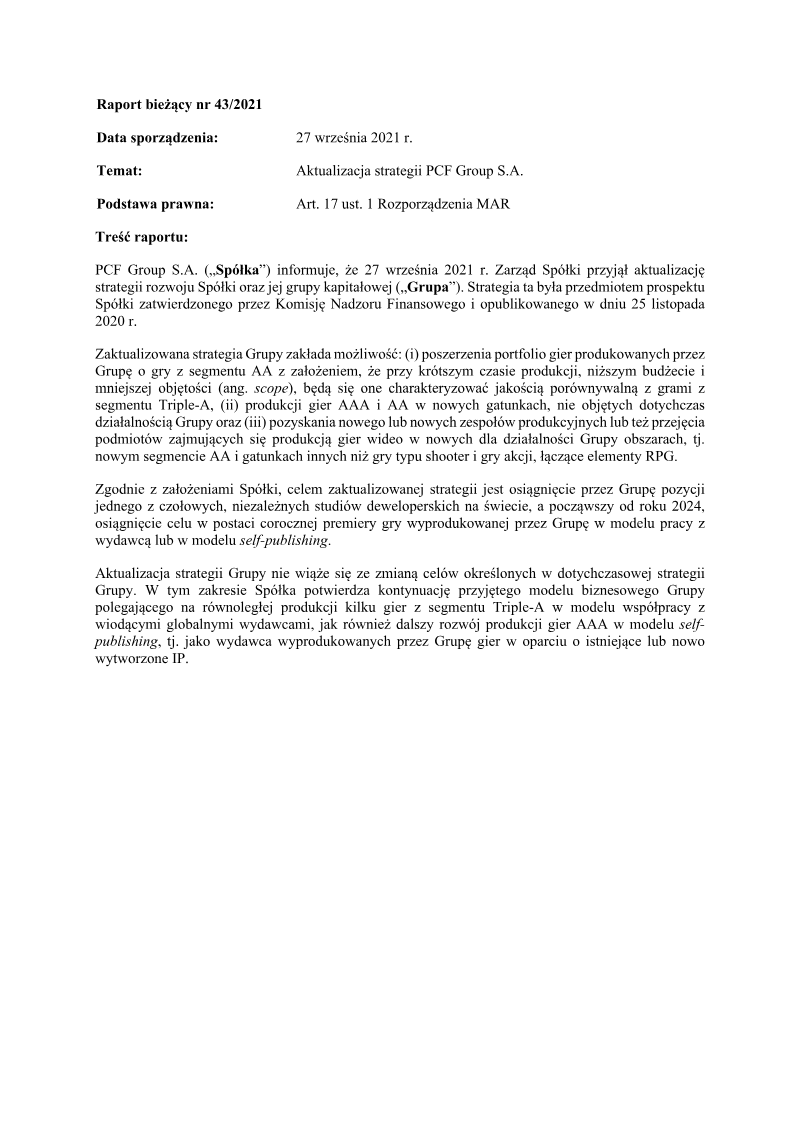
Aktualizacja strategii PCF Group S.A.
PCF Group S.A. announced on 27 September 2021 that its board adopted an updated development strategy for the company and its capital group. The update builds on a prospectus approved by the Polish Financial Supervision Authority in November 2020 and introduces three key expansion directions. First, the group plans to broaden its game portfolio by adding AA titles that can be produced more quickly and at lower budgets while maintaining quality comparable to Triple‑A releases. Second, it aims to develop AAA and AA games in new genres beyond its current focus on shooters and action titles, incorporating RPG elements. Third, the strategy includes acquiring or partnering with new production teams or companies that operate in these newly targeted segments.
The overarching objective is to position the group as one of the world’s leading independent development studios, with a target of releasing at least one new title annually from 2024 onward under either publisher collaboration or self‑publishing models. The update does not alter the existing strategic goals; it confirms the continued dual model of producing multiple Triple‑A games in partnership with major global publishers while expanding self‑publishing efforts for AAA titles based on existing or newly created intellectual property. The strategy therefore seeks to diversify genre offerings, streamline production pipelines for AA titles, and strengthen the group’s global competitive standing through both external partnerships and internal publishing capabilities.
- PCF Group S.A. aims to release at least one new game title annually starting in 2024.
- The company is expanding its portfolio to include AA-budget titles, which are intended to be produced faster and more cost-effectively than AAA projects while maintaining high quality.
- The group is diversifying its genre focus beyond shooters and action games by incorporating RPG elements into future AAA and AA developments.
- The strategy maintains a dual business model that combines collaborative projects with major global publishers alongside an increased focus on self-publishing AAA titles.
- PCF Group plans to strengthen its market position through the acquisition of or partnerships with new production teams that specialize in these targeted genres.
+2
PCF Group
Report1 pages
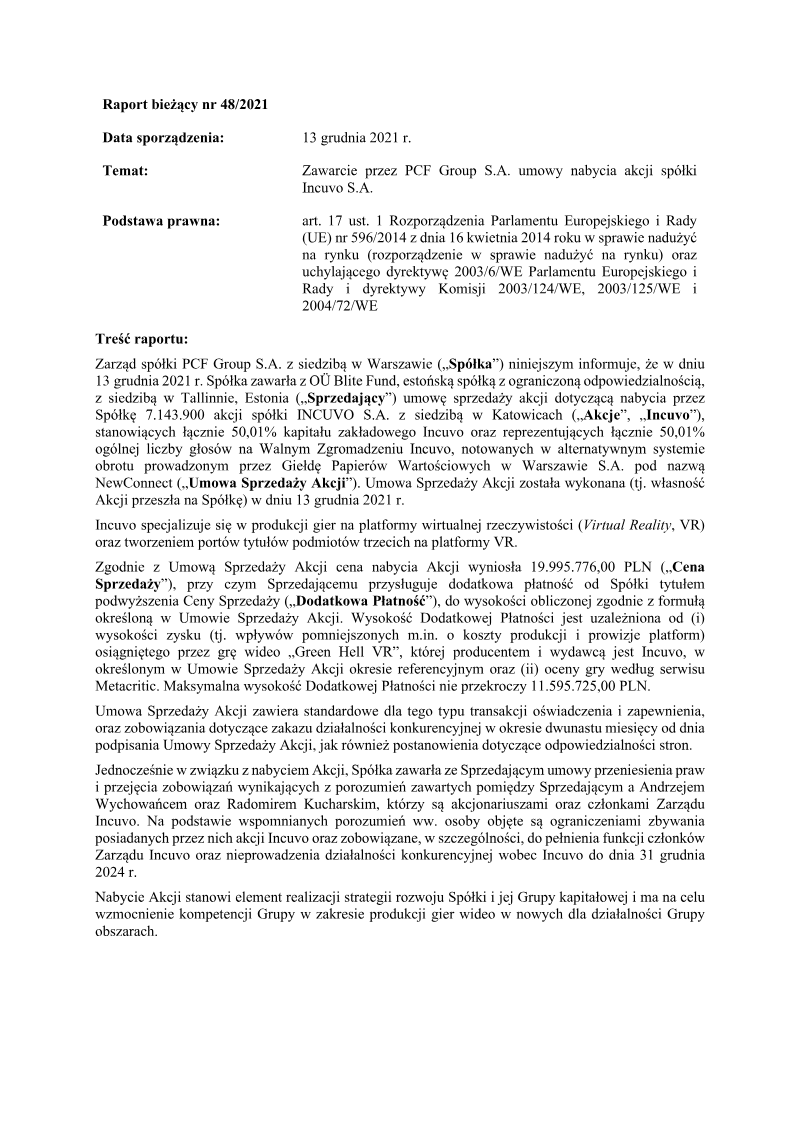
Current Report No. 48/2021: Acquisition of Incuvo S.A. Shares
PCF Group S.A., headquartered in Warsaw, completed the acquisition of 7,143,900 shares of Incuvo S.A. on 13 December 2021, representing 50.01 % of Incuvo’s share capital and voting rights. The transaction was executed under EU market‑abuse regulation, with the purchase price set at PLN 19,995,776.00 and an additional payment clause that may add up to PLN 11,595,725.00 based on the profitability of Incuvo’s VR title “Green Hell VR” and its Metacritic rating during a specified reference period. Incuvo specializes in virtual‑reality game development and porting third‑party titles to VR platforms.
The agreement includes customary representations, warranties, non‑competition restrictions for twelve months post‑closing, and liability provisions. Concurrently, PCF entered into transfer agreements with Incuvo’s shareholders Andrzej Wychowń and Radomir Kucharski, imposing sale restrictions on their shares and mandating continued board participation while prohibiting competitive activities until 31 December 2024.
This acquisition aligns with PCF Group’s strategic expansion into video‑game production, aiming to strengthen the group’s capabilities in emerging sectors. The transaction covers Poland and involves the NewConnect market of the Warsaw Stock Exchange, reflecting a focused geographic scope within the European VR gaming industry.
- PCF Group S.A. acquired a 50.01% majority stake in Incuvo S.A. on 13 December 2021 for a base price of PLN 19,995,776.
- The deal includes an earn-out provision of up to PLN 11,595,725, contingent on the profitability and Metacritic performance of the VR title 'Green Hell VR'.
- Incuvo S.A. specializes in virtual-reality game development and the porting of third-party titles to VR platforms.
- Key shareholders Andrzej Wychowń and Radomir Kucharski are bound by non-competition agreements and mandatory board participation until 31 December 2024.
- The acquisition is part of PCF Group’s strategic expansion to bolster its production capabilities within the emerging VR gaming sector.
+1
PCF Group
Report6 pages
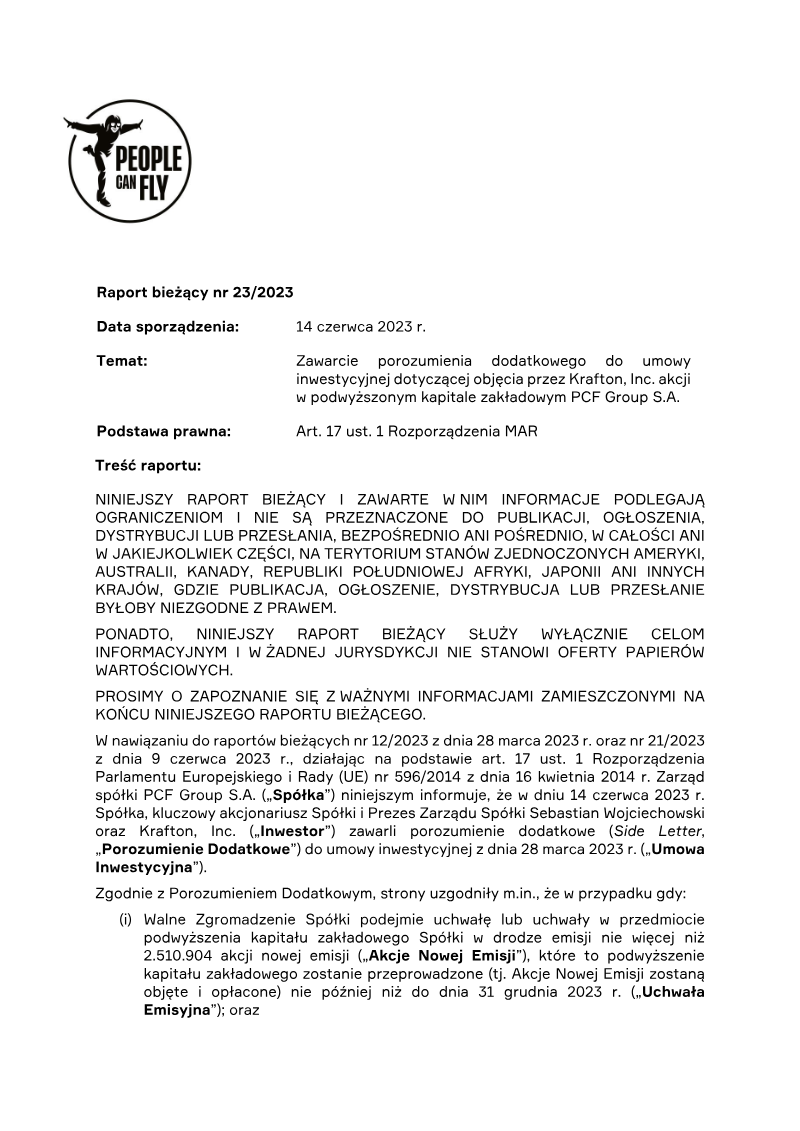
Current Report No. 23/2023: Investment Agreement Supplement Between Krafton, Inc. and PCF Group S.A.
The report announces that on 14 June 2023, Krafton, Inc. and PCF Group S.A., together with key shareholder Sebastian Wojciechowski, entered into a side‑letter to the investment agreement dated 28 March 2023. The side‑letter stipulates that if PCF Group increases its share capital by issuing up to 2 510 904 new shares before 31 December 2023, Krafton will have the right of first refusal to subscribe for shares that would bring its total holdings to 10 % of the capital and voting rights. The subscription price is fixed at PLN 40.20 per share, independent of the price set for other investors. The agreement does not obligate Krafton to purchase any shares, and the allocation of new shares to other investors remains unaffected.
The document is a regulatory disclosure under EU Regulation 596/2014 and Polish securities law, intended solely for informational purposes. It contains extensive legal caveats restricting distribution outside the European Economic Area and prohibiting any promotional use of the information. The report clarifies that it is not an offer, does not constitute a prospectus, and is limited to qualified investors in the EU, UK, or U.S. under Rule 144A. No financial projections or performance guarantees are provided; the report includes forward‑looking statements subject to risk and uncertainty. The disclosure emphasizes that no manager or affiliated party assumes liability for the accuracy of the information, and any investment decisions must rely on independently verified data.
- Krafton, Inc. secured a right of first refusal to acquire up to 10% of PCF Group S.A.’s total share capital and voting rights.
- The option to subscribe for new shares is valid if PCF Group issues up to 2,510,904 new shares before the 31 December 2023 deadline.
- The subscription price for Krafton is fixed at PLN 40.20 per share, regardless of the pricing terms offered to other investors.
- The agreement is non-binding for Krafton, meaning the company is under no obligation to purchase any shares.
- This side-letter supplements the original investment agreement established between Krafton and PCF Group on 28 March 2023.
+2
PCF Group
Report1 pages
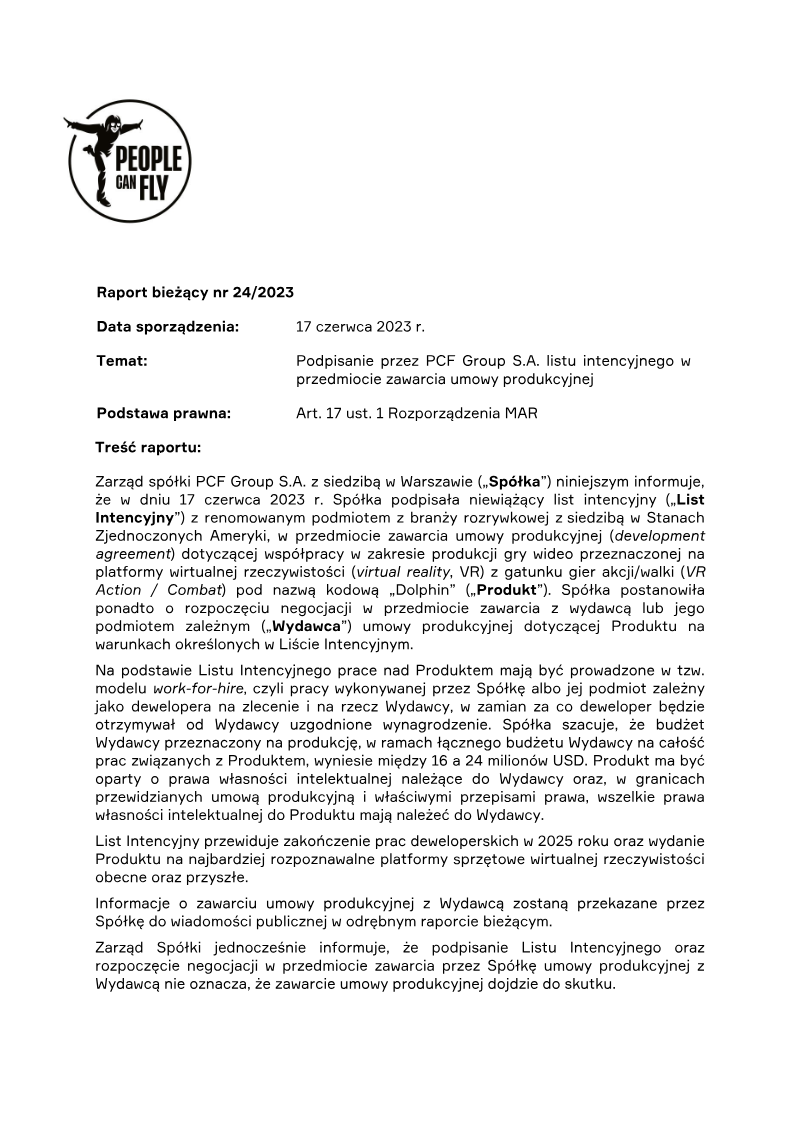
Current Report No. 24/2023: Signing of a Letter of Intent Regarding a Production Agreement
The report announces that PCF Group S.A., headquartered in Warsaw, entered into a non‑binding Letter of Intent on 17 June 2023 with a prominent U.S. entertainment company to develop a virtual‑reality action/combat video game under the code name “Dolphin.” The intent is to negotiate a production agreement with a publisher or its affiliate, under which PCF will act as a work‑for‑hire developer. The publisher’s total budget for the project is estimated between 16 million and 24 million USD, with intellectual property rights ultimately belonging to the publisher within contractual limits. Development is projected to conclude in 2025, with release planned for current and future leading VR hardware platforms. The report clarifies that signing the Letter of Intent does not guarantee a final production contract, and further details will be disclosed in a separate public update. The scope covers the U.S. entertainment partner and global VR platforms, focusing on action/combat gameplay. No survey or statistical methodology is cited; the information derives from corporate governance announcements and contractual estimates.
- PCF Group S.A. has signed a non-binding Letter of Intent to develop a virtual-reality action/combat game codenamed “Dolphin” for a major U.S. entertainment company.
- The project is structured as a work-for-hire agreement, with the publisher retaining intellectual property rights within contractual limits.
- The estimated production budget for the title is between 16 million and 24 million USD.
- Development is scheduled to conclude in 2025, with a target release across current and future leading VR hardware platforms.
- The Letter of Intent does not guarantee a final production contract, and negotiations for a formal agreement are ongoing.
+4
PCF Group
Report1 pages
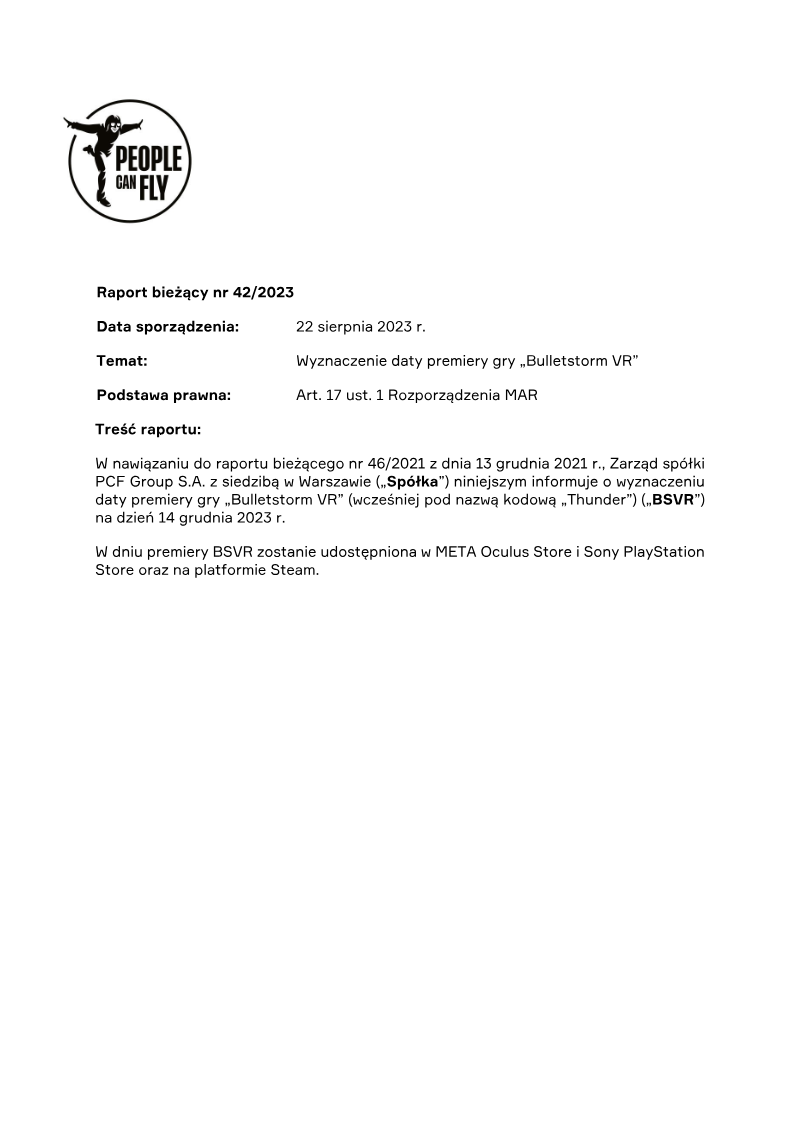
Wyznaczenie daty premiery gry Bulletstorm VR
The report announces the official release date for the virtual‑reality title “Bulletstorm VR,” previously known by its code name “Thunder.” The announcement, issued by the board of PCF Group S.A. on 22 August 2023, confirms that the game will launch on 14 December 2023. Distribution channels include the META Oculus Store, Sony PlayStation Store, and Steam, ensuring multi‑platform availability across major VR ecosystems. The release decision follows a prior interim report dated 13 December 2021, indicating that the company has maintained a consistent communication cadence regarding its VR portfolio. The document cites Article 17(1) of the MAR Regulation as the legal basis for the disclosure, underscoring compliance with regulatory reporting requirements. No additional data on sales projections, target demographics, or regional rollout specifics are provided; the focus remains strictly on the release date and platform distribution. The concise nature of the communication suggests that the primary objective is to inform stakeholders, regulators, and potential consumers of the finalized launch schedule. The report’s brevity and formal tone reflect standard corporate disclosure practices for product release announcements within the gaming industry.
- Bulletstorm VR (formerly codenamed "Thunder") is scheduled for official release on 14 December 2023.
- The title will be available across three major VR platforms: META Oculus Store, Sony PlayStation Store, and Steam.
- The release announcement was issued by the board of PCF Group S.A. on 22 August 2023.
- This disclosure was filed in accordance with Article 17(1) of the MAR Regulation to ensure regulatory compliance.
- The announcement follows a previous project update provided by the company on 13 December 2021.
+4
PCF Group
Report1 pages
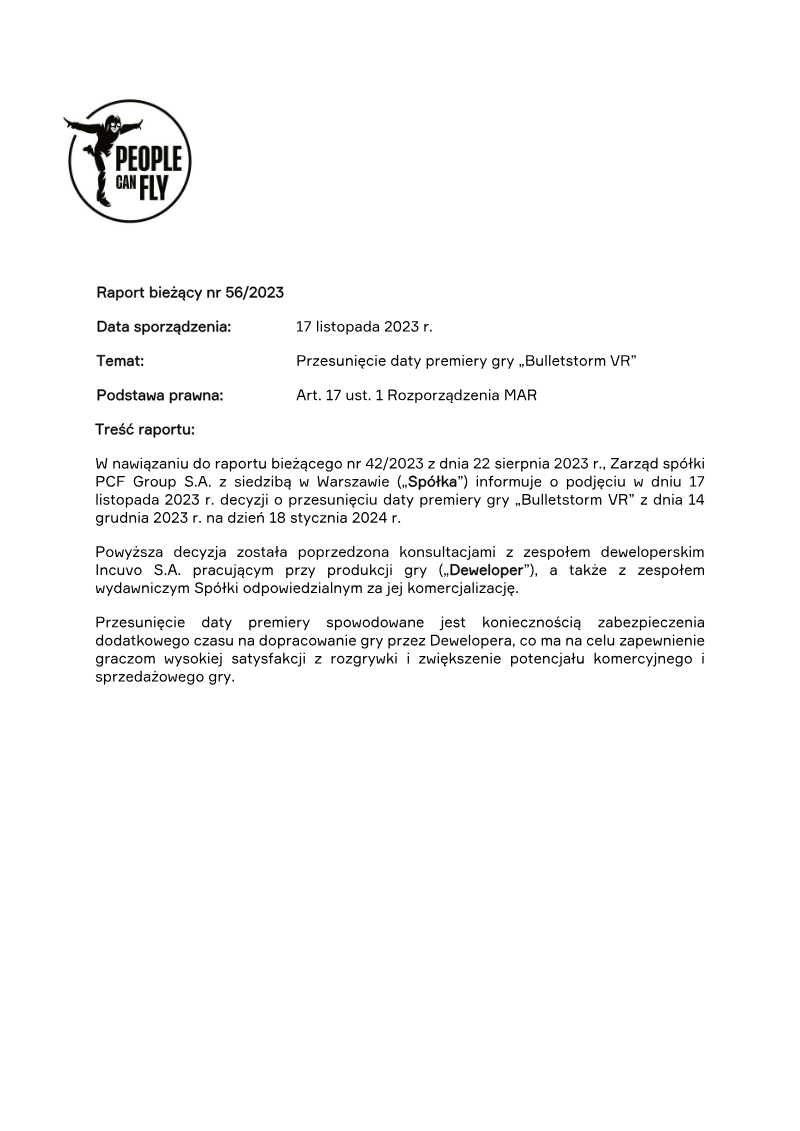
Raport Bieżący Nr 56/2023: Przesunięcie Daty Premiery Gry Bulletstorm VR
The report announces a postponement of the release date for the virtual‑reality title “Bulletstorm VR.” Originally slated for 14 December 2023, the launch has been rescheduled to 18 January 2024. The decision was taken by the board of PCF Group S.A., Warsaw, on 17 November 2023, following consultations with the development team at Incuvo S.A. and the company’s publishing staff. The primary rationale for the delay is to grant additional development time, ensuring that the final product meets player expectations and maximizes commercial potential. The announcement is framed within the legal context of Article 17(1) of Regulation MAR, underscoring compliance with regulatory reporting requirements. The scope is limited to the Polish market and pertains specifically to the VR gaming segment, with no broader geographic or temporal coverage indicated. No quantitative data or survey methodology is provided; the communication focuses solely on the administrative decision and its intended impact on product quality and sales prospects.
- The release date for Bulletstorm VR has been rescheduled from 14 December 2023 to 18 January 2024.
- The decision to delay the launch was finalized by the board of PCF Group S.A. on 17 November 2023.
- The postponement follows consultations between PCF Group S.A., the development team at Incuvo S.A., and internal publishing staff.
- The primary objective of the delay is to provide additional development time to ensure the final product meets player expectations and maximizes commercial potential.
- This announcement was issued in compliance with Article 17(1) of the Market Abuse Regulation (MAR) regarding regulatory reporting requirements.
+3
PCF Group
Report1 pages
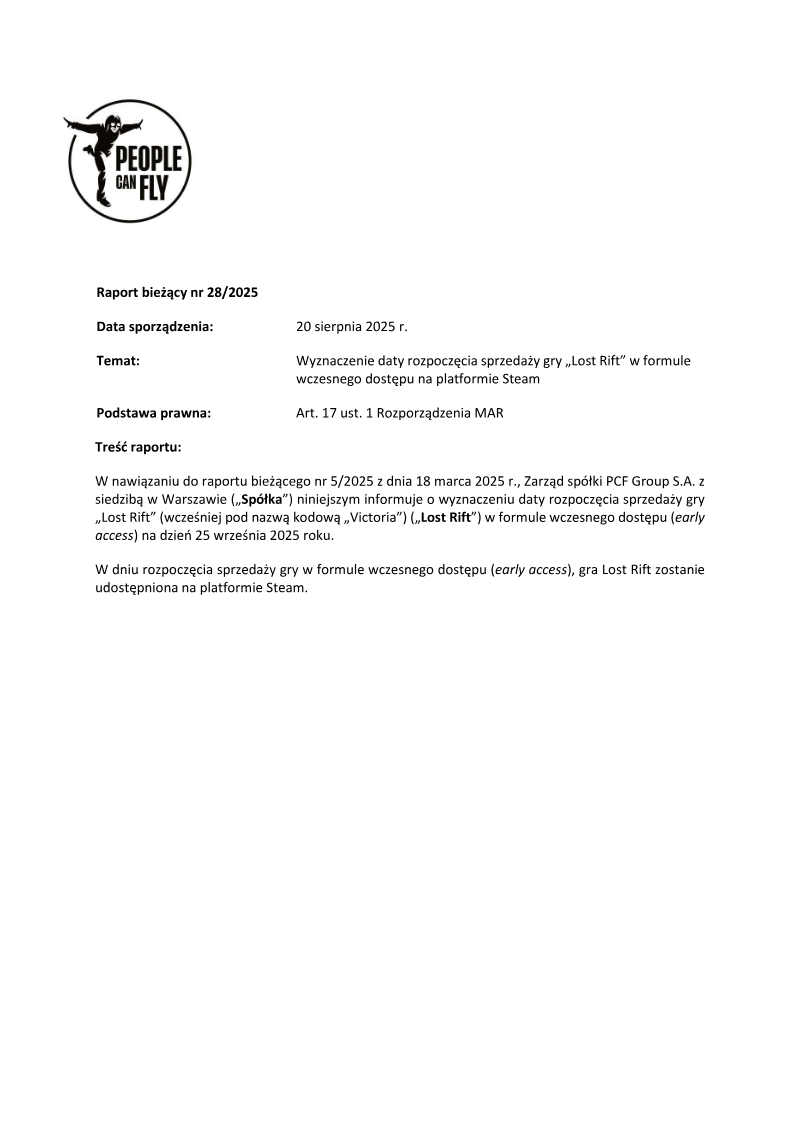
Raport Bieżący Nr 28/2025: Wyznaczenie Daty Rozpoczęcia Sprzedaży Gry „Lost Rift”
PCF Group S.A. has officially scheduled the early access release of its upcoming title, Lost Rift, for September 25, 2025. This announcement confirms the transition of the project, previously identified by the codename Victoria, into the commercialization phase on the Steam platform. The decision follows previous corporate disclosures regarding the development progress of the title, marking a significant milestone in the company’s current production pipeline.
The release strategy focuses on the early access model, a common industry practice that allows developers to gather player feedback and refine gameplay mechanics while the title remains in active development. By leveraging the Steam ecosystem, the company aims to establish an initial user base and facilitate iterative improvements ahead of a potential full-scale launch. This move aligns with the company’s broader operational objectives for the 2025 fiscal year, reflecting a strategic shift from internal development to public market engagement.
The scope of this release is global, as the Steam platform provides immediate international distribution for the title. The announcement serves as a formal regulatory update, ensuring transparency for stakeholders regarding the company’s product roadmap and revenue generation timelines. By setting a definitive date for the early access launch, the management team provides clarity on the project’s status and its readiness for public consumption within the competitive PC gaming market.
- PCF Group S.A. has scheduled the early access release of its new title, 'Lost Rift' (formerly codenamed 'Victoria'), for September 25, 2025.
- The game will launch globally on the Steam platform as part of the company's 2025 fiscal year operational objectives.
- The release utilizes an early access model to facilitate iterative development and gameplay refinement based on direct player feedback.
- This launch marks the project's transition from internal development to the commercialization phase.
- The announcement serves as a formal regulatory update to provide stakeholders with clarity on the company's product roadmap and revenue generation timeline.
+1
PCF Group

Report11 pages
Aktualizacja Strategii: Nowe Otwarcie
The updated strategy for People Can Fly (PCF Group) marks a transition toward a self-publishing model while maintaining its core expertise in developing high-end shooter games. Having successfully completed its post-IPO objectives, including the expansion of production capacity and the establishment of multiple creative studios across Europe and North America, the company now aims to scale its operations to support the simultaneous development of several ambitious projects. The primary thesis centers on leveraging internal intellectual property and proprietary technology, specifically the PCF Framework and Unreal Engine 5, to deliver high-quality gaming experiences while capturing a larger share of revenue through self-publishing.
Key operational findings highlight a shift from a single-project focus to a multi-project production model supported by over 600 employees. The company has implemented agile methodologies and Centers of Excellence to improve efficiency and risk management. Financial targets are aggressive, with a goal of reaching 3.0 billion PLN in total revenue between 2023 and 2027. To achieve this, PCF plans to release six games over the next four years, focusing on the Games-as-a-Service (GaaS) model to ensure long-term player engagement and recurring revenue. Projects currently in development include Gemini, Dagger, Bifrost, Victoria, and Thunder, with a mix of work-for-hire and self-published titles.
The scope of this strategy covers global operations across seven studios, including locations in Warsaw, Rzeszów, Kraków, Katowice, Newcastle, Montreal, and New York. To fund this expansion, the company intends to raise between 205 million and 295 million PLN through a new share issuance. This capital will be directed toward scaling development teams and supporting the production of its self-published portfolio, with no dividend payments expected before 2025.
- PCF Group aims to generate 3.0 billion PLN in total revenue between 2023 and 2027 by transitioning to a self-publishing model.
- The company plans to release six games over the next four years, prioritizing the Games-as-a-Service (GaaS) model to secure recurring revenue.
- To fund the expansion of its development teams and self-published portfolio, PCF intends to raise between 205 million and 295 million PLN through a new share issuance.
- Operations have scaled to over 600 employees across seven global studios in Europe and North America, supporting a new multi-project production model.
- Current development projects include Gemini, Dagger, Bifrost, Victoria, and Thunder, which utilize proprietary technology and Unreal Engine 5.
+3
PCF Group
Report5 pages
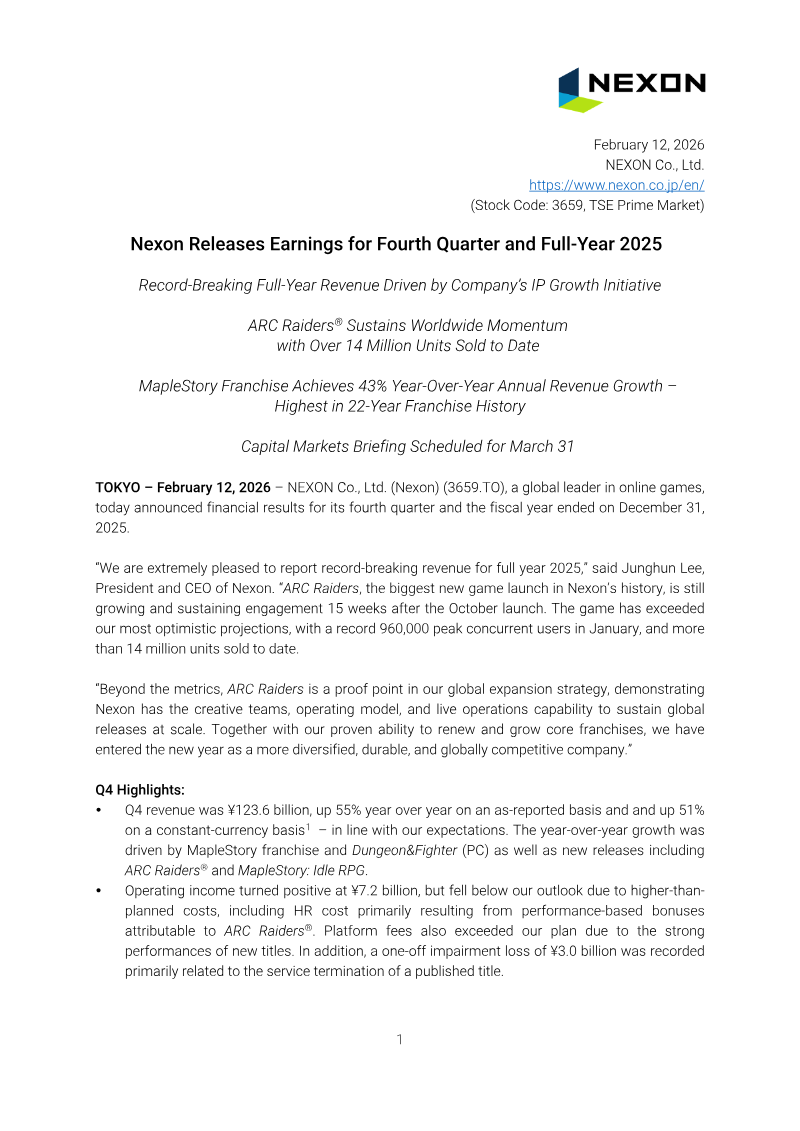
Nexon Releases Earnings for Fourth Quarter and Full-Year 2025
Nexon reported record-breaking financial results for the fiscal year ended December 31, 2025, driven by a strategic IP growth initiative that balanced the expansion of legacy franchises with successful new global launches. Full-year revenue reached ¥475.1 billion, a 6% increase year-over-year, while operating income remained stable at ¥124.0 billion. The fourth quarter saw a significant revenue surge of 55% to ¥123.6 billion, although net income declined 66% to ¥10.9 billion, primarily due to fluctuations in foreign exchange gains compared to the previous year and higher-than-anticipated costs related to performance bonuses and platform fees.
The growth was spearheaded by the launch of ARC Raiders, which sold over 14 million units within 15 weeks and achieved a peak of 960,000 concurrent users. Simultaneously, the 22-year-old MapleStory franchise delivered its highest annual revenue in history, growing 43% year-over-year. This performance offset a 21% decline in the Dungeon&Fighter franchise, despite a strong recovery in its PC segment in China and Korea. The period was also marked by a significant player trust initiative regarding MapleStory: Idle RPG; a coding error led Nexon to offer full refunds, resulting in a ¥9 billion reduction in Q4 revenue.
Geographically, the results reflect Nexon’s successful diversification beyond its traditional Asian strongholds into Western markets via console and PC platforms. Looking ahead to the first quarter of 2026, the company expects revenue growth between 32% and 44%, supported by sustained momentum from new titles and major updates to core IPs. Nexon remains committed to aggressive shareholder returns, doubling its dividend and completing a ¥100 billion share buyback program during the fiscal year.
- Nexon achieved record full-year 2025 revenue of ¥475.1 billion, a 6% year-over-year increase, with operating income holding steady at ¥124.0 billion.
- The new title ARC Raiders was a major growth driver, selling over 14 million units within 15 weeks and reaching a peak of 960,000 concurrent users.
- The 22-year-old MapleStory franchise reached record annual revenue with 43% year-over-year growth, helping to offset a 21% decline in the Dungeon&Fighter franchise.
- Q4 net income dropped 66% to ¥10.9 billion due to foreign exchange fluctuations, increased platform fees, and performance bonuses.
- A player trust initiative following a coding error in MapleStory: Idle RPG resulted in a ¥9 billion revenue reduction in Q4 due to full customer refunds.
+3
NEXON Co.Feb 2026
Report94 pages
The PC & Console Gaming Report 2025
The global PC and console gaming market is projected to reach $92.7 billion by 2027, driven by a significant recovery in the console sector. While PC growth remains modest at a 2.6% CAGR, the console segment is expected to expand by 7.0%, fueled by the anticipated launch of the Nintendo Switch 2 and blockbuster releases such as Grand Theft Auto VI. Despite a revenue dip in 2024 due to a lighter premium release schedule, total playtime grew by 6%, signaling robust engagement even as market dynamics shift toward a "near zero-sum" competition for player attention.
Player behavior is increasingly characterized by "calcification," where engagement is concentrated into a shrinking pool of established "forever games." Titles aged six years or older now command over 60% of playtime on PC and nearly half on consoles. This consolidation is most visible on PC, where just five legacy titles account for 30% of annual hours. While PlayStation has emerged as a growth leader with a 21% increase in playtime since 2021, the broader trend across all platforms shows players becoming more "unreachable," with a rising share of the audience engaging with only one to three games per year.
To combat stagnation, publishers are increasingly leveraging "recursive nostalgia" by reintroducing classic maps and mechanics. While this strategy yielded massive engagement spikes for Fortnite, its effectiveness varies, often serving as a short-term boost rather than a long-term retention tool unless structured as a permanent gameplay mode. Furthermore, the discoverability crisis has intensified as annual releases on Steam approached 19,000 in 2024. With the impact of traditional seasonal sales declining fourfold since 2019, success now requires a shift toward targeted global events, external traffic generation, and product differentiation to break through a market dominated by AAA franchises and entrenched free-to-play titles.
- The global PC and console market is projected to reach $92.7 billion by 2027, with the console segment expected to grow at a 7.0% CAGR driven by the Nintendo Switch 2 launch and Grand Theft Auto VI.
- Player engagement is increasingly 'calcified,' as titles aged six years or older now account for over 60% of PC playtime and nearly 50% of console playtime.
- Market competition for player attention has become a near zero-sum game, with a rising percentage of the audience now limiting their engagement to only one to three games per year.
- On PC, market consolidation is extreme, with just five legacy titles responsible for 30% of total annual hours played.
- Despite a 2024 revenue dip caused by a light release schedule, total player engagement grew by 6%, indicating that playtime remains robust even as monetization becomes more difficult.
+2
NewzooFeb 2026
Report13 pages
Aream & Co. Gaming CEO Survey 2025
The survey, conducted by Aream & Co., gauges executive optimism regarding consumer spending on gaming in 2025 across multiple channels and functional areas. Overall, 49 % of respondents view spending as “more optimistic,” another 49 % see it as unchanged, and only 2 % are less optimistic. When broken down by platform, mobile spending is perceived as more optimistic (49 %) while PC and console views are split between “more” (15–33 %) and “about the same.” In‑app purchases are viewed as more optimistic (80 %) versus in‑app advertising (41 %).
Key challenges identified include content saturation and over‑supply, with 33 % citing these as concerns; marketing environment issues affect 49 %, and macro conditions are a worry for 17 %. Despite these, 54 % anticipate more new games in 2025, and 37 % expect higher average budgets. Marketing spend is expected to rise for 48 %, while engineering and game development are seen as more optimistic (71 % and 42 %).
The survey also highlights a strong appetite for mergers and acquisitions, with 71 % expecting more M&A activity. Advanced integration across multiple functions is viewed as more optimistic (49 %) but limited implementation remains a concern.
The data derive from a global sample of gaming CEOs, reflecting perspectives across mobile, PC, console, and various functional departments. The findings suggest a cautiously optimistic outlook for 2025, tempered by supply‑side pressures and marketing challenges.
- Industry sentiment for 2025 is largely stable or positive, with 98% of CEOs reporting that consumer spending will be either unchanged (49%) or more optimistic (49%).
- M&A activity is expected to accelerate, with 71% of executives anticipating an increase in deal-making throughout 2025.
- In-app purchases are the primary revenue driver, with 80% of respondents optimistic about growth compared to only 41% for in-app advertising.
- Investment in development remains a priority, as 71% of CEOs are optimistic about engineering budgets and 42% about game development, with 37% expecting higher average project budgets.
- Marketing remains a critical pain point, with 49% of executives citing the current marketing environment as a major challenge despite 48% planning to increase their marketing spend.
+4
Aream & CoFeb 2026
Report231 pages
The State of Video Gaming: 2025
The global video game industry is currently undergoing a structural correction following a decade of rapid expansion that concluded in 2021. The primary thesis of this transition is that the industry’s previous growth engines—mobile expansion, live-service models, and pandemic-era engagement—have plateaued, leading to a 12% decline in real-term content spending. This downturn is characterized by widespread commercial underperformance, record-high layoffs, and a significant contraction in venture capital funding. As production budgets for AAA titles balloon toward $500 million, the market has become increasingly polarized, with player engagement and revenue heavily concentrated within a small cohort of long-standing, established franchises that effectively crowd out new releases.
Geographically and sectorally, the landscape is shifting as Chinese developers gain significant global market share, rising from 0.5% to 12.5% of non-domestic content spending over the last 13 years. While the mobile sector faces a 23% revenue drop due to privacy-related user acquisition costs and competition from social media, the industry is pivoting toward cross-platform accessibility and hardware-agnostic distribution. Platforms like Roblox and Steam continue to dominate engagement, though developers face increasing pressure from high platform commission fees and the necessity of navigating a saturated market where discovery is increasingly difficult.
Looking forward, the industry is attempting to mitigate these challenges through technological and business model innovation. Strategies include the integration of generative AI to enhance NPC behavior, the adoption of cloud-native simulations, and a strategic pivot toward programmatic advertising to supplement stagnant game pricing. Furthermore, regulatory pressures on app stores are expected to improve developer margins, while a resurgence in handheld hardware and cross-platform connectivity aims to unify fragmented ecosystems. Ultimately, the industry is moving toward a risk-averse, multiplatform approach, prioritizing long-term engagement and operational efficiency to survive an increasingly competitive and capital-intensive environment.
- The video game industry is undergoing a structural correction characterized by a 12% decline in real-term content spending following the post-2021 plateau of previous growth engines.
- Market polarization has intensified as AAA production budgets reach $500 million, causing revenue and engagement to concentrate within established franchises while crowding out new releases.
- Chinese developers have significantly expanded their global footprint, increasing their share of non-domestic content spending from 0.5% to 12.5% over the last 13 years.
- The mobile gaming sector has experienced a 23% revenue drop, driven by rising user acquisition costs linked to privacy regulations and increased competition from social media platforms.
- Industry players are shifting toward risk-averse, multiplatform strategies that leverage generative AI, cloud-native simulations, and programmatic advertising to counter stagnant game pricing and high production costs.
+4
EpyllionJan 2026
Report231 pages
The State of Video Gaming in 2025
The analysis demonstrates that global video‑gaming spend has surged to roughly $200 B in 2025, a 150 % rise since 2011, yet real‑term growth has stalled and margins have slipped to single digits. Mobile remains the only rapidly expanding segment, yet its revenue fell 23 % in Q1 2024 and download volumes dropped sharply after privacy deprecations, concentrating spend among a handful of high‑margin titles. Console sales have plateaued for a decade; Nintendo’s Switch drives modest growth while PlayStation and Xbox see flat or declining sales outside Japan, and AR/VR shipments underperform forecasts. PC and cloud‑based platforms such as Steam continue to dominate full‑game purchases, yet user engagement per capita remains low despite a 250 % rise in users and a 300 % increase in releases.
Geographic analysis shows China as the largest single market ($50–65 B) and India emerging as a significant contributor, together accounting for roughly 30 % of projected $300 B spend. Western developers capture about two‑thirds of growth, but Chinese and emerging‑market titles increasingly dominate the AAA landscape. Venture capital funding has contracted sharply—only 1,500 deals worldwide with a steep decline in late‑stage investments—and studios face record layoffs and shrinking publisher share prices, underscoring heightened risk.
The sector’s future hinges on non‑core, social‑centric platforms such as Roblox and UGC ecosystems that generate billions of engagement hours and pay developers substantial sums, albeit with limited autonomy. Cloud gaming, AI‑driven content, and ad‑supported SVOD models are emerging growth levers, yet rising development costs (AAA titles now exceeding $600 M) and thin operating margins continue to pressure publishers. Overall, the industry is in a state of consolidation, with blockbuster titles and platform‑centric ecosystems capturing most revenue while new entrants struggle to sustain momentum.
- Global gaming spend has reached $200 billion in 2025, representing a 150% increase since 2011, yet real-term growth has stalled and profit margins have compressed to single digits.
- Development costs for AAA titles now exceed $600 million, contributing to a landscape of record layoffs, shrinking publisher share prices, and a sharp contraction in venture capital funding to only 1,500 global deals.
- Mobile gaming revenue fell 23% in Q1 2024 following privacy deprecations, leading to a market where spend is increasingly concentrated among a small number of high-margin titles.
- China and India are becoming central to the industry's future, collectively accounting for approximately 30% of the projected $300 billion total market spend.
- While PC and platforms like Steam dominate full-game purchases, user engagement per capita remains low despite a 250% increase in the user base and a 300% rise in total game releases.
+1
EpyllionJan 2026
Report4 pages
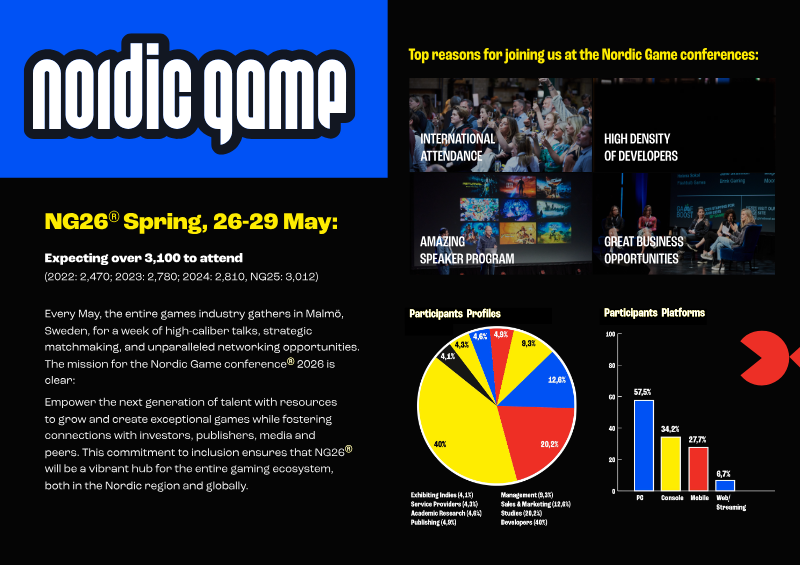
Nordic Game 2026: Participant Profiles and Platforms
Nordic Game 2026 serves as a primary hub for the Northern European video game industry, emphasizing a high density of developers and international attendance. The event facilitates business development and networking through a comprehensive speaker program, an expansive expo floor, and the annual Nordic Game Awards, which honors excellence among regional studios. The gathering targets a diverse range of industry professionals, including game startups, established studios, and service providers, with a specific focus on fostering connections between growing companies and global partners.
The participant base is heavily weighted toward production and leadership, with developers and artists making up the largest segment at 40% of all attendees. This is followed by professionals in sales and marketing at 12.6%, management at 9.3%, and service providers at 4.3%. Smaller contingents include exhibiting indies and various support roles. In terms of platform focus, PC remains the dominant sector for participants at 57.5%, followed by console development at 34.2% and mobile gaming at 27.7%. Web and other emerging platforms represent a smaller portion of the ecosystem at 6.7%.
The event infrastructure is designed to maximize return on investment through scalable exhibition options, ranging from small four-square-meter booths to large custom pavilions. Private meeting facilities are a core component of the offering, providing flexible spaces for four to fifty people to accommodate different business needs, from formal lectures to casual networking. By integrating sponsored content opportunities and specialized events like the Discovery Contest, the conference aims to support the entire lifecycle of game development within the Nordic region and beyond.
- PC development is the primary focus for 57.5% of Nordic Game 2026 participants, significantly outpacing console development at 34.2% and mobile gaming at 27.7%.
- Developers and artists constitute the largest attendee segment at 40%, followed by sales and marketing professionals at 12.6% and management at 9.3%.
- The event prioritizes business development by providing private meeting facilities that accommodate groups ranging from 4 to 50 people.
- Service providers represent 4.3% of the total participant base, which also includes a mix of startups, established studios, and exhibiting indies.
- Emerging platforms, including web-based gaming, account for 6.7% of the total development focus among conference attendees.
+1
Nordic GameJan 2026

Report35 pages
Video Game Market Update: Q3 2025
The global video game industry experienced a notable resurgence in growth during the third quarter of 2025, driven by a rebound in mobile in-app purchases and robust performance across PC and console platforms. The launch of the Nintendo Switch 2 served as a primary catalyst for console sector strength, reinforcing the enduring value of established intellectual property. While the broader capital markets faced significant headwinds, characterized by multi-year lows in public fundraising and subdued early-stage venture activity, the industry’s transaction landscape was defined by high-value consolidation. The $55 billion public takeover of Electronic Arts stands as the definitive event of the period, signaling a strategic shift toward large-scale mergers and acquisitions as the primary mechanism for growth.
Market dynamics currently favor established entities, with diversified publishers and PC and console developers commanding significant valuation premiums due to their proven profitability and market stability. This environment has concentrated investment power among a select group of firms. BITKRAFT emerged as the most active participant in the early-stage ecosystem over the past twelve months, leading the sector with 16 deals totaling $113 million. Alongside other prominent investors like Bessemer Venture Partners and Menlo Ventures, these firms continue to deploy capital despite the broader contraction in private investment.
Ultimately, the industry is transitioning into a phase of maturity where scale and intellectual property ownership are paramount. While early-stage funding remains constrained, the surge in total transaction value through megadeals indicates that institutional confidence remains high for proven assets. The current landscape suggests a bifurcated market where high-growth, established publishers attract significant capital, while smaller, early-stage ventures face a more challenging environment for securing liquidity and growth funding.
- The $55 billion public takeover of Electronic Arts highlights a strategic shift toward large-scale consolidation as the primary driver of industry growth in Q3 2025.
- The launch of the Nintendo Switch 2 acted as a major catalyst for console sector strength, reinforcing the market value of established intellectual property.
- The global video game industry saw a Q3 2025 resurgence fueled by a rebound in mobile in-app purchases and strong performance across PC and console platforms.
- BITKRAFT led the early-stage investment ecosystem over the past twelve months with 16 deals totaling $113 million, despite a broader contraction in private venture activity.
- The market is currently bifurcated, with diversified publishers and established developers commanding valuation premiums while smaller, early-stage ventures face significant liquidity and funding challenges.
+2
Aream & CoSept 2025
Report67 pages
2025 Global Games Market Report
The global games market is entering a period of moderate maturation, with total revenue projected to reach $188.8 billion in 2025, a 3.4% increase over the previous year. The industry now serves 3.6 billion players, reflecting a 4.4% year-over-year expansion. While mobile gaming maintains its dominance, accounting for $103.0 billion or 55% of total revenue, console gaming is poised for the strongest growth at 5.5%, reaching $45.9 billion. PC gaming remains a stable pillar with $39.9 billion in revenue. Despite the growth in player counts, average spend per payer is experiencing a slight decline, signaling a strategic pivot toward maximizing engagement and retention within saturated markets rather than relying solely on aggressive monetization.
Strategic success in this environment increasingly depends on long-tail engagement and the effective management of post-launch content. Data indicates that releasing single-player titles during the second quarter yields 34% higher engagement compared to the saturated holiday season. Furthermore, simultaneous multi-platform launches significantly outperform staggered releases, and titles exiting Early Access after a six-month window demonstrate superior acquisition results. Developers are also increasingly leveraging remakes and remasters to mitigate rising development costs, while user-generated content platforms like Roblox continue to expand as foundational ecosystems for daily active users.
Geographically, the market continues to diversify, with Latin America emerging as a notable growth region projected to reach $8.3 billion, driven primarily by mobile adoption. The industry’s analytical framework, which focuses on consumer spending on software and services, highlights that player attrition typically stabilizes after 12 weeks. Consequently, long-term commercial viability is now inextricably linked to aligning content updates and discounting strategies with this post-launch retention curve, ensuring that community support remains as critical as initial sales performance.
- The global games market is projected to reach $188.8 billion in 2025, a 3.4% year-over-year increase, driven by a player base that has expanded to 3.6 billion people.
- Mobile gaming remains the industry leader with $103.0 billion in revenue (55% of the total), while console gaming is expected to see the highest growth rate at 5.5%, reaching $45.9 billion.
- Average spend per player is declining, forcing a strategic shift toward long-tail engagement and retention rather than aggressive monetization in saturated markets.
- Releasing single-player titles in the second quarter yields 34% higher engagement than holiday-season launches, and simultaneous multi-platform releases consistently outperform staggered strategies.
- Developers are increasingly utilizing remakes and remasters to offset rising production costs, while platforms like Roblox are becoming essential ecosystems for maintaining daily active users.
+4
NewzooSept 2025
Report18 pages
The State of PC Game Distribution
The study aims to map the contemporary PC game distribution ecosystem and evaluate whether Steam functions as a de‑facto monopoly, while outlining alternative channels, associated risks, and growth opportunities for developers and publishers. It positions Steam’s dominance against emerging storefronts, physical media, and gray‑market platforms, offering strategic guidance for navigating a fragmented market beyond 2025.
Steam’s market power is evident: 2024 revenue reached $10.8 billion and concurrent active users rose from 25.4 million in 2021 to 40.5 million by September 2025. Eighty‑eight percent of surveyed studios report that Steam delivers over 75 % of their revenue, with 37 % relying on it for more than 90 %. Consequently, 72 % of respondents view Steam as a monopoly and 53 % express concern over this reliance. Nonetheless, diversification is growing—48 % have launched titles on the Epic Games Store, a similar share on the Xbox PC store, while 10 % and 8 % have used GOG and itch.io respectively. Physical releases persist, with 32 % of developers still issuing boxed copies and 72 % of consumers indicating a continued appetite for them.
Alternative distribution via e‑stores (e.g., Humble, Fanatical) and marketplaces (e.g., G2A, Kinguin) is gaining traction: 38 % of developers sell through e‑stores and 30 % through marketplaces. Seventy‑five percent anticipate at least a 10 % revenue uplift from these channels, and 80 % expect them to become
- Steam maintains a dominant market position, generating $10.8 billion in 2024 revenue with concurrent users increasing from 25.4 million in 2021 to 40.5 million by September 2025.
- Developer reliance on Steam is extreme, with 88% of studios deriving over 75% of their revenue from the platform and 37% relying on it for more than 90%.
- Despite 72% of developers labeling Steam a monopoly, diversification is underway, with 48% of studios utilizing the Epic Games Store and the Xbox PC store for distribution.
- Alternative distribution channels are gaining significant traction, as 38% of developers now sell through e-stores like Humble or Fanatical, and 30% utilize marketplaces like G2A or Kinguin.
- Financial projections for alternative channels are optimistic, with 75% of developers anticipating at least a 10% revenue uplift and 80% expecting these platforms to become increasingly vital.
+2
RokkyJun 2025
Report231 pages
The State of Video Gaming in 2026
The global video game industry is currently navigating a period of significant contraction and structural realignment following a decade of rapid expansion between 2011 and 2021. Real-term spending on game content has declined by approximately 12% since 2021, as the market shifts from a growth-oriented environment to a capital-constrained, zero-sum landscape. This downturn is marked by record-high layoffs, widespread studio closures, and a sharp reduction in venture capital funding. The industry is increasingly dominated by a small cohort of entrenched live-service titles that act as "black holes," consuming the vast majority of player time and financial resources, which makes the launch of new, independent titles increasingly difficult.
Market dynamics are further complicated by extreme resource inflation, with AAA production budgets frequently ballooning to between $200 million and $500 million. While mobile gaming remains the primary driver of global revenue, it faces its own challenges, including declining download volumes and rising user acquisition costs. Meanwhile, the console sector shows signs of stagnation, with current-generation hardware trailing its predecessors in total unit sales. As traditional growth models stall, the industry is pivoting toward new strategies, including the integration of programmatic advertising, the adoption of generative AI to improve production efficiency, and a push toward cross-platform accessibility to maximize player retention.
Geographically, the center of gravity is shifting toward Asian markets, where local developers are increasingly challenging Western incumbents with high-performing, globally resonant titles. Concurrently, the rise of user-generated content platforms like Roblox and the maturation of PC-based modding ecosystems are redefining how players engage with digital worlds. Looking forward, the industry is pinning its recovery on technological advancements in cloud computing and AI-driven development, alongside regulatory shifts that may allow developers to capture a larger share of revenue through alternative distribution channels. Success in this new era requires moving beyond traditional gameplay loops toward interconnected, persistent ecosystems that prioritize social infrastructure and long-term engagement.
- The video game industry is in a period of contraction, with real-term spending on content declining by approximately 12% since 2021.
- AAA production budgets have ballooned to between $200 million and $500 million, contributing to a capital-constrained environment marked by record-high layoffs and studio closures.
- A small cohort of entrenched live-service titles now dominates the market, acting as 'black holes' that consume the majority of player time and spending, making new independent launches increasingly difficult.
- The industry is pivoting toward generative AI to combat production cost inflation and integrating programmatic advertising to offset stalling growth in traditional console and mobile sectors.
- The global center of gravity is shifting toward Asian markets, where local developers are increasingly challenging Western incumbents with high-performing, globally resonant titles.
+2
EpyllionMay 2025
Report37 pages
Insights into the Japanese Gaming Market: 2025
The Japanese gaming market stands as a uniquely high-value ecosystem, generating 9.1% of global industry revenue despite accounting for only 2.2% of the worldwide player base. This disparity underscores a high average revenue per user driven by a mature demographic that prioritizes quality, depth, and domestic intellectual property. While Nintendo and established local publishers maintain a firm grip on the console sector, the landscape is undergoing a structural shift as PC gaming emerges as a critical growth engine, representing a substantial $2.5 to $3.0 billion opportunity for international entrants.
Success within this region necessitates a nuanced understanding of local consumer behavior, which diverges significantly from Western trends. Japanese players demonstrate a profound preference for narrative-driven, single-player role-playing games and fantasy-themed experiences, often eschewing the open-world, sports, and multiplayer-centric titles that dominate other major markets. This cultural specificity acts as a barrier to entry for many global publishers, who must tailor their content to align with these distinct aesthetic and gameplay expectations to achieve meaningful penetration.
Beyond cultural alignment, international companies must navigate complex macroeconomic conditions, most notably the volatility of the Japanese Yen. While the market remains a lucrative target, the combination of currency headwinds and the entrenched dominance of domestic franchises requires a strategic, long-term approach. By focusing on high-fidelity, story-rich experiences that resonate with the local appetite for solo play, external publishers can effectively capture a share of this high-margin market, provided they remain adaptable to the evolving preferences of the Japanese gaming audience.
- The Japanese gaming market generates 9.1% of global industry revenue despite representing only 2.2% of the worldwide player base, indicating an exceptionally high average revenue per user.
- PC gaming is a critical growth engine in Japan, representing a $2.5 to $3.0 billion opportunity for international publishers.
- Success in Japan requires prioritizing narrative-driven, single-player role-playing games and fantasy themes, which contrast with the multiplayer and sports-centric preferences of Western markets.
- Domestic publishers and Nintendo maintain a firm grip on the console sector, creating a high barrier to entry for international companies.
- International entrants must navigate macroeconomic challenges, specifically the volatility of the Japanese Yen, when planning market entry.
+2
NewzooJan 2025
Report23 pages
PC & Console Year in Review: 2025
The 2025 PC and Console Year in Review provides a comprehensive analysis of the global gaming landscape, focusing on market performance, consumer behavior, and development trends. The primary thesis highlights that while pre-launch marketing and wishlist campaigns remain foundational for success, post-release player reception and the integration of social, co-op elements are the primary drivers of long-term revenue and sustainability. The analysis covers the period from January 1, 2025, through late 2025, utilizing proprietary data estimates to track sales, player engagement, and platform distribution across global markets.
Key findings indicate that the premium game market remains dominant, accounting for 78% of Steam’s $16.8 billion revenue. Indie developers continue to capture significant market share, contributing over 25% of Steam’s total revenue, with "Triple-I" titles demonstrating exceptional return on investment. Geographically, China has solidified its position as a critical market, serving as the top region for Steam and a major driver for both Western and Eastern-developed titles. Furthermore, the data reveals a shift in marketing efficacy; while wishlist counts are rising, conversion rates are declining, forcing studios to experiment with in-game incentives and community-driven engagement strategies.
Genre trends show that action, adventure, and RPG titles continue to lead in player interest, though "cute" and atmospheric games experienced significant year-over-year growth in revenue. Co-op mechanics have emerged as a vital pillar for commercial success, with 11 of the top 20 highest-grossing titles featuring cooperative elements. From a technical perspective, Unreal Engine maintains its status as the market leader for AA and AAA development, while many studios continue to leverage proprietary engines for large-scale projects. The report concludes that while pre-launch hype is a useful tool for visibility, the post-release sales trajectory is ultimately dictated by player sentiment and the ability of a title to foster sustained social interaction.
- Premium games dominate the market, accounting for 78% of Steam’s $16.8 billion total revenue in 2025.
- Cooperative gameplay is a primary driver of commercial success, with 11 of the top 20 highest-grossing titles featuring co-op mechanics.
- Indie developers contribute over 25% of Steam’s total revenue, with 'Triple-I' titles delivering exceptional return on investment.
- China has become the top global region for Steam, serving as a critical market for both Western and Eastern-developed titles.
- Marketing efficacy is shifting as wishlist counts rise while conversion rates decline, necessitating a move toward in-game incentives and community-driven engagement.
+3
Alinea AnalyticsJan 2025