Report30 pages
2025 Report on Marketing Trends of Productivity Apps
The report analyzes global marketing activity for productivity apps during the first half of 2025, drawing on a dataset of over 1.6 billion ad creatives from more than 80 channels across 80+ countries. It shows that the total pool of mobile app (non‑game) advertisers fell 17.8 % YoY to an average of 107 k per month, while new advertiser share rose to 11.7 %. In the productivity‑app segment, active advertisers declined 6 % YoY to about 8.9 k per month, yet the proportion of new entrants exceeded 30 % after Q2. Regional analysis indicates Europe and North America remain the largest markets, but both experienced declines in advertiser counts; Oceania shows the highest creatives per advertiser. Category‑level data reveal business & office apps hold 14.4 % of advertisers, whereas entertainment apps dominate creative volume at 32.7 %. Platform performance data highlight Meta, Google, and TikTok as the top three channels for cross‑platform campaigns; Google delivers the highest conversion rates, Meta offers AI‑enhanced targeting, and TikTok provides cost‑efficient Gen Z engagement with a CPM of $3.2. Creative format insights show video and playable ads outperform static creatives, with TikTok favoring short native videos (15–60 s) and Meta using a mix of carousel and video. The report recommends a cross‑platform strategy that prioritizes video and playable formats, leverages AI for rapid creative iteration, and tailors messaging to include social proof, urgency, and lifestyle integration. The data were collected from January to June 2025 through sampling of global ad channels, with statistical forecasting and industry interviews used for analysis.
- The productivity app sector saw a 6% year-over-year decline in active advertisers to 8.9k per month, though new entrants surged to over 30% of the market share following Q2 2025.
- Meta, Google, and TikTok remain the primary channels for cross-platform campaigns, with Google leading in conversion rates and TikTok offering cost-efficient Gen Z engagement at a $3.2 CPM.
- Video and playable ads consistently outperform static creatives, with TikTok favoring 15–60 second native videos and Meta utilizing a combination of carousel and video formats.
- While business and office apps account for 14.4% of productivity advertisers, entertainment apps dominate the broader market creative volume at 32.7%.
- The total pool of non-game mobile app advertisers dropped 17.8% year-over-year to 107k per month, despite a 11.7% increase in the share of new advertisers.
+2
SocialPetaDec 2025

Report28 pages
H1 2025 AIGC Mobile App Marketing Analysis
The analysis demonstrates that while the global pool of active AI‑advertisers has contracted by 35–45 % in H1 2025, the remaining players are compensating with a markedly higher creative output—an 84 % increase to an average of 416 monthly creatives per advertiser. Video advertising dominates the landscape, with 84 % of all ads and more than half of inventory in 15‑30 second formats. Geographic patterns reveal that Europe and North America maintain the largest advertiser volumes, yet exhibit lower creative density than Japan and South Korea, which show the fastest growth rates. Market saturation appears to be driving these firms toward intensified brand exposure through increased creative frequency, even as overall advertiser participation declines.
Meitu’s financial results corroborate the commercial potency of AI‑driven features. Revenue rose 12.3 % to RMB 1.8 billion, largely propelled by a 45.2 % jump in AI‑powered imaging and design subscriptions to RMB 1.35 billion, while advertising income grew modestly by 5 %. The company’s flagship AI applications—“AI Wardrobe,” “WHEE,” and “Wink”—secured top positions in App Store charts across more than twelve countries, underscoring the role of AI enhancements in global user acquisition and subscription monetization.
The broader ecosystem of AI‑powered mobile apps, including chatbots, development tools, and educational platforms, continues to enjoy strong monthly active user figures and high stickiness. However, product overlap creates fierce competition, making clear positioning and precise subscription pricing essential for successful global expansion. Rapid overseas success is achievable when apps tailor local marketing strategies to regional preferences. These conclusions are drawn from SocialPeta’s extensive dataset of 1.6 billion advertising data points, sampled across 80+ channels and regions from January 2024 to June 2025.
- The number of active AI-advertisers in the mobile market contracted by 35–45% in H1 2025, while the remaining players increased their creative output by 84% to an average of 416 monthly creatives per advertiser.
- Meitu’s revenue grew 12.3% to RMB 1.8 billion in H1 2025, driven primarily by a 45.2% surge in AI-powered imaging and design subscriptions, which reached RMB 1.35 billion.
- Video advertising currently dominates the AI mobile landscape, accounting for 84% of all ads, with over half of inventory utilizing 15–30 second formats.
- Japan and South Korea are experiencing the fastest growth in creative density for AI-advertisers, outpacing the larger but less dense markets of Europe and North America.
- Meitu’s flagship AI applications—AI Wardrobe, WHEE, and Wink—achieved top-tier App Store rankings in over twelve countries, demonstrating the effectiveness of AI features in global user acquisition.
+4
SocialPetaDec 2025
Report56 pages
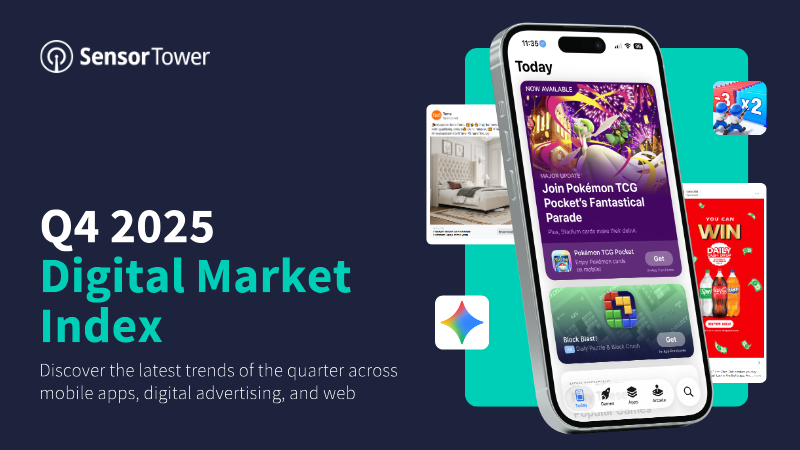
Digital Marketing Index Report: Q4 2025
The analysis evaluates global digital‑marketing dynamics for the final quarter of 2025, emphasizing shifts in channel performance, the rise of generative‑AI as a discovery source, and the concentration of retail‑media reach among dominant platforms. Growth patterns reveal a stark regional divide: India stands alone among the five largest markets as the only one posting positive overall change, while other leading economies recorded declines or stagnation.
In the United States, retail‑media impressions expanded 13 percent quarter‑over‑quarter to reach 123 billion, with Amazon accounting for the entire volume and delivering more than six times the impressions generated by Walmart. This concentration underscores Amazon’s expanding role as the primary conduit for retail‑media exposure in North America. Across the same period, generative‑AI referrals, although still representing less than one percent of total traffic, surged dramatically—up 133 percent year‑over‑year in the United States, United Kingdom and France, and 126 percent in Canada. The rapid acceleration signals that chat‑based assistants such as ChatGPT, Claude and Gemini are emerging as significant discovery engines despite their modest share of overall visits.
Conversely, traditional organic search experienced the only decline among major acquisition channels, falling four percent year‑over‑year. Paid advertising, email marketing and other performance‑driven tactics continued to post gains, reinforcing a broader transition toward paid and AI‑augmented pathways for user acquisition. The findings collectively illustrate a digital‑marketing ecosystem increasingly dominated by platform‑centric retail media and AI‑driven referral mechanisms, while legacy search channels lose ground in mature markets.
- India was the only major global market to record positive overall digital marketing growth in Q4 2025, while other leading economies experienced stagnation or decline.
- Generative AI referrals surged by 133% year-over-year in the US, UK, and France, signaling their emergence as significant discovery engines despite currently accounting for less than 1% of total traffic.
- US retail-media impressions grew 13% quarter-over-quarter to 123 billion, with Amazon capturing the entire volume and delivering six times the impressions of Walmart.
- Traditional organic search was the only major acquisition channel to decline in Q4 2025, falling 4% year-over-year.
- Digital marketing strategies are shifting toward paid advertising and AI-augmented pathways as legacy search channels lose market share in mature economies.
+2
Sensor TowerOct 2025

Report37 pages
Southeast Asia: Mobile Game Market Insights 2025
Southeast Asia solidified its position as the world’s second-largest mobile gaming market by downloads in early 2025, reaching 1.93 billion installs. While the region currently ranks seventh globally in revenue at $625 million, it demonstrates significant monetization potential fueled by expanding digital payment infrastructure and rising smartphone penetration. Indonesia serves as the primary volume driver with 870 million installs, while Thailand leads the region in consumer spending, generating $162 million. This growth is increasingly supported by publishers based in Singapore and Vietnam, who have emerged as a dominant global force, contributing over 5.8 billion installs to the international market through a mix of hypercasual hits and competitive titles.
Market dynamics reveal a shift toward high-engagement genres and localized content strategies. Although casual arcade and simulation games drive the highest download volumes, monetization is concentrated in Strategy, MOBA, and RPG segments. Mobile Legends: Bang Bang remains the regional revenue leader, sustained by hyper-local live operations and community engagement. Simultaneously, the 4X Strategy genre is experiencing rapid expansion, highlighted by a 77.7% revenue surge for titles like Last War: Survival. Conversely, traditional MMORPGs have seen a decline of nearly 20%, making way for Open World Adventure RPGs and sophisticated strategy games that leverage deep social and competitive mechanics.
The regional landscape is characterized by distinct national preferences and the global expansion of local firms. Vietnam has become a powerhouse for survival-themed hypercasual games, while Thailand shows a unique affinity for realistic sports simulations. Established titles like Garena Free Fire continue to dominate global charts by blending cultural relevance with nostalgic collaborations. Ultimately, the region’s trajectory is defined by a transition from high-volume downloads to sophisticated monetization, driven by a combination of community-led activations and the strategic global influence of Southeast Asian publishers.
- Southeast Asia is the world’s second-largest mobile gaming market by volume, recording 1.93 billion installs in early 2025, while ranking seventh globally in revenue at $625 million.
- Indonesia is the region's primary volume driver with 870 million installs, whereas Thailand leads in monetization, generating $162 million in consumer spending.
- Publishers based in Singapore and Vietnam have become a dominant global force, contributing over 5.8 billion installs to the international market through hypercasual and competitive titles.
- The 4X Strategy genre is experiencing rapid growth, evidenced by a 77.7% revenue surge for titles like Last War: Survival, while traditional MMORPGs have declined by nearly 20%.
- Monetization is concentrated in Strategy, MOBA, and RPG segments, with Mobile Legends: Bang Bang remaining the regional revenue leader due to hyper-local live operations.
+3
Sensor TowerJun 2025

Whitepaper26 pages
Maximize Your ROAS: Cutting-Edge Attribution Strategies in Mobile Gaming
Mobile gaming marketers currently face a critical measurement crisis driven by tightening privacy regulations, increased media fragmentation, and the inherent inaccuracies of traditional Last-Touch Attribution. These factors have rendered legacy models insufficient for capturing the true impact of marketing spend, as they frequently over-index on bottom-of-funnel touchpoints while ignoring the incremental value generated by upper-funnel awareness campaigns. To maintain competitive advantage and optimize Return on Ad Spend, the industry is transitioning toward sophisticated Marketing Mix Modeling, which leverages aggregated, privacy-compliant data to provide a more comprehensive view of channel performance.
The most effective strategy for modern publishers involves a dual-measurement framework that integrates tactical, real-time insights from Last-Touch Attribution with the strategic, long-term perspective offered by Marketing Mix Modeling. This hybrid approach is particularly vital for organizations managing substantial monthly budgets across diverse media channels, provided they possess at least one year of historical data to ensure model accuracy. By identifying the true incrementality of various platforms, developers can move beyond attribution blind spots and allocate resources with greater precision.
This analytical shift is essential for navigating the complexities of the global mobile gaming landscape. Platforms such as Kochava’s Always-On Incremental Measurement, often utilized in tandem with partners like TikTok for Business, represent the current standard for advertisers seeking to reconcile privacy-first data requirements with the need for actionable growth insights. Adopting these advanced modeling techniques allows publishers to move past fragmented measurement silos, ensuring that marketing investments are directed toward the channels that provide the most significant, measurable impact on long-term user acquisition and revenue growth.
- Mobile gaming marketers must transition from legacy Last-Touch Attribution to Marketing Mix Modeling (MMM) to overcome privacy regulations and media fragmentation that render bottom-of-funnel-focused models inaccurate.
- A dual-measurement framework combining real-time Last-Touch Attribution with long-term Marketing Mix Modeling is the most effective strategy for optimizing Return on Ad Spend.
- Marketing Mix Modeling requires a minimum of one year of historical data to ensure the accuracy necessary for identifying true channel incrementality.
- The hybrid measurement approach is specifically recommended for organizations managing substantial monthly budgets across diverse media channels.
- Platforms such as Kochava’s Always-On Incremental Measurement, used alongside partners like TikTok for Business, are currently the industry standard for reconciling privacy-compliant data with actionable growth insights.
+2
KochavaJan 2025

Report65 pages
The State of AAA Game Advertising: 2023 Review
The 2023 AAA game advertising landscape underwent a strategic pivot toward launch-focused campaigns, with new releases accounting for half of all top-tier spending. This shift reflects a broader industry trend of prioritizing high-impact, multi-channel visibility to capture immediate market share. While YouTube remains the dominant advertising medium for PC and console titles, publishers have increasingly diversified their media mix by integrating Facebook, TikTok, and Instagram to target specific demographics. This evolution in outreach is complemented by a growing reliance on platform-based partnerships, such as deep Xbox branding and hardware collaborations, which serve to anchor major titles within broader ecosystem strategies.
Creative execution in 2023 varied significantly based on the title’s core value proposition. Successful campaigns ranged from the consistent, exploration-themed branding of single-player experiences like Hogwarts Legacy to the dark, horror-inspired aesthetics and live-service integration of titles like Diablo IV. Furthermore, the industry increasingly utilized transmedia efforts and review-based accolades to sustain momentum. However, the year also highlighted the risks of fragmented marketing, as seen with Call of Duty: Modern Warfare III, which suffered from a lack of a cohesive reveal campaign and negative consumer perception regarding its status as a standalone sequel.
Ultimately, the year demonstrated that while massive advertising budgets and established intellectual property remain primary drivers for AAA success, organic viral growth and streamlined gameplay models also provide viable paths to market dominance. The industry is currently defined by a tension between traditional, high-spend multi-channel campaigns and the rising influence of mobile-first strategies and community-driven engagement. As publishers navigate these shifting dynamics, the ability to align creative messaging with specific platform strengths and cross-industry partnerships has become the definitive factor in maintaining visibility within an increasingly competitive global market.
- In 2023, AAA publishers shifted toward launch-focused campaigns, with new releases accounting for 50% of all top-tier advertising expenditure.
- While YouTube remains the primary advertising medium for PC and console games, publishers are increasingly diversifying their media mix by integrating Facebook, TikTok, and Instagram to target specific demographics.
- Strategic platform-based partnerships, such as deep Xbox branding and hardware collaborations, are now essential for anchoring major titles within broader ecosystem strategies.
- The failure of Call of Duty: Modern Warfare III demonstrated that fragmented marketing and a lack of a cohesive reveal campaign can severely damage consumer perception and market performance.
- Successful 2023 campaigns utilized varied creative strategies, ranging from exploration-themed branding for single-player titles like Hogwarts Legacy to horror-inspired aesthetics and live-service integration for Diablo IV.
+3
Sensor TowerJan 2025
Report35 pages
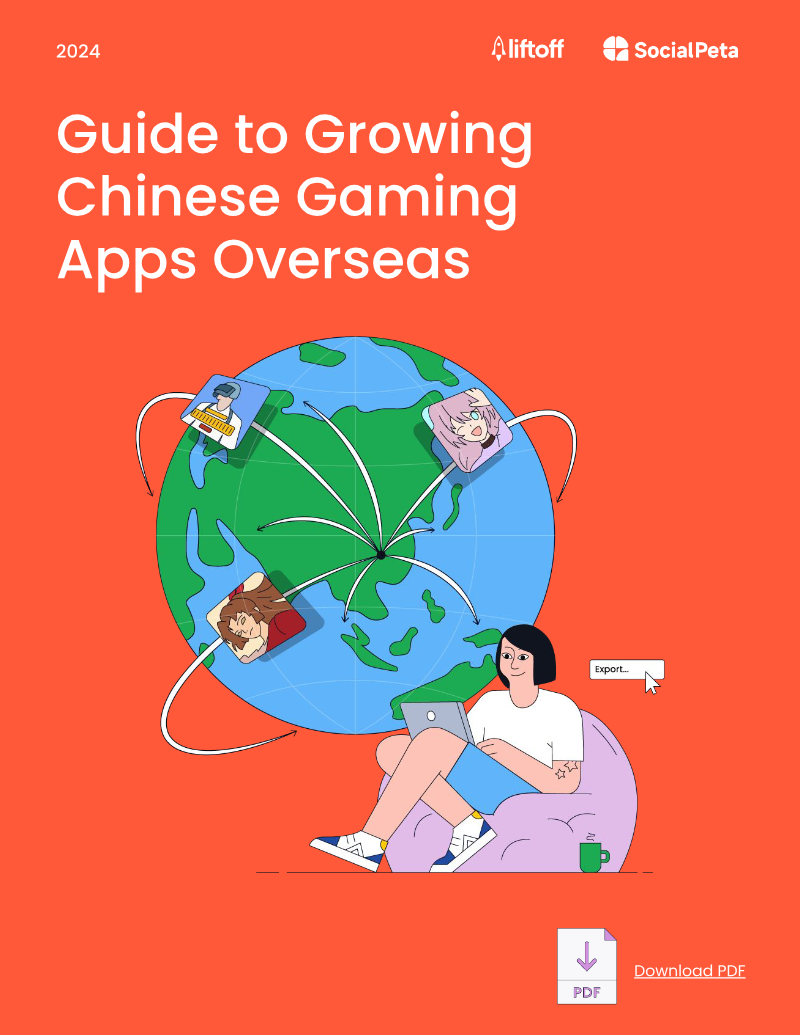
Guide to Growing Chinese Gaming Apps Overseas
Chinese gaming developers are aggressively expanding their global footprint by leveraging sophisticated monetization models and high-volume, AI-driven marketing strategies. The primary objective for these publishers is to balance the high revenue potential of mature markets like the United States, Japan, and South Korea against the rising costs of user acquisition. By prioritizing video advertising, which currently yields the highest Day 7 return on ad spend at 21%, developers are successfully capturing market share in competitive strategy and RPG segments.
Success in these international territories is increasingly predicated on hyper-localization and technological integration. Publishers are utilizing generative AI to streamline the production of localized ad creatives, voice-overs, and performance-tested copy, allowing for rapid iteration and regional customization. Leading titles demonstrate that high-engagement gameplay loops—such as the inclusion of social hangout spaces, customizable home systems, and minigame integrations—are essential for sustaining long-term retention. These efforts are further bolstered by strategic partnerships with local influencers and the implementation of innovative, time-limited gacha mechanics.
To maintain consistent growth, developers are diversifying their engagement tactics through gamified live events, including seasonal collections and interactive board-style challenges. These features, combined with trial character systems, allow publishers to cater to varied player motivations while maintaining a steady revenue stream. By synthesizing competitive intelligence with agile content updates, Chinese gaming apps are effectively navigating the complexities of global expansion, ensuring that both monetization and user interest remain high across diverse geographic regions.
- Video advertising is the most effective monetization channel for Chinese developers in mature markets, currently yielding a 21% Day 7 return on ad spend.
- Generative AI is being deployed at scale to automate the production of localized ad creatives, voice-overs, and performance-tested copy to reduce costs and speed up regional market entry.
- Long-term player retention is increasingly driven by integrating social hangout spaces, customizable home systems, and minigames into core gameplay loops.
- Developers are prioritizing expansion into high-revenue mature markets, specifically the United States, Japan, and South Korea, to offset rising global user acquisition costs.
- Engagement is being sustained through gamified live events, such as seasonal collections and interactive board-style challenges, alongside trial character systems.
+6
EAJan 2025

Report40 pages
The Gaming App Insights Report 2025: Unlocking Growth Opportunities for Mobile Marketers
The mobile gaming industry is entering a period of strategic recalibration, projected to reach $126.1 billion in revenue by 2025. This growth is underpinned by a transition toward hybrid monetization models and the integration of AI-powered personalization to combat persistent retention challenges. While global install volume grew by 4% in 2024, the market exhibits a distinct geographic divide; North American and European markets face stagnation, whereas Latin America and the Middle East and North Africa regions demonstrate robust expansion. Success in this evolving landscape requires developers to move beyond traditional acquisition, favoring diversified channels such as Connected TV and localized, player-centric engagement strategies.
Data from early 2025 indicates that user tracking remains a pivotal operational hurdle, with global App Tracking Transparency opt-in rates hovering at 37.9%. Although arcade games have seen notable improvements in opt-in performance, the United States remains relatively static at 32%, underscoring the necessity for refined messaging strategies to maintain visibility. Concurrently, the industry is grappling with a complex financial environment characterized by rising costs per install and declining average revenue metrics. These headwinds are forcing a shift in marketing tactics, as developers increasingly rely on a broader array of acquisition partners and data-informed creative experimentation to sustain growth.
Ultimately, the path to profitability in 2025 lies in prioritizing long-term player value over short-term acquisition metrics. By leveraging AI-driven optimization and fostering community-building initiatives, developers can mitigate the impact of declining revenue per user. The industry is clearly moving toward a more sophisticated, data-reliant ecosystem where the ability to measure performance across fragmented channels—including mobile and Connected TV—is essential for maintaining a competitive advantage in a maturing global market.
- The mobile gaming market is projected to reach $126.1 billion in revenue by 2025, driven by a shift toward hybrid monetization and AI-powered personalization.
- Global install volume grew by 4% in 2024, but growth is geographically polarized with stagnation in North America and Europe contrasted by expansion in Latin America and the MENA region.
- Global App Tracking Transparency (ATT) opt-in rates remain low at 37.9%, with the United States market stagnant at a 32% opt-in rate.
- Developers face a challenging financial environment defined by rising costs per install and declining average revenue metrics, necessitating a shift toward long-term player value over short-term acquisition.
- To sustain growth, developers must diversify acquisition channels beyond traditional mobile ads, specifically integrating Connected TV and data-informed creative experimentation.
+5
GamingReportJan 2025
Report20 pages
The Importance of Wishlists in 2025: Do Wishlists Matter?
Steam wishlists serve as a critical metric for predicting commercial success in the video game industry, functioning as a primary indicator of pre-launch momentum. Data analysis reveals that wishlist distribution is highly top-heavy, with a significant majority of games launching with fewer than 10,000 wishlists, while only a small fraction of titles achieve the 100,000-plus threshold required to reliably forecast a breakout performance. There is a strong 70% correlation between pre-launch wishlist counts and first-month unit sales, particularly for titles that surpass the 100,000-wishlist milestone.
Genre-specific trends highlight that action and adventure titles consistently generate the highest levels of pre-release buzz, often benefiting from the brand equity and marketing budgets of AAA and AA publishers. Conversely, casual and MMO titles frequently rely on post-launch engagement, such as live updates and community building, rather than pre-release wishlist accumulation. Regardless of genre, the timing of a Steam page launch is vital; top-performing games typically establish their presence six to twelve months before release, utilizing a steady stream of trailers and development updates to build and maintain audience interest.
The findings are based on an analysis of games launched on Steam from March 2024 onwards, utilizing proprietary estimation models and industry data. The research emphasizes that while wishlists are not a guarantee of success for every title, they act as a essential barometer for market interest. For developers and publishers, the data underscores that early visibility and sustained marketing efforts are necessary to reach the wishlist tiers that statistically correlate with long-term commercial viability.
- Steam wishlists are a primary indicator of commercial success, showing a 70% correlation between pre-launch counts and first-month unit sales.
- The 100,000-wishlist threshold is the critical benchmark required to reliably forecast a breakout performance for a new title.
- The vast majority of games launch with fewer than 10,000 wishlists, reflecting a highly top-heavy distribution of pre-launch momentum.
- Top-performing titles typically establish their Steam page six to twelve months before release to maintain audience interest through consistent updates.
- Action and adventure games generate the highest pre-release buzz, while casual and MMO titles rely more heavily on post-launch engagement than wishlist accumulation.
+3
Video Game InsightsJan 2025

Report49 pages
Target, Connect, Engage: Driving Profitable App Growth
Achieving sustainable mobile app growth in a privacy-centric digital landscape requires a sophisticated integration of precise measurement tools and advanced advertising optimization. The primary objective of modern mobile marketing is to shift focus from simple installation metrics toward high-value user engagement and long-term profitability. By leveraging Mobile Measurement Partners (MMPs) in tandem with platform-specific optimization features, brands can navigate complex cross-channel user journeys, mitigate ad fraud, and significantly improve their return on ad spend.
Data-driven strategies, specifically those utilizing App Event Optimization and Value-Based Optimization, serve as the foundation for scaling performance. These methodologies allow advertisers to move beyond broad acquisition tactics, instead employing granular audience segmentation and real-time tracking to identify and retain high-value users. Case studies involving major global brands such as Burger King, Rappi, and Carrefour demonstrate that this technical synergy consistently yields substantial improvements in conversion rates and overall revenue. For instance, integrated campaigns have successfully driven multi-fold increases in return on investment, proving that technical precision directly correlates with commercial success.
The scope of these strategies encompasses global mobile markets, focusing on the intersection of social media advertising and third-party attribution. Success in this environment relies on a structured, agile approach that prioritizes diversified creative testing and consistent budget management. By combining the analytical depth of an MMP with the reach and targeting capabilities of platforms like TikTok, developers can effectively lower customer acquisition costs while maximizing user lifetime value. Ultimately, the integration of these technologies is essential for any organization seeking to maintain a competitive edge in the evolving mobile ecosystem.
- Mobile marketing strategy must shift from simple installation metrics to prioritizing high-value user engagement and long-term profitability to ensure sustainable growth.
- Integrating Mobile Measurement Partners (MMPs) with platform-specific optimization tools is essential for navigating cross-channel journeys, mitigating ad fraud, and improving return on ad spend.
- App Event Optimization and Value-Based Optimization are the primary methodologies for scaling performance through granular audience segmentation and real-time tracking.
- Global brands including Burger King, Rappi, and Carrefour have achieved substantial improvements in conversion rates and multi-fold increases in ROI by utilizing integrated, data-driven campaigns.
- Lowering customer acquisition costs while maximizing user lifetime value requires a combination of analytical depth from MMPs and the reach of social media platforms like TikTok.
+2
KingJan 2025

Report66 pages
Insights Into Global Mobile Game Marketing Trends
The analysis demonstrates that mobile‑game marketing is increasingly driven by real‑time, AI‑enhanced creative data sourced from a global platform covering more than 80 countries and 1.6 billion daily‑updated assets. This infrastructure enables marketers to identify high‑quality, short‑form clips—particularly TikTok‑style and live‑action videos—that accelerate testing cycles and reduce acquisition costs. User acquisition remains the primary lever for installs, while retargeting is essential to sustain engagement and monetization. Emerging formats such as non‑intrusive in‑game audio ads and custom product pages are gaining traction, reflecting a broader shift toward data‑driven, AI‑augmented strategies.
Genre‑level insights reveal that role‑playing games dominated advertising in the first half of 2025, with a competitive creative volume of 224 monthly assets per genre. Casino titles experienced a 14.5 % year‑over‑year increase in advertiser share, while tower‑defense gameplay surged across top titles. Geographic intensity is highest in North America and Europe, with Southeast Asia following closely; all regions exhibit a pronounced move toward AI‑generated creatives. North American advertisers grew 25.8 % in H1 2025, deploying over 5 million creatives and favoring high‑quality portrait formats (720×1280, 52 s) that drive strong engagement metrics.
The study identifies a critical mismatch between creative freshness and acquisition costs, noting that many campaigns suffer from delayed updates and poorly targeted landing pages. Recommendations emphasize increasing creative refresh rates, refining audience segmentation, and rigorous A/B testing to sustain novelty and improve return on investment. Overall, the findings underscore a mobile‑gaming ecosystem that is rapidly adopting AI‑driven creative production and diversified monetization tactics, with North America and Europe leading in both volume and innovation.
- Mobile game marketing is shifting toward AI-enhanced creative production, leveraging global platforms to identify high-performing short-form, live-action, and TikTok-style video assets.
- North American advertising activity grew by 25.8% in H1 2025, with advertisers deploying over 5 million creatives, predominantly favoring 720x1280 portrait formats.
- Role-playing games led advertising volume in H1 2025 with 224 monthly assets per genre, while casino titles saw a 14.5% year-over-year increase in advertiser share.
- Campaign performance is currently hampered by a mismatch between creative freshness and acquisition costs, necessitating higher refresh rates and more rigorous A/B testing.
- User acquisition remains the primary driver for installs, though retargeting is essential for sustaining long-term engagement and monetization.
+1
SocialPetaJan 2025

Report49 pages
Target. Connect. Engage: Driving Profitable App Growth with Revenue-Boosting Strategies
The primary purpose of the analysis is to demonstrate how a strategic partnership between a mobile measurement partner (MMP) and TikTok’s advertising ecosystem can unlock profitable growth for app marketers. By integrating real‑time attribution, privacy‑preserving measurement, and value‑based optimization, brands can accurately credit campaigns, reduce fraud, and maximize return on ad spend (ROAS) across the entire customer journey.
Key findings show that cross‑platform visibility is essential for identifying high‑value users and optimizing acquisition budgets, especially amid tightening privacy regulations on iOS and Android. AppsFlyer’s comprehensive measurement suite, combined with TikTok’s SKAdNetwork tools and self‑reporting network, delivers precise audience targeting and cost‑effective user acquisition. Case studies from Burger King, Casas Bahia, and Carrefour illustrate tangible results: a 7× ROI for coupon activations, a 44 % lift in conversion rates with a 55 % ROI gain, and a 29 % increase in in‑app revenue with triple the return compared to other channels.
The document outlines best practices for app install and retargeting campaigns, recommending the use of App Event Optimization (AEO) and Value‑Based Optimization (VBO) to focus spend on high‑value actions. Automated Smart Performance Campaigns and real‑time ROAS measurement via AppsFlyer integrations further enhance efficiency and lifetime value.
Geographically, the insights apply globally across major mobile markets, with a focus on the U.S., Europe, and emerging regions where TikTok’s user base is rapidly expanding. The time frame covers current privacy‑driven advertising environments and anticipates ongoing downturns, positioning the partnership as a resilient growth strategy for 2024‑2026.
- Integrating AppsFlyer’s measurement suite with TikTok’s advertising ecosystem enables brands to maximize ROAS through real-time attribution and privacy-compliant user acquisition.
- Case studies demonstrate significant performance gains, including a 7x ROI for Burger King, a 44% conversion lift for Casas Bahia, and a 29% increase in in-app revenue for Carrefour.
- App marketers should prioritize App Event Optimization (AEO) and Value-Based Optimization (VBO) to focus advertising spend on high-value user actions.
- Automated Smart Performance Campaigns and real-time ROAS measurement are recommended strategies to maintain growth and efficiency through 2026 despite tightening privacy regulations.
- Cross-platform visibility is essential for identifying high-value users and optimizing acquisition budgets across both iOS and Android environments.
+2
AppsFlyerJan 2025
Report8 pages
Plan Your Chart-Topping Game Launch: Monster Hunter Case Study
The case study demonstrates how Capcom leveraged Stream Hatchet’s campaign platform and Sideqik’s influencer‑management tools to create a viral cultural moment for the launch of Monster Hunter Wilds. The core strategy combined a 12‑hour marathon live stream hosted by high‑profile YouTube creator iShowSpeed, bespoke in‑game weapon and armor designs from cosplay influencers, and a DLC‑code giveaway that directed viewers to a custom landing page. Data‑driven planning, contract coordination, and cross‑team communication were used to ensure seamless execution and to maximize both paid and earned reach across YouTube, TikTok, Instagram and Twitch.
Performance metrics show the initiative generated 5.03 million earned‑media views, placing iShowSpeed at the fifth‑most‑watched Monster Hunter Wilds streamer on launch day, and achieved a 7.1 percent engagement rate on earned media. Seventy‑two earned‑media posts contributed to the view total, while platform‑level analysis recorded earned‑view shares of roughly 3.8 percent and paid‑view shares of 3.7 percent, with an overall engagement rate of 3.2 percent. Overlap analysis identified a low‑overlap, large‑audience segment of approximately 7.2 million Twitch users, informing future audience‑targeting decisions.
The methodology relied on Stream Hatchet and Sideqik SaaS platforms to capture real‑time chat sentiment, viewer overlap, benchmark comparisons, and code‑distribution analytics. A dedicated team of data analysts produced a comprehensive post‑campaign report that highlighted strengths, weaknesses, and actionable modifications for subsequent launches. The campaign’s geographic scope was global, focusing on the major streaming ecosystems active in early 2025, and targeted the core gaming and esports audience segments associated with action‑RPG titles.
- Capcom’s Monster Hunter Wilds launch campaign generated 5.03 million earned-media views and achieved a 7.1 percent engagement rate on earned content.
- A 12-hour marathon stream featuring iShowSpeed positioned him as the fifth-most-watched creator for the game on launch day.
- The campaign utilized a multi-platform strategy across YouTube, TikTok, Instagram, and Twitch, resulting in an overall engagement rate of 3.2 percent.
- Audience overlap analysis identified a distinct, low-overlap segment of 7.2 million Twitch users, providing a data-backed foundation for future targeting.
- The initiative combined high-profile influencer partnerships with bespoke in-game content and DLC-code giveaways to drive traffic to a custom landing page.
Stream HatchetJan 2025

Report22 pages
Creative Analytics
The mobile advertising landscape in the third quarter of 2023 reveals a shifting environment characterized by a decline in total advertisers but a significant surge in video-centric content. Data indicates that the total number of advertisers fell to 54,900, a 7% year-over-year decrease compared to the 59,000 recorded in the third quarter of 2022. Despite this overall contraction, the gaming, entertainment, and lifestyle verticals maintained upward momentum in advertiser activity. In the United States specifically, the market saw 4.68 billion downloads and $6.5 billion in revenue, with gaming securing the top position in both metrics despite slight year-over-year market drops.
Creative strategies have pivoted heavily toward video formats, which now account for 80% of all creatives, up from 69% in the previous quarter. This growth comes at the expense of static images, while playable ads remain a niche segment at 2% of the market. Analysis of the 15.2 million total creatives shows a heavy platform bias toward Android, which hosts 68% of ad content compared to 32% on iOS. In the competitive US market, top-tier advertisers maintain a massive scale, averaging nearly 54,000 creatives across nine different ad networks.
The rise of User-Generated Content (UGC) has become a central pillar of modern mobile UA strategy. Effective creative execution now relies on organic trends, charismatic creators, and native storytelling techniques. Key findings suggest that successful UGC ads utilize "problem-solution" narratives, text overlays to accommodate sound-off viewing, and sketches that align with brand values. By leveraging creators who mirror the target audience and utilizing cliffhangers or popular music, advertisers are increasingly focusing on engagement and virality to offset the broader downward trend in the number of active market participants.
- Video-centric content now dominates the mobile advertising landscape, accounting for 80% of all creatives in Q3 2023, up from 69% in the previous quarter.
- Total mobile advertisers declined 7% year-over-year to 54,900, though the gaming, entertainment, and lifestyle verticals bucked this trend with continued growth.
- Android remains the primary platform for ad distribution, hosting 68% of the 15.2 million total creatives compared to 32% on iOS.
- In the US market, gaming remains the leading category for both downloads (4.68 billion) and revenue ($6.5 billion), despite experiencing slight year-over-year market contractions.
- Top-tier advertisers are maintaining high-volume strategies, deploying an average of 54,000 creatives across nine different ad networks.
+2
AppticaJan 2025

Report46 pages
Global State of Game Publishing & Marketing 2025 Industry Report
The global game publishing market is entering a period of significant expansion, projected to grow from $117.4 billion in 2025 to $150.7 billion by 2030. This growth is underpinned by a fundamental shift toward cross-platform development and the democratization of publishing tools, which has enabled independent titles to achieve massive commercial success alongside traditional publishers. A 40% increase in multi-platform launches reflects a strategic move to maximize player engagement, while the rise of "publishing as a service" models allows smaller studios to access professional marketing and analytical scale without traditional gatekeeping.
The industry has almost entirely transitioned to a digital-first model, with digital sales accounting for 95% of total revenue. Marketing strategies now prioritize influencer partnerships and transmedia collaborations over traditional retail channels, as 40% of enthusiasts now make purchasing decisions based on creator recommendations. This digital dominance is further reinforced by the rise of Live Service Gaming, which is expected to reach $18.7 billion by 2030. Publishers are increasingly leveraging real-time AI data analytics and community-building initiatives to sustain long-term monetization and player retention in this competitive landscape.
Revenue streams are diversifying rapidly as the market moves away from one-time purchases toward recurring models. While the premium purchase market shows only marginal growth, subscription models are forecasted to surge at a 12.2% CAGR, reaching $21.6 billion by 2030. Additionally, the esports sector remains a high-growth area, driven by sponsorships and media rights. Ultimately, sustainable growth in the modern era requires a player-centric approach that balances technological innovation with community engagement, ensuring that cross-platform strategies and AI-driven monetization can effectively offset rising development costs.
- The global game publishing market is projected to grow from $117.4 billion in 2025 to $150.7 billion by 2030, driven by cross-platform development and the democratization of publishing tools.
- Digital sales now account for 95% of total revenue, signaling a near-total transition away from traditional retail channels.
- Subscription-based revenue models are forecasted to grow at a 12.2% CAGR, reaching $21.6 billion by 2030, while the premium one-time purchase market experiences only marginal growth.
- Live Service Gaming is a critical growth pillar expected to reach $18.7 billion by 2030, supported by real-time AI data analytics to drive player retention.
- Influencer partnerships have become a primary marketing driver, with 40% of enthusiasts basing their purchasing decisions on creator recommendations.
+1
Epic GamesJan 2025
Report117 pages
State of Gaming & Influencer Marketing 2025
The global gaming industry has entered a period of stabilization, with 2024 revenues reaching $187.7 billion and a projected player base of 4 billion by 2027. While mobile gaming remains the dominant sector, accounting for nearly half of all revenue at $92.6 billion, the market is undergoing a structural shift. PC gaming has emerged as a primary growth driver, evidenced by Steam’s record $10.8 billion revenue in 2024 and a historic surge in indie game sales, which surpassed AA and AAA titles for the first time. This evolution is supported by a transition toward hybrid monetization, cross-platform experiences, and a hardware market projected to reach $120 billion by 2028.
Influencer marketing has become an indispensable pillar of this ecosystem, with spending expected to hit $32.55 billion by 2025. The landscape is moving away from raw traffic metrics toward "influence quality," where authentic storytelling and niche engagement take precedence over total follower counts. Nano-influencers, particularly on platforms like TikTok and Twitch, are achieving engagement rates exceeding 10%, significantly outperforming larger creators. While Instagram remains the preferred platform for 90% of brand partnerships, the rise of AI-driven optimization and virtual influencers is reshaping how content is produced and consumed across YouTube and emerging platforms like Kick.
Successful game launches now rely on sophisticated, multi-platform influencer funnels that utilize early access marathons and Twitch Drops to convert awareness into long-term community advocacy. As social commerce expands globally, particularly following its success in Asian markets, the industry is prioritizing long-term strategic planning over short-term user acquisition. The integration of AI tools, augmented reality, and direct-shopping features indicates a future where gaming and creator content are inextricably linked, requiring brands to adopt agile, data-driven strategies to maintain loyalty in an increasingly fragmented global market.
- The global gaming industry reached $187.7 billion in 2024, with mobile gaming remaining the dominant sector at $92.6 billion and the total player base projected to hit 4 billion by 2027.
- PC gaming is a primary growth driver, highlighted by Steam’s record $10.8 billion revenue in 2024 and indie game sales surpassing those of AA and AAA titles for the first time.
- Influencer marketing spending is projected to reach $32.55 billion by 2025, with a strategic shift toward niche engagement and nano-influencers who achieve engagement rates exceeding 10%.
- The gaming hardware market is projected to reach $120 billion by 2028, supported by a broader industry transition toward cross-platform experiences and hybrid monetization.
- While 90% of brand partnerships currently favor Instagram, the industry is increasingly adopting AI-driven optimization, virtual influencers, and multi-platform funnels like Twitch Drops to drive long-term community advocacy.
+1
AAA AgencyJan 2025
Report74 pages
Japan’s World of Gaming & Influencer Marketing 2025
Japan represents the world’s third-largest gaming market, valued at $26.3 billion in 2024 with projections to exceed $60 billion by 2033. This growth is underpinned by a mature player base of 55.5 million, characterized by the highest average revenue per user globally at approximately $580. While mobile gaming currently commands 75% of consumer spending, the market is undergoing a structural transition. Digital distribution and subscription models are increasingly replacing physical media, while the PC sector exhibits a robust 8.8% annual growth rate. Domestic giants Sony and Nintendo maintain market leadership by leveraging iconic intellectual properties and a cultural preference for narrative-heavy genres such as RPGs and adventure titles.
The ecosystem is increasingly defined by the convergence of gaming, live streaming, and broader entertainment. Esports revenue is expected to reach ¥21.8 billion by 2025, supported by a shift in viewership toward platforms like YouTube and Twitch. A unique cultural phenomenon in this space is the dominance of VTubers and virtual influencers, who drive significant engagement among Gen Z and Millennial demographics. Marketing strategies have pivoted toward these creators and nano-influencers to achieve authenticity, particularly as major publishers aim to quadruple the international market for Japanese content by integrating anime aesthetics into global entertainment ecosystems.
Technological advancements in 5G, cloud streaming, and augmented reality are further diversifying the landscape, though traditional social dynamics remain influential. While YouTube and X serve as the primary digital hubs for the gaming community, professional networking continues to favor established platforms like Facebook over LinkedIn due to local cultural barriers. As the mobile sector prepares for a projected rebound to $21 billion by 2025, the industry focus remains on cross-platform accessibility and the expansion of "evergreen" franchises within an increasingly digital and interconnected global market.
- Japan’s gaming market is valued at $26.3 billion in 2024 and is projected to exceed $60 billion by 2033, supported by 55.5 million players and the world's highest average revenue per user at approximately $580.
- Mobile gaming currently accounts for 75% of consumer spending, with a projected rebound to $21 billion by 2025, while the PC sector maintains a robust 8.8% annual growth rate.
- Domestic leaders Sony and Nintendo maintain market dominance by leveraging iconic intellectual properties and a strong cultural preference for narrative-heavy RPGs and adventure titles.
- Esports revenue in Japan is expected to reach ¥21.8 billion by 2025, driven by a shift in viewership toward YouTube and Twitch.
- VTubers and virtual influencers are the primary drivers of engagement for Gen Z and Millennial demographics, leading publishers to prioritize these creators for authentic marketing.
+1
NintendoJan 2025

Report37 pages
Starfield: How It Achieved 10M Players
The marketing and commercial performance of Bethesda’s Starfield reflects a strategic evolution in digital promotion, transitioning from traditional trailer-based campaigns to a diversified, multi-channel approach. By prioritizing platforms like TikTok, Twitch, and Instagram during the 2023 pre-order phase, the campaign successfully built massive momentum, culminating in the title reaching the top of Steam’s Wishlist and securing over 300,000 followers prior to launch. A critical component of this success was the integration with Microsoft’s ecosystem, specifically leveraging "Day One on Game Pass" messaging and Bing’s AI search capabilities to maximize visibility and accessibility across the Xbox and PC markets.
Upon release, the title became the largest launch in Bethesda’s history, surpassing 10 million players despite a highly competitive landscape featuring major RPG rivals. This achievement was supported by a substantial $21.2 million advertising investment, which ranked second in the RPG category for the year. A significant portion of this budget—over one-third—was allocated to Over-the-Top (OTT) advertising, signaling a shift toward high-impact streaming services. While the game achieved a favorable critical reception with a Metacritic score of 84, user sentiment remained polarized across Steam and Game Pass, and initial Twitch viewership saw a steady decline following the early-access period.
The broader industry context for these findings is supported by digital marketing intelligence that tracks competitor spending, creative messaging, and regional targeting. By analyzing spend patterns across social and digital platforms, the data illustrates how major publishers are increasingly moving away from centralized video platforms toward fragmented, high-engagement social media and streaming services to capture audience attention in a crowded marketplace. This analysis covers the primary 2021 to 2023 launch window, focusing on the global RPG segment and the shifting dynamics of digital ad distribution.
- Starfield reached 10 million players at launch, marking the largest release in Bethesda’s history despite a competitive RPG market.
- The marketing campaign utilized a $21.2 million advertising budget, the second-highest in the RPG category for 2023.
- Over one-third of the total advertising budget was allocated to Over-the-Top (OTT) streaming services, reflecting a strategic shift toward high-impact digital distribution.
- Pre-launch momentum was driven by a multi-channel social strategy on TikTok, Twitch, and Instagram, resulting in over 300,000 followers and the top spot on Steam’s Wishlist.
- Integration with the Microsoft ecosystem, specifically 'Day One on Game Pass' messaging and Bing’s AI search, was critical to maximizing visibility across Xbox and PC.
+2
Sensor TowerJan 2025

Report13 pages
Guide to Consumer Rights, Advertising and Data Protection: Spain
The guide is intended to equip Spanish video‑game publishers, developers and marketers with a practical understanding of the legal framework governing consumer rights, advertising and data protection. It draws on the General Law for the Defence of Consumers and Users, the General Advertising Law, the Unfair Competition Law, the General Data Protection Regulation and the Spanish Organic Law on Data Protection, applying them to digital products released in Spain throughout 2025.
Key consumer‑protection provisions require clear pre‑purchase information, a 14‑day withdrawal right for most digital purchases, and safeguards against unfair terms such as unilateral contract changes. Exceptions apply to virtual currencies, physical copies that have been opened and age‑rated titles once gameplay begins. Developers must maintain and communicate updates, while digital assets—including NFTs—must be presented with transparent licensing terms and explicit notices when the right of withdrawal is lost. Advertising must avoid misleading claims, covert sponsorship, political content outside election periods, and any material that exploits minors, encourages violence, discrimination or unhealthy behaviours; influencer promotions must be marked with visible disclosures such as #Sponsored or #Ad.
Data‑protection obligations centre on distinguishing controller and processor roles, informing users through layered privacy notices, and securing personal data—including special categories—via documented processing activities and contractual safeguards. For users under 14, parental consent must be verified through age checks or electronic signatures. The guide concludes with a checklist summarising rights to information, withdrawal, fair advertising, loot‑box age verification, ongoing game maintenance and GDPR‑compliant data handling.
- Digital purchases in Spain generally require a 14-day right of withdrawal, though this is waived for age-rated titles once gameplay begins and for opened physical copies or virtual currencies.
- Data processing for users under 14 requires verified parental consent, which must be obtained through age-verification mechanisms or electronic signatures.
- Influencer marketing must include clear, visible disclosures such as #Sponsored or #Ad to avoid violating regulations against covert sponsorship.
- Advertising content is strictly prohibited from exploiting minors, promoting violence or discrimination, or featuring political messaging outside of designated election periods.
- Digital assets and NFTs must be sold with transparent licensing terms and explicit notifications informing users exactly when their right of withdrawal is forfeited.
+1
AEVIJan 2025

Report6 pages
Securing Competitiveness in Human-Creativity-Driven BGM Production in the Age of AI-Generated Music: South Korea
The interview with Hong Eun‑Ji, CEO of T2Sound, examines how background‑music (BGM) producers in South Korea can preserve competitive advantage as AI‑generated music becomes increasingly affordable and rapid. The central thesis is that human creativity—particularly the ability to convey authentic emotion and intent—remains the decisive factor that AI cannot replicate, and that leveraging AI as a collaborative tool rather than a threat can enhance, not replace, the artistic value of BGM.
Key insights emphasize that quality and emotional resonance, achieved through meticulous mixing and mastering, are the core values guiding T2Sound’s work. The company prioritises collaboration with external creators, believing that collective expertise yields richer nuance than isolated in‑house production. Market trends reveal a shift among overseas buyers toward tracks with distinctive sonic signatures rather than generic pleasantness, and Korean BGM’s success abroad is linked to its unique emotional line and texture. In short‑form media, the interview highlights the necessity of an immediate, memorable hook within the first few seconds to secure brand recognition and audience immersion.
Looking ahead to 2026, the conversation predicts a consolidation around financially proven genres such as hip‑hop and trot in Korea, reflecting an industry increasingly driven by economic sustainability. The interview’s qualitative methodology—direct dialogue with a leading BGM provider—offers a focused perspective on the evolving interplay between AI tools, human artistry, and global market demands within the South Korean audio‑content sector.
- Human creativity remains the primary competitive advantage for BGM producers, as the ability to convey authentic emotion and intent cannot be replicated by AI.
- T2Sound maintains market competitiveness by prioritizing meticulous mixing and mastering to ensure high-quality emotional resonance, rather than competing solely on speed or cost.
- Global demand is shifting away from generic background music toward tracks with distinctive sonic signatures, with Korean BGM gaining traction due to its unique emotional texture.
- Short-form media content requires an immediate, memorable hook within the first few seconds to successfully secure brand recognition and audience immersion.
- T2Sound leverages a collaborative model with external creators to achieve richer artistic nuance than what is typically produced through isolated in-house workflows.
+1
KOCCA – Korea Creative Content AgencyJan 2025