
Report29 pages
Investing and Financial Management App Market and Advertising Trends 2025
Investment‑management and crypto trading applications have accelerated growth in 2025, with global downloads rising 12 % to about five billion. The surge is driven primarily by mobile‑first trading platforms and cryptocurrency apps that attract tens of millions of new users annually, reshaping consumer access to worldwide financial markets. Market fragmentation is evident: U.S. and Japanese users prefer established brokerages, whereas India and Southeast Asian consumers gravitate toward local, mobile‑centric services.
User demographics reveal a pronounced male bias across all regions, ranging from 70 % to over 90 % in crypto apps. Mature economies such as the U.S., Japan, and South Korea show a more balanced gender split (25–38 % female), while high‑growth markets like India and Vietnam have only 13–17 % female users. Age distribution centers on the 25‑44 cohort, with advanced markets featuring a larger share of users aged 35–54 and emerging markets attracting more 18‑24 year olds. Crypto platforms skew even younger, with up to 30 % of users aged 18‑24.
Advertising strategies mirror these demographic patterns. In the U.S., large brokerages allocate substantial budgets to capture a mature market, whereas Indian platforms such as Groww and Angel One generate over 120 billion global impressions through low‑fee, mobile‑first experiences and relatable storytelling. In Japan and South Korea, digital‑first brokers dominate via high‑impact video and social media campaigns that align with local cultural preferences.
Sensor Tower, a global mobile‑market intelligence provider headquartered in North America, Europe, and Asia, supplies four core products—App Intelligence, Store Intelligence, Ad Intelligence, and Usage Intelligence—to marketers, developers, and analysts seeking competitive insights across these rapidly evolving markets.
- Global downloads for investment and crypto trading apps rose 12% in 2025, reaching approximately five billion total downloads.
- User demographics are heavily male-skewed, with crypto apps reaching over 90% male users and emerging markets like India and Vietnam reporting only 13–17% female participation.
- Market preferences are geographically fragmented: U.S. and Japanese users favor established brokerages, while consumers in India and Southeast Asia prioritize local, mobile-centric platforms.
- Indian platforms Groww and Angel One have achieved significant scale, generating over 120 billion global ad impressions through low-fee, mobile-first strategies.
- The core user base is aged 25–44, though crypto platforms attract a younger demographic with up to 30% of users falling into the 18–24 age bracket.
+2
Sensor Tower

Report24 pages
1H 2025 Amazon Retail Media: An Inside Look at How Brands Are Showing Up
Amazon Retail Media dominated the first half of 2025, capturing $618 million in ad spend—more than double Walmart’s $236 million and nearly six times Chewy’s $105 million—while attracting 9,542 unique advertisers, a figure nine times larger than Walmart’s 1,076. The network’s scale is driven primarily by consumer packaged goods (CPG) and technology brands, with Samsung leading spend ($7.1 million), followed by Unilever ($5.7 million) and L’Oréal ($5.3 million). Top product categories reflected this focus: Personal Care ($38 million), Computers & Consumer Electronics ($23 million), and Food & Beverages ($19 million). Monthly spend patterns on Amazon are largely advertiser‑driven rather than retailer‑initiated, with brand campaigns such as L’Oréal’s winter skincare and Vital Essentials’ spring dog‑treat promotion creating sharp spikes.
Channel strategy analysis shows Amazon relies heavily on OnSite Display, accounting for 50 % of spend and 49 % of the network’s total advertising dollars, contrasting with a more balanced mix at competitors like Chewy and Home Depot. OffSite Display, social, and video placements are comparatively low, indicating a conversion‑focused approach that prioritizes high‑intent shoppers browsing Amazon’s own properties. Creative formats are largely formulaic, featuring “Shop Now” calls to action and discount messaging; only a few brands experiment with full‑funnel, multi‑channel activations such as Chips Ahoy’s combined OTT and OnSite strategy.
These insights, derived from Sensor Tower’s Retail Media Insights platform—which aggregates spend, media mix, and creative data across retail partners—highlight Amazon’s unparalleled reach and conversion orientation while pointing to opportunities for brands to differentiate through broader channel mixes and stronger brand‑building narratives.
- Amazon Retail Media dominated the market in 1H 2025 with $618 million in ad spend, significantly outpacing Walmart ($236 million) and Chewy ($105 million).
- Amazon’s advertiser base is nine times larger than Walmart’s, hosting 9,542 unique advertisers compared to Walmart’s 1,076.
- Samsung, Unilever, and L’Oréal were the top spenders in 1H 2025, contributing $7.1 million, $5.7 million, and $5.3 million respectively.
- OnSite Display accounts for 50% of Amazon’s ad spend, reflecting a strategy heavily focused on capturing high-intent shoppers directly on its own platform.
- Personal Care ($38 million), Computers & Consumer Electronics ($23 million), and Food & Beverages ($19 million) represent the top product categories for ad investment.
+2
Sensor Tower

Report29 pages
State of Mobile 2025: Why Community Wins on Mobile
The State of Mobile 2025 report examines the current mobile ecosystem, emphasizing how community engagement—particularly on Reddit—drives sustained app growth. The analysis draws from data provided by Adjust, Sensor Tower, and Reddit’s own measurement tools, covering iOS and Google Play users worldwide during 2024. Key market metrics show that mobile app usage reached 4.2 trillion hours, with in‑app purchase revenue hitting $150 billion—a 13% year‑over‑year increase. Downloads have stabilized at roughly 135–140 billion annually, while average revenue per user rose to $285,000. Four major growth drivers are identified: generative AI apps (17 billion downloads in 2024, up from 5 billion in 2019), non‑game spend (in‑app purchase revenue outside gaming climbed $14 billion, a 25% YoY jump), mobile gaming (IAP revenue grew 4% to $81 billion, with strategy and puzzle genres leading), and cryptocurrency apps (session counts up 37% YoY, driven by Bitcoin price recovery).
The report’s core thesis is that Reddit users exhibit higher engagement and monetization than users acquired through other social or digital channels. Adjust data on 150 million Reddit installs show that Reddit‑driven users spend 55% more time in-app on Day 1, rising to 103% by Day 30, and achieve 12–15% higher retention rates across North America, EMEA, and APAC. Day‑1 spend rates are 41% higher than other social platforms and 159% higher than digital media, underscoring the community’s influence on lifetime value.
Methodologically, the study aggregates anonymous, event‑level data from Adjust, comparing key metrics—time spent, retention, and spend—across Reddit, other social platforms (Facebook, Twitter, TikTok, Snapchat, Pinterest), and broader digital media. The findings suggest that authentic, community‑driven conversations on Reddit not only accelerate download decisions but also foster deeper, more profitable user relationships. The report concludes with actionable best practices for brands to leverage Reddit’s conversational ecosystem, improve onboarding, and measure non‑monetary interactions to maximize long‑term LTV.
- Reddit-acquired users demonstrate significantly higher lifetime value, with 41% higher Day-1 spend than other social platforms and 159% higher than digital media.
- Reddit users exhibit superior long-term retention and engagement, spending 55% more time in-app on Day 1 and 103% more by Day 30 compared to other channels.
- Global mobile in-app purchase revenue reached $150 billion in 2024, representing a 13% year-over-year increase, while total usage hit 4.2 trillion hours.
- Generative AI apps experienced massive growth in 2024, reaching 17 billion downloads compared to 5 billion in 2019.
- Non-gaming in-app purchase revenue grew by $14 billion, a 25% year-over-year increase, while mobile gaming revenue grew 4% to $81 billion.
+2
Reddit

Report9 pages
Where the UGC Dollars Flow: Mapping $9B Investments in Creator Economy
The analysis maps a $9 billion investment wave in user‑generated content (UGC) gaming from 2020 to 2025, covering roughly 80 companies and titles. Early‑stage rounds (pre‑seed to Series A) account for $0.5 billion, while late‑stage and corporate deals bring the total to $8.9 billion, including major platform names such as Roblox, Epic Games (Fortnite), Linden Lab, and Sandbox. Corporate venture capital and strategic investors contribute $3.5 billion, with notable commitments from Sony/Kirkbi ($2 billion in 2022) and Disney ($1.5 billion in 2024). Modding ecosystems—overwolf, mod.io, CurseForge—receive $0.4 billion in VC or M&A activity.
The report tracks engagement metrics, noting Roblox’s 73.5 billion logged hours in 2024 and a peak concurrent user base of 21 million, while Fortnite Creative stabilizes around 1.3 million concurrent users. Creator payouts have risen sharply, with Roblox and Fortnite together disbursing approximately $1.5 billion to developers in 2024, and quarterly earnings showing a 38 % increase from Q2 23 to Q3 23.
Funding follows a classic hype cycle: an initial surge during Roblox’s IPO and metaverse buzz (2020‑21), a pullback in 2022, and renewed strategic investment from incumbents in 2023‑24. Early‑stage rounds remain steady, averaging 12–15 deals per year, targeting “next Roblox/Fortnite” platforms and infrastructure. The largest early‑stage investments include $50 million raised by YAHAHA in 2020 and multiple $15–40 million Series A rounds for platforms such as ZAllbaba, Manticore, and Lighforge.
Overall, the data illustrate a mature UGC ecosystem that has evolved from hobbyist modding to professionalized creator economies, with sustained capital inflows and growing monetization pathways for both platforms and individual creators.
- The UGC gaming sector attracted $9 billion in total investment between 2020 and 2025, with $8.9 billion concentrated in late-stage and corporate deals.
- Strategic investment from industry incumbents is a primary driver, highlighted by Sony/Kirkbi’s $2 billion commitment in 2022 and Disney’s $1.5 billion investment in 2024.
- Creator monetization is scaling rapidly, with Roblox and Fortnite collectively disbursing approximately $1.5 billion to developers in 2024 and reporting a 38% quarterly earnings increase between Q2 and Q3 2023.
- Roblox remains the dominant platform with 73.5 billion logged hours in 2024 and 21 million peak concurrent users, while Fortnite Creative maintains a stable base of 1.3 million concurrent users.
- Early-stage funding remains consistent at 12–15 deals per year, focusing on infrastructure and platforms attempting to replicate the success of established leaders like Roblox and Fortnite.
+3
InvestGame

Report11 pages
Game Data: Building vs Buying
The document evaluates the trade‑offs between building an in‑house data pipeline and purchasing a third‑party solution for game analytics, using GameAnalytics’ PipelineIQ Pro as the primary example. It argues that while custom pipelines offer full control, they demand significant upfront investment in infrastructure, skilled personnel, and ongoing maintenance. The cost of hiring a data team—engineers, scientists, analysts—and cloud services (ingestion, storage, query, visualization) can reach nearly $50 k per month for a mid‑size studio with 5 million MAU, with human capital accounting for 89 % of the expense. In contrast, a vendor‑managed pipeline costs approximately $5.9 k per month, with the same headcount but lower operational overhead; human capital represents 78 % of that budget. The analysis highlights additional benefits of third‑party solutions, such as standardized event schemas, economies of scale in storage, rapid deployment (hours to days versus months), scalability without knowledge silos, and delegated privacy compliance. Methodologically, the comparison uses a hypothetical studio scenario to calculate total cost of ownership (TCO), breaking down monthly allocations into human, storage, query, and visualization costs. Geographic scope is global, with no regional restrictions noted; the time frame covers current market conditions and projected growth. The conclusion favors purchasing a proven pipeline for studios that lack the resources or urgency to build internally, citing lower TCO, faster time‑to‑insight, and reduced risk of technical debt.
- Building an in-house data pipeline for a studio with 5 million MAU costs approximately $50,000 per month, compared to $5,900 per month for a third-party solution like GameAnalytics’ PipelineIQ Pro.
- Human capital is the primary cost driver for both approaches, accounting for 89% of the budget for in-house builds and 78% for vendor-managed pipelines.
- Third-party solutions offer significantly faster deployment timelines, ranging from hours to days, whereas custom in-house pipelines typically require months to implement.
- Purchasing a proven pipeline reduces the risk of technical debt and eliminates knowledge silos that often occur when studios rely on internal engineering teams to maintain custom infrastructure.
- Vendor-managed solutions provide operational advantages including standardized event schemas, economies of scale in storage, and delegated responsibility for privacy compliance.
+1
InvestGame

Report23 pages
Game Analytics 100: The Retention Curve
The analysis demonstrates that player retention in mobile games can be accurately modeled with a power‑law curve, expressed either as \(r(n)=a\,b^n\) or \(r(n)=a\,n^{b}\). By fitting the curve to a limited set of cohort data—typically day‑1, day‑3, and day‑7 retention—analysts can derive the parameters \(a\) (initial retention level) and \(b\) (decay exponent). Excel’s LINEST function on logged values provides a straightforward method for estimating these coefficients, yielding representative curves such as \(r(n)=0.396\,n^{-0.472}\).
Once fitted, the curve serves multiple forecasting purposes. It predicts daily active users for any future day through a recurrence relation that incorporates the retention rate and cumulative DAU. It also enables calculation of player duration by summing \(r(n)\) over time, which feeds directly into lifetime value (LTV) estimates. For instance, with an average revenue per daily active user of \$1.00, the model projects LTV90 around 7.65 and LTV180 near 10.17, illustrating how early retention translates into long‑term monetization.
The methodology extends to benchmarking against industry standards. By comparing a studio’s day‑1, day‑7, day‑30, and day‑90 retention figures to genre‑specific percentiles provided by GameAnalytics, developers can identify performance gaps and prioritize optimization efforts. The approach is applicable across mobile game segments worldwide and covers the entire post‑install period, offering a scalable tool for forecasting, monetization planning, and competitive analysis.
- Mobile game retention follows a predictable power-law curve, modeled as r(n)=an^b, which allows analysts to forecast long-term player behavior using only day-1, day-3, and day-7 cohort data.
- Fitting retention curves enables precise lifetime value (LTV) projections; for example, an average revenue of $1.00 per daily active user results in an LTV90 of 7.65 and an LTV180 of 10.17.
- Analysts can derive the initial retention level (a) and decay exponent (b) by applying the LINEST function to logged cohort values in Excel, yielding representative curves such as r(n)=0.396n^-0.472.
- The retention model facilitates accurate daily active user (DAU) forecasting by applying a recurrence relation to the calculated retention rates and cumulative DAU figures.
- Developers can identify performance gaps by benchmarking their day-1, day-7, day-30, and day-90 retention metrics against genre-specific percentiles provided by GameAnalytics.
+2
East Side Games
Report20 pages
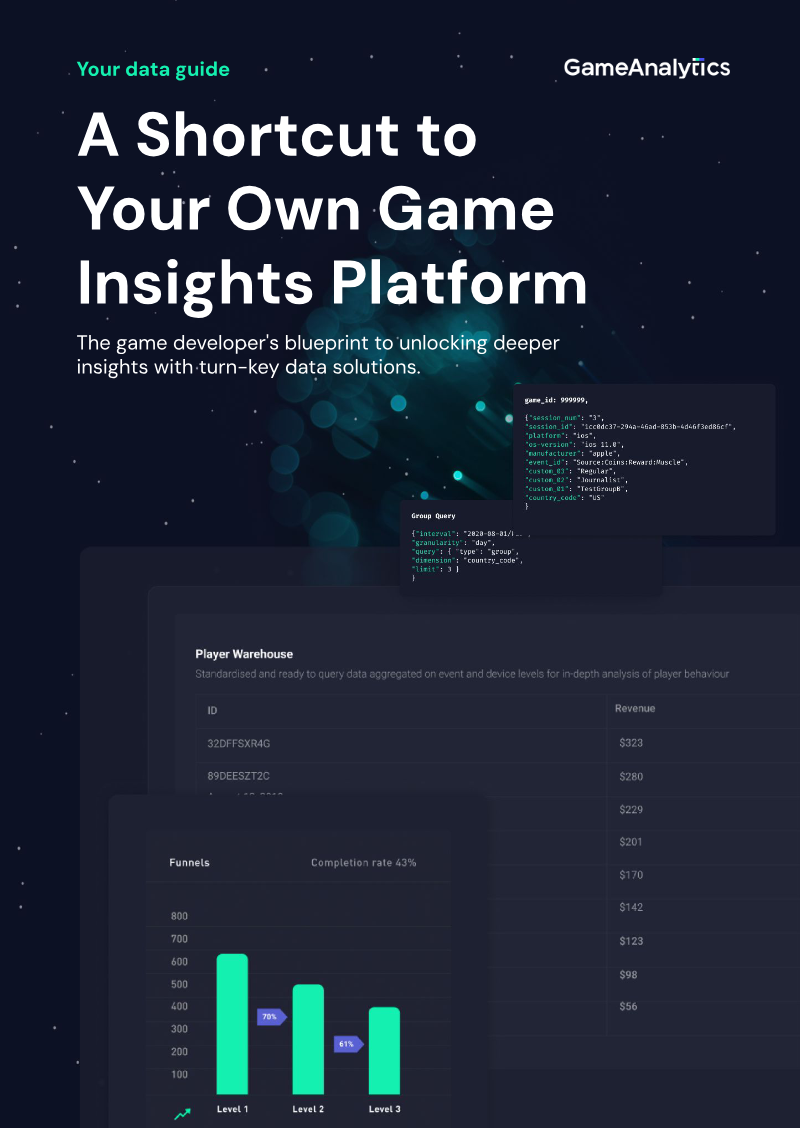
A Shortcut to Your Own Game Insights Platform
The guide presents a turnkey solution for game studios to build an in‑house data pipeline without the high costs of custom engineering. It introduces two core offerings: Player Warehouse, a pre‑aggregated data hub delivered in SQL or Parquet to BigQuery, Redshift, Snowflake, or Spark; and Raw Export, a real‑time JSON stream that preserves all custom event fields for unstructured analysis. The document emphasizes that these services eliminate the need for proprietary SDKs, ETL development, and ongoing infrastructure maintenance, offering a cost‑effective alternative to building a data lake from scratch.
Key findings highlight that Player Warehouse provides daily refreshed event and player‑level tables, enabling analysts to run advanced SQL queries, blend data from mediation or attribution sources, and retain up to one year of historical data. Raw Export supports real‑time analytics, custom dashboards, and long‑term enrichment through AWS S3 or BigQuery exports. The guide cites case studies—such as a VR MMO that leveraged Player Warehouse to boost engagement and a publisher that increased LTV by 50% across 19 titles using Raw Export—illustrating tangible ROI gains.
The scope covers global game studios, with examples from iOS, Android, Steam, and VR platforms. Timeframes referenced include daily updates for Player Warehouse and real‑time streaming for Raw Export, while the data pipeline supports integration with major BI tools (Looker, Power BI, Data Studio) and mediation/attribution services. Methodologically, the platform handles data ingestion via SDKs, normalizes events, and stores them in a cloud warehouse, abstracting SQL handling from end users. The document concludes by positioning GameAnalytics as a privacy‑first, ISO‑27001 and SOC 2 compliant partner that delivers rapid deployment—hours rather than months—for studios seeking scalable, customizable analytics.
- GameAnalytics provides a turnkey data pipeline that eliminates the need for custom ETL development, proprietary SDKs, and ongoing infrastructure maintenance.
- The platform offers two primary data delivery methods: Player Warehouse for daily refreshed, SQL-ready event tables and Raw Export for real-time JSON streaming.
- A publisher utilizing Raw Export achieved a 50% increase in lifetime value (LTV) across 19 titles, while a VR MMO leveraged Player Warehouse to improve player engagement.
- The solution integrates with major BI tools like Looker, Power BI, and Data Studio, and supports data blending from external mediation and attribution sources.
- Player Warehouse supports up to one year of historical data retention and delivers data directly to BigQuery, Redshift, Snowflake, or Spark.
+1
InvestGame

Whitepaper10 pages
Your Data Tracking Plan: A Step-by-Step Guide for GameAnalytics
GameAnalytics presents a structured framework for designing and implementing data tracking within games, emphasizing the creation of a comprehensive tracking plan that aligns analytics teams with development stakeholders. The guide outlines five sequential steps: first, brainstorming core questions about player behavior and business objectives; second, translating those questions into specific events using predefined categories such as Session, Business, Resource, Progression, Error, Ads, and Impression; third, defining dimensions and attributes to contextualize events with user identifiers, device details, and custom fields; fourth, integrating the plan through GameAnalytics SDKs tailored to various platforms; and fifth, maintaining an iterative process that revisits questions and updates events as the game evolves. Key recommendations include limiting custom events to a maximum of 50 unique identifiers, adopting a Category > Sub‑Action framework for clarity, and ensuring rigorous validation to avoid duplicate or misleading data. The document stresses the importance of consistent documentation, ownership assignment, and cross‑functional collaboration to prevent redundant data collection and maintain analytical integrity. By following this step‑by‑step methodology, developers can establish a reliable data pipeline that supports accurate KPI measurement and informed decision‑making throughout the game’s lifecycle.
- Establish a structured tracking plan by aligning business objectives and player behavior questions with seven predefined event categories: Session, Business, Resource, Progression, Error, Ads, and Impression.
- Limit custom events to a maximum of 50 unique identifiers to maintain data integrity and prevent system clutter.
- Adopt a consistent Category > Sub-Action naming framework to ensure clarity and prevent redundant or misleading data collection.
- Contextualize all events by defining specific dimensions and attributes, including user identifiers, device details, and custom fields.
- Assign clear ownership and maintain rigorous validation processes to ensure the analytical pipeline remains accurate throughout the game's lifecycle.
+1
GameAnalytics

Report75 pages
Playing for the Planet: Untangling the Carbon Complexities of the Video Gaming Industry
The analysis demonstrates that the video‑gaming sector remains fragmented in its approach to carbon accounting, with only a minority of companies—12 out of 222 surveyed—committed to science‑based targets. This shortfall stems largely from uncertainty around measuring Scope 3 emissions, particularly in categories such as purchased goods and product use. The report underscores a growing industry momentum: the Playing for the Planet Alliance now includes 42 members, and initiatives like the Green Games Guide and Ubisoft’s Climate School illustrate a shift toward embedding climate action within both operations and game content. Concrete progress is evident, for example, the Games Consoles Voluntary Agreement’s 54 TWh energy savings and the documented dominance of Scope 3 categories 1 (purchased goods) and 11 (use of sold products) in studios’ footprints.
Carbon intensity across the supply chain varies markedly by hardware, display technology, and regional electricity mix. Current‑generation consoles draw 150–200 W during gameplay, while PCs can reach 100–300 W; mobile devices consume only a few watts. A high‑end 4K TV can match console power when running HDR, and the carbon intensity of 200 Wh ranges from ≈13 gCO₂e in France to ≈81 gCO₂e in the United States. These disparities highlight opportunities for reducing emissions through hardware efficiency, extended device lifetimes, and the adoption of renewable electricity or green tariffs.
The report calls for consistent, industry‑aligned reporting frameworks—particularly the GHG Protocol Scope 3 categories—and greater granularity by business unit or product. It recommends iterative, data‑quality‑driven methods for estimating Category 1 and 2 emissions, prioritising primary supplier data for high‑spend items while applying spend‑based factors elsewhere. For Category 7 (employee commuting) and Category 11 (use‑phase emissions), detailed calculation examples illustrate the need to account for lifetime usage, regional grid intensity, and potential double‑counting. Real‑time accounting of use‑phase emissions is identified as a critical research gap, with cloud and CDN providers’ inconsistent reporting underscoring the need for standardized data.
Overall, the sector is moving toward greater transparency and actionable climate messaging, yet significant gaps remain in measurement, reporting consistency, and the integration of emerging technologies such as cloud gaming and AI. Addressing these challenges will be essential for credible net‑zero pathways across the global video‑gaming industry.
- Only 12 out of 222 surveyed gaming companies have committed to science-based carbon reduction targets, highlighting a significant industry-wide gap in formal climate accountability.
- Scope 3 emissions—specifically purchased goods (Category 1) and the use of sold products (Category 11)—represent the dominant share of the industry's total carbon footprint.
- Energy consumption during gameplay varies significantly by hardware, with current-generation consoles drawing 150–200W and PCs reaching up to 300W, compared to only a few watts for mobile devices.
- The carbon intensity of gaming is highly dependent on regional electricity grids, with 200Wh of consumption resulting in approximately 13gCO2e in France versus 81gCO2e in the United States.
- The Games Consoles Voluntary Agreement has successfully achieved 54 TWh in energy savings, demonstrating the efficacy of hardware efficiency standards.
Playing for the Planet Alliance
Report5 pages
East vs. West: Monetization Trends
The study examines how mobile gaming spending patterns differ between Eastern and Western markets, focusing on frequency of purchases, average spend per transaction, and motivational drivers. Findings reveal that Eastern gamers purchase in‑app items more often than Western players; 35 % of East spend frequently versus 36 % in the West, with a higher proportion of occasional and rare spenders in the West. When it comes to transaction size, Eastern users tend to pay more per purchase: 76 % spend over $10 compared with only 42 % of Western users, while a smaller share of East spend under $5 (30 %) versus 8 % in the West. Motivational analysis shows that Western gamers prioritize value and bundles, whereas Eastern players are more attracted to exclusivity, limited‑time items, new offers, and character acquisition. The research covers key markets in Asia—Korea and Japan—and Western regions including the United States, United Kingdom, and broader Europe. Data were collected through a survey of mobile gamers across these regions, with sample sizes sufficient to compare spending behaviors and motivations. The report concludes that monetization strategies should be tailored regionally: value‑based bundles may resonate better in the West, while exclusive content and limited editions could drive higher spend in Eastern markets.
- Eastern mobile gamers demonstrate a significantly higher propensity for large transactions, with 76% of purchases exceeding $10 compared to only 42% in Western markets.
- Western mobile gamers are more likely to make small-scale purchases, with 8% of spenders in the West opting for transactions under $5, contrasted with 30% in the East.
- Monetization strategies in the West should prioritize value-based bundles, as these resonate more effectively with the purchasing preferences of Western players.
- Eastern markets, specifically Korea and Japan, show a stronger consumer preference for exclusivity, limited-time offers, and character acquisition.
- Purchase frequency remains relatively balanced across regions, with 35% of Eastern gamers and 36% of Western gamers identified as frequent spenders.
+5
Mistplay
Report22 pages
The 2026 State of Web Gaming Report: A Study of Developer and Gamer Perceptions
The study demonstrates that web gaming has evolved from a niche, low‑quality outlet into a central discovery and revenue engine for the industry. Across 2,000 gamers and 400 developers surveyed in 2026, data reveal that 62 % of players discover new titles via the web and 53 % spend more than $50 monthly on games, underscoring a highly engaged, high‑spending audience. Ninety percent of players find games online, yet only 53 % of studios plan to port mobile titles to browsers within a year, highlighting a perception gap between consumer enthusiasm and developer adoption.
Web games thrive in an attention‑saturated media environment because they are short, low‑friction, and can be updated instantly to capture cultural moments. More than half of players listen to music or watch shows while gaming, and 38 % use social media simultaneously, positioning web games as a complementary entertainment layer. Developers cite discoverability (46 %) and gateway potential to other platforms (44 %) as key strengths, while rapid iteration and zero‑install access drive engagement and revenue. Monetisation maturity remains a barrier, yet the medium’s ability to reach players at the top of the purchase funnel is clear.
The data also show that web gaming no longer represents a low‑quality channel; 92 % of players rate HTML5 titles as high quality, and 37 % play multiple times a day. Web platforms drive discovery for 62 % of players, and high‑spending consumers are increasingly found online. Consequently, developers who omit web distribution risk missing a growing, engaged, and monetisable audience that now sits at the forefront of the purchase funnel.
- Web gaming is a significant discovery channel: 62% of web gamers have downloaded or purchased a game after discovering it on the web, and 53% of developers see it as a means to reach new players.
- Web gamers are highly engaged and valuable: 37% play multiple times per day, 86% play at least a few times a week, and 53% spend over $50 on gaming purchases monthly.
- Developers are increasingly embracing web gaming, with 27% planning to port mobile games to browsers in the next 12 months, and 56% agreeing it's a growing channel.
- There's a disconnect between some developer perceptions and reality: 32% of developers believe web gaming is a 'low-quality channel' despite 92% of consumers rating HTML5 web games as 'quite' or 'very' high quality.
- Web gaming offers low-friction access and high convenience, with 71% of respondents reporting stable or increasing web gaming time relative to social media, and 58% playing because games are free.
+1
PokiJun 2026

Report64 pages
Oświadczenie dotyczące zrównoważonego rozwoju: Polska 2025
The statement establishes MTG’s commitment to a comprehensive sustainability agenda for 2025, integrating environmental stewardship, social responsibility and robust governance across its entire value chain. The company’s board maintains a 29 % female composition, and ESG oversight is embedded in the audit/ESG committee with executive pay linked to performance. Science‑Based Targets drive a 46.2 % reduction in Scope 1–2 GHG emissions by 2031 and a 20‑point rise in the S&P Global CSA score by 2027, while a 5 % executive pay linkage to ESG outcomes reinforces accountability.
Operationally, MTG targets Scope 1–3 emissions through energy‑efficiency upgrades, renewable procurement and low‑carbon digital services. Climate risks are quantified via IEA/IPCC scenarios, revealing significant temperature rises in India, Israel and Spain but no severe droughts or flooding; indirect Scope 3 emissions dominate the materiality assessment. The company’s 2031 decarbonisation roadmap aligns with EU Fit for 55, and a 40 % GHG cut in scopes 1–2 and 25 % in scope 3 by 2030 is monitored annually against a 2024 baseline.
Human‑capital strategies emphasize flexible work, DE&I, health and safety, and AI‑driven productivity. Annual engagement surveys, performance reviews (93 % participation) and a 22.7 % gender‑pay gap are tracked, with no discrimination incidents reported. Governance frameworks address anti‑corruption, whistleblowing and cyber‑security, while data privacy is upheld through GDPR‑compliant DPIAs, “privacy by design” and age‑gating mechanisms for digital titles.
Geographically, the focus spans Poland with operations in India, Israel and Spain; temporally, the scope covers 2025 with forward‑looking targets to 2031. The statement aligns with CSRD/ESRS requirements, mapping disclosures and ensuring compliance across environmental, social and governance dimensions.
- MTG has committed to a 46.2% reduction in Scope 1–2 greenhouse gas emissions by 2031, with a 2030 target of a 40% cut in Scopes 1–2 and 25% in Scope 3 against a 2024 baseline.
- Executive accountability is reinforced by linking 5% of executive pay to ESG performance outcomes, overseen by a board committee with 29% female representation.
- The company aims to increase its S&P Global CSA score by 20 points by 2027 while aligning its decarbonization roadmap with the EU Fit for 55 framework.
- Materiality assessments indicate that indirect Scope 3 emissions are the primary environmental impact, with climate risk modeling identifying potential temperature rises in India, Israel, and Spain.
- Human capital management includes tracking a 22.7% gender pay gap and maintaining a 93% participation rate in annual performance reviews, with no reported discrimination incidents.
Modern Times Group

Presentation16 pages
AI in MTG: Moving Beyond Theory
The document argues that artificial intelligence has become a strategic asset in mobile game development, transforming every phase of the lifecycle from ideation to live operations. It claims that AI enables teams to prototype, test, and launch content at a fraction of the time previously required, citing examples such as concept‑art generation in days instead of months and single‑person prototype teams that reduce sunk costs. The thesis emphasizes that the combination of trillions of player data points, world‑class creative teams, evergreen intellectual property, and AI as a workflow enabler creates a competitive moat that is difficult to scale for rivals.
Key findings include a 99 % cost reduction in marketing asset creation, an 80 % time saving on influencer spotlights, and a 75 % reduction in analyst turnaround times when querying data through AI agents. The document reports that five new games launched in 2026 adopted an “AI‑first” approach, allowing rapid iteration and simultaneous development of specialized content. It also highlights that AI agents can analyze A/B tests, suggest optimizations, and generate localized UGC‑style assets to lower CPI and improve player engagement.
The scope covers the global mobile gaming market, focusing on mid‑core titles with large player bases. Methodology is implied through internal tooling: 50+ AI platforms (e.g., Claude, Cursor, ComfyUI) and BigQuery‑based agents that process terabytes of data daily. The analysis suggests that AI integration not only accelerates production but also democratizes data insights, freeing analysts to tackle higher‑level strategic questions.
- Adopting an 'AI-first' development approach enabled the launch of five new mobile games in 2026, facilitating rapid iteration and simultaneous production of specialized content.
- AI integration has achieved significant operational efficiencies, including a 99% reduction in marketing asset costs and an 80% time saving on influencer spotlight production.
- Data analysis turnaround times have been reduced by 75% by utilizing AI agents to query large-scale datasets, allowing analysts to focus on high-level strategy.
- AI tools, including Claude, Cursor, and ComfyUI, have transformed production timelines, enabling concept art generation in days rather than months.
- The combination of AI-driven workflows, proprietary player data, and evergreen intellectual property creates a significant competitive moat in the mid-core mobile gaming market.
+2
Modern Times Group
Report57 pages
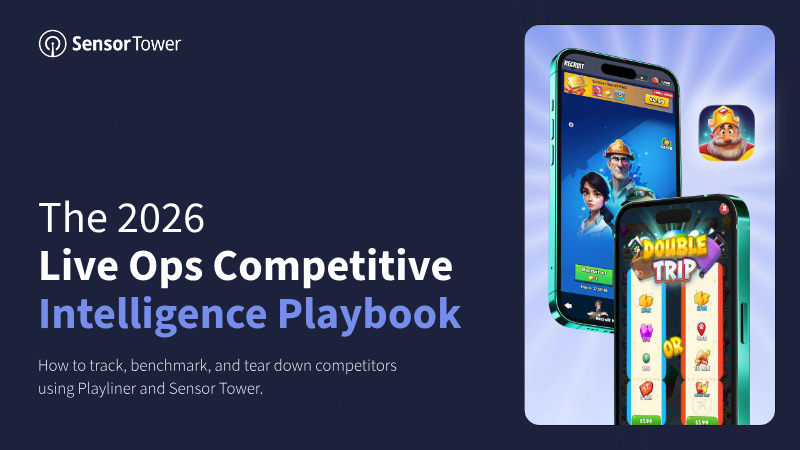
2026 Live Ops Competitive Intelligence Playbook
Optimizing Live Ops execution requires a disciplined, five-step analytical framework that moves beyond simple feature replication toward strategic, data-backed product decisions. By leveraging competitive intelligence tools to monitor event cadence, mechanics, and performance metrics, developers can effectively benchmark their titles against both direct and aspirational competitors. The primary objective is to transition from viewing individual mechanics as isolated features to implementing a cohesive, multi-layered calendar structure that drives player engagement across short, medium, and long-term horizons.
Across the puzzle, strategy, and casino genres, standard features such as tournaments, milestone rewards, and gacha wheels have become industry table stakes. Maintaining a competitive advantage now depends on the sophisticated sequencing of these events to foster social competition, create artificial urgency, and funnel player spending toward climactic moments. In the 4X strategy sector, successful titles utilize disciplined, multi-week cycles that escalate from solo challenges to server-wide competition. Meanwhile, the casino segment increasingly relies on specialized rolling offers and seasonal cycles to sustain momentum and maximize revenue spikes.
The scope of these strategies extends beyond in-game mechanics to include broader ecosystem shifts, such as the adoption of direct-to-consumer web stores to bypass platform fees and improve margins. Because the gaming landscape evolves rapidly, competitive intelligence must function as an ongoing, iterative process rather than a static assessment. Developers who prioritize a holistic system of player-agency mechanics and continuous monitoring are better positioned to maintain market parity and drive sustainable growth in an increasingly crowded global mobile market.
- In the puzzle genre, milestone rewards are the most frequent event type in 2026, with Tasty Travels launching four such events between March and May 2026.
- Royal Match drives weekend revenue spikes primarily through Live Ops-induced monetization and conversion increases, rather than growth in DAU, downloads, or time spent.
- For casino slot titles, '1+Free' offers generate the highest average release revenue impact, despite 'Rolling Offers' being the most prevalent specialized offer type used by 9 of 12 analyzed games.
- Sprint goal tournaments are the second most trending event mechanic in 2026, with Gossip Harbor and Tasty Travels actively deploying them throughout March and April.
- Merge events have become a key trend in match-swap games, with titles like Royal Match, Matching Story, Piggy Kingdom, and Matchington Mansion adopting the mechanic in 2026.
+4
Sensor TowerMay 2026
Report32 pages
Conversion Drivers in Videogames: Q1 2026
Marketing strategy and community sentiment serve as the primary determinants of conversion performance in the global video game industry as of early 2026. While pricing models like free-to-play and premium structures influence baseline metrics, the efficacy of acquisition campaigns depends more heavily on the alignment between marketing channels and specific player decision-making behaviors. Traditional last-click attribution models frequently undervalue high-funnel awareness efforts, necessitating a shift toward incrementality testing and extended retargeting windows to accurately capture the impact of early-stage engagement.
Player decision cycles vary significantly across industry segments, dictated largely by the social and cooperative dynamics inherent in different genres. Multiplayer and massively multiplayer online titles require longer conversion windows due to the complexity of social coordination, whereas single-player experiences benefit from strategies that emphasize urgency and individual-driven processes. Consequently, marketing efforts for multiplayer games should prioritize social proof and sustained community engagement, while single-player titles gain more traction through direct, time-sensitive calls to action.
Game quality and public perception act as critical multipliers for conversion, particularly within the premium sector. High Steam review scores, specifically those reaching the highest sentiment tiers, can nearly triple conversion rates for premium titles, whereas free-to-play conversion remains largely indifferent to such metrics. Because premium games involve extended evaluation periods, marketers must maintain consistent community-focused sentiment management to protect long-term conversion potential. By tailoring acquisition strategies to these distinct genre-based behaviors and moving beyond simplistic attribution, publishers can better optimize campaign performance and maximize player acquisition efficiency.
- Marketing execution is the primary driver of performance, with conversion rates for F2P games varying by 371x across different ad networks, dwarfing the 35% baseline advantage F2P titles hold over Premium games.
- Last-click attribution models undervalue upper-funnel awareness channels like YouTube, as 50% of the most popular demand-generating ad networks are not effectively captured by last-click metrics.
- Premium games priced above $40 require nearly twice the conversion window of mid-tier titles, and players take 27% longer to convert on Premium titles (141 hours) compared to F2P titles (111 hours).
- Steam review scores significantly impact Premium game performance, where moving from a 'Mixed' to 'Very Positive' rating can nearly triple conversion rates, whereas review scores show no measurable impact on F2P conversion.
- Multiplayer games exhibit longer decision cycles, taking 2.5x longer to convert than single-player titles, with MMO players requiring a median of 49.5 hours to convert compared to 21 hours for shooter players.
+3
GamesightMay 2026
Report57 pages
Digital Market Index: Q1 2026
The global digital economy experienced a significant structural transition during the first quarter of 2026, characterized by a pivot away from traditional mobile gaming toward generative artificial intelligence and short-form entertainment. While global in-app purchase revenue climbed 9.3% to $43.5 billion, this growth was primarily fueled by non-gaming sectors. Mobile gaming faced a notable contraction, with downloads falling 12% year-over-year, even as puzzle titles maintained their status as a primary revenue anchor. Conversely, the generative AI sector surged by 174%, signaling a shift in consumer engagement as users increasingly migrate from web-based interfaces to dedicated mobile applications.
Geographically, the market landscape is bifurcating between mature and emerging economies. The United States market exhibited signs of cooling, recording its lowest revenue growth rate at 3.5%, while India and Indonesia emerged as primary drivers of download volume. Despite the slowdown in U.S. consumer spending, the digital advertising sector remained resilient, growing 15% to $48 billion. This expansion was heavily supported by a 31% increase in software-related ad spend, as advertisers aggressively reallocated budgets from linear television toward targeted digital channels and retail media networks.
Retail media continues to evolve beyond the dominance of Amazon, with platforms like Walmart and Target capturing significant share by leveraging offsite social channels. This trend is particularly pronounced in essential categories such as personal care and food and beverages. As the industry matures, the competitive landscape for generative AI has also become more distributed, with market share spreading across multiple platforms like Gemini and Claude. These findings reflect a broader trend of digital consolidation, where mobile-first engagement and AI-driven utility define the current trajectory of the global digital marketplace.
- Global in-app purchase (IAP) revenue reached $43.5 billion in Q1 2026, marking 9% year-over-year growth and the 13th consecutive quarter of positive performance.
- US digital ad spend grew 15% year-over-year to $48 billion in Q1 2026, with Reddit emerging as the fastest-growing channel at 89% year-over-year growth.
- US mobile IAP revenue growth slowed to an all-time low of 3% year-over-year, recording two consecutive quarters of decline from its $15.1 billion peak.
- Generative AI advertising spend in the US surged to over $430 million in Q1 2026, more than triple the amount spent in Q1 2025, contributing to a 31% year-over-year increase in software ad spend.
- Retail media ad impressions in the US declined 3% year-over-year to 156 billion, driven by a 14% drop in Amazon impressions, even as Amazon maintained over 88 billion impressions and 4x the scale of Walmart.
+3
Sensor TowerMay 2026

Report63 pages
Why Players Play: The Psychology Behind Mobile Games
Mobile game development relies on the strategic alignment of product features with fundamental human psychological drivers to maximize player retention and monetization. By integrating core motivations such as mastery, curiosity, and social connection with defensive psychological triggers like loss aversion and the fear of missing out, developers create highly sticky ecosystems. The primary thesis posits that long-term success in the mobile sector is not merely a product of gameplay quality, but the result of a deliberate, evidence-based architecture that increases the perceived cost of player attrition.
The industry utilizes a sophisticated framework known as the Motivation Wheel to categorize game events and align them with specific business objectives, such as increasing average revenue per user or extending session duration. This approach sequences positive reinforcement—such as visible progress and reward systems—with negative motivators that compel action. By layering these mechanics, developers effectively transform natural session exit points into persistent hooks. Features like battle passes, streaks, and time-limited events leverage the sunk cost fallacy, shifting the player’s primary motivation from intrinsic enjoyment to a defensive necessity to protect accumulated progress.
This analytical approach to game design is prevalent across the global mobile gaming market, focusing on the intersection of behavioral psychology and product management. By systematically engineering these psychological deficits, developers ensure that engagement remains high even after the initial novelty of a game fades. Ultimately, the integration of these mechanics serves to minimize guesswork in product planning, allowing studios to foster deep, long-term player investment through the calculated application of urgency, social pressure, and the psychological weight of digital achievement.
- Social connection is the most effective retention mechanic because it creates a switching cost that prevents players from moving to competitors, as they cannot transfer their clan or community identity.
- Win streaks are the most powerful ARPU-driving mechanic because they simultaneously leverage progress, near-miss tension, loss aversion, urgency, and social pressure.
- Visible progress is essential for casual games; players require concrete proxies like progress maps, star counts, or numerical growth to feel a sense of competence and reward.
- Retention can be extended at natural session 'exit points' by using time-limited boosters or curiosity-driven teasers to convert a sense of completion into a new hook.
- Urgency and FOMO are most effective when the time-limited window is restricted to 5–20% of the total event duration, forcing players to choose between missing out or playing harder.
+3
Sensor TowerMay 2026
Report9 pages
ESG Fact Sheet: FY 2023/24
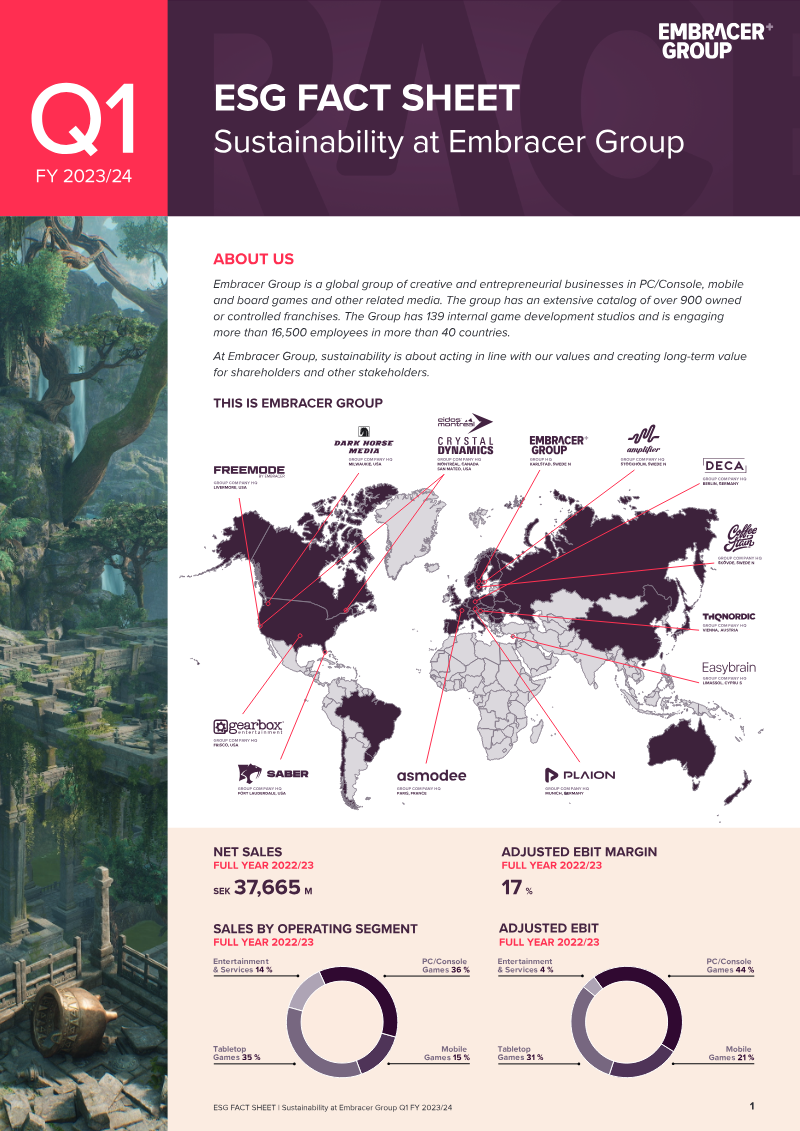
Embracer Group’s FY 2023/24 ESG Fact Sheet outlines the company’s sustainability framework, titled Smarter Business, which focuses on three core pillars: Great People, Solid Work, and Our Planet. Operating across more than 40 countries with 139 internal studios, the organization aims to integrate ethical governance and long-term value creation into its global operations. The company’s sustainability strategy is supported by 16 group policies and 12 guidelines, with oversight provided by the Audit and Sustainability Committee and an internal Ambassador Group.
Key performance indicators for the 2022/23 financial year highlight both progress and areas for development. Within the Great People pillar, the company reported a 26% female representation rate and an employee satisfaction score (eNPS) of +29. To foster leadership diversity, the board has committed to doubling the number of female managing directors and studio heads by 2025. Regarding environmental impact, the company has conducted a comprehensive greenhouse gas inventory, reporting total emissions of 687,102 tCO2e. The firm has aligned its climate strategy with the Paris Agreement, targeting a 45% reduction in carbon emissions by 2030 compared to a 2021/22 baseline.
The company utilizes a structured methodology for tracking progress, including annual global employee surveys and standardized sustainability due diligence during acquisitions. Furthermore, the organization actively participates in industry-wide initiatives such as the UN Global Compact, Women in Games, and PlayCreateGreen. By integrating these partnerships with internal training programs on privacy and ethics, the company seeks to manage operational risks while promoting digital well-being and accessibility across its portfolio of over 900 franchises.
- Embracer Group has committed to a 45% reduction in total carbon emissions by 2030, using the 2021/22 financial year as its baseline.
- The company reported total greenhouse gas emissions of 687,102 tCO2e for the 2022/23 financial year.
- Female representation across the organization stands at 26%, with a board-level mandate to double the number of female managing directors and studio heads by 2025.
- The organization maintains an employee satisfaction score (eNPS) of +29 across its 139 internal studios.
- Sustainability oversight is managed through 16 group policies and 12 guidelines, with governance provided by an Audit and Sustainability Committee and an internal Ambassador Group.
+3
Embracer Group

Report45 pages
Corporate Responsibility Report 2013
Modern Times Group (MTG) maintains a comprehensive corporate responsibility strategy centered on media integrity, employee welfare, environmental stewardship, and ethical business governance. During the 2013 fiscal year, the organization prioritized digital development and the protection of young audiences, achieving recognition in the Dow Jones Sustainability Europe Index. With a workforce of 3,361 employees and net sales reaching 14,129 MSEK, the company leveraged its extensive media reach to contribute over 42 million TSEK in combined financial and media-time donations to charitable causes, most notably through the Reach for Change social entrepreneurship foundation.
Operational performance in 2013 reflected a mix of progress and systemic challenges. Environmental efforts yielded a strong score of 88 out of 100 in the CDP report, supported by energy-efficient infrastructure and carbon disclosure initiatives, despite a 7% rise in total carbon emissions linked to corporate expansion. Internally, the company implemented rigorous anti-bribery policies and updated editorial standards. However, workforce metrics revealed persistent disparities, including a gender pay gap where female remuneration averaged 70% of male earnings, alongside a decline in return-to-work rates following parental leave.
The reporting process, conducted in accordance with GRI G4 Core standards and independently assured by Ethos International, identified customer data integrity and child protection as the most material issues for the business. While the company successfully established a new Corporate Responsibility Advisory Group to oversee governance, auditors noted significant limitations in existing data collection systems. Future strategic objectives focus on harmonizing human resources data, improving supply chain management, and refining internal reporting mechanisms to better track labor and training metrics across the company’s global operations.
- MTG achieved 14,129 MSEK in net sales while contributing 42 million TSEK in financial and media-time donations, primarily through the Reach for Change foundation.
- The company reported a significant gender pay gap in 2013, with female remuneration averaging only 70% of male earnings.
- MTG earned a score of 88 out of 100 in the CDP environmental report, though total carbon emissions increased by 7% due to corporate expansion.
- Materiality assessments identified customer data integrity and child protection as the primary strategic risks for the business.
- The organization maintained a workforce of 3,361 employees while experiencing a decline in return-to-work rates following parental leave.
+1
Modern Times Group

Report13 pages
Modern Responsibility Report 2008
The Modern Times Group (MTG) 2008 Modern Responsibility Report outlines the company’s strategic commitment to integrating social, environmental, and ethical considerations into its international broadcasting and entertainment operations. The primary thesis posits that sustainable and responsible business practices are essential for long-term commercial success and community development. By formalizing its corporate responsibility program, which was originally introduced in 2004, the company seeks to maximize the positive influence of its media platforms while minimizing potential negative societal impacts.
The report covers MTG’s diverse operations across 30 countries, including Scandinavia, the Baltics, Central and Eastern Europe, Africa, and North America. The company’s business segments—Viasat Broadcasting, MTG Radio, Online, and Modern Studios—reach an audience of 125 million viewers and over three million daily radio listeners. Key performance data for 2008 highlights significant charitable engagement, with the company donating 78 million Swedish krona in airtime and helping to raise 56 million Swedish krona for various social causes. Environmental initiatives included the implementation of a strict travel policy, the adoption of energy-efficient office practices, and the calculation of carbon emissions for operations in Scandinavia and the UK, which totaled 4,223 tonnes of CO2.
Methodologically, the report relies on internal data collection, including employee training metrics, carbon footprint calculations based on the Greenhouse Gas Protocol, and stakeholder engagement feedback. The company maintains a workforce of 2,810 employees, with 46% of staff receiving formal training through the internal MTG Academy in 2008. Governance is managed by senior leadership, supported by a central coordinator and local ambassadors, with a newly established committee tasked with overseeing future objectives. The report serves as a foundational disclosure of the company’s commitment to transparency, with plans to expand reporting scope and data collection systems in subsequent years.
- MTG formalized its corporate responsibility program in 2008 to integrate ethical and environmental standards across its broadcasting operations in 30 countries.
- The company reached an audience of 125 million viewers and over three million daily radio listeners through its Viasat Broadcasting, radio, online, and studio segments.
- MTG contributed 78 million Swedish krona in airtime and facilitated the raising of 56 million Swedish krona for various social causes during 2008.
- Carbon emissions for operations in Scandinavia and the UK totaled 4,223 tonnes of CO2, tracked using the Greenhouse Gas Protocol.
- The company employed 2,810 staff members in 2008, with 46% of the workforce completing formal training through the internal MTG Academy.
Modern Times Group