Updated Apr 30, 2026 by Modern Times Group
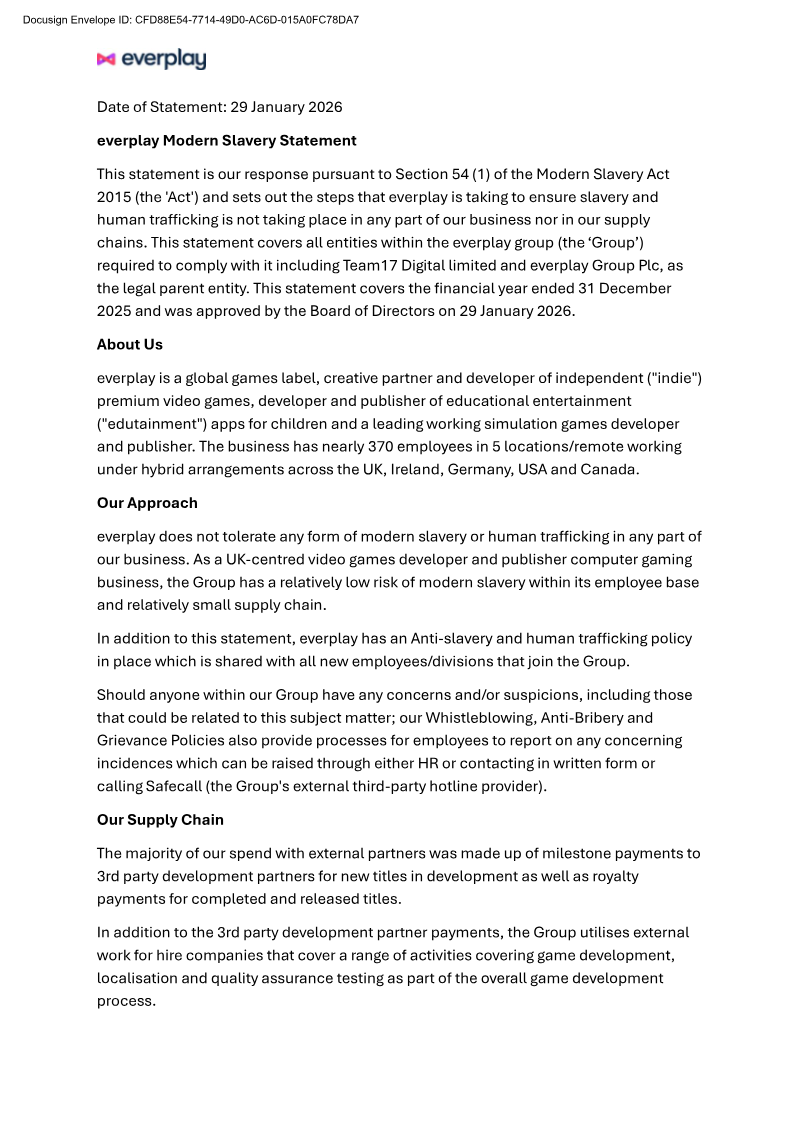
Everplay maintains a zero-tolerance stance toward modern slavery and human trafficking across its global operations and supply chains. As a UK-centered video games developer and publisher, the organization identifies as having a relatively low inherent risk due to the nature of the digital entertainment industry. The operational scope covers the financial year ending December 31, 2025, and encompasses approximately 370 employees working across the United Kingdom, Ireland, Germany, the United States, and Canada. The primary supply chain expenditures involve milestone and royalty payments to third-party development partners, alongside work-for-hire contracts for game development, localization, and quality assurance testing. While the overall risk profile remains low, the organization identifies localization and quality assurance as areas carrying a slightly higher risk. To mitigate these concerns, all new and renewing contracts include mandatory compliance clauses regarding the Modern Slavery Act 2015, granting the company the right to terminate agreements in the event of a breach. Governance is managed through the Audit Committee, which reports to the Board of Directors at least twice annually. Due diligence efforts include a risk-based approach to supplier assessment and the implementation of internal policies such as whistleblowing, anti-bribery, and grievance procedures. Employees and third parties are provided with confidential reporting channels, including an external hotline. The effectiveness of these measures is tracked through an annual risk register assessment, which currently reports zero incidents of modern slavery. Training and awareness initiatives are provided to ensure that employees and stakeholders can identify and report potential risks effectively.
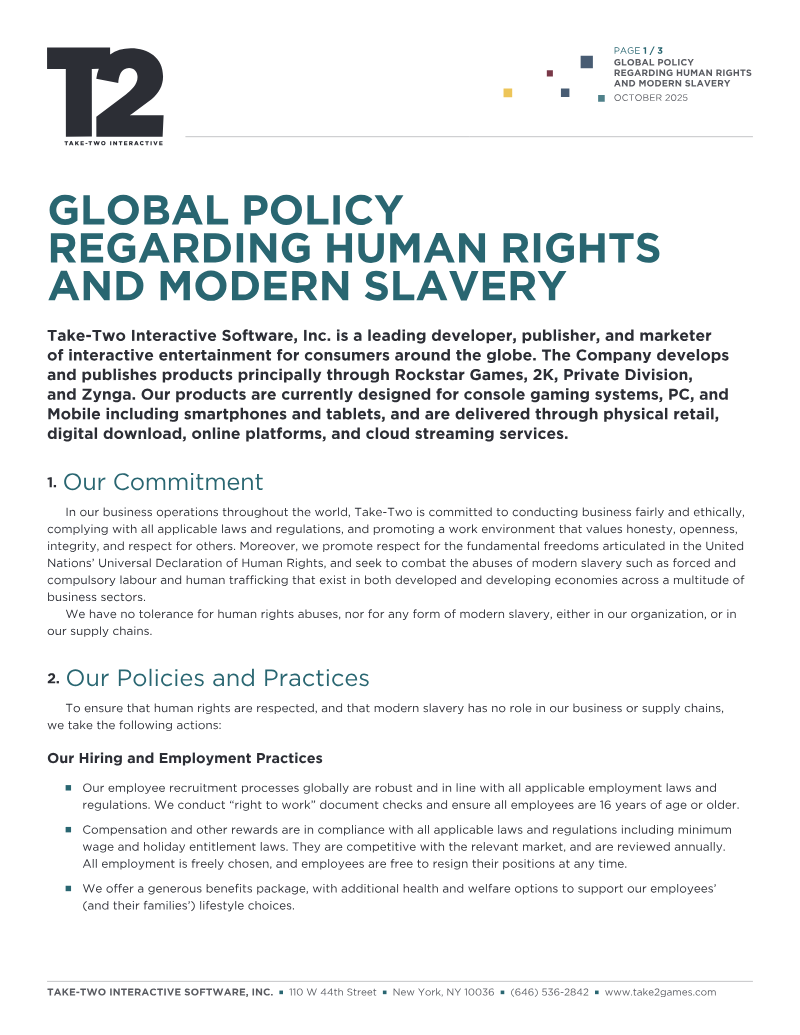
Take-Two Interactive Software establishes a comprehensive framework for maintaining ethical business practices and safeguarding human rights across its global operations as of October 2025. The primary objective is to eliminate modern slavery, forced labor, and human trafficking within the organization and its extensive supply chains. This commitment extends across all major publishing labels, including Rockstar Games, 2K, Private Division, and Zynga, covering the development and distribution of interactive entertainment for console, PC, and mobile platforms. The policy outlines rigorous hiring and employment standards, mandating that all employees be at least 16 years of age and that employment is strictly voluntary. Compensation and benefits are reviewed annually to ensure they meet or exceed legal minimums and market standards. Furthermore, the company enforces a strict non-discrimination policy, ensuring that recruitment and career advancement are based solely on ability and merit rather than protected characteristics. These internal standards are reinforced by a Global Code of Business Conduct and Ethics that applies to all directors, officers, employees, and contractors. To ensure compliance throughout the supply chain, which includes disc replicators, printers, and logistics providers in regions such as North America, Europe, and Japan, the company utilizes a dedicated Supplier Code. This requires third-party partners to represent that they do not utilize child, prison, or slave labor. Oversight is maintained through biennial training for employees and targeted training for consultants. Additionally, the company provides a confidential reporting hotline managed by an independent third party, protecting whistleblowers from retaliation. Key suppliers are also expected to conduct periodic internal or independent audits to verify adherence to labor, health, and safety standards.
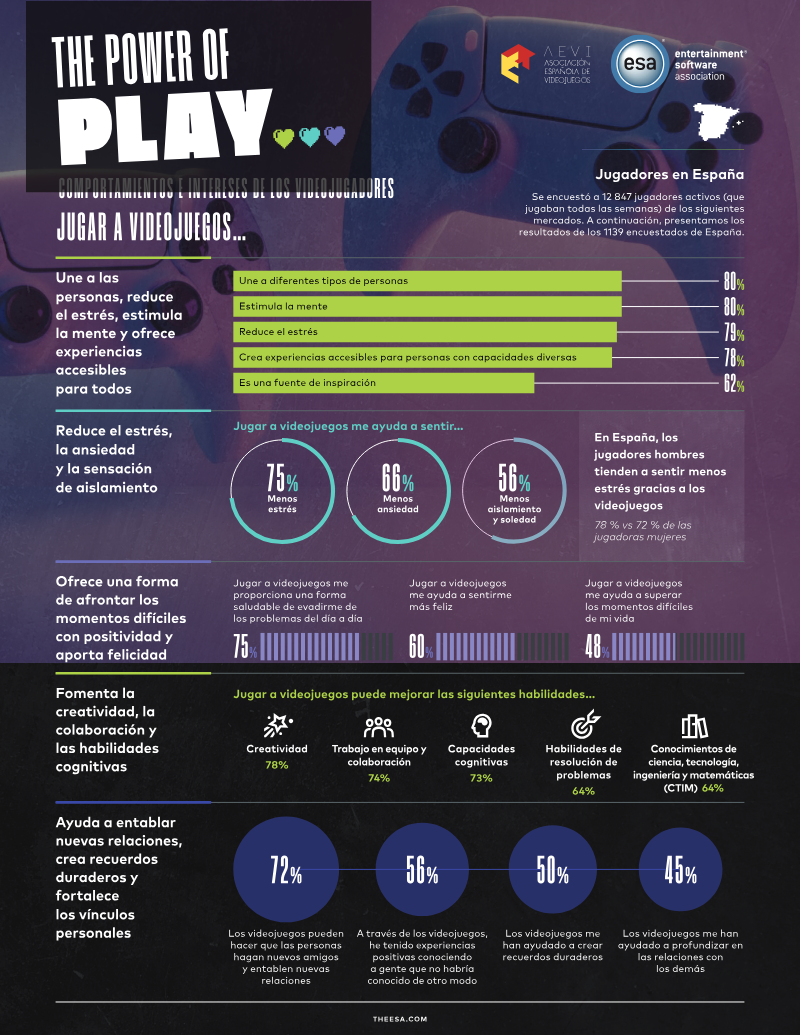
The research surveyed more than 24,000 active gamers from 21 nations on six continents, representing a broad cross‑section of the global gaming population (average age 41, 48 % female). Its central thesis is that video games function as a powerful catalyst for cognitive, social, educational, and mental‑health benefits, extending far beyond entertainment. Across all regions, a majority of players report gaming primarily for fun (56 %), stress relief (55 %) and mental stimulation (46 %). Mobile devices dominate usage (55 % of respondents), followed by PCs/laptops and consoles, while 73 % say gaming reduces feelings of isolation and 81 % view it as mentally stimulating. Perceived skill development is strong: 77 % associate gaming with enhanced creativity, 74 % with problem‑solving, and substantial portions note improvements in teamwork, resilience and social interaction. The survey highlights a professional impact, with 43 % globally—reaching 76 % in Nigeria and 70 % in India—believing gaming positively shaped their education or career. Mental‑health outcomes are equally pronounced; 70‑90 % report reduced stress, increased happiness and a healthier outlet for daily challenges, with the highest well‑being scores in India, Nigeria and Mexico. Online multiplayer is identified as the primary social connector, cited by up to 96 % of respondents. Complementary academic research corroborates these findings, showing that digital games boost learning engagement, reading skills and decision‑making, while immersive technologies such as AR/VR enhance performance in high‑stress professional settings, including medical surgery and aerospace training. Collectively, the evidence positions video games as a validated tool for skill development, education, and mental‑health recovery across diverse global markets.
The FY 2025 impact analysis presents Electronic Arts’ comprehensive ESG strategy, arguing that responsible stewardship of people, planet, and data is integral to sustainable growth in the interactive‑entertainment sector. By quantifying progress across talent, climate, privacy and security, the report demonstrates how the company translates corporate responsibility into measurable outcomes while maintaining its global market position. Across a workforce of more than 6,000 employees worldwide, 83 % now have access to internal AI tools, and 17 % of new hires are returning staff, contributing to an industry‑leading attrition rate of –0.1 %. Expanded benefits—including paid parental leave and bereavement support—paired with a balanced gender composition, underpin the talent‑focused results. Community engagement generated 18,000 volunteer hours and $5.9 million in investments, reinforcing the social dimension of the strategy. Environmental performance shows a clear downward trajectory: total operational emissions fell to 6.6 Mt CO₂e in FY25, down from 7.3 Mt in FY24 and 10.6 Mt in FY23, with Scope 1 emissions at 2.98 Mt and Scope 2 (market‑based) comprising the remainder, while energy consumption reached 380,859 GJ, fully sourced from office operations. The company’s carbon‑neutral status and renewable‑energy initiatives address identified climate risks such as acute physical events, volatile energy prices, rising carbon costs and emerging reporting regulations. Data‑privacy and security are governed by a privacy‑by‑design framework overseen by the Audit Committee, delivering explicit player notice, consent and control, data‑minimisation, and partner‑risk contracts. The security management system aligns with ISO, NIST and CIS standards, undergoes annual independent validation, operates a 24‑hour SOC and mandates annual training for all staff. An articulated AI governance model completes the governance pillar, ensuring responsible deployment of emerging technologies. Collectively, these initiatives illustrate a holistic, globally scoped commitment to ESG excellence throughout FY 2025.