Updated Jun 1, 2026 by Reddit
Report
Published by Reddit, Adjust, Sensor Tower
From installs to impact, discover a community-driven In collaboration with Reddit, Adjust, developed a go-to resource filled Our goal? That’s simple. To share insights on where the industry is headed and help brands harness the power of communities to drive r/ios Visit Reddit for Business for more resources 2 TL;DR 2 State of Mobile from Sensor Tower 5 The Power of Communities from Adjust 12 Harnessing the Power o...
STATE OF MOBILE 2025 Why community wins on mobile From installs to impact, discover a community-driven approach to mobile growth r/iosapps ER r/AppIdeas
03 Join th TL;DR In collaboration with Reddit, Adjust, and Sensor Tower—leaders in community, measurement, and market intelligence—we’ve developed a go-to resource filled with mobile app insights. Our goal? That’s simple. To share insights on where the industry is headed and help brands harness the power of communities to drive r/ios long-term app growth. r/AppIdeas r/appdev r/iosapps Visit Reddit for Business for more resources 2
03 Join th Table of contents TL;DR 2 State of Mobile from Sensor Tower 5 The Power of Communities from Adjust 12 Harnessing the Power of Communities by Reddit 20 O Visit Reddit for Business for more resources 3
Seizing the mobile moment Last year, mobile users spent a staggering 4.2 trillion hours on apps, with consumer spending hitting a record $150 billion. With mobile engagement at an all-time high, brands have a massive opportunity to capture and sustain user attention. to captureand sustain user attention. Visit Reddit for Business for more resources 4
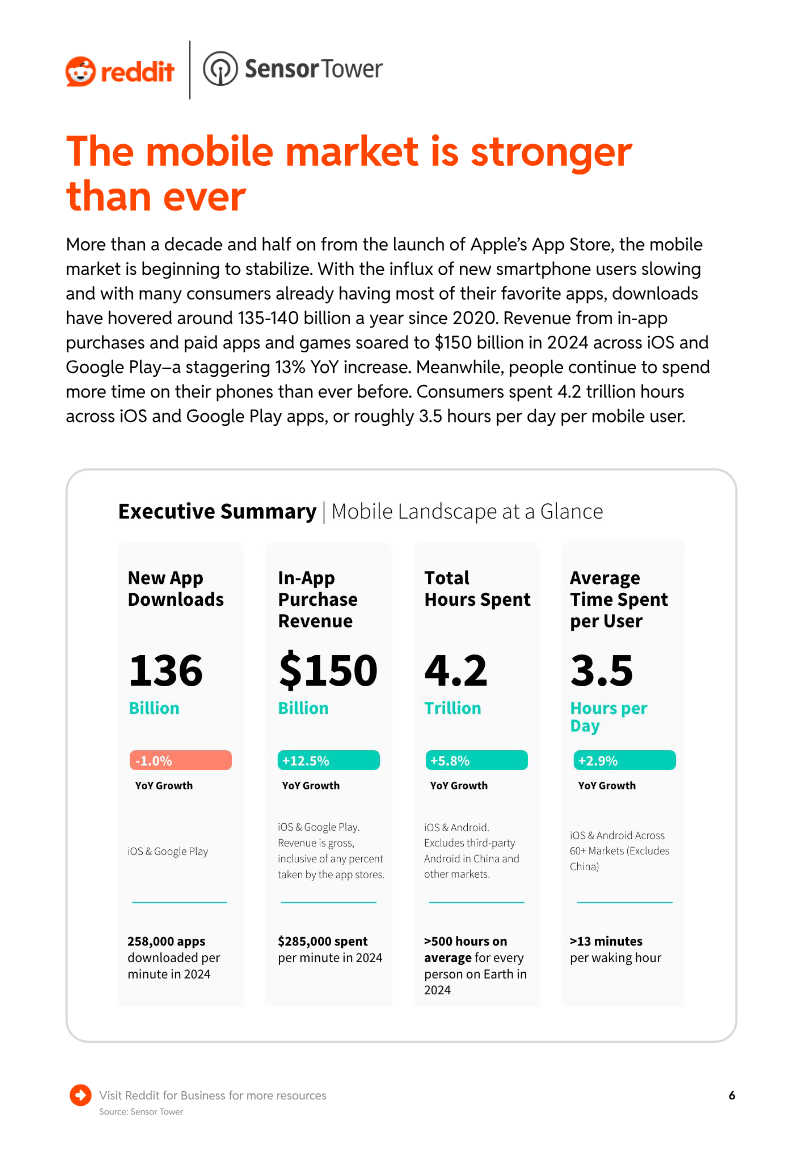
03 Join th The mobile market is stronger than ever More than a decade and half on from the launch of Apple’s App Store, the mobile market is beginning to stabilize. With the influx of new smartphone users slowing and with many consumers already having most of their favorite apps, downloads have hovered around 135-140 billion a year since 2020. Revenue from in-app purchases and paid apps and games soared to $150 billion in 2024 across iOS and Google Play–a staggering 13% YoY increase. Meanwhile, people continue to spend more time on their phones than ever before. Consumers spent 4.2 trillion hours across iOS and Google Play apps, or roughly 3.5 hours per day per mobile user. Executive Summary Mobile Landscape at a Glance New App In-App Total Average Downloads Purchase Hours Spent Time Spent Revenue per User 136 $150 4.2 3.5 Billion Billion Trillion Hours per Day -1.0% +12.5% +5.8% +2.9% YoY Growth YoY Growth YoY Growth YoY Growth iOS & Google Play. iOS & Android. iOS & Android Across iOS & Google Play Revenue is gross, Excludes third-party 60+ Markets (Excludes inclusive of any percent Android in China and China) taken by the app stores. other markets. 258,000 apps $285,000 spent >500 hours on >13 minutes downloaded per per minute in 2024 average for every per waking hour minute in 2024 person on Earth in 2024 Visit Reddit for Business for more resources 6
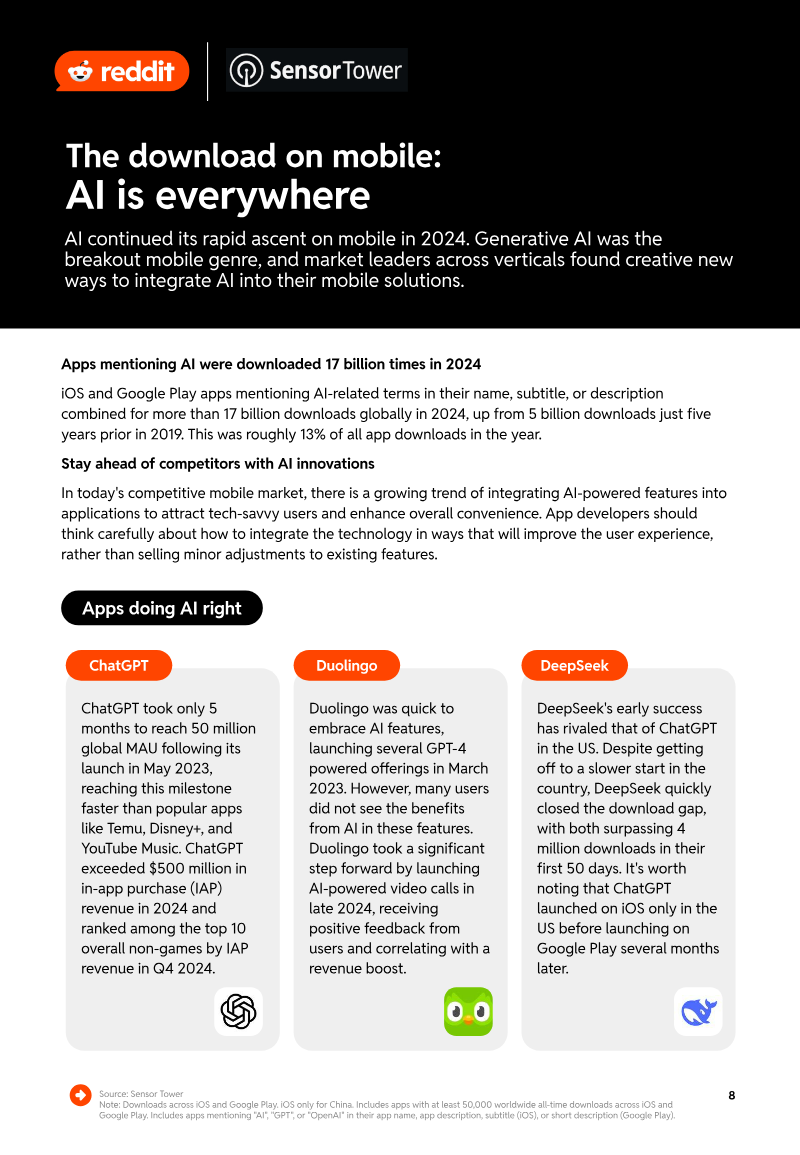
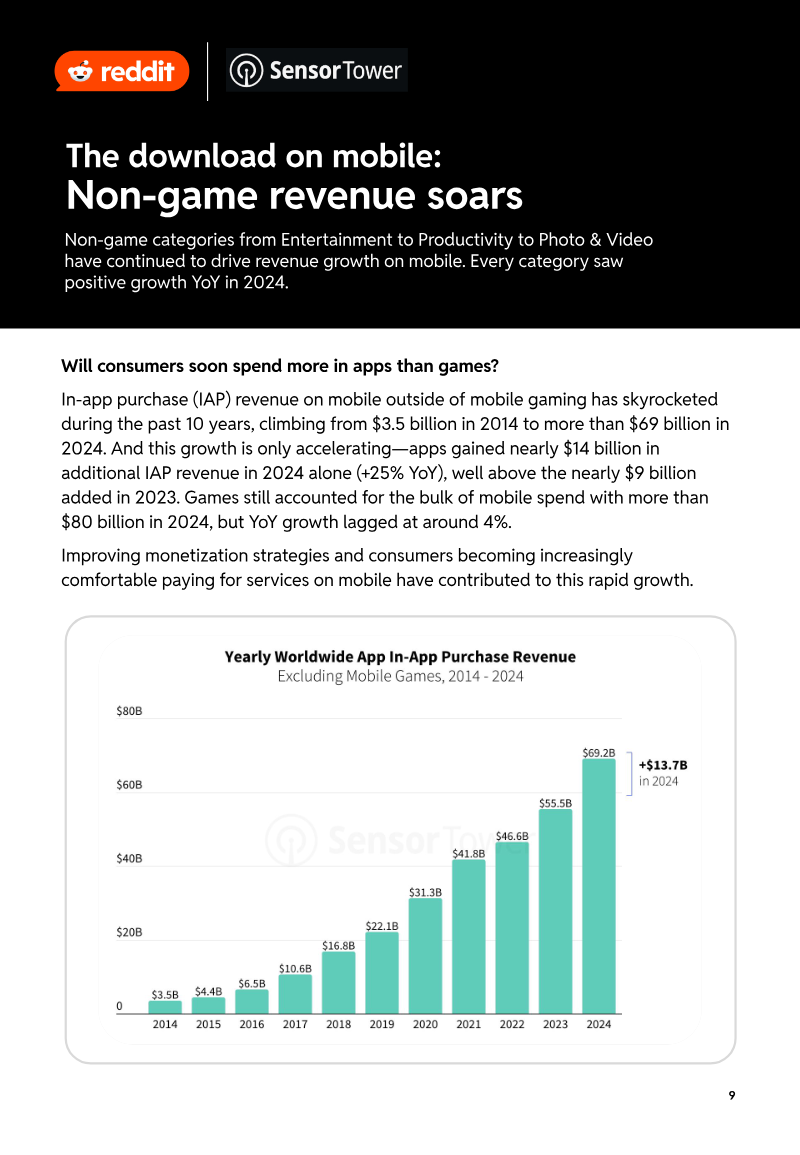
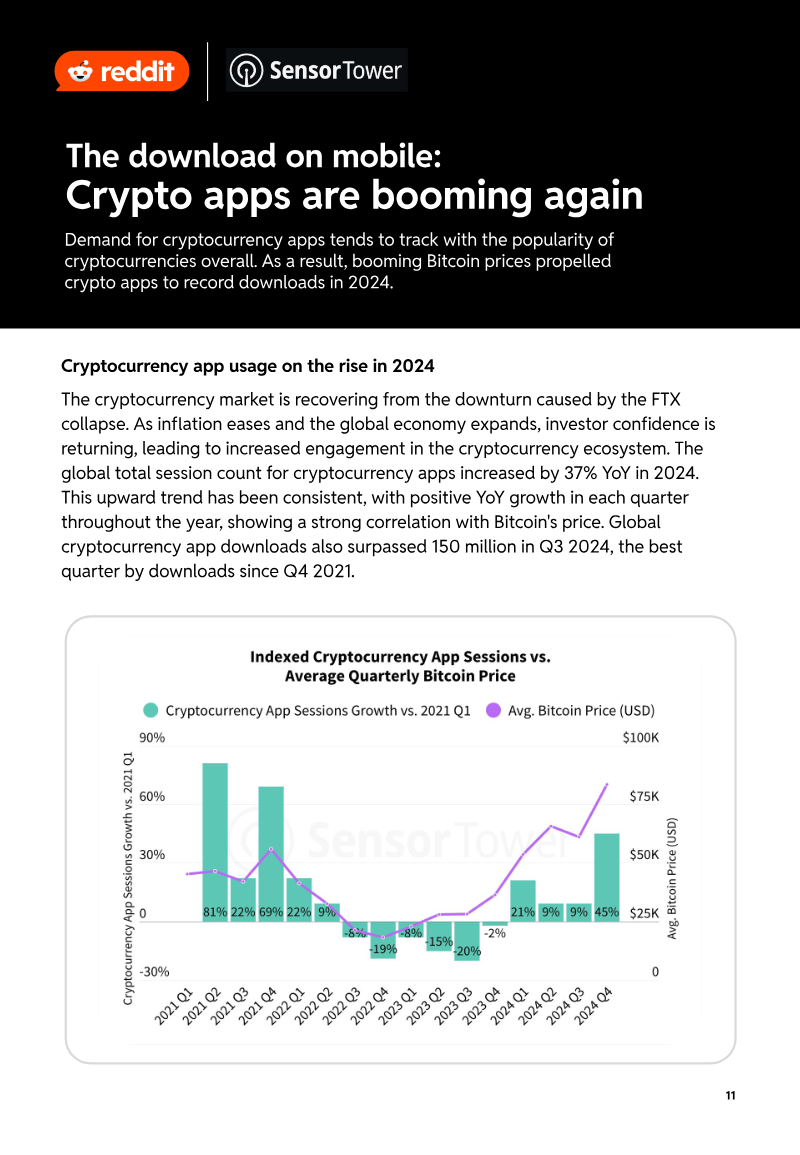
The download on mobile: Four trends to keep tabs on AI is everywhere 01 AI apps continued to soar in 2024, and use cases spread across verticals, from productivity to finance. 02 Consumer spend in non-games soars Revenue growth accelerated to +25% year-over-year (YoY). Consumers are willing to pay for services across categories. Mobile gaming bounces back 03 Gaming in-app purchase revenue climbed 4% YoY as Strategy, Puzzle, and Action fuel growth. 04 Crypto apps are booming again Improving macroeconomic conditions and higher Bitcoin prices helped fuel a d resurgence in crypto apps. Source: Sensor Tower
With Over 400,000 Advertisers Analyzed, the 2026 Global Mobile Gaming Marketing T hite Paper Decodes How Growth Is Being As the global mobile gaming market shifts from rapid expansion driven by new user acquisition to an increasingly competitive battle for existing users, 2025 marks a decisive turning point for marketers worldwide.
The mobile gaming industry is entering a period of strategic recalibration, projected to reach $126.1 billion in revenue by 2025. This growth is underpinned by a transition toward hybrid monetization models and the integration of AI-powered personalization to combat persistent retention challenges. While global install volume grew by 4% in 2024, the market exhibits a distinct geographic divide; North American and European markets face stagnation, whereas Latin America and the Middle East and North Africa regions demonstrate robust expansion. Success in this evolving landscape requires developers to move beyond traditional acquisition, favoring diversified channels such as Connected TV and localized, player-centric engagement strategies. Data from early 2025 indicates that user tracking remains a pivotal operational hurdle, with global App Tracking Transparency opt-in rates hovering at 37.9%. Although arcade games have seen notable improvements in opt-in performance, the United States remains relatively static at 32%, underscoring the necessity for refined messaging strategies to maintain visibility. Concurrently, the industry is grappling with a complex financial environment characterized by rising costs per install and declining average revenue metrics. These headwinds are forcing a shift in marketing tactics, as developers increasingly rely on a broader array of acquisition partners and data-informed creative experimentation to sustain growth. Ultimately, the path to profitability in 2025 lies in prioritizing long-term player value over short-term acquisition metrics. By leveraging AI-driven optimization and fostering community-building initiatives, developers can mitigate the impact of declining revenue per user. The industry is clearly moving toward a more sophisticated, data-reliant ecosystem where the ability to measure performance across fragmented channels—including mobile and Connected TV—is essential for maintaining a competitive advantage in a maturing global market.
Chinese gaming applications continue to exert a dominant influence on the global stage, particularly within the strategy and role-playing game segments in mature markets such as the United States, Japan, and South Korea. While these regions offer substantial revenue potential, they are characterized by intense competition and elevated costs per install. To navigate these challenges, successful publishers are shifting toward hyper-localized strategies that tailor art styles to regional aesthetic preferences—favoring manga-inspired visuals in Japan and realistic or cartoon aesthetics in Western markets—while utilizing local influencers to establish brand credibility. Technological innovation serves as a primary driver for operational efficiency and user acquisition. The integration of generative AI has become essential for the rapid localization of ad creative, voice-overs, and marketing copy, ensuring both speed and brand compliance. High-performing titles currently leverage high-volume, innovative campaigns that incorporate minigames and AI-enhanced visuals to capture player attention. Beyond acquisition, long-term retention is increasingly supported by the implementation of social hangout spaces, home-building systems, and character trial models that balance accessibility with monetization. Monetization strategies have evolved to prioritize engagement through sophisticated, time-limited mechanics. Publishers are frequently employing box gachas, pull-milestone rewards, and gamified event structures such as diceboards and bingo to incentivize spending. Furthermore, the consistent deployment of diverse live events remains a critical requirement for maintaining player interest and competitive viability. By combining these aggressive monetization tactics with a commitment to continuous content updates, Chinese developers are effectively sustaining growth and deepening their footprint across the global gaming landscape throughout 2024.
The mobile gaming landscape experienced a notable shift in monetization and user acquisition patterns between 2022 and the first half of 2023. In-app purchase (IAP) activity demonstrated robust growth across both major mobile operating systems, with Android and Apple platforms recording increases of 23% and 24%, respectively. This upward trend in monetization suggests a resilient consumer base despite broader economic fluctuations within the mobile app ecosystem. Geographic distribution of installs remained relatively stable on Android, with India, Brazil, and the United States maintaining their positions as the top three markets. Conversely, the iOS landscape underwent more significant regional changes, as the United Kingdom, Canada, and Germany gained prominence, displacing China and Saudi Arabia from the top five rankings. These shifts highlight the evolving importance of Western markets for iOS-based mobile game developers. Ad network performance also saw a realignment in competitive dominance. On Android, Google Ads ascended to the top position for total installs in the first half of 2023, while Meta entered the top five. On iOS, AppLovin reclaimed the leading position, and Meta secured a top-five spot, reflecting a dynamic advertising environment where major platforms continue to vie for market share. This analysis relies on anonymized data aggregated by Tenjin from January 1, 2022, through June 30, 2023. The findings are restricted to ad networks and countries that achieved a minimum threshold of 25 million installs, ensuring that the reported trends represent significant market activity. By tracking these metrics, the data provides a clear view of the shifting priorities and regional focus areas for mobile publishers navigating the transition toward hybrid monetization models.