
Report23 pages
Stream Hatchet Video Game Streaming Trends Report 2022 First Quarter Report
The report examines live video‑game streaming activity in Q1 2022, focusing on audience growth, platform market share, and creator performance across Twitch, YouTube Gaming, Facebook Gaming, and emerging competitors such as Trovo, AfreecaTV, and Naver TV. Total hours watched across all platforms rose 140 % from Q1 2019, yet the growth rate slowed to a 6 % decline versus Q1 2021, reflecting creator fatigue and pandemic‑induced saturation. Twitch maintained dominance with 75 % of total hours, adding 286 million hours (5 % growth), while Trovo and AfreecaTV experienced double‑digit gains of 188 % and 15 %, respectively. Esports viewership remained resilient, increasing by 61 % from pre‑pandemic levels and contributing 80 % of esports hours on Twitch.
Creator analytics reveal that xQcOW led all platforms with 62.8 million hours, while Spanish‑speaking channels dominated the top 30 % of viewership. Female creators such as Ironmouse and Valkyrae achieved significant growth, largely driven by VTuber content. Core viewers—those watching 5 hours daily—constitute only 7.8 % of the audience but generate two‑thirds of total hours and are 24 times more likely to engage with repeated advertising. Mobile game streaming remains largely casual, yet core audiences drive 78 % of mobile stream hours.
Methodologically, the study aggregates live and VOD metrics from third‑party APIs across 14 platforms, applying manual labeling and automated filtering to produce hourly, concurrent, and retention statistics. The findings underscore a maturing streaming ecosystem where platform diversification, creator niche specialization, and core audience targeting are pivotal for marketers and publishers.
- Twitch remains the dominant streaming platform with 75% of total market share, growing by 5% (286 million hours) in Q1 2022 despite a broader industry decline.
- Total hours watched across all streaming platforms fell by 6% compared to Q1 2021, signaling a market correction following pandemic-era saturation and creator fatigue.
- Core viewers who watch at least 5 hours daily represent only 7.8% of the total audience but account for two-thirds of all hours watched and are 24 times more likely to engage with ads.
- Esports viewership remains a high-performing sector, showing a 61% increase over pre-pandemic levels with 80% of all esports hours occurring on Twitch.
- Emerging platforms are gaining traction, with Trovo and AfreecaTV recording significant viewership growth of 188% and 15% respectively in Q1 2022.
+1
Stream HatchetJan 2022

Report2 pages
Global Esports and Live Streaming Market Report
The report outlines the global esports and live‑streaming landscape for 2022, emphasizing key tournaments, viewership metrics, and emerging strategic shifts by major publishers. Counter‑Strike: Global Offensive dominated with the PGL Major Antwerp drawing 10.5 million hours watched and an average concurrent unique viewer (ACU) of 96.7 k, followed by Dota 2 and League of Legends events that collectively attracted over 20 million hours. Valorant’s regional tours and the upcoming Champions Tour in Japan added nearly 3 million hours, while Wild Rift’s global championship moved to Singapore with a $2 million prize pool and 24 teams. PUBG Mobile’s Nations Cup returned to Bangkok with a $500 k prize pool, and the IEM Rio Major was re‑announced after pandemic cancellations, selling out tickets in Brazil’s Jeunesse Arena.
The analysis highlights a shift toward franchising models that reduce entry barriers, notably Riot’s new Valorant structure that foregoes franchise fees in favor of long‑term partnerships and financial stipends, contrasting with the high costs seen in League of Legends. Third‑party organizers are encouraged to host off‑season events, expanding grassroots participation and diversifying content. The report also notes the growing importance of women’s tournaments, such as Riot’s Game Changers initiative, to broaden audience engagement.
Data were sourced from Newzoo’s platform aggregating Twitch, YouTube, and Facebook Gaming streams, covering global viewership across 2022. The scope spans North America, Europe, Asia-Pacific, and Latin America, focusing on major esports titles and live‑streaming platforms. The methodology involved compiling broadcast hours, ACU figures, and prize pool totals to assess market size, growth drivers, and investment trends within the esports ecosystem.
- Counter-Strike: Global Offensive led 2022 viewership with the PGL Major Antwerp recording 10.5 million hours watched and an average concurrent viewership of 96.7k.
- Riot Games is shifting its Valorant esports strategy from high-cost franchising to a partnership model that eliminates franchise fees in favor of financial stipends.
- Major esports titles including Dota 2 and League of Legends events generated over 20 million hours of combined viewership in 2022.
- Wild Rift’s global championship in Singapore featured a $2 million prize pool across 24 teams, while the PUBG Mobile Nations Cup in Bangkok offered a $500k prize pool.
- Valorant’s regional tours and the upcoming Champions Tour in Japan contributed nearly 3 million hours of viewership to the global landscape.
+1
NewzooJan 2022
Report30 pages
Newzoo’s Games, Esports, Live Streaming, Cloud and the Metaverse
The analysis examines how emerging technologies and shifting consumer behaviors are reshaping the global gaming ecosystem. Blockchain‑based monetisation, particularly non‑fungible tokens (NFTs), has met with mixed reception. While the promise of secure, legitimised trading is evident in titles such as Axie Infinity, major publishers have reacted cautiously. Valve’s ban of crypto games on Steam and Ubisoft’s withdrawal from NFT initiatives after player backlash illustrate a broader industry reluctance, compounded by regulatory constraints in jurisdictions like South Korea and platform‑level anti‑steering rules from Apple and Google. Consequently, publishers are exploring “NFT‑like” features under less controversial branding to satisfy investor appetite while mitigating gamer discontent.
Live‑streaming and cloud gaming are emerging as pivotal drivers of player engagement. Interactive shows such as Facebook’s Rival Peak and PAC‑MAN Community have amassed over 100 million minutes of viewership in three months, opening new monetisation avenues. The semiconductor shortage is accelerating the migration of high‑end titles—Elden Ring, Starfield—to cloud platforms. Services like NVIDIA GeForce NOW and Google Stadia have already recorded user growth, while publishers leverage cloud to deliver AAA content on legacy hardware (e.g., Nintendo Switch) and broaden access through subscription bundles such as Game Pass Ultimate. This trend signals a shift toward broader platform reach and subscription retention.
Geographically, the Asia‑Pacific region dominates global game revenues at $42.6 billion, driven by China’s mobile‑first market and an 8.7% compound annual growth rate (CAGR). North America matches this revenue figure at $42.6 billion, with a 7.9% CAGR. Latin America, the Middle East, and Africa are projected to grow faster than the global average, increasing their share of worldwide revenues. COVID‑19’s impact on Asia‑Pacific was muted, partly due to a strong console gaming emphasis that helped sustain growth. The findings collectively underscore the importance of balancing innovative monetisation models, expanding platform accessibility, and regional market dynamics in shaping the future of gaming.
- The Asia-Pacific and North American markets are currently tied for the global lead in game revenue at $42.6 billion each, with Asia-Pacific maintaining an 8.7% compound annual growth rate.
- Cloud gaming is expanding rapidly as publishers use services like NVIDIA GeForce NOW to deliver AAA titles to legacy hardware, driven by semiconductor shortages and the need for broader platform reach.
- Major publishers are pivoting away from explicit NFT branding due to significant player backlash and platform-level restrictions from companies like Valve, Apple, and Google, opting instead for less controversial 'NFT-like' monetization features.
- Interactive live-streaming content is proving to be a high-engagement driver, with titles like Rival Peak and PAC-MAN Community generating over 100 million minutes of viewership in a three-month period.
- Emerging markets in Latin America, the Middle East, and Africa are projected to outpace the global average in revenue growth, signaling a shift in the geographic distribution of the gaming industry.
+4
NewzooJan 2022
Report15 pages
Video Game Streaming Trends: 2022 Second Quarter Report
The second quarter of 2022 marked a period of stabilization for the live streaming industry as the rapid growth spurred by pandemic lockdowns began to cool. Total hours watched across major platforms fell 15% year-over-year to 8.1 billion hours. This decline is attributed in part to creator fatigue, evidenced by a 20% drop in unique channels and a 16% decrease in total hours broadcast. Despite this contraction, the industry remains significantly larger than its pre-pandemic state in 2019.
Twitch continues to dominate the market with a 68% share of total hours watched, followed by YouTube at 14%. Facebook Gaming saw a significant 50% decline in watch time compared to the previous year. Conversely, disruptor platforms like Trovo experienced a 127% increase in viewership, largely driven by Russian streamers migrating from Twitch. While the broader market slowed, the esports segment grew by 8%, with major events like the League of Legends Mid-Season Invitational and the PGL Major Antwerp driving significant engagement.
The data highlights a strategic shift among esports organizations, which are increasingly relying on content creators to reach broader audiences. For example, 98% of the hours watched for Luminosity were generated by its affiliated creators rather than competitive matches. Top-tier games like Grand Theft Auto V and League of Legends maintained their dominance, while new releases like The Quarry demonstrated the potential for narrative-driven titles to capture short-term viewership peaks. Non-gaming content also made an impact, as the Johnny Depp vs. Amber Heard trial boosted the Just Chatting category by over 7% during the quarter.
This analysis covers global streaming trends across nearly 20 platforms, including Twitch, YouTube, and Facebook Gaming, for the period of April through June 2022. The findings are based on proprietary data aggregation and business intelligence from Stream Hatchet.
- Total hours watched across live streaming platforms fell 15% year-over-year to 8.1 billion in Q2 2022, signaling a post-pandemic market stabilization.
- Twitch maintains a dominant 68% market share of total hours watched, while YouTube holds 14% and Facebook Gaming experienced a 50% decline in viewership.
- The esports segment grew by 8% during the quarter, bolstered by major events like the League of Legends Mid-Season Invitational and the PGL Major Antwerp.
- Creator activity contracted significantly, with a 20% drop in unique channels and a 16% decrease in total hours broadcast compared to the previous year.
- Esports organizations are increasingly reliant on content creators for reach, as evidenced by 98% of Luminosity’s total watch time being generated by affiliated creators rather than competitive matches.
+1
Stream HatchetJan 2022
Report30 pages
Newzoo Trends to Watch 2022: Games, Esports, Live Streaming, Cloud and the Metaverse
The analysis projects that 2022 will be defined by a cautious expansion of emerging monetisation models and a deepening investment in immersive technologies. While non‑fungible tokens and crypto‑based revenue streams continue to provoke player backlash, platform bans and regulatory scrutiny, publishers are expected to experiment with “NFT‑like” features under less contentious branding. Concurrently, legal pressure on Apple and Google is likely to ease app‑store steering rules, creating alternative payment pathways that could reshape distribution economics.
Metaverse and virtual‑reality narratives are driving substantial capital inflows, with major hardware releases from Meta, Sony and Apple building on the strong sales of the Quest 2 in 2021. High‑profile titles such as Horizon Forbidden West illustrate the market’s appetite for immersive experiences. A parallel “brand gold rush” in virtual real‑estate is accelerating, exemplified by multi‑million‑dollar acquisitions in Decentraland’s Fashion District and The Sandbox, where corporations are establishing branded malls and interactive spaces.
Globally, the games industry generated $175.9 billion in 2021, anchored by the Asia‑Pacific region’s $88.2 billion contribution and an 8.7 percent compound annual growth rate. North America remains a significant market, while esports and cloud‑based services continue to expand the ecosystem’s reach and monetisation potential. The convergence of these trends suggests a year of strategic experimentation, heightened investment in immersive platforms, and evolving regulatory landscapes shaping the future of interactive entertainment.
- The global games industry generated $175.9 billion in 2021, with the Asia-Pacific region contributing $88.2 billion and maintaining an 8.7 percent compound annual growth rate.
- Publishers are shifting away from explicit NFT branding due to player backlash and regulatory scrutiny, opting instead to experiment with 'NFT-like' features under alternative labels.
- Legal pressure on Apple and Google is expected to force a relaxation of app-store steering rules, potentially creating new payment pathways that will alter distribution economics.
- Major hardware releases from Meta, Sony, and Apple are building on the momentum of the Quest 2 to drive capital into immersive technologies and virtual reality.
- A 'brand gold rush' is occurring in virtual real estate, with corporations spending millions to acquire space in platforms like Decentraland and The Sandbox for branded malls and interactive experiences.
+3
NewzooJan 2022
Report51 pages
Global Esports & Live Streaming Market Report
The global esports market is projected to reach $1.38 billion in revenue and an audience of 532 million by the end of 2022, signaling a period of robust expansion and structural evolution. China remains the dominant regional player, contributing nearly one-third of total global revenue. While sponsorships continue to serve as the industry’s financial backbone, accounting for approximately 60% of income, organizations are increasingly diversifying into direct-to-fan models. These new revenue streams include lifestyle apparel, blockchain-integrated loyalty programs, and educational platforms, reflecting a strategic shift toward positioning esports as a broader lifestyle brand.
The live-streaming ecosystem is experiencing even more rapid growth, with the audience expected to reach 1.41 billion by 2025 at a compound annual growth rate of 16.3%. This surge is fueled by the rise of non-gaming content and the explosive popularity of mobile esports in emerging markets such as Southeast Asia, Latin America, and the Middle East. Demographically, the esports audience represents a high-value target for advertisers, as nearly three-quarters of enthusiasts are employed full-time and 44% belong to high-income brackets.
Platform dynamics reveal a clear geographic and technological divide. Twitch maintains its dominance in Western markets for PC and console gaming, while YouTube Gaming and Facebook Gaming have successfully captured the mobile-centric audiences of emerging regions. To challenge established leaders, platforms are leveraging massive video-on-demand audiences and exclusivity deals to convert passive viewers into live participants. Despite this growth, the industry faces potential volatility from the fluctuating cryptocurrency sector and the possible migration of audiences toward emerging metaverse events.
- The global esports market is projected to reach $1.38 billion in revenue with 532 million viewers by the end of 2022, with China accounting for nearly one-third of total global revenue.
- The live-streaming audience is forecast to grow at a 16.3% compound annual growth rate, reaching 1.41 billion users by 2025.
- Sponsorships remain the primary financial driver at 60% of total income, though organizations are diversifying into lifestyle apparel, blockchain loyalty programs, and educational platforms.
- The esports demographic is highly attractive to advertisers, with 75% of enthusiasts employed full-time and 44% falling into high-income brackets.
- Platform dominance is split geographically, with Twitch leading Western PC and console markets while YouTube Gaming and Facebook Gaming capture mobile-centric audiences in Southeast Asia, Latin America, and the Middle East.
+2
NewzooJan 2022
Report18 pages
Key Insights Into UK Gamers
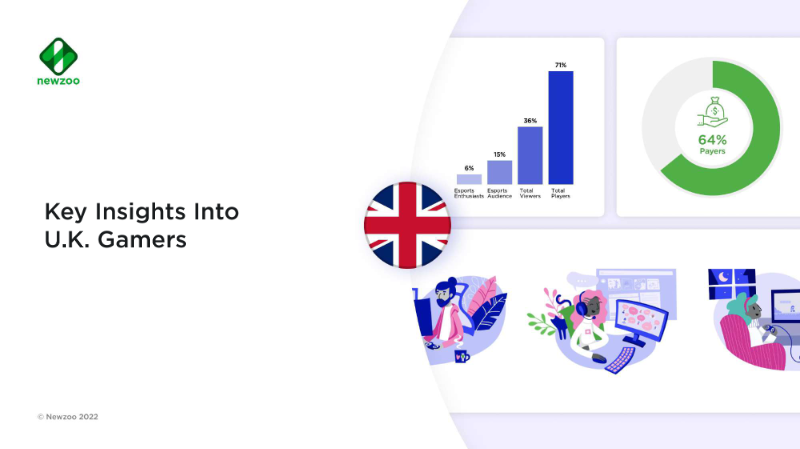
The United Kingdom represents a major global gaming hub, ranking as the sixth-largest market by revenue and tenth by player population as of late 2022. Research conducted among the online population aged 10 to 65 indicates that gaming is a primary entertainment pillar in the region, with 71% of the population identifying as game enthusiasts. This engagement is split between active play and content viewership, with 36% of the population exclusively playing games and another 35% both playing and viewing gaming video content.
The demographic profile of UK gamers is nearly balanced by gender, consisting of 52% male and 47% female players. While gaming spans all age groups, the 21-35 bracket is the most active. Motivation for play is driven primarily by the desire to unwind and relax, followed by the pursuit of achievement and social interaction. When categorized by persona, Time Fillers—those who play casually to pass the time—represent the largest segment, followed by Mainstream Gamers who engage deeply with both play and viewership.
Platform preferences show that mobile gaming has the highest reach at 46%, followed by console at 41% and PC at 29%. However, PC and console players demonstrate higher average weekly time commitments compared to mobile users. Financial engagement is also significant, with 63% of players identified as payers. The primary driver for spending is the availability of sales or special offers, though social motivations, such as spending to play with friends or family, also influence purchasing behavior.
The findings are based on a 2022 survey of 2,010 respondents in the United Kingdom, part of a broader global study covering 36 markets. The methodology utilizes a representative sample of the online population to track dozens of key performance indicators, including audience profiles, platform behavior, and monetization trends.
- The UK is a major global gaming hub, ranking sixth in revenue and tenth in player population, with 71% of the population aged 10-65 identifying as game enthusiasts.
- Engagement is evenly split between active players (36%) and those who both play and view gaming video content (35%).
- Mobile gaming has the highest reach at 46%, followed by console (41%) and PC (29%), though PC and console users dedicate more time to gaming weekly.
- The gamer demographic is nearly gender-balanced at 52% male and 47% female, with the 21-35 age bracket serving as the most active segment.
- 63% of UK gamers are payers, with spending primarily driven by sales, special offers, and social motivations like playing with friends or family.
+1
NewzooJan 2022

Report18 pages
Consumer Insights: Games & Esports 2022
Gaming has evolved into a multi-dimensional entertainment ecosystem where traditional play is no longer the sole driver of engagement. Findings indicate that 79% of the global online population are game enthusiasts, participating through playing, viewing content, or socializing in virtual worlds. This shift is most pronounced among younger generations; for Gen Alpha, gaming has surpassed social media and streaming video as the primary source of entertainment.
The research highlights a significant trend toward the "metaverse," with 75% of players and 44% of non-players engaging in game worlds for social interaction without playing the core game. This high level of engagement translates into substantial economic impact, with consumer spending in the sector projected to exceed $200 billion in 2023. Approximately half of Gen Alpha, Gen Z, and Millennial gamers are already classified as payers, a figure expected to rise as younger cohorts gain independent purchasing power.
Data suggests that gamers are a highly receptive audience for brands, exhibiting 36% more positive attitudes toward brand messaging compared to non-players. However, the diversity of the audience necessitates a nuanced approach. Using proprietary segmentation, the analysis shows that while older generations often act as "Time Fillers," younger audiences are more likely to be "Ultimate Gamers" or "All-Round Enthusiasts." Even within the same genre, such as Battle Royale, player demographics and motivations vary significantly between titles like Fortnite and Apex Legends, affecting their preferences for products like energy drinks or alcohol.
The findings are based on a 2022 study utilizing Computer Assisted Web Interviewing (CAWI) with a representative sample of 75,930 respondents. The scope covers 36 global markets across North America, Europe, Latin America, and Asia-Pacific, targeting the online population aged 10 to 65. Additional sentiment studies on the metaverse and blockchain gaming supplement the core consumer data.
- Gaming has become a primary entertainment ecosystem for 79% of the global online population, with Gen Alpha prioritizing gaming over social media and streaming video.
- Consumer spending in the gaming sector is projected to exceed $200 billion in 2023, driven by a payer base that includes approximately 50% of Gen Alpha, Gen Z, and Millennial gamers.
- Game worlds are increasingly used for social interaction rather than gameplay, with 75% of players and 44% of non-players utilizing these environments for non-gaming social engagement.
- Gamers are a highly receptive audience for advertising, demonstrating a 36% more positive attitude toward brand messaging compared to non-players.
- Audience motivations vary significantly by demographic, with older users often acting as 'Time Fillers' while younger cohorts are more likely to be 'Ultimate Gamers' or 'All-Round Enthusiasts'.
+1
NewzooJan 2022

Report19 pages
Video Games – A Force for Good: Europe's Video Game Industry
This analysis provides a comprehensive overview of the European video games industry as of 2021, detailing its economic impact, demographic reach, and social contributions. Jointly produced by ISFE and EGDF, the findings highlight a sector that remained stable following the pandemic-induced surge of 2020, maintaining a market value of €23.3 billion across key European territories. The industry supports a significant workforce, employing over 98,000 people across Europe, with 74,000 located within the EU. Data is primarily sourced from Ipsos, GameTrack, and GSD, covering major markets including France, Germany, Italy, Spain, and the United Kingdom.
The demographic data reveals that video gaming is a mainstream cultural activity, with 52% of the European population aged 6 to 64 participating. The average player age is 31.3 years, and women represent nearly 48% of the total player base. While engagement remains high, average weekly playtime returned to pre-pandemic levels of nine hours. The digital ecosystem dominates the market, accounting for 81% of total revenue, driven largely by app-based gaming and in-game extras.
A significant portion of the analysis focuses on industry responsibility and social impact. It underscores the effectiveness of the PEGI age rating system and the prevalence of parental control tools, noting a sharp decline in unsupervised in-game spending by minors. Furthermore, the industry is positioned as a driver for digital literacy and mental well-being, with specific initiatives targeting STEM education for girls and climate change through the Green Game Jam. The report concludes that the sector is a vital component of Europe’s digital economy, increasingly recognized for its pedagogical value and commitment to diversity and environmental sustainability.
- The European video game market maintained a stable value of €23.3 billion in 2021, following the initial pandemic-driven surge.
- The industry employs over 98,000 people across Europe, with 74,000 of those roles based within the EU.
- Digital revenue dominates the sector, accounting for 81% of total market value through app-based gaming and in-game purchases.
- Video gaming is a mainstream activity in Europe, engaging 52% of the population aged 6 to 64 with an average player age of 31.3 years.
- Gender representation in gaming is nearly balanced, with women accounting for 48% of the total player base.
+1
Interactive Software Federation of EuropeJan 2022
Report25 pages
A Rising Market: Southeast Asia
Southeast Asia represents a rapidly accelerating segment of the global esports market, characterized by high growth rates in both viewership and revenue. Between 2019 and 2024, the region is projected to see a compound annual growth rate (CAGR) in audience size that significantly outpaces global averages, with year-over-year increases reaching as high as 18.2%. This expansion is driven by a mobile-first gaming culture where 82% of the online population plays mobile games and 39% of players identify mobile as their primary platform. Key markets fueling this trend include Indonesia, Vietnam, the Philippines, Thailand, Malaysia, and Singapore.
The regional ecosystem is heavily influenced by mobile-centric titles, specifically Mobile Legends: Bang Bang, Garena Free Fire, and PUBG Mobile. These three games accounted for roughly half of all global esports hours watched for those titles on Twitch and YouTube Live during the first half of 2021. Revenue streams in the region mirror global trends, with sponsorship serving as the primary contributor, supported by media rights, publisher fees, and digital goods. Government intervention also plays a critical role in market maturation, with initiatives like the Youth Esports Program in the Philippines and the integration of esports into the 30th SEA Games as a medal event.
Data for these findings was sourced from Newzoo’s 2021 Global Esports and Live Streaming Market Report and Consumer Insights. The methodology utilized a Major City Approach for most Southeast Asian nations to represent active internet users aged 10-50, while Singapore data covered the general online population within that age bracket. The findings conclude that improved internet infrastructure and the accessibility of mobile devices are the primary catalysts for long-term engagement and the continued attraction of non-endemic brand sponsorships to the region.
- Southeast Asia's esports audience is experiencing rapid expansion, with year-over-year growth reaching as high as 18.2% between 2019 and 2024.
- The market is defined by a mobile-first culture where 82% of the online population plays mobile games and 39% identify mobile as their primary gaming platform.
- Three mobile titles—Mobile Legends: Bang Bang, Garena Free Fire, and PUBG Mobile—accounted for approximately 50% of all global esports hours watched for those specific games on Twitch and YouTube Live in the first half of 2021.
- Key growth markets in the region include Indonesia, Vietnam, the Philippines, Thailand, Malaysia, and Singapore.
- Revenue generation in the region is primarily driven by sponsorships, supplemented by media rights, publisher fees, and digital goods.
+1
NewzooJul 2021
Report16 pages
Esports Rising: State of the Global Esports Market
The global esports market is experiencing a period of robust expansion, characterized by double-digit growth in both viewership and revenue. Total industry revenues are projected to reach $1.08 billion by the end of 2021, representing a 14.5% year-over-year increase. This financial growth is primarily driven by sponsorships and media rights, which remain the dominant revenue streams. China has solidified its position as the primary market leader, maintaining the largest share of both global esports revenues and the highest concentration of esports enthusiasts.
Audience engagement has surged significantly, with total hours watched on major streaming platforms like Twitch and YouTube increasing by 76% in 2020. While general live-streaming saw the most dramatic rise, dedicated esports viewership also grew by 12.6% during the same period. The global audience is on a trajectory to exceed 577 million viewers by 2024, split between occasional viewers and dedicated enthusiasts. Regional growth is particularly strong in emerging markets, with the Rest of World category seeing a 10% year-over-year increase in enthusiasts, outpacing the growth rates of North America and Europe.
The sponsorship landscape is undergoing a structural shift from short-term, one-year experimental deals to multi-year strategic partnerships. This evolution reflects increased confidence from brands in the long-term stability of the industry. There is a notable influx of non-endemic sponsors, particularly from the financial services sector, including banks and insurance companies seeking to reach younger demographics. Additionally, the furniture industry has accelerated its involvement, with 32 sponsorship deals closed by manufacturers in a twelve-month period as remote work and home-based gaming increased.
Despite the logistical challenges posed by the transition to online-only formats during global lockdowns, the industry demonstrated resilience. While traditional sports faced total shutdowns, esports leagues successfully migrated to digital play, though issues like internet latency persisted. Major publishers like Riot Games have seen significant returns on new titles, with Valorant emerging as a major driver of live esports hours. As the industry moves forward, a return to in-person LAN events is anticipated, though the timeline for the return of live audiences remains contingent on global health conditions.
- The global esports market is projected to reach $1.08 billion in revenue by the end of 2021, marking a 14.5% year-over-year increase driven primarily by sponsorships and media rights.
- Total hours watched on major streaming platforms like Twitch and YouTube surged by 76% in 2020, with the global audience expected to exceed 577 million viewers by 2024.
- China remains the dominant market leader, holding the largest share of global esports revenue and the highest concentration of enthusiasts.
- Sponsorship models are shifting from short-term experimental deals to multi-year strategic partnerships, with non-endemic sectors like financial services and furniture manufacturers increasingly entering the space.
- Emerging markets categorized as 'Rest of World' are currently outpacing North America and Europe in growth, recording a 10% year-over-year increase in enthusiasts.
+1
NewzooMay 2021

Report19 pages
Europe's Video Game Industry: Key Facts 2021
The European video game industry serves as a significant economic and social pillar, generating €23.3 billion in annual revenue while supporting a workforce of nearly 100,000 professionals across 4,600 studios. As of 2021, the sector reached a broad audience of 124.8 million players, representing 52 percent of the total European population. This demographic is increasingly diverse, with women accounting for nearly half of all gamers and the 45–64 age bracket emerging as the fastest-growing segment. Beyond its financial contributions, the industry functions as a vital social and mental health resource, fostering connectivity and engagement across age groups.
Commitment to consumer safety and ethical standards remains a core operational priority. The industry maintains rigorous oversight through the PEGI rating system and comprehensive parental controls, ensuring that gameplay environments remain responsible and age-appropriate. These efforts are complemented by a broader push toward social responsibility, including the integration of gaming into educational frameworks and the promotion of diversity initiatives within the workforce.
Environmental sustainability has also become a central strategic objective for the European market. Major industry bodies, including the ISFE and EGDF, are actively coordinating efforts to achieve climate neutrality. This transition is evidenced by the widespread adoption of carbon measurement and offsetting practices, with a substantial majority of companies in key markets like Germany already implementing formal sustainability programs. Supported by a robust network of national trade associations, the industry continues to leverage its collective influence to drive policy development and long-term growth within the European digital ecosystem.
- The European video game industry generated €23.3 billion in annual revenue as of 2021.
- The sector employs nearly 100,000 professionals across 4,600 studios.
- The industry reached 124.8 million players in 2021, accounting for 52 percent of the total European population.
- The player demographic is highly diverse, with women representing nearly 50 percent of gamers and the 45–64 age bracket serving as the fastest-growing segment.
- Industry bodies including the ISFE and EGDF are coordinating efforts to achieve climate neutrality, with most companies in Germany already implementing formal sustainability programs.
+1
ISFEJan 2021

Report28 pages
Video Game Streaming Trends Report: 2021 Yearly Report
The report establishes that video‑game streaming has solidified its position as a core element of global pop culture, with 21 % year‑over‑year growth in watch time during 2021—an increase that, while lower than the 81 % surge seen in 2020, still reflects a substantial expansion of audiences worldwide. The analysis covers the three dominant Western platforms—Twitch, YouTube Gaming, and Facebook Gaming—across all major regions, noting that Twitch leads overall hours watched (≈6 billion) and maintains a 31.4 % YoY increase, whereas YouTube’s live‑stream hours declined by 15 % but its VOD ecosystem grew, and Facebook Gaming achieved a 59 % YoY rise, narrowing the gap with YouTube in Q3‑Q4.
Key content insights reveal that mobile titles such as Garena Free Fire, PUBG Mobile, and Valorant dominate viewership, together generating over 5.6 billion hours—32 % of total hours watched—while PC and console staples like GTA V, Minecraft, and Apex Legends remain top‑tier. The report highlights 10 peak moments that drew record concurrent viewership, underscoring the influence of esports and mobile‑game tournaments.
Demographic analysis shows a persistent gender imbalance: only 27 % of the top 3,000 streamers are female, and women represent a mere 5 % of the top 200 creators. Platform‑specific initiatives—YouTube’s promotion of Valkyrae, Facebook Gaming’s female spotlight series, and Twitch’s updated harassment policies—are noted as efforts to address this gap.
Methodologically, the study aggregates publicly available data on hours watched, peak concurrent viewers (CCV), and monetization metrics from subscriptions and Bits. It segments streamers into tiers—Mega, Macro, Mid‑Tier, Micro—to illustrate revenue concentration: the top 1.2 % of influencers generate 15.8 % of total revenue, while micro‑tier creators (93 % of all streamers) account for 56 % of subscription and Bits income. The report concludes that while the creator economy remains highly skewed, sustained growth in mobile gaming and platform diversification continues to reshape the industry’s landscape.
- Video game streaming grew 21% in 2021, with Twitch leading the market at 6 billion hours watched and a 31.4% year-over-year increase.
- Facebook Gaming experienced significant momentum with a 59% year-over-year rise, while YouTube Gaming saw a 15% decline in live-stream hours despite growth in its VOD ecosystem.
- Mobile titles including Garena Free Fire, PUBG Mobile, and Valorant accounted for 32% of total viewership, totaling over 5.6 billion hours watched.
- The creator economy remains highly concentrated, as the top 1.2% of influencers capture 15.8% of revenue, while micro-tier creators—representing 93% of the streamer base—generate 56% of subscription and Bits income.
- A persistent gender gap exists in the industry, with women comprising only 27% of the top 3,000 streamers and just 5% of the top 200 creators.
+1
Stream HatchetJan 2021

Report19 pages
Video Games – a Force for Good (2021)
The 2021 Key Facts report, a joint publication by ISFE and EGDF, provides a comprehensive analysis of the European video game industry’s market performance, player demographics, and social impact. Covering the 2021 calendar year with comparative data from 2020, the report focuses on the European Union and broader European markets, including the United Kingdom. Data is derived from Ipsos, GameTrack, and Games Sales Data (GSD), utilizing surveys and retail tracking across more than 20 European nations.
The findings indicate a stable market valued at €23.3 billion, maintaining the significant revenue gains achieved during the 2020 pandemic lockdowns. While the total number of players grew by 6% to reach 52% of the European population, average weekly playtime decreased to 9 hours, returning to pre-pandemic levels. The digital ecosystem dominates the sector, accounting for 81% of total revenue, driven largely by app-based gaming and in-game extras. Demographically, the average player age is 31.3 years, and women represent nearly 48% of the total player base.
Beyond economic metrics, the report emphasizes the industry’s commitment to social responsibility and sustainability. It highlights the widespread adoption of the PEGI age rating system and the effectiveness of parental control tools, noting a significant decrease in unauthorized in-game spending by minors. The document also outlines industry-wide initiatives to improve workforce diversity, where women currently make up 22% of employees, and details environmental efforts such as the Green Game Jam and the Games Consoles Voluntary Agreement to reduce energy consumption. Finally, the report identifies esports as a high-growth segment, with global revenues surpassing $1 billion in 2021.
- The European video game market maintained a stable valuation of €23.3 billion in 2021, successfully sustaining the revenue gains achieved during the 2020 pandemic.
- Digital sales dominate the industry, accounting for 81% of total revenue, with growth primarily driven by app-based gaming and in-game purchases.
- The European player base grew by 6% in 2021 to encompass 52% of the total population, with an average player age of 31.3 years and a gender split of 48% women.
- Average weekly playtime dropped to 9 hours in 2021, signaling a return to pre-pandemic engagement levels despite the increase in total player count.
- Esports emerged as a high-growth sector, with global revenues exceeding $1 billion during the 2021 calendar year.
+1
European Games Developer FederationJan 2021

Report41 pages
La Guía de los Esports
Resumen ejecutivo de “La Guía de los Esports” (Basado en los ocho apartados que aparecen en el material proporcionado)
1. Contexto macro‑económico del sector Tamaño del mercado: US $947.1 M en 2020; proyectado a superar el billón de dólares en los próximos años. Audiencia global: > 215 millones de “entusiastas” (personas que ven competiciones al menos una vez al mes). Motor de crecimiento: Broadband rápido y fiable. Las regiones con mejor conectividad (Este de Asia, Norte de Europa y Norteamérica) concentran la mayor parte del potencial de mercado.
2. Evolución de géneros y penetración regional Nuevos géneros híbridos: Battle‑royale (desde 2017) – p.ej. Fortnite, PUBG. Auto‑battlers (desde 2019) – p.ej. Teamfight Tactics, Dota Auto‑Chess. Penetración de audiencia (por población): | Región | % de población | Fans estimados | |--------|----------------|----------------| | China | 6.09 % | 88 M | | Norteamérica | 4.93 % | 18.2 M | | Europa | 3.90 % | 29.2 M | | Latinoamérica | (dato incompleto) | — | La distribución es muy desigual; los mercados emergentes aún presentan gran margen de expansión.
3. Arquitectura del ecosistema Propiedad intelectual: Los publishers (editores) son dueños del IP, financian el desarrollo y establecen las reglas competitivas. Actores interdependientes: Desarrolladores → crean el juego. Plataformas (Steam, Epic, consolas) → distribución y hosting. Organizadores de torneos → eventos y ligas. Equipos profesionales → gestión de jugadores y marcas. Jugadores (pro y amateur) → contenido y rendimiento. Creadores de contenido (streamers, youtubers) → comunidad y monetización. Profesionalización: Programas de becas multimillonarios, ligas estructuradas (ej. LCS, LEC, Overwatch League) y contratos con cláusulas de exclusividad y derechos de imagen.
4. Crecimiento de audiencia y de ingresos Audiencia total: 435.9 M (2021) → 577.2 M (estimado 2024) – CAGR +7.7 %. Ingresos: < $1.1 B (2021) → proyección > $1.5 B para 2024 (
- The esports market is projected to grow from under $1.1 billion in 2021 to over $1.5 billion by 2024, maintaining a compound annual growth rate (CAGR) of 7.7%.
- Global esports viewership is expected to reach 577.2 million people by 2024, up from 435.9 million in 2021.
- Market potential is heavily concentrated in regions with high-speed broadband infrastructure, specifically East Asia, Northern Europe, and North America.
- China leads global market penetration with 88 million fans, representing 6.09% of its population, significantly outpacing North America (4.93%) and Europe (3.90%).
- The ecosystem is defined by publisher-controlled intellectual property, where developers dictate competitive rules and league structures like the LCS, LEC, and Overwatch League.
+2
AEVIJan 2021

Report35 pages
Guida agli Esports: Italia
The analysis positions esports as a rapidly expanding digital sport that, in 2021, generated $947.1 million in revenue and attracted more than 215 million fans worldwide, with total direct earnings approaching $1.1 billion. Growth is concentrated in regions with advanced broadband infrastructure—East Asia, Northern Europe and North America—where titles that balance accessibility, competitive depth and spectator‑friendly design dominate the market. The ecosystem is defined by five interdependent actors: game publishers, tournament organizers, professional and amateur teams, players, and fan communities, each relying on robust licensing agreements and strong intellectual‑property protection to sustain competitive formats and monetisation pathways.
Publishers invest heavily, often exceeding $100 million per title, and retain exclusive control over game updates, balance changes and the creation of official competitive modes, making their cooperation essential for event staging and broadcast rights. Organisers must secure these rights before launching tournaments, while fan‑generated content such as streaming, casting and influencer activity drives viewership and ancillary revenue streams. The sector’s economic impact extends beyond digital earnings; flagship events have delivered measurable short‑term gains—Rotterdam recorded €2.36 million in visitor revenue and Katowice generated $12.8 million—while also enhancing city branding, attracting young talent and prompting infrastructure investment.
Education and social inclusion are emerging pillars, with universities offering scholarships and curricula that leverage esports to develop digital, problem‑solving and teamwork skills. Initiatives targeting gender balance, including Women in Games and dedicated incubators, aim to broaden participation and address persistent representation gaps. The overarching conclusion stresses that sustained, coordinated action among industry bodies, policymakers and diversity‑focused programs is vital to cement esports’ legitimacy, protect minors, and unlock its full economic and societal potential.
- The global esports market reached $947.1 million in revenue in 2021, with total direct earnings approaching $1.1 billion and a fan base exceeding 215 million.
- Market growth is primarily concentrated in regions with advanced broadband infrastructure, specifically East Asia, Northern Europe, and North America.
- Game publishers hold exclusive control over competitive ecosystems, often investing over $100 million per title to manage updates, balance changes, and essential broadcast rights.
- Flagship esports events provide significant local economic impact, evidenced by $12.8 million generated in Katowice and €2.36 million in visitor revenue in Rotterdam.
- The esports value chain relies on five interdependent actors—publishers, organizers, teams, players, and fan communities—underpinned by strict intellectual property protection and licensing agreements.
+1
IIDEA – Italian Interactive Digital Entertainment AssociationJan 2021
Report12 pages
Rise of the Player-Fan: The Growing Opportunity of Mobile Esports in Asia
Mobile esports has emerged as a primary driver of player engagement and revenue across Asia, signaling a shift from traditional PC and console dominance to a mobile-first competitive landscape. The central thesis posits that Asia is the global epicenter of this evolution, fueled by a massive population of 1.5 billion gamers and a robust infrastructure of internet cafes, local streaming platforms, and increasing 5G penetration. By lowering hardware barriers to entry, mobile technology has transformed casual players into "player-fans" who both compete in and spectate high-stakes tournaments.
Key data points highlight the scale of this growth, with global esports prize pools increasing 40% between 2017 and 2019 to exceed $228 million. In 2019 alone, mobile esports generated $19.5 billion in global revenue, with Asia accounting for 68% of that total. China remains the largest single market, boasting 350 million esports fans, while Southeast Asia saw a 244% increase in tournament prize values between 2018 and 2019. The COVID-19 pandemic further accelerated these trends, with gamers in Asia spending up to 75% more time playing and viewership in China doubling during lockdowns.
The scope of this analysis covers major Asian markets including China, South Korea, Japan, India, and Southeast Asia, focusing on the period between 2017 and 2020. It examines industry segments ranging from hardware manufacturing and 5G infrastructure to specific game genres like MOBAs and Battle Royales. Methodology relies on primary data from Niko Partners, including consumer panels of over four million users, executive interviews, and market modeling to provide a comprehensive outlook on the region's competitive gaming trajectory.
- Asia dominates the global mobile esports landscape, accounting for 68% of the $19.5 billion in total global mobile esports revenue generated in 2019.
- China is the world's largest esports market with 350 million fans, while Southeast Asia experienced a 244% surge in tournament prize values between 2018 and 2019.
- Global esports prize pools grew by 40% between 2017 and 2019, reaching a total valuation exceeding $228 million.
- Mobile technology has lowered hardware barriers to entry for 1.5 billion Asian gamers, effectively converting casual players into active competitive participants and spectators.
- The COVID-19 pandemic acted as a significant growth catalyst in Asia, leading to a 75% increase in time spent gaming and a doubling of esports viewership in China.
+1
Niko PartnersJul 2020

Report22 pages
2020 Year in Review: Digital Games and Interactive Media
The global digital games and interactive media industry experienced significant growth in 2020, with total revenue rising 12% year-over-year to $126.6 billion. This expansion was primarily driven by the COVID-19 pandemic, which forced consumers to remain at home and seek alternative forms of entertainment. As traditional leisure activities like professional sports and cinema were suspended, video games became a primary outlet for social interaction and entertainment, with 55% of U.S. residents reporting increased gaming activity as a direct result of the lockdowns.
Market performance was characterized by the dominance of free-to-play titles, which accounted for 78% of total digital revenue, largely fueled by mobile gaming in Asian markets. However, the premium games segment saw the most rapid growth, increasing by 28% as blockbuster releases like Animal Crossing: New Horizons and Call of Duty: Modern Warfare captured consumer spending. Gaming video content also emerged as a major pillar of the industry, reaching 1.2 billion viewers and generating $9.3 billion in revenue. Additionally, the virtual reality sector saw a 25% increase in game earnings, bolstered by the release of high-profile titles and the adoption of standalone headsets like the Oculus Quest 2.
The analysis relies on digital point-of-sale data from publishers, developers, and payment service providers, tracking the monthly spending of 195 million paying digital gamers worldwide. Findings indicate that while the initial surge in spending was tied to pandemic-related lockdowns, the long-term behavioral shifts in gaming habits are expected to persist. Looking ahead, the industry is projected to maintain its momentum, with ongoing trends including the consolidation of major publishers, the rise of subscription-based models, and the continued integration of mainstream brands and public figures into interactive digital spaces.
- The global digital games and interactive media industry grew 12% year-over-year in 2020, reaching $126.6 billion in total revenue.
- Free-to-play titles dominated the market, accounting for 78% of total digital revenue, primarily driven by mobile gaming in Asian markets.
- Premium game sales experienced the fastest growth at 28%, bolstered by high-profile releases such as Animal Crossing: New Horizons and Call of Duty: Modern Warfare.
- Gaming video content became a major industry pillar, attracting 1.2 billion viewers and generating $9.3 billion in revenue.
- The virtual reality sector saw a 25% increase in earnings, supported by the launch of major titles and the adoption of standalone hardware like the Oculus Quest 2.
+4
SuperDataJan 2020

Report33 pages
The Past, Present and Future of Games
The analysis outlines the evolution of gaming from its early stages to contemporary and projected future states, emphasizing demographic shifts, monetization models, and technological convergence. It identifies a multi‑segment consumer base—ranging from “Ultimate Gamers” to “Time Fillers”—and quantifies engagement levels, noting that 45 % of U.S. gamers aged 10‑30 integrate social features into gameplay, while mobile gaming accounts for a growing share of revenue. The report highlights the rise of “games as a service,” cloud gaming, and esports ecosystems, citing 2020 revenue growth of 29 % in PC games and a 19.6 % increase in mobile downloads, with projected 2023 gamer spend up 21 %. Key platforms such as Fortnite, League of Legends, and Genshin Impact dominate viewership, with streaming hours on Twitch and YouTube rising fivefold between 2018 and 2019. The document also maps global value chains, noting Disney’s acquisition of BamTech for sports streaming rights and AT&T’s expansion into esports content. Methodologically, the study draws on Newzoo Consumer Insights surveys, platform analytics, and industry revenue data from 2002‑2027, covering North America, Europe, Asia-Pacific, and emerging markets. The findings underscore a convergence of gaming with social networking, mobile commerce, and 5G‑enabled cloud services, positioning the industry for continued diversification and higher lifetime value per consumer.
- The gaming industry is experiencing significant growth, evidenced by a 29% increase in PC game revenue and a 19.6% rise in mobile downloads in 2020, with total consumer spend projected to grow by 21% in 2023.
- Gaming is increasingly defined by social integration, with 45% of U.S. gamers aged 10–30 utilizing social features during gameplay.
- Streaming viewership has surged, as evidenced by a fivefold increase in hours watched on Twitch and YouTube between 2018 and 2019, led by dominant titles like Fortnite, League of Legends, and Genshin Impact.
- The industry is shifting toward a 'games as a service' model, supported by the convergence of cloud gaming, 5G technology, and mobile commerce to increase consumer lifetime value.
- Major media and telecommunications corporations are actively consolidating their position in the gaming ecosystem, exemplified by Disney’s acquisition of BamTech and AT&T’s expansion into esports content.
+1
NewzooJan 2020

Report14 pages
Europe and Esports: High Engagement and Even Higher Potential
The study demonstrates that European esports audiences are expanding rapidly, with a projected 92 million viewers by the end of 2020 and a year‑over‑year growth of 7.4 %. Enthusiasts—those watching professional content more than once a month—total 33 million, while occasional viewers comprise the remaining 59 million. Revenue forecasts show a global market of nearly €974 million in 2020, rising to €1.6 billion by 2023, with Europe mirroring this trajectory.
Survey data from 10,175 respondents aged 18‑45 across ten Western and Northern European countries reveal that esports engagement is not confined to the youngest cohort; only 33 % of 18‑20 year olds are regular enthusiasts, whereas the 21‑25 age group leads in engagement. Geographic variation is pronounced: Finland shows a 52 % enthusiast rate among 18‑20 year olds, compared to 21 % in the UK. COVID‑19 lockdowns increased viewership in markets with stricter restrictions, and 62 % of respondents in Spain and the UK expect continued higher viewership post‑lockdown.
Gender analysis indicates that 32 % of the audience are women, primarily occasional viewers. Nonetheless, female participation in competitive play is rising, with 60 % of respondents acknowledging growth in women’s involvement. Women spend money on esports products at a comparable rate to men (46 % vs 38 %) and favor physical merchandise, whereas men lean toward digital items such as skins and premium passes.
The research underscores strong cross‑sport interest, with 64 % of viewers also supporting a favorite sports team, and highlights the strategic opportunity for brands to engage this growing, diverse, and monetarily active audience.
- The European esports market is projected to reach 92 million viewers by the end of 2020, with a 7.4% year-over-year growth rate.
- Global esports revenue is forecasted to climb from €974 million in 2020 to €1.6 billion by 2023, with Europe following a similar growth trajectory.
- Esports engagement is not limited to the youngest demographic, as the 21–25 age group currently leads in enthusiast participation compared to the 18–20 cohort.
- Geographic engagement varies significantly, with Finland reporting a 52% enthusiast rate among 18–20 year olds compared to only 21% in the UK.
- Women comprise 32% of the esports audience and demonstrate high purchasing power, with 46% spending on esports products compared to 38% of men.
+1
PayPalJan 2020