Report10 pages
Zasady prowadzenia procesu budowy księgi popytu oraz subskrypcji: PCF Group S.A.
NINIEJSZY DOKUMENT NIE JEST PRZEZNACZONY DO DYSTRYBUCJI, BEZPOŚREDNIO CZY POŚREDNIO, NA TERYTORIUM ALBO DO STANÓW ZJEDNOCZONYCH AMERYKI, AUSTRALII, KANADY LUB JAPONII ANI INNYCH KRAJÓW, GDZIE PUBLIKACJA, OGŁOSZENIE, DYSTRYBUCJA LUB PRZESŁANIE BYŁOBY NIEZGODNE Z PRAWEM. NINIEJSZY DOKUMENT NIE STANOWI OFERTY PAPIERÓW WARTOŚCIOWYCH W JAKIEJKOLWIEK JURYSDYKCJI. PROSIMY O ZAPOZNANIE SIĘ Z ZASTRZEŻENIAMI PRAWNYMI ZAMIESZCZONYMI NA KOŃCU NINIEJSZEGO DOKUMENTU.
- PCF Group S.A. is conducting a book-building process and private subscription for 1 to 6,670,000 Series H ordinary bearer shares, each with a nominal value of PLN 0.02, to be listed on the Warsaw Stock Exchange.
- The offering aims to stabilize the company's short-term financial liquidity, secure working capital for 'work for hire' contracts, and enable orderly and predictable business expansion while maintaining operational flexibility.
- Sebastian Wojciechowski, a significant shareholder and CEO, intends to subscribe for up to PLN 5 million worth of Series H shares, provided his allocation does not exceed 50% of the total shares offered.
- The book-building process is scheduled to open on August 6, 2025, and close at 4:00 PM CEST on August 11, 2025.
- Eligible investors who held at least 0.25% of the company's share capital by the Preference Day will have a pre-emptive right to subscribe for Series H shares to maintain their proportional voting rights.
+1
PCF Group
Report6 pages
Current Report No. 24/2025: Determination of the Number and Issue Price of Series H Shares
PCF Group S.A., based in Warsaw, has formally determined the parameters for its Series H share issuance following the conclusion of a book-building process on August 11, 2025. The company will offer a total of 6,670,000 new ordinary bearer shares to investors. The issue price for these shares has been set at 3.00 PLN per share, a rate that will apply uniformly to all participating investors.
This issuance is being conducted as a private subscription under the Polish Commercial Companies Code, utilizing the company’s authorized capital. The offering is structured as a public offering that is exempt from the requirement to publish a prospectus or other formal information documents, in accordance with the European Union’s Prospectus Regulation. The decision to proceed with this capital increase, with the exclusion of existing shareholders' pre-emptive rights, was made with the approval of the company's Supervisory Board and follows authorization granted by the Ordinary General Meeting of Shareholders on June 23, 2025.
The offering is strictly limited to qualified investors and specific eligible parties in jurisdictions where such an offer is legally permissible. The company has explicitly restricted the distribution of information regarding this issuance in the United States, Australia, Canada, Japan, South Africa, and other regions where such actions would violate local securities laws. The shares have not been registered under the U.S. Securities Act of 1933 and are not intended for public offering outside of Poland. The company maintains that this disclosure is for informational purposes only and does not constitute a recommendation or solicitation to purchase securities.
- PCF Group S.A. will issue 6,670,000 new Series H ordinary bearer shares at a fixed price of 3.00 PLN per share.
- The issue price was finalized on August 11, 2025, following the conclusion of a formal book-building process.
- The capital increase is being executed as a private subscription, utilizing the company’s authorized capital and excluding existing shareholders' pre-emptive rights.
- The offering is structured as a public offering exempt from the requirement to publish a prospectus under European Union regulations.
- The issuance is restricted to qualified investors and specific eligible parties, with explicit prohibitions on distribution in the U.S., Australia, Canada, Japan, and South Africa.
PCF Group
Report6 pages
Current Report No. 23/2025: Commencement of Book Building Process
PCF Group S.A., a Warsaw-based entity, has officially initiated a book-building process for the issuance of up to 6,670,000 Series H ordinary bearer shares. The primary objective of this capital raise is to secure approximately 20 million PLN to stabilize the company’s short-term financial liquidity and provide necessary working capital. These funds are intended to support the ongoing execution of contracts within the company’s work-for-hire business model, facilitating a predictable and orderly scaling of operations while maintaining cost discipline to restore operational profitability.
The offering process is being conducted in accordance with resolutions adopted by the company’s management board on August 6, 2025, with Trigon Dom Maklerski S.A. and Trigon Investment Banking serving as the lead entities for the subscription. To support the offering, the company has established July 31, 2025, as the preference date for existing shareholders. Additionally, Sebastian Wojciechowski, the company’s President and a significant shareholder, has declared an intention to participate in the book-building process and subsequent offering, committing to acquire Series H shares for up to 5 million PLN, provided his allocation does not exceed 50% of the total shares issued in this offering.
The scope of this offering is restricted to jurisdictions where such activity is legally permissible, specifically excluding the United States, Australia, Canada, Japan, and South Africa. The shares are being offered exclusively to qualified investors in compliance with relevant European Union and local regulations, and no prospectus is required for this issuance. The company remains subject to existing lock-up agreements regarding its shares, which extend through December 31, 2027, with specific provisions for future long-term incentive programs involving call options.
- PCF Group S.A. has initiated a book-building process to issue up to 6,670,000 Series H ordinary bearer shares to raise approximately 20 million PLN.
- The capital raise is intended to stabilize short-term financial liquidity and provide working capital to support the company’s work-for-hire business model.
- President and significant shareholder Sebastian Wojciechowski has committed to purchasing up to 5 million PLN worth of the new shares, provided his allocation does not exceed 50% of the total issuance.
- Trigon Dom Maklerski S.A. and Trigon Investment Banking are managing the subscription process, which is restricted to qualified investors in permissible jurisdictions excluding the U.S., Australia, Canada, Japan, and South Africa.
- The offering is exempt from prospectus requirements and follows management board resolutions adopted on August 6, 2025, with a preference date for existing shareholders set for July 31, 2025.
+1
PCF Group
Report5 pages
Raport Bieżący Nr 25/2025: Podjęcie Uchwały w Sprawie Emisji Akcji w Ramach Docelowego Podwyższenia Kapitału Zakładowego
PCF Group S.A. has formally announced the adoption of a resolution regarding the issuance of 6,670,000 ordinary bearer shares of Series H. This action is being executed as part of a targeted increase in the company’s share capital. The decision was finalized by the company’s management board on August 12, 2025, in accordance with regulatory requirements concerning market abuse and public offering procedures.
The scope of this announcement is strictly limited to providing information regarding the share issuance and does not constitute a public offer, advertisement, or promotional material for the new shares. The issuance is intended exclusively for qualified investors within the European Economic Area and specific professional categories in the United Kingdom. The company has explicitly stated that no prospectus is required for this transaction under current European regulations, as the offering is structured to qualify for exemptions from standard prospectus requirements.
Geographically, the distribution of this information is subject to significant legal restrictions. The announcement is not intended for publication, distribution, or transmission in the United States, Australia, Canada, Japan, South Africa, or any other jurisdiction where such actions would be unlawful. The new shares have not been registered under the U.S. Securities Act of 1933 and may not be offered or sold within the United States absent registration or an applicable exemption. The company and its designated manager disclaim all liability regarding the accuracy or completeness of the information provided, emphasizing that potential investors must conduct their own independent analysis before making any investment decisions.
- PCF Group S.A. has authorized the issuance of 6,670,000 new Series H ordinary bearer shares as part of a targeted capital increase.
- The management board finalized the resolution for the share issuance on August 12, 2025.
- The offering is restricted exclusively to qualified investors within the European Economic Area and specific professional categories in the United Kingdom.
- The transaction is structured to qualify for exemptions from standard prospectus requirements, meaning no formal prospectus will be published.
- The issuance is legally restricted from distribution in the United States, Australia, Canada, Japan, and South Africa.
PCF Group
Report1 pages
Raport Bieżący Nr 28/2025: Wyznaczenie Daty Rozpoczęcia Sprzedaży Gry „Lost Rift”
PCF Group S.A. has officially scheduled the early access release of its upcoming title, Lost Rift, for September 25, 2025. This announcement confirms the transition of the project, previously identified by the codename Victoria, into the commercialization phase on the Steam platform. The decision follows previous corporate disclosures regarding the development progress of the title, marking a significant milestone in the company’s current production pipeline.
The release strategy focuses on the early access model, a common industry practice that allows developers to gather player feedback and refine gameplay mechanics while the title remains in active development. By leveraging the Steam ecosystem, the company aims to establish an initial user base and facilitate iterative improvements ahead of a potential full-scale launch. This move aligns with the company’s broader operational objectives for the 2025 fiscal year, reflecting a strategic shift from internal development to public market engagement.
The scope of this release is global, as the Steam platform provides immediate international distribution for the title. The announcement serves as a formal regulatory update, ensuring transparency for stakeholders regarding the company’s product roadmap and revenue generation timelines. By setting a definitive date for the early access launch, the management team provides clarity on the project’s status and its readiness for public consumption within the competitive PC gaming market.
- PCF Group S.A. has scheduled the early access release of its new title, 'Lost Rift' (formerly codenamed 'Victoria'), for September 25, 2025.
- The game will launch globally on the Steam platform as part of the company's 2025 fiscal year operational objectives.
- The release utilizes an early access model to facilitate iterative development and gameplay refinement based on direct player feedback.
- This launch marks the project's transition from internal development to the commercialization phase.
- The announcement serves as a formal regulatory update to provide stakeholders with clarity on the company's product roadmap and revenue generation timeline.
+1
PCF Group
Report7 pages
Raport Bieżący Nr 32/2025: Zakończenie Subskrypcji Nowych Akcji Zwykłych na Okaziciela Serii H Spółki
PCF Group S.A. has formally concluded the private subscription of 6,670,000 new series H ordinary bearer shares. The primary purpose of this announcement is to confirm the successful completion of the issuance process, which was conducted as a private subscription under the Polish Commercial Companies Code. The total value of the offering reached 20,010,000 PLN, with each share issued at a price of 3.00 PLN.
The subscription process involved a book-building phase held between August 6 and August 11, 2025, with all subscription agreements finalized by August 14, 2025. The shares were fully covered by cash contributions from 16 investors. Because the issuance was fully subscribed through these agreements, no formal allocation process or reduction in the number of shares was necessary. The company has noted that final costs associated with the offering are currently being reconciled and will be disclosed in a subsequent report once verified by the involved parties.
This transaction was restricted to qualified investors and was not subject to a public prospectus requirement under European Union regulations. The offering was limited to specific jurisdictions, explicitly excluding the United States, Australia, Canada, Japan, and South Africa, in compliance with international securities laws. The company maintains that this disclosure is for informational purposes only and does not constitute a recommendation or a public offer of securities in any jurisdiction where such action would be unlawful.
- PCF Group S.A. has successfully completed a private subscription of 6,670,000 new series H ordinary bearer shares.
- The offering raised a total of 20,010,000 PLN, with each share priced at 3.00 PLN.
- The issuance was fully subscribed by 16 investors, eliminating the need for a formal allocation process or share reduction.
- Subscription agreements were finalized by August 14, 2025, following a book-building phase that occurred between August 6 and August 11, 2025.
- The transaction was restricted to qualified investors and was exempt from public prospectus requirements under EU regulations.
+1
PCF Group
Report1 pages
Raport Bieżący Nr 37/2025: Zmiana Daty Przekazania Skonsolidowanego Raportu Półrocznego
PCF Group S.A. has formally announced a revision to its financial reporting schedule regarding the consolidated semi-annual report for the first half of 2025. The company, which operates within the capital markets sector, has rescheduled the publication date of its financial results from the previously communicated date of September 24, 2025, to September 30, 2025.
This adjustment is executed in accordance with the regulatory requirements set forth by the Minister of Finance regarding the disclosure of current and periodic information by securities issuers. The shift in the reporting timeline serves to finalize the consolidated financial statements for both the PCF Group S.A. Capital Group and the parent entity.
The decision to delay the release by six days follows the initial disclosure of the reporting calendar provided by the company’s management board in January 2025. By aligning with these updated administrative protocols, the organization ensures compliance with legal obligations governing transparency and the dissemination of financial data to shareholders and the broader investment community.
- PCF Group S.A. has rescheduled the publication of its consolidated semi-annual report for the first half of 2025 from September 24, 2025, to September 30, 2025.
- The six-day delay is intended to allow for the finalization of consolidated financial statements for both the parent entity and the PCF Group S.A. Capital Group.
- The revised reporting timeline remains in compliance with regulatory requirements set by the Minister of Finance regarding the disclosure of periodic information by securities issuers.
- This update modifies the original reporting calendar that was initially disclosed by the company's management board in January 2025.
- The adjustment ensures the organization meets its legal obligations for transparency and the dissemination of financial data to shareholders and the investment community.
PCF Group
Report2 pages
Podsumowanie kosztów subskrypcji akcji serii H
PCF Group S.A. has finalized the accounting for costs associated with the issuance of 6,670,000 series H ordinary bearer shares. The primary objective of this disclosure is to provide transparency regarding the financial expenditures incurred during the subscription process, ensuring compliance with regulatory requirements for public companies listed on the Warsaw Stock Exchange.
The total cost of the series H share issuance amounted to 265,800.00 PLN. These expenses were exclusively related to the preparation and execution of the offer, as the company did not utilize sub-underwriters, nor was a prospectus required for this specific offering. The breakdown of these costs includes 135,390.00 PLN for legal services, 115,410.00 PLN for transactional advisory services, and 15,000.00 PLN for registration and admission fees with the Central Securities Depository of Poland and the Warsaw Stock Exchange.
The average cost per unit for the subscription of series H shares is approximately 0.04 PLN. In terms of financial reporting, the company has accounted for these issuance costs by reducing the reserve capital derived from the surplus of the issue price over the nominal value of the shares. This summary reflects the final financial impact of the capital increase as of October 2025, confirming that no promotional or additional sub-underwriting costs were incurred during the transaction.
- PCF Group S.A. incurred total costs of 265,800.00 PLN for the issuance of 6,670,000 series H ordinary bearer shares.
- The average cost per share for the subscription process was approximately 0.04 PLN.
- Legal services accounted for the largest portion of expenses at 135,390.00 PLN, followed by 115,410.00 PLN for transactional advisory services.
- Registration and admission fees for the Warsaw Stock Exchange and the Central Securities Depository of Poland totaled 15,000.00 PLN.
- The company financed these issuance costs by reducing the reserve capital derived from the surplus of the issue price over the nominal share value.
PCF Group
Report1 pages
Raport bieżący nr 41/2025: Wyznaczenie daty premiery gry „Tracked: Shoot to Survive”
PCF Group S.A. has officially scheduled the global release of the title Tracked: Shoot to Survive for November 13, 2025. This announcement confirms the commercial launch timeline for the project, which was previously developed under the internal codename Bison. The game is specifically optimized for the Meta Quest 3 and Meta Quest 3S virtual reality hardware platforms.
The decision to finalize the release date follows a multi-year development cycle, with initial project disclosures dating back to late 2023 and further updates provided in early 2025. By targeting the Meta Quest ecosystem, the company is positioning this release within the growing sector of standalone virtual reality gaming. This strategic move reflects the studio's ongoing efforts to expand its portfolio within the immersive technology market.
The announcement serves as a formal regulatory disclosure, ensuring transparency regarding the company’s production pipeline and commercial milestones. As the launch date approaches, the focus shifts toward the final deployment of the software to the specified VR platforms. This release represents a significant step in the company's current development roadmap, marking the transition of the project from the production phase to active market availability.
- PCF Group S.A. will release the game 'Tracked: Shoot to Survive' globally on November 13, 2025.
- The title is developed exclusively for the Meta Quest 3 and Meta Quest 3S virtual reality hardware platforms.
- The project was previously managed under the internal codename 'Bison' and has been in development since at least late 2023.
- This release marks the transition of the project from the production phase to active market availability.
- The launch represents a strategic expansion of PCF Group S.A.'s portfolio into the standalone virtual reality gaming sector.
+1
PCF Group

Report11 pages
Aktualizacja Strategii: Nowe Otwarcie
The updated strategy for People Can Fly (PCF Group) marks a transition toward a self-publishing model while maintaining its core expertise in developing high-end shooter games. Having successfully completed its post-IPO objectives, including the expansion of production capacity and the establishment of multiple creative studios across Europe and North America, the company now aims to scale its operations to support the simultaneous development of several ambitious projects. The primary thesis centers on leveraging internal intellectual property and proprietary technology, specifically the PCF Framework and Unreal Engine 5, to deliver high-quality gaming experiences while capturing a larger share of revenue through self-publishing.
Key operational findings highlight a shift from a single-project focus to a multi-project production model supported by over 600 employees. The company has implemented agile methodologies and Centers of Excellence to improve efficiency and risk management. Financial targets are aggressive, with a goal of reaching 3.0 billion PLN in total revenue between 2023 and 2027. To achieve this, PCF plans to release six games over the next four years, focusing on the Games-as-a-Service (GaaS) model to ensure long-term player engagement and recurring revenue. Projects currently in development include Gemini, Dagger, Bifrost, Victoria, and Thunder, with a mix of work-for-hire and self-published titles.
The scope of this strategy covers global operations across seven studios, including locations in Warsaw, Rzeszów, Kraków, Katowice, Newcastle, Montreal, and New York. To fund this expansion, the company intends to raise between 205 million and 295 million PLN through a new share issuance. This capital will be directed toward scaling development teams and supporting the production of its self-published portfolio, with no dividend payments expected before 2025.
- PCF Group aims to generate 3.0 billion PLN in total revenue between 2023 and 2027 by transitioning to a self-publishing model.
- The company plans to release six games over the next four years, prioritizing the Games-as-a-Service (GaaS) model to secure recurring revenue.
- To fund the expansion of its development teams and self-published portfolio, PCF intends to raise between 205 million and 295 million PLN through a new share issuance.
- Operations have scaled to over 600 employees across seven global studios in Europe and North America, supporting a new multi-project production model.
- Current development projects include Gemini, Dagger, Bifrost, Victoria, and Thunder, which utilize proprietary technology and Unreal Engine 5.
+3
PCF Group
Report1 pages
Zmiana daty przekazania skonsolidowanego raportu kwartalnego za trzeci kwartał 2025 roku
PCF Group S.A. has formally announced a revision to its financial reporting schedule for the third quarter of 2025. The primary purpose of this communication is to notify stakeholders and regulatory bodies of a delay in the release of the company’s consolidated quarterly report, which was originally scheduled for publication on November 26, 2025.
The updated timeline establishes December 1, 2025, as the new date for the disclosure of the consolidated financial results for the Group. This adjustment serves to align the company with its ongoing reporting obligations under the relevant financial regulations governing issuers of securities. The change represents a brief postponement of five days from the previously communicated deadline.
This administrative update pertains exclusively to the corporate financial disclosure schedule of PCF Group S.A. for the specified fiscal period. No further details regarding the underlying financial performance or operational status of the company were provided in this notification, as the announcement is strictly limited to the procedural modification of the reporting calendar.
- PCF Group S.A. has postponed the release of its consolidated quarterly report for Q3 2025 by five days.
- The new publication date for the Q3 2025 financial results is December 1, 2025.
- The original deadline for the financial disclosure was scheduled for November 26, 2025.
- This schedule adjustment is a procedural update intended to ensure compliance with financial reporting obligations for securities issuers.
- The announcement contains no information regarding the company's financial performance or operational status for the period.
PCF Group
Report1 pages
Raport Bieżący Nr 44/2025: Zawarcie Warunkowego Porozumienia ze Spółką Square Enix Limited
PCF Group S.A. has entered into a conditional agreement with Square Enix Limited to finalize the financial settlement of the Gemini project and formally terminate existing development and publishing partnerships. This agreement marks the conclusion of two long-standing collaborations, specifically the 2020 production-publishing contract for the Gemini project and the 2016 agreement concerning the Madness project. As part of this settlement, both parties have agreed to waive all potential claims arising from their previous professional relationship.
The effectiveness of this agreement is subject to a specific condition precedent involving the transfer of technical assets. PCF Group is required to deliver a comprehensive closing kit containing all development materials related to the Gemini project within 30 days of the agreement date. Square Enix Limited then has a subsequent 30-day window to verify and accept these materials. Should the publisher fail to respond or formally reject the contents of the closing kit, the agreement will expire, and the stipulated legal consequences, including the termination of the contracts and the waiver of claims, will not take effect.
This development represents a strategic shift in the operational relationship between the Warsaw-based developer and the London-based publisher. By resolving these outstanding project obligations, the parties aim to clear the path for future independence or alternative partnerships. The company intends to provide further updates as the verification process for the closing kit progresses and the final status of the agreement is confirmed.
- PCF Group S.A. and Square Enix Limited have signed a conditional agreement to formally terminate their 2020 Gemini project contract and 2016 Madness project agreement.
- The settlement includes a mutual waiver of all potential claims arising from the previous professional relationship between the two companies.
- The agreement is contingent upon PCF Group delivering a comprehensive closing kit of all Gemini project development materials within 30 days of the agreement date.
- Square Enix Limited has a 30-day window following the delivery of the closing kit to verify and accept the materials.
- If Square Enix fails to accept the closing kit or does not respond within the 30-day verification period, the agreement will expire and the contract terminations and claim waivers will not take effect.
+2
PCF Group
Report1 pages
Raport Bieżący Nr 47/2025: Rozpoczęcie przez PCF Group S.A. Negocjacji w Przedmiocie Zawarcia Umowy Współpracy
PCF Group S.A. has officially entered into formal negotiations regarding a new service agreement and statement of work with a prominent, unnamed publisher. This development follows the receipt of a formal proposal on December 20, 2025, which the company analyzed before committing to the negotiation process on December 23, 2025. The potential partnership centers on the development of a new video game title, structured under a work-for-hire model where the company will act as the developer in exchange for agreed-upon compensation.
The decision to pursue this collaboration aligns with the company’s long-term strategic goals, specifically the updated corporate strategy announced in January 2023. This strategy explicitly prioritizes the pursuit of high-quality work-for-hire opportunities with reputable industry partners to diversify revenue streams and leverage internal development capabilities. The terms currently under discussion are consistent with standard service agreements typical for large-scale game development projects within the global interactive entertainment industry.
While the initiation of these talks marks a significant step toward securing a new project, the company emphasizes that the negotiations do not guarantee a final binding agreement. The outcome remains subject to the successful conclusion of discussions between the parties. Further updates regarding the status of the contract will be disclosed to the public once a definitive agreement is reached or if the negotiations are terminated.
- PCF Group S.A. entered formal negotiations on December 23, 2025, to develop a new video game title for an unnamed publisher under a work-for-hire model.
- The potential partnership follows a formal proposal received by PCF Group S.A. on December 20, 2025.
- The project is intended to provide compensation for development services, aligning with the company's January 2023 strategy to diversify revenue through high-quality work-for-hire contracts.
- The terms currently under discussion are consistent with standard service agreements for large-scale, global interactive entertainment projects.
- No binding agreement has been finalized, and the company will only provide further updates upon the conclusion or termination of these negotiations.
+1
PCF Group
Report2 pages
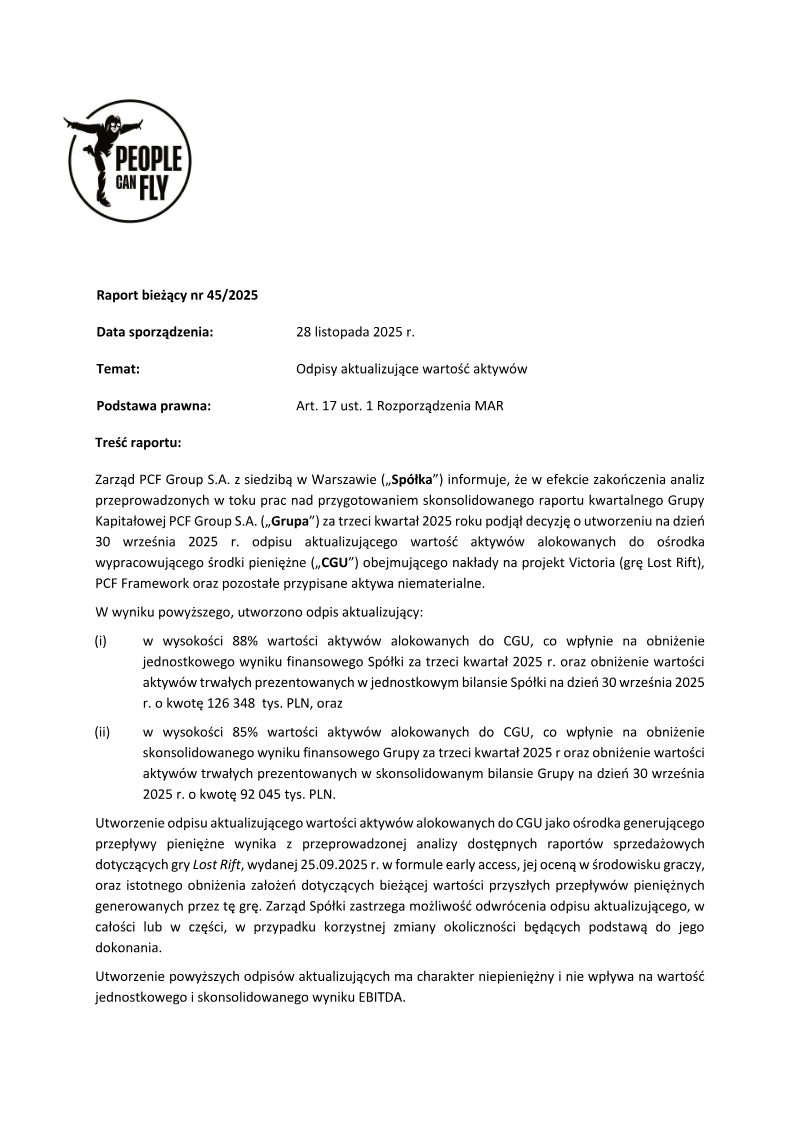
Raport Bieżący Nr 45/2025: Odpisy Aktualizujące Wartość Aktywów
PCF Group S.A. has initiated significant asset impairment charges following a performance review of the project Victoria, specifically the game Lost Rift, alongside the PCF Framework and associated intangible assets. This decision, finalized in November 2025, reflects a strategic reassessment of the carrying value of these assets as of September 30, 2025. The impairment was triggered by disappointing sales data following the early access launch of Lost Rift on September 25, 2025, compounded by unfavorable player reception and a downward revision of projected future cash flows.
The financial impact of these adjustments is substantial, affecting both the company’s standalone and consolidated financial statements. On a standalone basis, the company recognized an impairment of 88% of the relevant asset value, resulting in a reduction of 126,348 thousand PLN. On a consolidated level, the impairment accounts for 85% of the asset value, totaling 92,045 thousand PLN. While these figures significantly lower the value of fixed assets reported on the balance sheet for the third quarter of 2025, the charges are non-cash in nature and do not impact the company’s EBITDA.
Management maintains the possibility of reversing these impairment charges, either in whole or in part, should market conditions or the commercial performance of the affected assets improve. These figures remain estimates and are subject to final audit verification before the publication of the full 2025 financial statements. The scope of this adjustment is limited to the specific cash-generating unit associated with the Lost Rift project and its supporting technological framework within the broader PCF Group portfolio.
- PCF Group S.A. recognized a consolidated asset impairment of 92,045 thousand PLN, representing 85% of the carrying value of the 'Lost Rift' project and its associated PCF Framework.
- On a standalone basis, the company recorded an impairment of 126,348 thousand PLN, which equates to 88% of the relevant asset value.
- The impairment was triggered by poor sales performance and negative player reception following the early access launch of 'Lost Rift' on September 25, 2025.
- The financial adjustments are non-cash in nature and will not impact the company’s EBITDA, though they significantly reduce fixed assets on the Q3 2025 balance sheet.
- Management has indicated that these impairment charges may be reversed in the future if the commercial performance of the affected assets improves.
PCF Group
Report1 pages
Terminy publikacji raportów okresowych: PCF Group S.A. 2026
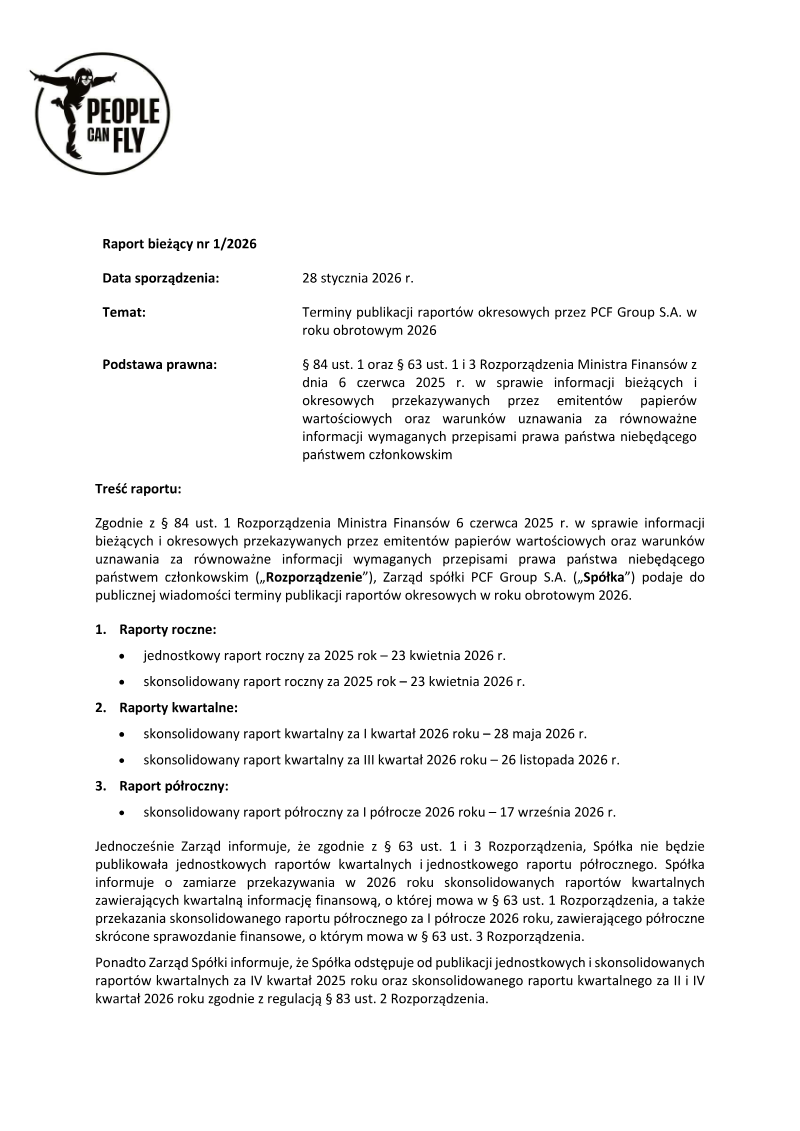
PCF Group S.A. has established its financial reporting schedule for the 2026 fiscal year, ensuring compliance with regulatory requirements for issuers of securities. The primary objective of this disclosure is to provide stakeholders and the investment community with a transparent timeline for the release of audited annual, semi-annual, and quarterly financial statements. This schedule facilitates market predictability and aligns with the company’s obligations under current financial regulations.
The reporting calendar begins on April 23, 2026, with the publication of both the standalone and consolidated annual reports for the 2025 fiscal year. Subsequent disclosures include the consolidated quarterly report for the first quarter of 2026 on May 28, 2026, and the consolidated semi-annual report for the first half of 2026 on September 17, 2026. The final scheduled disclosure is the consolidated quarterly report for the third quarter of 2026, set for November 26, 2026.
In accordance with specific regulatory exemptions, the company will not publish standalone quarterly or semi-annual reports. Furthermore, the company has opted to forgo the publication of quarterly reports for the fourth quarter of 2025, as well as the second and fourth quarters of 2026. By focusing exclusively on consolidated reporting, the company streamlines its financial communication strategy while maintaining adherence to the disclosure standards mandated for the 2026 reporting period.
- PCF Group S.A. will release its 2025 standalone and consolidated annual reports on April 23, 2026.
- The consolidated report for the first quarter of 2026 is scheduled for publication on May 28, 2026.
- The consolidated semi-annual report for the first half of 2026 will be released on September 17, 2026.
- The consolidated report for the third quarter of 2026 is set for publication on November 26, 2026.
- PCF Group S.A. will not publish standalone quarterly or semi-annual reports, opting instead to focus exclusively on consolidated reporting.
PCF Group
Report136 pages
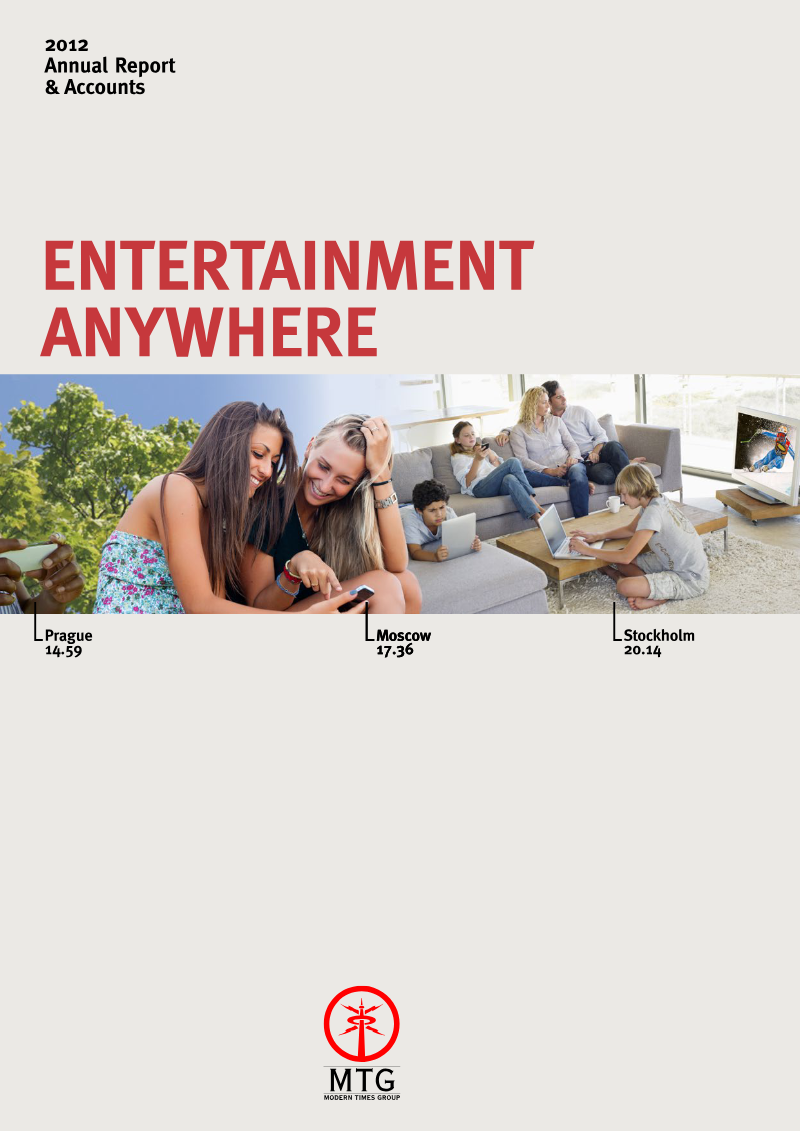
Annual Report and Accounts 2012
14.59 Moscow Stockholm CEO’s Review 1 CFO’s Review 4 Five Year Summary 6 Modern Responsibility 10 Directors’ Report 16 The MTG Share 46 Corporate Governance Report 50 Board of Directors 60 Executive Management 63 Consolidated Financial Statements 67 Parent Company Financial Statements ...
- In 2012, the Group acquired 80% of Zitius Service Delivery AB (Sweden's leading independent Open Access Communications Operator with ~150,000 connected fibre households), a 53% stake in Paprika Latino (a Central and Eastern European TV production group), and 100% of AS Latvijas Neatkarīgā Televīzija (Latvia's second largest free-TV channel operator).
- The Group sold its Bet24 operations to Unibet Group plc for approximately EUR 13.5 million on May 3, 2012.
- MTG received USD 7.8 million in dividends from CTC Media in December 2012, bringing total dividend payments from CTC Media in 2012 to USD 31.2 million.
- The Group's total operations generated revenues of 2,124 SEK million in 2012, compared to 2,492 SEK million in 2011 and 1,855 SEK million in 2010.
- Asset impairment charges and non-recurring costs were 3,352 SEK million in 2011, primarily due to charges in Bulgaria and Slovenia.
+1
Modern Times Group
Report60 pages
Gamedev Salary Pulse 2026: North America, Western Europe, Nordics, Central and Eastern Europe
The game development industry is currently navigating a period of profound structural instability, characterized by widespread workforce reductions and a pervasive sense of professional anxiety. Despite the rapid integration of artificial intelligence, the primary driver of current career displacement remains studio restructuring rather than technological replacement. While the majority of the workforce remains employed in hybrid or remote roles, a significant portion of professionals are actively reassessing their career trajectories. This climate of cautious realism is reflected in market sentiment, where nearly 40 percent of industry participants anticipate further decline, leading to increased emotional fatigue and a shift in priorities toward time-based benefits, such as the four-day workweek, over traditional office perks.
Geographically, the industry maintains a clear hierarchy in compensation, with North America consistently commanding the highest salary tiers across all seniority levels. In contrast, Central and Eastern Europe continue to function as the most cost-effective hubs for talent acquisition. This regional disparity underscores a broader trend of geographic diversification, as studios balance the need for specialized expertise with the economic realities of global operations. Although the workforce remains mobile, the prevalence of remote work has effectively anchored many professionals, creating a distinct divide where on-site employees demonstrate a significantly higher propensity for international relocation compared to their remote counterparts.
The current landscape is defined by a maturing workforce dominated by mid-to-senior level professionals, accompanied by a concerning decline in new entrants. This demographic shift, coupled with the ongoing volatility in employment, has necessitated more flexible recruitment strategies. Studios are increasingly moving away from traditional hiring models, favoring diverse solutions that range from subscription-based flat-fee packages to comprehensive recruitment process outsourcing. As the industry continues to evolve, these data-driven benchmarks serve as a critical framework for both studios and professionals attempting to navigate the complexities of global compensation and shifting labor market dynamics.
- Nearly 40 percent of game industry professionals anticipate further market decline, driving a shift in worker priorities toward time-based benefits like the four-day workweek over traditional office perks.
- Workforce reductions and studio restructuring remain the primary drivers of career displacement, significantly outpacing job losses attributed to artificial intelligence integration.
- North America maintains the highest global salary tiers for all seniority levels, while Central and Eastern Europe remain the most cost-effective regions for talent acquisition.
- The industry is experiencing a demographic shift characterized by a maturing workforce of mid-to-senior level professionals and a concerning decline in new entrants.
- Remote work has anchored the workforce, resulting in a clear divide where on-site employees are significantly more likely to relocate internationally than their remote counterparts.
+3
8BitMar 2026

Report104 pages
Corporate Responsibility Report 2024
Corporate Responsibility Report 2024 Introduction Patients Science Employees Communities Planet Governance Data <td>Corporate Responsibility at Alnylam</td> stol. S7 Catalina, patient (Spain) On the cover, left: Tsuyoshi, patient and his wife Rika (Japan) Corporate Responsibility Report 2024 Introduction Patients Science Employees Communities Planet Governance Data A Pivotal Year at Alnylam Transforming Lives Through Innovat...
- Alnylam's Patient Access Philosophy, established in 2017, was revisited in 2024 to expand its reach and ensure patients benefit from their medicines.
- Alnylam launched a 'Patient Perspectives series' in 2024 to help employees understand the experiences of patients, caregivers, and advocates impacted by the diseases they serve.
- In 2024, Alnylam focused on cardiovascular provider collaboration, engaging global cardiologists and other specialists to understand their needs due to two approved medicines and a robust pipeline in this area.
- Alnylam's modular drug discovery platform utilizes a three-pronged approach: delivery of RNAi therapeutics to new tissues, enhancement of existing platform designs, and investment in human genetics to identify drug targets.
- Alnylam was named to Newsweek’s 'America’s Most Responsible Companies 2025' for the third consecutive year, moving from #422 in 2023 to #153 in 2025.
+1
Alnylam Pharmaceuticals
Report19 pages
Cyprus Game Industry: Senior+ Employment Landscape 2025
The study examines the senior‑level employment landscape in Cyprus’s game industry for 2025, drawing on an anonymous survey of 113 professionals and a comparative analysis with European peers. Findings reveal that senior‑plus talent in Cyprus exhibits low job mobility, with 71 % reporting no change in the past year and only 20 % moving voluntarily. When moves occur, they are largely strategic, aimed at improving compensation or scope rather than reacting to instability. Senior professionals prioritize financial reliability, clear role definitions, and predictable work environments over brand visibility or rapid career acceleration. Lifestyle factors—including climate, taxation, and family considerations—reinforce long‑term retention and reduce relocation willingness.
Job security perceptions are higher in Cyprus (average 2.68 on a 5‑point scale) than across Europe, yet the expected risk of job loss in the next year is also higher for many roles. Burnout and limited professional development opportunities emerge as key structural risks, with 66 % reporting burnout and only 53 % receiving employer‑funded training. Overtime is common, with 27 % working one to two times a month and 45 % accepting it as part of leadership duties, contributing to long‑term fatigue.
Salary data show Cyprus median salaries for senior roles (e.g., €98 k for top management) below European averages, while desired salaries are substantially higher (e.g., €135 k for top management). Relocation openness is moderate, with 36 % not open and 32 % very open; visa support, health insurance, and relocation bonuses are the most valued benefits.
Overall, the market is mature but faces challenges in retaining talent through sustained engagement and development rather than short‑term compensation incentives. The primary risk for employers is gradual burnout and skill stagnation hidden behind long tenure, rather than sudden turnover.
- Senior-level talent in Cyprus exhibits low job mobility, with 71% of professionals reporting no change in employment over the past year.
- A significant retention risk exists in the form of burnout, which affects 66% of senior professionals, compounded by the fact that only 53% receive employer-funded training.
- Median salaries for top management in Cyprus are approximately €98k, falling significantly short of the €135k desired by professionals in these roles.
- Overtime is a systemic issue, with 45% of leaders accepting it as a standard duty and 27% of the broader senior workforce working overtime at least once or twice a month.
- While 36% of senior professionals are not open to relocation, 32% are very open, with visa support, health insurance, and relocation bonuses identified as the most critical incentives.
+1
Values ValueMar 2026

Report8 pages
PEGI: European Game Information
The text serves as an educational and promotional overview of the Pan‑European Game Information (PEGI) rating system, using a comic‑style narrative to capture the attention of younger gamers while delivering core information about age‑based content classification. Its central thesis is that PEGI provides the most comprehensive mechanism for informing consumers about video‑game suitability, thereby ensuring safe and informed purchasing decisions across Europe.
Key points emphasize that PEGI operates in more than thirty countries and employs a traffic‑light colour scheme to convey age recommendations: green icons for games suitable for all audiences (ages 3 and 7), amber for intermediate levels, and red for titles restricted to adults (18+). The system also includes content descriptors that clarify specific elements that may affect suitability, reinforcing transparency for parents and players. The narrative illustrates the progression through various “worlds” representing age brackets—3, 7, 12, 16, and 18—highlighting that each tier is tailored to increasingly experienced gamers.
The scope is continental, covering the European video‑game market and all major platforms, with references to the official website and downloadable applications for iPhone, Android, and Windows 7 Phone. No empirical methodology is presented; the piece relies on descriptive exposition and visual storytelling rather than survey data. Overall, the material positions PEGI as a reliable, universally adopted standard that guarantees 100 % informed choice for consumers.
- The PEGI rating system is the standardized age-classification mechanism for video games across more than 30 European countries.
- Age suitability is communicated through a traffic-light color scheme: green for ages 3 and 7, amber for intermediate levels, and red for 18+ restricted titles.
- The system utilizes specific content descriptors alongside age ratings to provide transparency regarding the elements that influence a game's suitability.
- PEGI ratings cover all major gaming platforms and are designed to facilitate informed purchasing decisions for both parents and players.
- The classification framework is structured into five distinct age brackets: 3, 7, 12, 16, and 18.
+1
AEVI