Updated Apr 30, 2026 by Modern Times Group
Report
Published by Modern Times Group
MTG’s 2014 operational strategy centered on the integration of corporate responsibility into its core business model, prioritizing digital data protection, the rights of minors, and the preservation of freedom of expression. By aligning operations with UN Global Compact and OECD guidelines, the company achieved net sales of 16,746 MSEK while maintaining a rigorous ethical framework. This governance structure included the implementation of a new supplier code of conduct, mandatory anti-bribery training, and the introduction of an external whistleblower system, resulting in zero confirmed cases of corruption during the fiscal year. The company’s commitment to social and environmental stewardship was evidenced by a 33% reduction in energy consumption per employee since 2010 and an improved CDP score of 90B. Beyond internal efficiency, MTG leveraged its media platforms to double donated airtime for social and environmental causes. HR initiatives focused on decentralizing operations to empower local markets, fostering a diverse workforce of 4,111 employees representing 44 nationalities. While the company successfully promoted initiatives like Women in Tech, it acknowledged ongoing challenges regarding gender pay parity and high turnover rates in sales-intensive roles, leading to the restructuring of certain internal development goals. Operating across diverse geographic regions, MTG maintained strict neutrality and regulatory adherence through robust content rating systems and parental controls. Independent assurance provided by Ethos International confirmed that the company’s performance indicators met the Core level of the Global Reporting Initiative G4 guidelines. While the organization successfully met most targets regarding data protection and environmental impact, auditors recommended the adoption of advanced digital management systems to enhance the accuracy of future human resource data collection, ensuring continued transparency and operational efficiency in subsequent reporting periods.
Content CEO’s Words 1 Organisational Profile 2 Governance & Everyday Ethics 6 Materiality & Reporting 10 Economics 13 Human Rights /Freedom of Expression 15 Product Responsibility 17 Doing More 21 Labour Practices 23 Environment 29 Progress 33 GRI Index and Report Boundaries 36 Report Boundaries 39 Independent Assurance Statement 40
CEO’s Words Corporate responsibility (CR) is now position paper on freedom of expression closer to our local markets, our audiences, and freedom of the media. our consumers and customers than ever We face up to challenges. And we em before. brace changes in consumer behavior be Yes, we’re still pushing how we give cause they bring opportunity. In fact, we back to the communities we’re in. Our thrive on change. So bring on 2015. We’re work with Reach for Change reached aiming to be the #1 digital entertainer out new heights with our launch of the Game there. To see how CR is with us every step Changer campaign this year. But to of the way, please read on to get the full achieve long term sustainable profitability, picture. The shifts are here to stay and CR needs to thread through every day, we embrace them and drive our business every part of our business. accordingly. This is our way. G4-1 Just as our business is market and customer driven, our CR is stakeholder led. So we watch and listen to all those impacted by our business and prioritise our work accordingly. 2013’s materiality analysis has been a guiding light for our work during 2014. And substantial shifts in consumer behavior and our operating environment are reflected in significant changes in our business model. We now have new digital priorities, such as data and customer protection and privacy. The focus on protecting minors and the right to freedom of expression have also never been more relevant or critical. But while the market sets the pace, so does what is going on in the world around us.
ess model. We now have new digital priorities, such as data and customer protection and privacy. The focus on protecting minors and the right to freedom of expression have also never been more relevant or critical. But while the market sets the pace, so does what is going on in the world around us. We can’t ignore the current geo-po litical shifts and must comply with the international sanctions that have followed the escalation of the crisis in Ukraine. Both of which have meant that, as a business, we have had to work extra hard to review our procedures and counterparties to ensure that we continue to comply with international sanctions. Furthermore, our own channels’ news and current affairs coverage provides a valuable, independ ent and unbiased perspective on both global and local issues. By continuing to promote freedom of expression and of the media, our clear objective is to enable all of our audiences and e they are, to have customers, wherever what is going on informed opinions about in addition around them. That’s why, to highlighting our new digital Jørgen Madsen Lindemann priorities, in 2014 we chose to publish our President & Chief Executive Officer A PAT ON THE BACK iS ALWAYS NICE. Dow Jones WCDP We do our best to try and gauge where we are at interally, But FTSE4Good Sustal sometimes it's nice to get some eaterral feedback. We feel wery in Cenltaboratin sith Robatin fortunate to have been ranked in these established global
Business Overview Our Business Areas G4-9 G4-17 FREE-TV F CEANDINAVIA 10 channals. Aso availble on: Viasal satollite platform via M third party cablo networks. • IPTV mobilo PAY-TY EMERGING MARKETS networks. • Markoting and selling of pay-TV packagos on Digital the Viasat satollito platforms in tho Baltics and torrestrial Ukralne and, until Novembor 2014, Raduga TV networks in in Russia. Swedon Viasat distributes 36 channels vin third party and Norway. pay-TV notworks in 36 countrios across Contral Catch-up and Eastorn Europo, Africa and tho Unitod sorvicos. Statos. CTC MEDIA Troce was acguired in June 2014 and MTG's 2014 sharoholding in mainly oporatos music TV channols. Russia's largost indopondont tolovision broadcattor CTC Modia amountod to 37.9% of issued sharos and 38.5% of outstanding shares. PAY-TV NORDIC Prominm pary TV packg and content on: Viatat satolite platform. Viaplay online platform. MTO OTHER BUSINESS Third party IPTV Nice Entortainment Group is the our and cable content production and distribution notworks. businots in Scandinavia, Europe and Africa. Distrib ution of • MTGx is our digital accolorator for existing 37 Viasat pary-TV and future digital entertainment products channels vis and sorvions. third party • MTG Rndio consists of national commorcial t menttworks. FREE-TV EMERGING nolworks in Swodon and Norway, as well as MARKETS national and local stations in tho Baltics. 20 channola in tho Baltics, the Czoch Ropublic, Bulgaria, Hungary, Ghana and Tanzania. Key Figures & Financial Position KeyFigures & Financial Position
national commorcial t menttworks. FREE-TV EMERGING nolworks in Swodon and Norway, as well as MARKETS national and local stations in tho Baltics. 20 channola in tho Baltics, the Czoch Ropublic, Bulgaria, Hungary, Ghana and Tanzania. Key Figures & Financial Position KeyFigures & Financial Position KEy Ficuress Fhancial Pohition 2012 2013 2014 Net seles (MSEK) 13,336 14,073 16,746 Operating income (MSEK) 2,04 1,730 1,130 Basikc eamings per share (SEK) 22.93 16.39 17.10 Average number of employees 3,00 4,361 4,111 FINANCIAL FOSITION Shareholder's equty 5,134 4,295 5,831 *Please note that MTG’s 50% ownership interest in Raduga has been account ed for as an equity participation with effect from 1 January 2014 due to chang es in IFRS rules. Results for prior periods have been adjusted in the Group’s reporting for the purposes of comparison.
Brand Footprint oo.tanoL MTG Countries 2014 n Countries with operations but no offices n Countries with offices n MTG Headquarters n Afghanistan n Albania n Algeria n Angola n Antigua n Armenia n Australia n Austria n Azerbaijan n Bahrain n Barbados n Belarus n Belgium n Belize n Benin n Bosnia and Herzegovina n Botswana n Bulgaria n Burkina Faso n Burundi n Cameroon n Cape Verde n Central African Republic n Chad n Colombia n Comores n Congo n Costa Rica n Croatia n Cyprus n Czech Republic n Democratic Republic of Congo n Denmark n Djibouti n Dominican Republic n Egypt n Lichtenstein n Senegal n El Salvador n Lithuania n Serbia n Equatorial Guinea n Luxembourg n Seychelles n Eritrea n Libya n Sierra Leone n Estonia n Macedonia n Singapore n Ethiopia n Madagascar n Slovakia n Finland n Malawi n Slovenia n France n Malaysia n Somalia n Gabon n Maldives n South Africa n Gambia n Mali n South Korea n Georgia n Malta n South Sudan n Germany n Mauritania n Spain n Ghana n Mauritius n Sri Lanka n Grenada n Mexico n St Kitts & Nevis n Guatemala n Moldovia n St Lucia n Guinea Bissau n Monaco n St Vincent n Guinea n Mongolia n Sudan n Haiti n Montenegro n Surinam n Honduras n Morocco n Swaziland n Hong Kong n Mozambique n Sweden – MTG n Hungary n Namibia Headquarters n Iceland n Netherlands n Switzerland n India n Nicaragua n Syria n Indonesia n Niger n Tanzania n Iran n Nigeria n Togo n Iraq n Norway n Tunisia n Israel n Oman n Turkey n Italy n Panama n Uganda n Ivory Coast n Poland
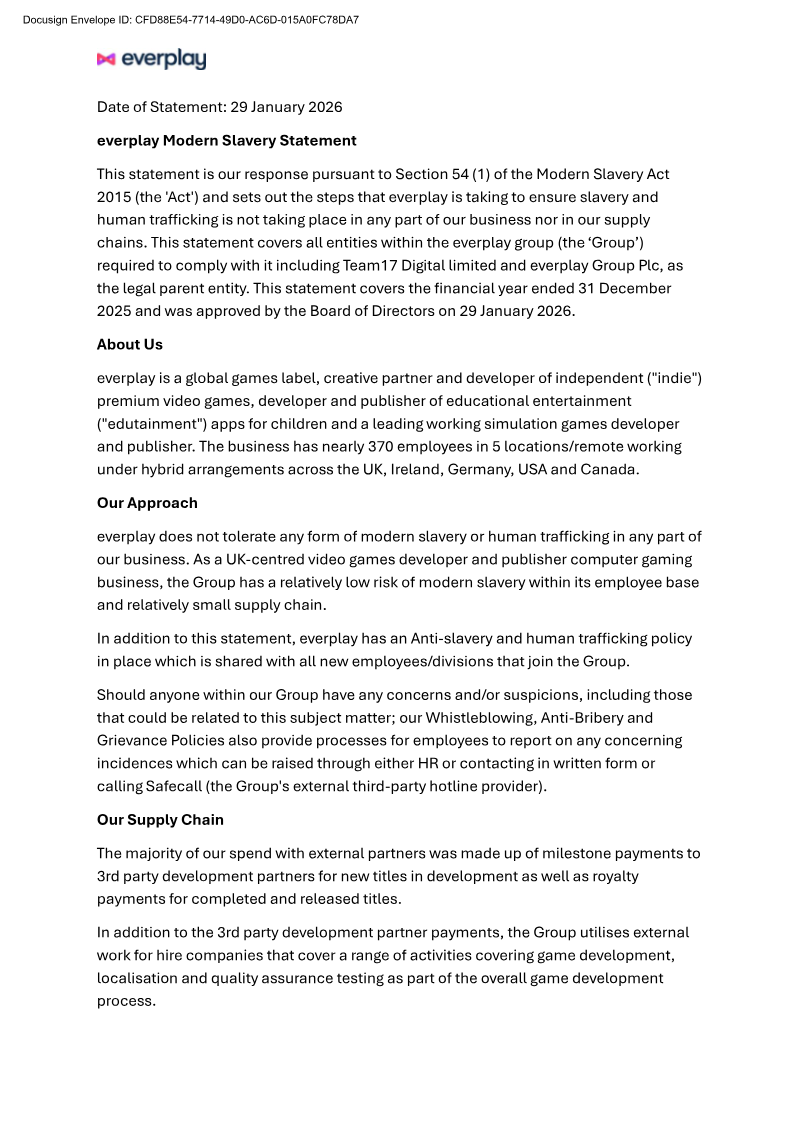
Everplay maintains a zero-tolerance stance toward modern slavery and human trafficking across its global operations and supply chains. As a UK-centered video games developer and publisher, the organization identifies as having a relatively low inherent risk due to the nature of the digital entertainment industry. The operational scope covers the financial year ending December 31, 2025, and encompasses approximately 370 employees working across the United Kingdom, Ireland, Germany, the United States, and Canada. The primary supply chain expenditures involve milestone and royalty payments to third-party development partners, alongside work-for-hire contracts for game development, localization, and quality assurance testing. While the overall risk profile remains low, the organization identifies localization and quality assurance as areas carrying a slightly higher risk. To mitigate these concerns, all new and renewing contracts include mandatory compliance clauses regarding the Modern Slavery Act 2015, granting the company the right to terminate agreements in the event of a breach. Governance is managed through the Audit Committee, which reports to the Board of Directors at least twice annually. Due diligence efforts include a risk-based approach to supplier assessment and the implementation of internal policies such as whistleblowing, anti-bribery, and grievance procedures. Employees and third parties are provided with confidential reporting channels, including an external hotline. The effectiveness of these measures is tracked through an annual risk register assessment, which currently reports zero incidents of modern slavery. Training and awareness initiatives are provided to ensure that employees and stakeholders can identify and report potential risks effectively.
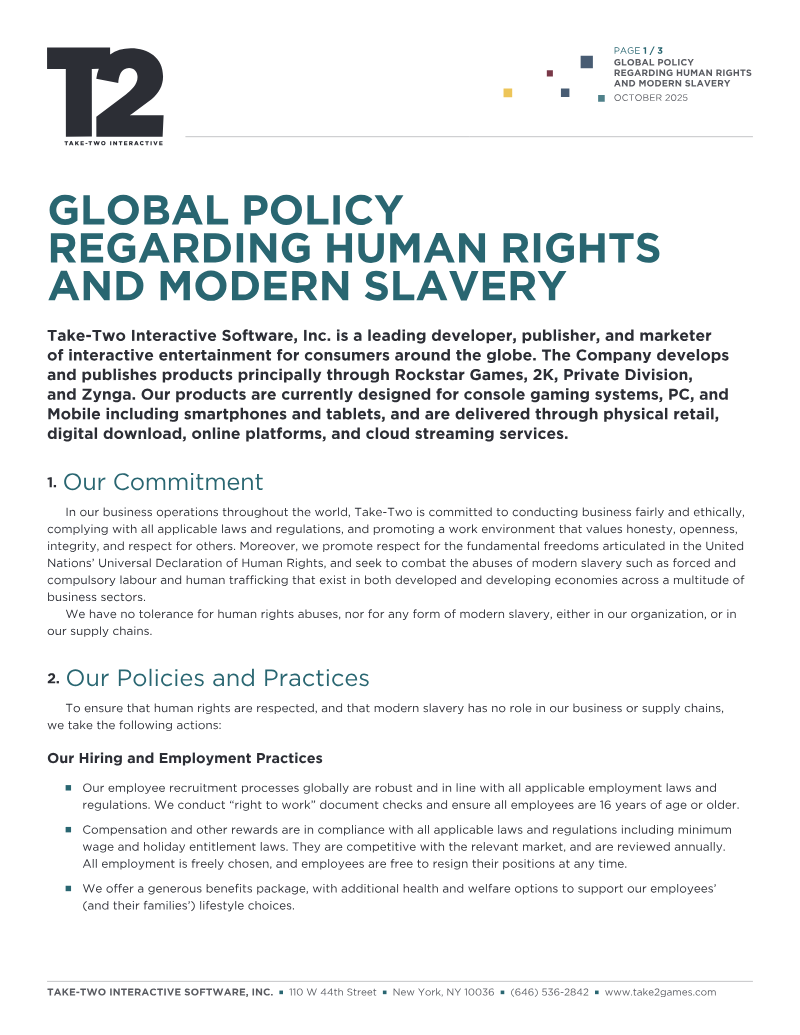
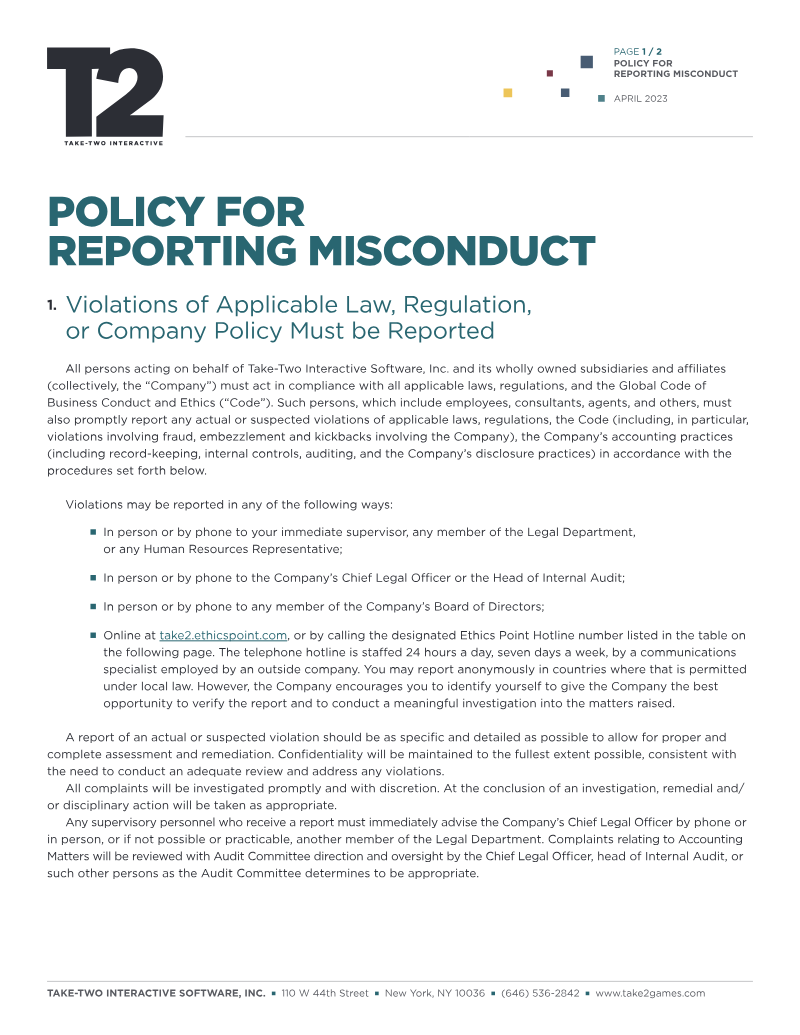
Take-Two Interactive Software establishes a comprehensive framework for maintaining ethical business practices and safeguarding human rights across its global operations as of October 2025. The primary objective is to eliminate modern slavery, forced labor, and human trafficking within the organization and its extensive supply chains. This commitment extends across all major publishing labels, including Rockstar Games, 2K, Private Division, and Zynga, covering the development and distribution of interactive entertainment for console, PC, and mobile platforms. The policy outlines rigorous hiring and employment standards, mandating that all employees be at least 16 years of age and that employment is strictly voluntary. Compensation and benefits are reviewed annually to ensure they meet or exceed legal minimums and market standards. Furthermore, the company enforces a strict non-discrimination policy, ensuring that recruitment and career advancement are based solely on ability and merit rather than protected characteristics. These internal standards are reinforced by a Global Code of Business Conduct and Ethics that applies to all directors, officers, employees, and contractors. To ensure compliance throughout the supply chain, which includes disc replicators, printers, and logistics providers in regions such as North America, Europe, and Japan, the company utilizes a dedicated Supplier Code. This requires third-party partners to represent that they do not utilize child, prison, or slave labor. Oversight is maintained through biennial training for employees and targeted training for consultants. Additionally, the company provides a confidential reporting hotline managed by an independent third party, protecting whistleblowers from retaliation. Key suppliers are also expected to conduct periodic internal or independent audits to verify adherence to labor, health, and safety standards.
The FY 2025 impact analysis presents Electronic Arts’ comprehensive ESG strategy, arguing that responsible stewardship of people, planet, and data is integral to sustainable growth in the interactive‑entertainment sector. By quantifying progress across talent, climate, privacy and security, the report demonstrates how the company translates corporate responsibility into measurable outcomes while maintaining its global market position. Across a workforce of more than 6,000 employees worldwide, 83 % now have access to internal AI tools, and 17 % of new hires are returning staff, contributing to an industry‑leading attrition rate of –0.1 %. Expanded benefits—including paid parental leave and bereavement support—paired with a balanced gender composition, underpin the talent‑focused results. Community engagement generated 18,000 volunteer hours and $5.9 million in investments, reinforcing the social dimension of the strategy. Environmental performance shows a clear downward trajectory: total operational emissions fell to 6.6 Mt CO₂e in FY25, down from 7.3 Mt in FY24 and 10.6 Mt in FY23, with Scope 1 emissions at 2.98 Mt and Scope 2 (market‑based) comprising the remainder, while energy consumption reached 380,859 GJ, fully sourced from office operations. The company’s carbon‑neutral status and renewable‑energy initiatives address identified climate risks such as acute physical events, volatile energy prices, rising carbon costs and emerging reporting regulations. Data‑privacy and security are governed by a privacy‑by‑design framework overseen by the Audit Committee, delivering explicit player notice, consent and control, data‑minimisation, and partner‑risk contracts. The security management system aligns with ISO, NIST and CIS standards, undergoes annual independent validation, operates a 24‑hour SOC and mandates annual training for all staff. An articulated AI governance model completes the governance pillar, ensuring responsible deployment of emerging technologies. Collectively, these initiatives illustrate a holistic, globally scoped commitment to ESG excellence throughout FY 2025.
This research examines the professional landscape of the global gaming industry, drawing on a survey of over 160 professionals conducted during Gamescom 2025. The sample represents a diverse geographic spread, with significant participation from Europe and North America, alongside emerging representation from Latin America, Asia-Pacific, and Africa. Demographically, the industry remains male-dominated (65%), though women (30%) and non-binary individuals (6%) constitute a notable portion of the workforce. The data highlights a mid-career-heavy industry, where nearly half of the respondents possess six to ten years of experience, while newcomers are increasingly rare due to slowed recruitment and a preference for senior talent. The central thesis identifies a stark paradox: while 76% of professionals report high job satisfaction driven by a deep passion for creative expression, trust in the industry as a sustainable career path has collapsed, evidenced by a Net Promoter Score (NPS) of -40. This disillusionment is most pronounced among veterans aged 45 and older. While the "spark of passion" remains the primary motivator for joining and staying in the field, it is increasingly undermined by systemic issues. Key deterrents include low compensation (54%), unstable employment (43%), and burnout (30%). The findings conclude that the industry is at a critical juncture. Professionals envision a future defined by player-centric design, cross-platform development, and increased diversity. However, they warn that the current model—characterized by "suits" maximizing short-term profits and frequent layoffs—is unsustainable. The research suggests that a "Golden Age" of gaming can only be achieved by shifting from profit-driven exploitation of passion toward structural stability, fair compensation, and genuine collaboration. Without these changes, the industry risks a continuous drain of the talent required to sustain its creative output.