Vampyr
Game
5 documents in the library are about Vampyr, from writers such as DiGRA, Don't Nod and Home Interactive. Each has a summary and key insights with the page they come from.
Connections
Each row is a game or company named alongside Vampyr, each column a document, oldest first. A mark means that document names it. Select a row to see those documents.
Documents about Vampyr
Moral Ambiguity in Playdead Games
This paper examines how moral ambiguity is expressed in Playdead's games Limbo and Inside, arguing that their combination of silent storytelling, constrained agency, and sparse world design compels players to make ethically significant choices without full knowledge of context or motivation.
- The paper defines moral ambiguity as occurring when players must take morally relevant actions with unforeseeable consequences and without complete knowledge of a character's motivations.
- Unlike games that frame the protagonist as inherently good, Playdead's Limbo and Inside widen player agency and invite independent moral reflection rather than encouraging justification of the protagonist's actions.
- In Limbo, the nameless protagonist's survival often requires harming others or exploiting the environment, and the lack of narrative context leaves the ethical weight of these acts uncertain.
It's a Monster's World
This paper examines Vampyr, a 2018 horror role-playing game by Dontnod Entertainment set in early twentieth-century London, through the lens of ludonarrative dissonance and the construction of monstrosity in play.
- The paper argues that Vampyr (Dontnod Entertainment, 2018), a horror RPG set in early twentieth-century London, casts the player as a doctor-turned-vampire, and its central tension is between what the game mechanically rewards and what its story asks the player to feel, a case of ludonarrative dissonance.
- The author frames Vampyr as a 'technology of subjectivity,' drawing on Halberstam's theory of monstrous bodies to analyse how the game directs players to act monstrously.
- Avoiding killing is possible but makes the game markedly harder, while the most efficient way to gain experience is to drain named civilians with personal bonds to the protagonist, often after healing them and exploiting private information about their lives.


Home Interactive H1 2018/2019 Earnings and Q3 2018/2019 Revenue Presentation
Focus Home Interactive’s H1 2018/2019 earnings and Q3 revenue presentation details a period of significant financial growth and operational success driven by a selective publishing model.
- Focus Home Interactive achieved year-to-date revenue exceeding €100 million by December 2018, representing a 55% increase over the previous year.
- Management raised the fiscal year 2019 revenue outlook to over €110 million, with long-term targets set between €130 million and €150 million by March 2022.
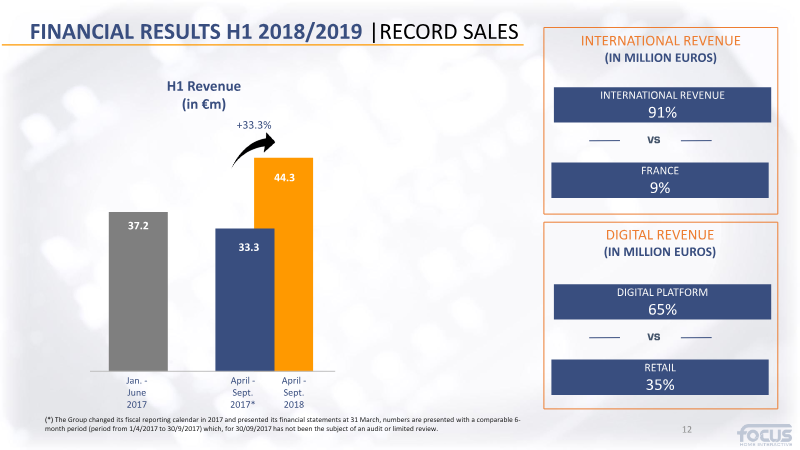
- H1 2018/2019 revenue reached €44.3 million, a 33.3% increase year-over-year, with operating income rising to €7.0 million or 15.8% of revenue.

Don't Nod Entertainment Half-Year Financial Report 2018
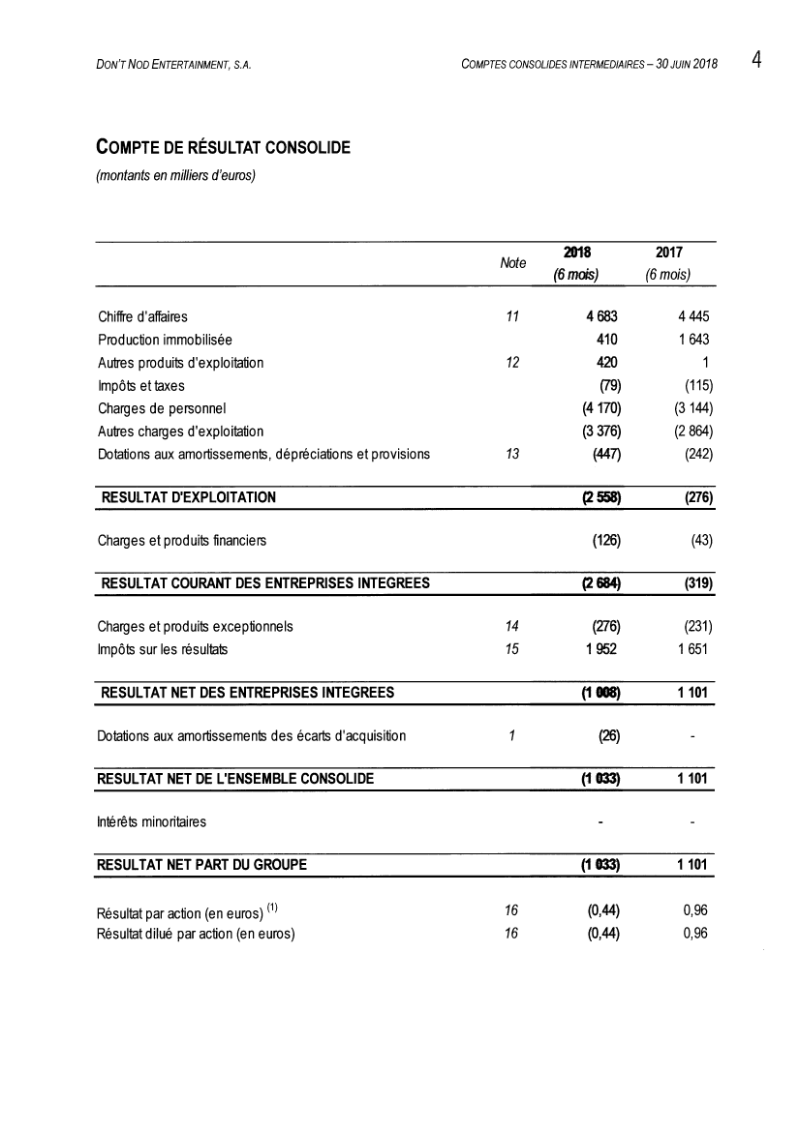
Don't Nod Entertainment underwent a transformative period during the first half of 2018, marked by a successful initial public offering on Euronext Growth that raised approximately €30.5 million.
- Don't Nod Entertainment raised €30.5 million through an IPO on Euronext Growth in H1 2018, allowing the company to exit a court-ordered continuation plan and transition into a public limited company.
- The company reported €4.68 million in revenue for H1 2018, driven by the releases of Vampyr and The Awesome Adventures of Captain Spirit.
- Despite revenue growth, the studio recorded a net loss of €1.03 million due to significant investments in research and development and the capitalization of production costs.


Focus Home Interactive Annual Results 2017-2018
Focus Home Interactive achieved a total revenue of €89.9 million during the 15-month fiscal period concluding on March 31, 2018.
- Focus Home Interactive generated €89.9 million in revenue during the 15-month fiscal period ending March 31, 2018.
- Digital distribution accounted for 64 percent of total revenue, while international markets outside of France contributed 89 percent of sales.
- The company’s back-catalog remains a core financial pillar, representing 42 percent of total revenue for the period.