
The Legend of Zelda: A Link to the Past
GameBy Nintendo Entertainment Analysis & Development · Released Nov 21, 1991
Venture back to Hyrule and an age of magic and heroes. The predecessors of Link and Zelda face monsters on the march when a menacing magician takes over the kingdom. Only you can prevent his evil plot from shattering the land of Hyrule.
- How much revenue has The Legend of Zelda: A Link to the Past made?
- How many players does The Legend of Zelda: A Link to the Past have, and how is that changing?
- What do industry reports say about The Legend of Zelda: A Link to the Past's performance?
- Which games compete with The Legend of Zelda: A Link to the Past, and how do they compare?
Connections
Each row is a game or company named alongside The Legend of Zelda: A Link to the Past, each column a document, oldest first. A mark means that document names it. Select a row to see those documents.
About the game
- Released
- Nov 21, 1991
- Developer
- Nintendo Entertainment Analysis & Development
- Publishers
- St. GIGA, Nintendo, Playtronic, Gradiente
- Genres
- Puzzle, Adventure
- Platforms
- Satellaview, Super Nintendo Entertainment System, Wii, Wii U, New Nintendo 3DS, Super Famicom
- Links
- Official site, Wikipedia
Game data from IGDB.com
Documents about The Legend of Zelda: A Link to the Past
Nintendo Announces a Slew of Price Hikes, Beyond Just the Switch 2
Nintendo announced a sweeping set of price increases on May 8, 2026, alongside its annual results, with Sony delivering its own investor update the same day. Nintendo revised prices on 20 products.
- Nintendo is increasing the price of the Switch 2 by $50 in the U.S., Canada, and Europe starting September 1, with a $50 increase for various Switch models in Japan effective May 25.
- Rising component costs, specifically memory chips, and tariff impacts are expected to add ¥100 billion ($638 million) in additional expenses for Nintendo this fiscal year.
- Nintendo has lowered its full-year sales projection for the Switch 2 to 16.5 million units for the April 2026 to March 2027 period, citing market saturation and the new price hikes.

Steam Deck: What Type of Games Excel on It?
This analysis investigates the types of games that perform well on the Steam Deck, utilizing data from Steam user reviews where over 50% of playtime occurred on the device.
- The Steam Deck accounts for approximately 2.75% of total playtime across representative publisher portfolios, indicating it remains a complementary rather than primary market.
- The device's installed base is estimated to be between 5 and 7 million units.
- Steam Deck success is driven by 'lite console' titles, specifically indie, platformer, and adventure games that mirror the preferences of the Nintendo Switch audience.

Dutch Games Association's Martine Spaans On The Meaning Of Games And Their Evolution In Blockchain
The Dutch gaming sector has matured into a robust ecosystem of approximately 550 studios, spanning from independent developers to major industry players like Guerrilla Games.
- The Dutch gaming sector has grown into a robust ecosystem comprising approximately 550 studios, ranging from independent developers to major entities like Guerrilla Games.
- The Dutch Games Association is actively lobbying for government funding to address a competitive disadvantage against neighboring European nations and ensure long-term industry viability.
- Blockchain integration in gaming is shifting away from speculative play-to-earn models toward circular, play-and-own economies that prioritize interoperable assets and player ownership.
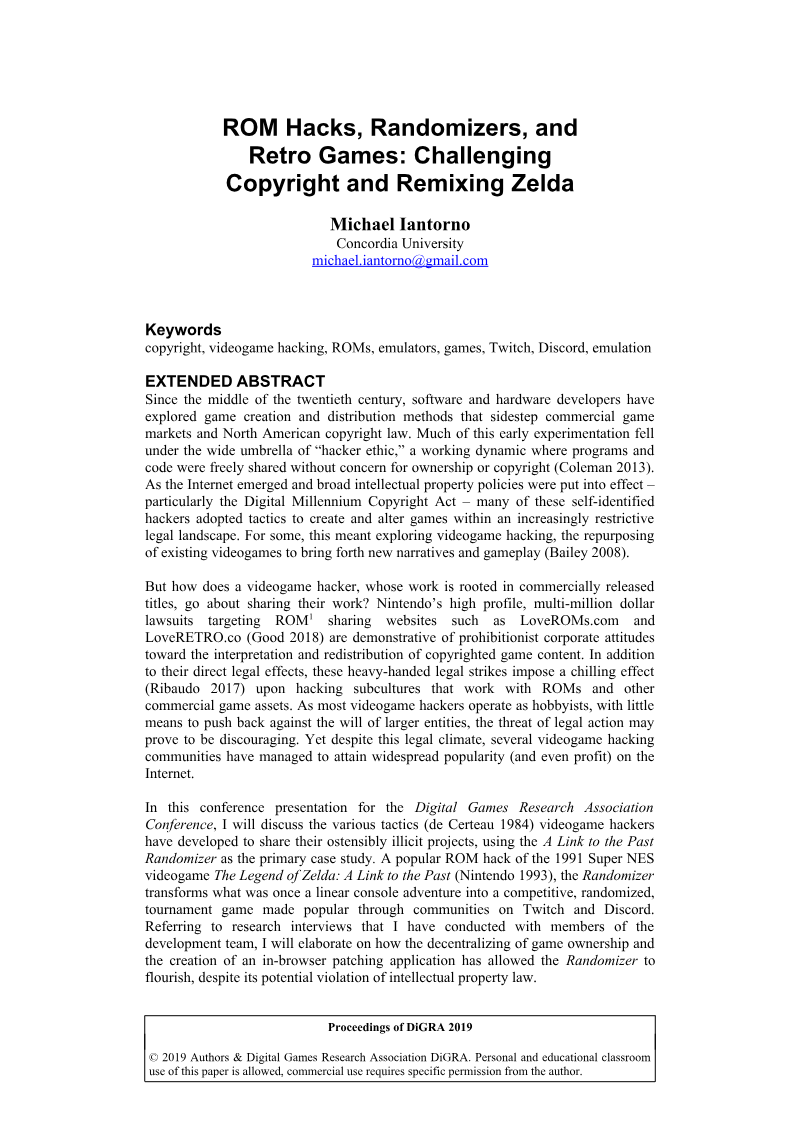
ROM Hacks, Randomizers, and Retro Games: Challenging Copyright and Remixing Zelda
This conference paper, presented at the 2019 Digital Games Research Association (DiGRA) conference, examines how videogame hacking communities share and distribute projects built on copyrighted commercial games despite legal risk.
- The paper uses the A Link to the Past Randomizer, a ROM hack of the 1991 Super NES game The Legend of Zelda: A Link to the Past, as its central case study; the hack turns the linear adventure into a randomized, competitive game played through communities on Twitch and Discord.
- The author frames ROM hacking communities as creative labour operating at the margins of media production and law, placing the work within the history of hacker ethics and the tightening of intellectual property enforcement after the rise of the Internet and the Digital Millennium Copyright Act.
- Nintendo's lawsuits against ROM distribution sites such as LoveROMs.com and LoveRETRO.co are argued to produce a chilling effect on hobbyist hackers who lack the resources to resist corporate pressure.
Companies behind it
As the documents state it.