Silent Hill
Documents about Silent Hill
The Metaphor is Meaning - "Show, Don't Tell" in Game Design - Extra Credits
Game design often relies on the unique intersection of literal and metaphorical elements, allowing developers to convey complex narrative depth without relying solely on text-based exposition.
- Game designers can replace text-based exposition by using visual and interactive mechanics as metaphors to convey complex narrative depth.
- Effective metaphorical design requires early development planning to ensure that character traits, environmental assets, and narrative arcs are intentionally aligned with symbolic meanings.
- Specific gameplay elements, such as the tattoos in the Yakuza series or the psychological manifestations in Silent Hill 2, serve as shorthand for internal character struggles and thematic commentary.
Mechanics and Tone - How Does Gameplay Relate to Story? - Extra Credits
The synthesis of gameplay mechanics and narrative is a fundamental pillar of effective game design.
- Gameplay mechanics must be developed as a foundational element of the narrative rather than an afterthought to ensure cohesive, immersive player experiences.
- Disjointed mechanics and narrative cause player disengagement, as users begin to perceive the story as an interruption to the gameplay loop.
- Effective mechanical design functions like literary style or artistic color palettes, grounding the player in the game’s emotional stakes and intended tone.

Horror That Lingers - How the Uncanny Instills Fear - Extra Credits
Modern horror media frequently fails to leave a lasting psychological impact because it relies on fleeting sensations like jump scares, gore, or power fantasies.
- True psychological horror relies on the 'uncanny'—the distortion of familiar, mundane environments—rather than jump scares or gore, which are easily dismissed as non-threatening by the player.
- The uncanny triggers a subconscious sense of unease by presenting elements that are recognizable but slightly 'off,' forcing the brain to constantly scan for anomalies in the environment.
- By grounding horror in reality rather than fantasy, developers prevent players from distancing themselves from the experience, allowing the fear to linger after the game session ends.
Mechanics as Metaphor - II: Creating Narrative Depth - Extra Credits
The integration of mechanics as metaphor serves as a critical strategy for elevating narrative depth in video games.
- Developers should prioritize mechanics as metaphors to convey complex themes, moving beyond reliance on traditional cutscenes and dialogue.
- A singular, well-defined conceptual focus—such as alienation or psychological delusion—must be established early in production to ensure art, sound, and code align to reinforce the narrative.
- Designers should shift away from rigid, hand-holding gameplay models and instead create spaces of possibility that encourage player interpretation.
Playing Like a Designer - II: How to Analyze Game Design - Extra Credits
Effective game design analysis requires moving beyond subjective labels like good or bad to understand the mechanics and intent behind a title.
- Professional game analysis requires shifting from a consumer mindset to a structural evaluation of mechanics, moving beyond subjective labels like 'good' or 'bad'.
- Designers should prioritize breadth of experience by sampling a wide variety of genres, as most games reveal their core systems within the first hour of play.
- Identify 'first-order optimal strategies' (food strategies), which provide high power for low skill; these can break single-player depth but are essential for maintaining novice engagement in competitive games.

Bad Writing - Why Most Games Tell Bad Stories - Extra Credits
The primary thesis regarding the perceived poor quality of video game writing is that the industry conflates narrative with dialogue.
- The industry's primary failure in storytelling stems from conflating narrative with dialogue, ignoring that true game narrative is an integration of mechanics, art, level design, and UI.
- Narrative must be treated as a core architectural component from the start of development rather than an afterthought used to bridge gaps between gameplay segments.
- Developmental constraints, such as bringing writers in late to reconcile scripts with pre-existing mechanics or technical limitations, frequently undermine narrative cohesion.


Konami Group Interim Report: Fiscal 2026
The Konami Group Interim Report for the first half of fiscal 2026, covering the period from April 1, 2025, to September 30, 2025, details a period of record-breaking financial growth and strategic expansion.

Konami Group Interim Report: Fiscal 2024
The Konami Group Interim Report for the first half of fiscal year 2024, covering the period from April 1, 2023, to September 30, 2023, outlines a period of robust financial recovery and strategic expansion.
- Konami Group reported strong growth for the first half of fiscal 2024, with total revenue reaching ¥153.85 billion (up 3.7% YoY) and operating profit rising 39.6% to ¥35.44 billion.
- Profit attributable to owners of the parent increased by 35.2% to ¥26.83 billion, supporting the maintenance of an interim dividend of ¥62.0 per share, the company's highest level to date.
- The Digital Entertainment segment continues to leverage major IP, including the launch of 'eFootball 2024' and the mobile title 'PAWAFURU PUROYAKYU Eikan Nine Cross Road,' which achieved 7.5 million downloads in its first month.


Consolidated Financial Results: Six Months Ended September 30, 2022
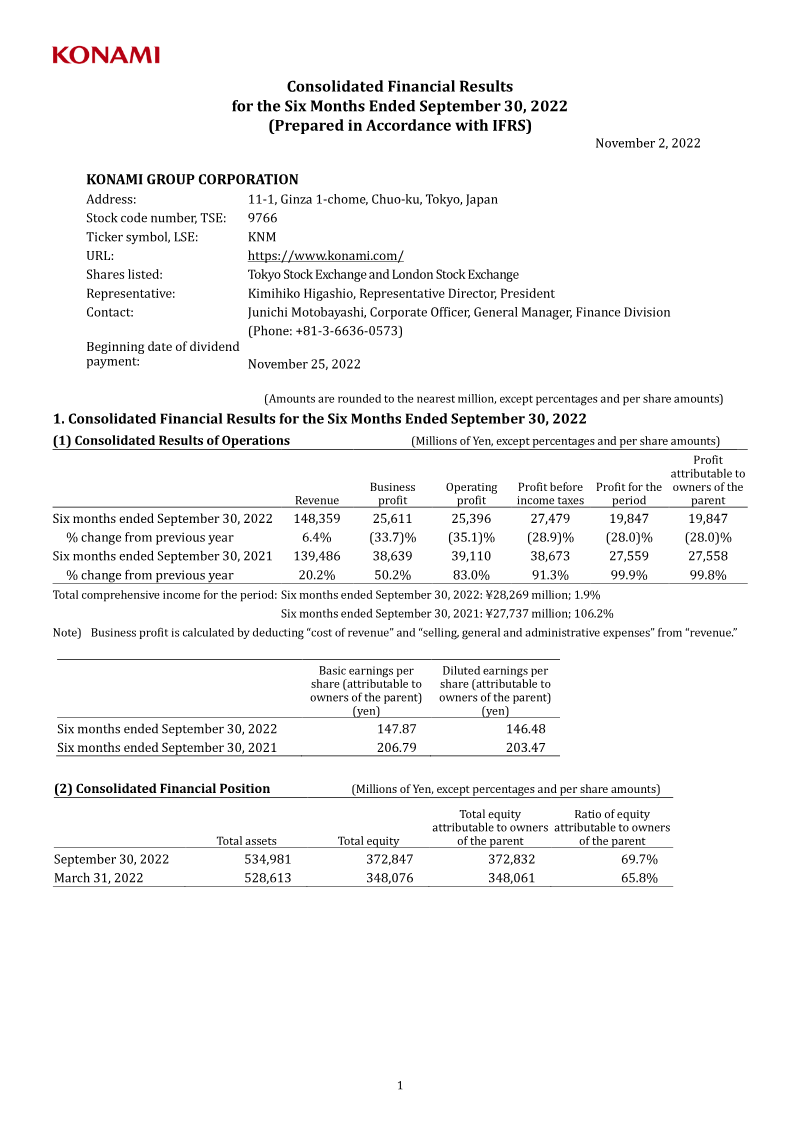
Konami Group achieved record-high revenue of ¥148,359 million for the six-month period ending September 30, 2022, representing a 6.4% year-on-year increase.
- Konami Group achieved record-high revenue of ¥148,359 million for the six months ending September 30, 2022, a 6.4% year-on-year increase driven by new titles, the Gaming & Systems segment, and the U.S. market.
- Consolidated business profit dropped 33.7% to ¥25,611 million, while net profit declined to ¥19,847 million due to rising development, marketing, and global energy costs.
- Despite margin contraction, the company maintained its full-year fiscal forecast of ¥320,000 million in revenue and ¥76,500 million in operating profit.