GameDev Reports
Media68 documents
Documents
Article
Games and Numbers: September 9 – September 21, 2026
This bi-weekly industry update provides a summary of key performance milestones for PC, console, and mobile titles between September 9 and September 21, 2026. The report serves as a tracker for sales figures, player engagement, and commercial success across the global gaming landscape.
In the PC and console sector, several established franchises and new releases reached significant sales thresholds. The Dragon Quest series surpassed 100 million lifetime copies sold, while the Phoenix Wright: Ace Attorney Trilogy exceeded 5 million units. Dave the Diver reached 10 million copies sold, with its associated paid downloadable content moving 1 million units. Recent releases also showed strong momentum: Wardogs achieved 2 million sales within its first five days of Early Access, and ReStory: Chill Electronics Repairs reached 500,000 sales in six weeks. Additionally, anticipation remains high for upcoming titles, with Phantom Blade Zero securing over 3 million wishlists ahead of its October 2026 launch, and Graveyard Keeper 2 surpassing 1 million wishlists.
The mobile gaming segment highlighted long-term revenue and recent growth trends. Age of Magic reached a cumulative $120 million in revenue over an eight-year period, supported by 20 million total downloads. Meanwhile, Ludus: Merge Arena reported $29 million in gross revenue for the first half of 2026, marking its most successful quarter to date during the second quarter of the year. These figures underscore the continued viability of both long-running live-service titles and mid-cycle mobile growth strategies.
- The Dragon Quest series has surpassed 100 million lifetime copies sold, up from 95 million in autumn 2025.
- Dave the Diver by Mintrocket has reached 10 million units sold, with its 'In the Jungle' DLC contributing an additional 1 million sales.
- Bulkhead’s Wardogs sold 2 million copies in its first five days of Early Access, significantly exceeding the 400,000-unit break-even threshold.
- The Phoenix Wright: Ace Attorney Trilogy collection has surpassed 5 million copies sold, contributing to the series' total of 15 million units as of June 30, 2026.
- Playkot’s mobile title Age of Magic has generated $120 million in revenue and reached 20 million installs over its eight-year lifespan.
+2
GameDev ReportsSept 2026

Article
The Polish Gaming Industry 2025
The Polish gaming industry is currently undergoing a period of significant contraction and structural adjustment. According to the 2025 industry report published by the Polish Agency for Enterprise Development (PARP), the sector has seen approximately one in four studios close or cease operations over the past two years. As of October 2025, there are 824 active studios and publishers in Poland, employing 14,568 people, a decline from the 15,290 recorded in previous assessments.
Financial performance reflects this downturn, with total industry revenue reaching PLN 5.52 billion in 2024, an 8% year-over-year decrease and a notable drop from the 2022 peak of PLN 6.48 billion. While major entities like CD Projekt and 11 bit studios continue to report strong financial results, the broader industry—particularly smaller studios—faces stagnation. Access to capital has become increasingly restricted, exacerbated by the expiration of state support programs at the end of 2023 and a general climate of investor caution. This lack of funding has forced many developers to release titles prematurely or pivot to smaller, lower-risk projects.
The industry’s competitive standing has also shifted. Poland has fallen from first to seventh place in Steam’s Top 200 most-anticipated games list, a decline attributed to both the current development cycles of major studios and the loss of state-backed development incentives. Despite these challenges, the sector remains heavily export-oriented, with 97% of revenue generated outside of Poland. While the immediate outlook suggests continued stagnation, there is cautious optimism regarding renewed interest from international investors in Japan, South Korea, and China, alongside government efforts to establish a new long-term development strategy for the domestic gaming sector.
- The Polish gaming industry experienced a significant contraction between 2023 and 2025, with approximately 25% of studios (at least 120 companies) closing or halting operations.
- Total industry revenue in 2024 fell to PLN 5.52 billion (€1.293 billion), an 8% year-over-year decline from the 2022 peak of PLN 6.48 billion.
- Poland’s global competitiveness has dropped, falling from 1st place in 2021 to 7th place in 2025 on Steam’s Top 200 most anticipated games list.
- Industry employment decreased from 15,290 to 14,568, with small studios struggling to hire and retain talent due to widespread budget cuts and a lack of new funding.
- State support for the industry has effectively vanished, as almost all government funding programs concluded in December 2023, leaving Polish developers at a disadvantage compared to regions like Germany.
+1
GameDev ReportsSept 2026
Article
Weekly Gaming Reports Recap: September 14–18, 2026
The global gaming market is projected to reach $213.9 billion in 2026, marking a 6.1% year-over-year increase. Despite this growth, the industry is entering a phase of decelerating expansion, prompting a strategic pivot from aggressive audience acquisition toward deeper monetization of the existing 1.65 billion spenders. While the PC segment currently leads in growth potential, the broader landscape faces notable volatility, evidenced by a 4% revenue contraction across the five largest European markets in 2025, largely attributed to a significant downturn in console performance.
Operational challenges are intensifying across the sector, characterized by a disconnect between corporate revenue growth and internal workforce stability. Although the top ten public gaming companies reported a 6.7% revenue increase in early 2026, the industry is grappling with record-low hardware shipments and declining subscription service engagement. Simultaneously, the European labor market is experiencing a marked decline in employee sentiment, with an eNPS of -9.8 reflecting widespread job insecurity. This instability is compounded by a structural transition toward project-based hiring and the integration of artificial intelligence, which has complicated talent acquisition and professional development.
Regulatory and consumer behavioral shifts are further reshaping the industry’s operational framework. PEGI has implemented its most substantial reforms since 2003, introducing stricter age-rating mandates for titles that utilize loot boxes and engagement-driven monetization mechanics. These regulatory pressures coincide with a notable shift in consumer spending habits, as average expenditures among children have declined for the second consecutive year. Despite this, parental oversight remains robust, with a vast majority of guardians actively utilizing control tools and monitoring online interactions, signaling a more cautious and regulated environment for youth-oriented gaming content.
- Global gaming market growth is decelerating, with Newzoo forecasting an average annual growth rate of 4.3% for 2026–2029, down from 6.3% between 2023 and 2026.
- PC gaming is projected to be the fastest-growing segment at 5.2% annually through 2029, while mobile growth has nearly halved and console growth is expected to remain modest at 2.6%.
- Employee sentiment in the European games industry has declined significantly, with the employee Net Promoter Score (eNPS) dropping from +9.7 in 2024 to -9.8 in 2026.
- AI adoption is reshaping industry labor, with 78% of workers reporting changes to their workflow and 35% of founders citing AI as a reason to forgo new hires.
- Full-time employment is increasingly becoming a privilege, as the industry shifts toward a model where only core staff receive benefits while most labor is hired for specific, short-term project phases.
GameDev ReportsSept 2026
Article
GameDev Reports MCP: Member Cabinet
GameDev Reports has launched a new centralized digital infrastructure, the Member Cabinet, designed to streamline access to industry research and analytical content for paid subscribers. The primary objective of this initiative is to enhance user experience by consolidating all subscription-based materials into a single, unified portal. By providing a dedicated hub, the platform aims to improve the accessibility and utility of its proprietary data for industry professionals.
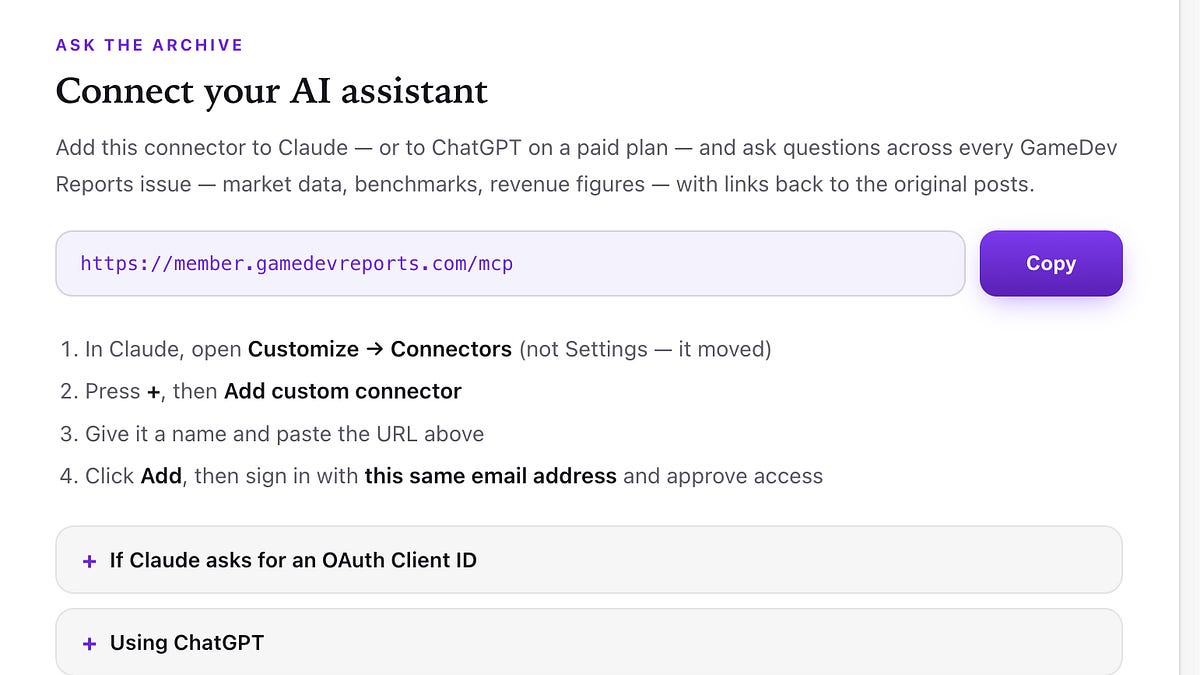
A significant feature of this update is the integration of Model Context Protocol (MCP) capabilities, which allows subscribers to interface directly with GameDev Reports materials through AI tools such as ChatGPT and Claude. This integration represents a shift toward leveraging generative AI to facilitate more efficient data retrieval and synthesis for users. By enabling direct interaction with the research database, the platform seeks to provide a more interactive and responsive environment for analyzing game industry trends.
The rollout is currently in an early-access phase, with the platform emphasizing that the system is functional but subject to ongoing refinement. Access is managed through a secure authentication process linked to the user’s existing subscription email, supporting standard sign-in methods like Google authentication. This development reflects a broader industry trend toward integrating specialized research databases with AI-driven workflows to provide subscribers with more immediate and actionable insights. The scope of this service covers the entirety of the GameDev Reports repository, catering to a professional audience seeking streamlined access to industry intelligence as of September 2026.
- GameDev Reports has launched a new member cabinet at member.gamedevreports.com to centralize content for paid subscribers.
- Paid subscribers can now access GameDev Reports materials directly within ChatGPT and Claude via the new MCP (Model Context Protocol) integration.
- Access to the member portal is managed via email authentication, with support for Google sign-in or email-based magic links.
- The platform is currently in an early-access phase, with the publisher noting that while the system is functional, it is still undergoing initial testing.
- The update, announced on September 13, 2026, consolidates all subscription benefits into a single, dedicated interface.
GameDev ReportsSept 2026
Article
Weekly Gaming Reports Recap: September 7 - September 11, 2026
This weekly industry summary provides a comprehensive overview of global gaming market performance for early September 2026, synthesizing data from mobile, PC, and console sectors. The primary focus is on August 2026 performance metrics, including revenue records, regional market shifts in Southeast Asia, and notable sales milestones for major PC and console titles.
In the mobile sector, August saw five games surpass $100 million in monthly revenue, with Gossip Harbor achieving an all-time revenue record of $112.3 million. Honor of Kings maintained its lead with $152.7 million, while Pokémon GO experienced a 50% revenue decline following its anniversary month. In Southeast Asia, the gaming market is projected to reach $5.9 billion in 2026, with a revised forecast pushing the $7 billion milestone to 2030, two years later than previously anticipated. The region now hosts over 300 million players, with Thailand emerging as the highest-spending market.
PC and console performance highlights include Onimusha: Way of the Sword selling over 1 million copies on its first day and Farming Simulator 25 reaching 5 million lifetime sales. Steam experienced record-breaking activity with over 700 new game launches in a single week, though the majority of these titles saw limited engagement. How To Fish emerged as the top-selling new Steam release in August with 6.39 million copies sold. Additionally, the industry observed a significant surge in platform traffic during the GTA 6 trailer preview, which drew 31.1 million views on Netflix, briefly causing service disruptions. These findings underscore a market characterized by high-performing established franchises alongside a saturated indie landscape on PC platforms.
- August 2026 mobile gaming saw five titles exceed $100 million in revenue, led by Honor of Kings ($144.5 million) and PUBG Mobile ($138.5 million), while Roblox slipped to fifth place with $100.6 million.
- Steam experienced a record-breaking volume of new releases in late August 2026 with 720 titles launching in one week, though 74% failed to reach ten reviews and only 10 games surpassed 1,000 reviews.
- Southeast Asia's gaming market is projected to reach over 300 million players in 2026, with Thailand expected to surpass $2 billion in annual player spending by the end of the year.
- Capcom's Onimusha: Way of the Sword sold over 1 million copies on its first day of release, marking a successful return for the franchise after a 20-year hiatus.
- The fishing-and-shooting game How To Fish was the top-selling new Steam release in August 2026, moving 6.39 million copies and generating $25.79 million in revenue.
+3
GameDev ReportsSept 2026
Article
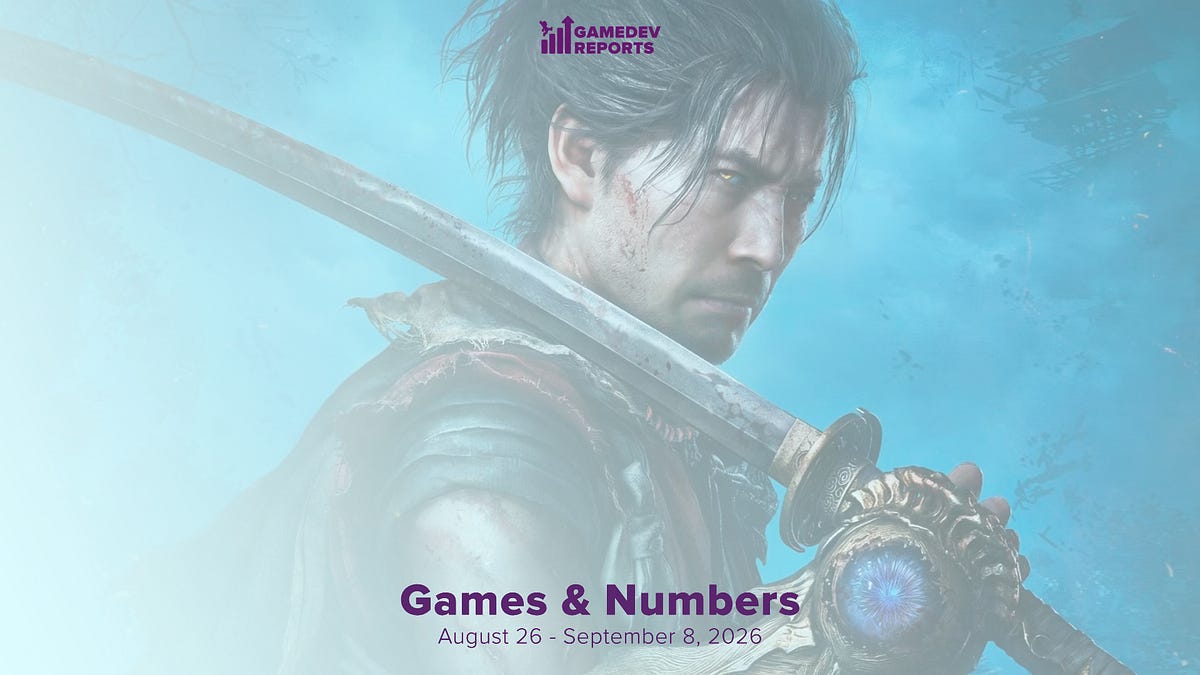
Games and Numbers: August 26 – September 8, 2026
This bi-weekly industry report provides a comprehensive overview of performance milestones and market trends across the PC, console, and mobile gaming sectors for the period of August 26 to September 8, 2026. The analysis focuses on sales figures, player engagement metrics, and platform-level activity to illustrate the current health and trajectory of the global gaming market.
Key findings highlight significant commercial successes for established and emerging titles. Farming Simulator 25 reached 5 million copies sold over 21 months, while the early-access title Manor Lords surpassed 4 million units sold in 28 months. Capcom’s Onimusha: Way of the Sword demonstrated strong market demand with over 1 million copies sold on its first day. In the mobile sector, Pokémon GO reached a significant historical milestone, accumulating over $9 billion in revenue over its ten-year lifespan, with the United States and Japan serving as the primary revenue drivers.
Platform-level data reveals a record-breaking period for Steam, which saw over 700 new game launches in a single week, though market saturation remains high as 74% of these titles failed to garner more than ten reviews. Additionally, the report notes the massive cultural impact of promotional media, specifically the GTA 6 trailer, which caused a 35% spike in Netflix viewership and temporary service outages due to high traffic. Industry events also showed positive momentum, with Gamescom 2026 drawing 368,000 visitors, reflecting a 3% increase in attendance compared to the previous year. These data points, aggregated from various industry sources and market analysts, underscore a period of high volume in content releases and sustained engagement for major intellectual properties.
- Pokémon GO has generated over $9 billion in revenue and surpassed 800 million downloads in its ten-year history, with the US and Japan accounting for over 65% of total earnings.
- Capcom’s Onimusha: Way of the Sword sold over 1 million copies on its first day of release, contributing to the franchise surpassing 10 million total lifetime sales.
- Steam set an all-time record by launching 720 games in a single week (August 24–30, 2026), though 74% of these titles failed to reach ten reviews.
- The GTA 6 trailer reached 31.1 million views on Netflix in four days, causing a 35% spike in platform viewership and a temporary service outage.
- Farming Simulator 25 has reached 5 million copies sold over 21 months, while Manor Lords has surpassed 4 million copies sold during its 28-month early access period.
+2
GameDev ReportsSept 2026
Article
Weekly Gaming Reports Recap: August 31 - September 4, 2026
This summary reviews key industry data from early September 2026, focusing on the German games market and the Japanese mobile app landscape. The analysis draws from annual industry reports, including data from YouGov, Sensor Tower, Adjust, and the German trade association "game," covering performance metrics through the first half of 2026.
The German games market experienced 4% growth in 2025, reaching €9.382 billion, though the first half of 2026 saw a 3% year-over-year decline to €4.2 billion. While hardware and online services previously drove growth, recent figures indicate a cooling period. The industry currently comprises 956 companies, reflecting a return to growth after a brief contraction, though total headcount has slightly decreased to 12,235. Notably, German-developed titles capture only a small fraction of domestic consumer spending, highlighting a reliance on international products.
In Japan, the mobile app market shows shifting consumption patterns. While mobile game installs grew 3% in the first half of 2026, the composition of top-grossing apps is changing; games now represent only four of the top ten apps by consumer spend, down from eight in 2024. Card games emerged as the fastest-growing genre, with a 113% increase in sessions. Despite a rise in retention rates compared to 2025, the market faces a decline in paid-to-organic ratios and lower costs per install. Overall, the Japanese mobile sector is increasingly influenced by non-gaming verticals, particularly finance and manga services, which are capturing significant consumer attention and spending.
- The German games market saw a 3% year-over-year revenue decline in H1 2026 to €4.2 billion, driven by an 8% drop in hardware sales and a 1% decrease in game sales.
- Germany's games industry headcount fell 3% year-over-year to 12,235 employees, though the total number of game companies rebounded to 956, a 4% increase from 2025.
- Digital distribution dominates the German market at 69% of all game purchases, rising to 99% for PC titles, while console digital sales remain at 42%.
- Gamescom 2025 achieved record-breaking engagement with 357,000 visitors and 1.1 billion total views across all video formats, representing a 101% year-over-year increase in viewership.
- In Japan's mobile market, the share of games in the top 10 by consumer spend has decreased, with only four games present in Q1 2026 compared to eight in 2024.
+2
GameDev ReportsSept 2026
Article
Weekly Gaming Reports Recap: August 24 - August 28, 2026
Newzoo now puts the 2026 gaming market at $213.9 billion, up 6.1% YoY; Bain & Company expects it to reach just $232 billion by 2029.
- The global games market generated $263.7 billion in 2025, with mobile gaming accounting for 61% of total revenue ($160.6 billion) and PC/console contributing 38% ($101.6 billion).
- The worldwide player base is projected to reach 3.7 billion in 2026, a 4.4% year-over-year increase, with mobile platforms capturing 84% of all players.
- Grand Theft Auto VI has secured 4.55 million pre-orders generating $446 million in revenue, with 77% of pre-orders originating on PS5 and 90% of buyers opting for the $100 Ultimate Edition.
- Cyprus has emerged as a high-growth gaming hub, expanding at 18% annually—significantly faster than the 4% average growth rate for European studios—though new releases struggle to generate revenue compared to established titles.
- In 2026, the Asia-Pacific region will account for 47% of global market revenue ($100.7 billion), while the US and China combined will represent 52% of total consumer spending.
GameDev ReportsAug 2026

Article
Games and Numbers: August 12 — August 25, 2026
This bi-weekly industry update provides a snapshot of performance milestones for various PC, console, and mobile titles between August 12 and August 25, 2026. The report focuses on sales figures, revenue generation, and player engagement metrics to illustrate the current commercial health of both major AAA releases and notable independent titles.
Key findings highlight significant commercial momentum for several high-profile games. Meccha Chameleon reached 20 million copies sold within two months of release, while ARC Raiders has generated approximately $551 million in total revenue since its October 2025 launch. Pre-orders for GTA VI have already secured $446 million in revenue, with a strong preference for the $100 Ultimate Edition among consumers. Additionally, Pokémon Pokopia has achieved 5 million units sold, representing a significant attach rate for the Nintendo Switch 2 console.
The data also underscores the impact of marketing and promotional events on long-term engagement. A free giveaway for Moonlighter attracted 7 million new players in five days, effectively doubling its seven-year player base. Similarly, the release of a new film helped drive a resurgence for Marvel’s Spider-Man 2, which saw daily player counts exceed 1 million for the first time since 2023. Other notable performance markers include 007 First Light reaching 4 million units sold in three months and various titles, such as Big Walk and Machine Party, surpassing the 1 million copies sold threshold shortly after launch. The report draws from industry sales trackers, financial disclosures, and developer announcements to provide a comprehensive overview of the global gaming market's current trajectory.
- GTA VI has generated $446 million in revenue from 4.55 million pre-orders, with 90% of buyers opting for the $100 Ultimate Edition and 77% of orders originating on PS5.
- Meccha Chameleon achieved 20 million copies sold within two months of its release on Steam.
- ARC Raiders has reached 16.3 million units sold since its October 2025 launch, generating approximately $551 million in total revenue.
- Marvel’s Spider-Man 2 saw a resurgence in engagement following a movie premiere, with daily players exceeding 1 million for the first time since 2023 and total lifetime sales reaching 18.2 million units.
- Pokémon Pokopia has sold over 5 million copies in four months, representing an attach rate of roughly one in five Nintendo Switch 2 owners.
+2
GameDev ReportsAug 2026

Article
CYGMA: The Cyprus Video Game Industry 2025
The 2025 Cyprus Video Game Industry report, published by the Cyprus Game Makers Association (CYGMA), provides a comprehensive analysis of the nation’s gaming sector, highlighting its significant global influence relative to its small population. The report serves as a definitive baseline for the industry, utilizing data from sources including BCG, Sensor Tower, Newzoo, and the Registrar of Companies to evaluate market performance, employment trends, and investment activity.
Cyprus has established itself as a global leader in the mobile gaming space, ranking first in the world for companies, revenue, and mobile downloads per capita. In 2025, the island hosted 415 game companies, which collectively generated over €3.2 billion in revenue. The sector has become a vital component of the national economy, with its contribution to GDP rising from approximately €300 million in 2019 to €1.15 billion by 2024, representing 3.3% of the total GDP. While mobile gaming remains the primary engine of growth—accounting for 615 million downloads in 2025—the industry faces the common challenge of relying heavily on legacy titles, as only 4% of annual revenue originated from new releases.
The report also details a robust ecosystem for corporate growth and investment. Between 2019 and 2024, the number of registered gaming companies grew by 133%, while the workforce expanded by 200% to 4,320 employees. Financial activity remains active, with €2.76 billion in M&A deals recorded between 2020 and 2025. Furthermore, the industry benefits from favorable tax incentives, including an IP Box regime that effectively taxes game IP profits at approximately 3% and an R&D super-deduction program. These findings underscore Cyprus's position as a high-growth hub for international game development, characterized by a rapid expansion rate that significantly outpaces the broader European market.
- Cyprus leads the world in games companies, revenue, and mobile downloads per capita, with 415 active companies generating over €3.2 billion in 2025.
- The video game sector's contribution to Cyprus's national GDP grew significantly from approximately €300 million (1.3%) in 2019 to €1.15 billion (3.3%) in 2024.
- Mobile gaming is the primary economic driver in Cyprus, accounting for roughly €1.8 billion in revenue in 2025, with the vast majority generated by legacy titles rather than new releases.
- Between 2020 and 2025, Cyprus-based companies participated in 21 exits worth a combined €2.76 billion, highlighted by Miniclip’s €1.06 billion acquisition of Easybrain in 2025.
- Employment in the Cyprus games industry tripled from 1,438 people in 2019 to 4,320 in 2024, though the rate of growth for both headcount and new company formation slowed by 2024.
GameDev ReportsAug 2026
Article
Weekly Gaming Reports Recap: August 17 – August 21, 2026
The global gaming industry is currently navigating a period of significant structural realignment, characterized by a contraction in traditional console and PC sectors alongside shifting regional growth patterns. During the first half of 2026, the mobile gaming market experienced a 2% decline in in-app purchase revenue and an 11.9% drop in downloads. While the puzzle genre emerged as a primary driver of revenue gains, mid-core and RPG segments faced notable downturns. This volatility is compounded by broader labor instability, with the industry on track to reach a record 14,666 job losses by the end of the year.
Market dynamics reveal a clear consolidation of power among advertising platforms, as AppLovin and AdMob now control nearly 65% of the mobile game ad revenue market. Paid acquisition remains the dominant strategy, though the rise of hypercasual titles and aggressive ad spending by newcomers indicates a highly competitive landscape. While the United States market struggles with a 2% year-to-date decline and a 29% drop in hardware sales due to rising costs and lower unit volume, other regions are thriving. India’s gaming sector is on a strong growth trajectory toward a $1.77 billion valuation by 2030, and China’s domestic market has demonstrated resilience with a 12.17% year-over-year increase.
PC and console sectors are currently facing a paradox of record-high release volumes paired with declining revenue and unit sales. Despite this, niche segments such as browser-based gaming remain stable, particularly within Asian markets. The industry’s overall performance remains bifurcated, with legacy hardware and mid-core mobile titles struggling to maintain momentum while specific high-performing mobile applications and emerging regional markets provide necessary growth. These trends collectively signal a transition toward a more fragmented global ecosystem where success is increasingly dependent on regional adaptation and efficient user acquisition strategies.
- China’s domestic gaming market grew 12.17% year-over-year in H1 2026 to approximately $27.9 billion, driven by increased revenue per user rather than player base expansion, which grew only 0.82% to 684 million.
- The gaming industry is projected to see 14,666 job losses in 2026, an increase of 788 from the previous month's forecast.
- Mobile IAP revenue saw significant regional declines, including $648 million in US Casino, $297 million in Korean RPG, and $229 million in Japanese RPG, partly due to a shift toward direct-to-consumer (D2C) payment models.
- Honor of Kings reclaimed the top spot for IAP revenue with $1.078 billion, while Last War: Survival and Whiteout Survival both experienced 16% revenue declines.
- Major publishers show varying levels of single-project dependency in 2026, with NBA 2K26 accounting for 34.4% of 2K's copies sold, while Ubisoft maintains a more diversified portfolio with The Crew Motorfest representing only 7.3%.
+1
GameDev ReportsAug 2026
Article
Layoffs in the Gaming Industry: 2026
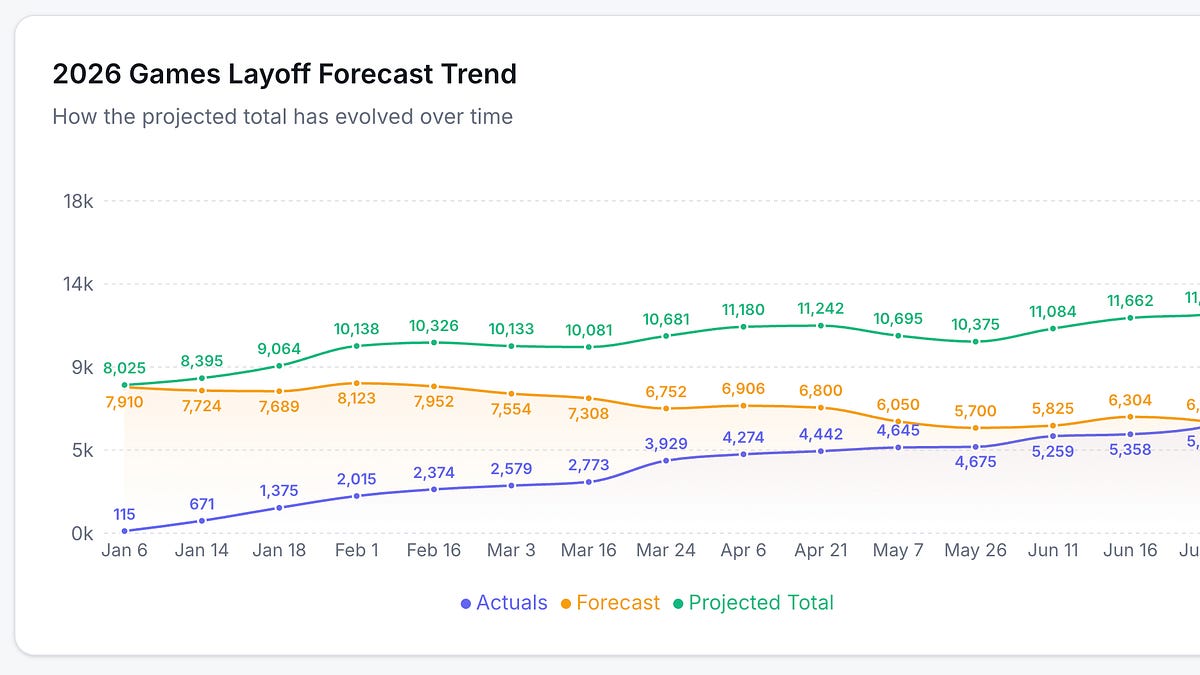
The gaming industry is currently experiencing a significant period of workforce contraction, with projections indicating that 14,666 employees will lose their jobs throughout 2026. This forecast has been revised upward by nearly 83% since the beginning of the year, reflecting a worsening trend in industry stability. As of August 11, 2026, 10,140 layoffs have been confirmed, with an additional 4,526 expected before the year concludes. While 2024 remains the record year for industry job losses, the current trajectory suggests that 2026 could potentially surpass previous annual totals.
The data, compiled from public sources by industry analyst Amir Satvat, highlights a high concentration of job losses within specific regions and organizations. North America is the most heavily impacted, accounting for 66% of all layoff events and approximately 79% of affected personnel, with the United States alone representing 48% of the total. Europe follows with roughly 30% of the impact. Furthermore, the industry is seeing a high degree of consolidation in these losses; the five largest reduction events account for 56% of the total, with major entities like Microsoft contributing significantly to these figures.
Over the five-year period from 2022 to 2026, the industry has recorded a total of 58,494 layoffs. The persistent nature of these reductions, coupled with the fact that 2026 has already exceeded the annual totals of 2022, 2023, and 2025, underscores a challenging environment for gaming professionals. The ongoing reliance on public data tracking remains a critical tool for monitoring these shifts in the global gaming labor market.
- The gaming industry is projected to reach 14,666 total layoffs in 2026, with 10,140 jobs already confirmed lost as of August 11.
- While 2024 remains the record year for industry job losses with 15,631, the 2026 forecast has increased by nearly 83% since January and could potentially set a new record by year-end.
- North America is the primary center of these reductions, accounting for 79% of affected personnel and 66% of all layoff events, with the U.S. alone representing 48% of the total.
- Layoff activity is highly concentrated, as the five largest reduction events account for 56% of all job losses, with the top two events alone responsible for approximately 44%.
- Microsoft significantly impacted 2026 figures by cutting 1,600 roles from its gaming division, with an additional 1,600 cuts expected over the following year.
+1
GameDev ReportsAug 2026