Left 4 Dead
7 documents in the library are about Left 4 Dead, from writers such as Game Developers Conference, Alinea Analytics and Extra Credits, the newest from 2026. Each has a summary and key insights with the page they come from.

Left 4 Dead is a cooperative first-person shooter set during a zombie outbreak on the East Coast of the United States. Four players control survivors who must fight through hordes of infected humans, creatures transformed by a rabies-like pathogen that causes extreme aggression and loss of higher brain function. Gameplay emphasizes teamwork, with colored outlines showing teammate positions through walls, shared healing items, and friendly fire creating consequences for careless shooting. An AI system called the Director dynamically adjusts enemy placement, item spawns, and pacing based on player performance. Beyond common infected, players face five special mutated types with unique abilities. Campaigns are divided into levels connected by safe houses, each culminating in a desperate last stand for rescue.
- Released
- Nov 17, 2008
- Developers
- Valve, Turtle Rock Studios
- Publisher
- Electronic Arts
- Genres
- Shooter
- Platforms
- PC (Microsoft Windows), Mac, Xbox 360
- Links
- Wikipedia
Game data from IGDB.com
Documents about Left 4 Dead
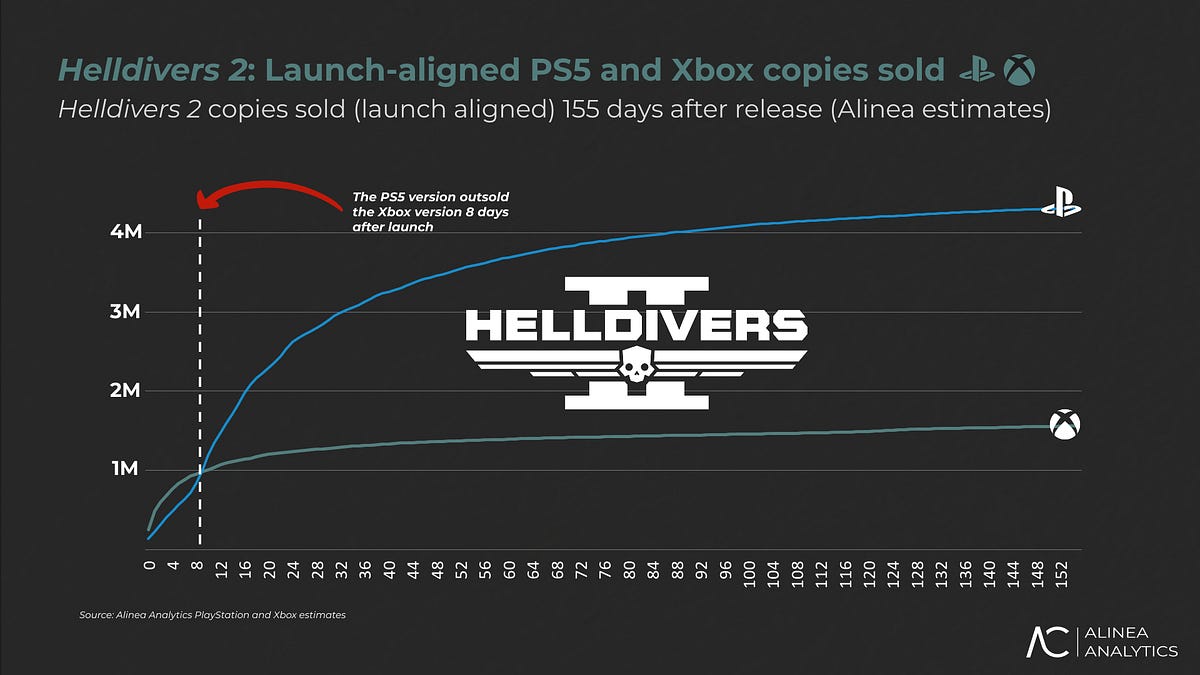
Helldivers 2 Sales and Co-op Market Analysis
Helldivers 2 has achieved significant commercial success, reaching 20 million copies sold across Steam, PlayStation 5, and Xbox as of January 2026. This performance has generated over $700 million in gross revenue.
- Helldivers 2 has surpassed 20 million copies sold across all platforms, generating over $700 million in gross revenue.
- Steam is the primary driver of the game's success with 13.1 million copies sold, significantly outperforming the 5.6 million units sold on PS5.
- The August 2025 Xbox launch contributed 1.6 million units to the total, helping the title reach its 20 million milestone.

Video Game Difficulty is Hard (But It Doesn't Have To Be) | Extra Credits Gaming
Traditional difficulty settings in video games often fail to serve players effectively because they require users to commit to a specific challenge level before they have experienced the game’s mechanics.
- Traditional difficulty settings often fail because they force players to make a permanent choice before they have experienced the game's mechanics or pacing.
- Player ego frequently prevents users from lowering difficulty settings; developers report that many players would rather quit a game entirely than switch to 'easy' mode.
- Adaptive difficulty systems, such as the 'game rank' feature in Resident Evil 4 or 'automatic challenge tuning' in Ratchet & Clank, secretly adjust mechanics like enemy health and item drops based on real-time player performance.

Valve's "Secret Weapon"
Valve’s development philosophy centers on the rigorous and iterative use of playtesting as a primary mechanism for game design.
- Valve treats game mechanics as scientific hypotheses, using frequent playtesting to validate design decisions with observed player behavior rather than relying on verbal feedback.
- The studio mandates weekly playtesting cycles from the earliest stages of production to identify pacing issues and design flaws before they become systemic.
- Designers are required to conduct their own observations in silence to ensure they gain firsthand, unbiased insight into how users interact with the game world.

Procedural Regeneration: Matching the World to the Player
Procedural regeneration represents an evolution of traditional procedural generation, shifting the focus from static world creation to the dynamic alteration of level design in response to player performance and behavior.
- Procedural regeneration shifts game design from static construction to dynamic, AI-driven environments that adjust in real-time based on player skill, health, and behavioral choices.
- The 'outward' regeneration model, utilized in games like Left 4 Dead, monitors player state to dictate future challenges such as enemy spawns and path difficulty.
- The 'inward' regeneration model, exemplified by the title Eternity, uses continuous environment shuffling and double-buffering techniques to transform physical space during gameplay.
Keep it Together: Encouraging Cooperative Behavior During Co-op Play
Effective cooperative play relies on the principle of shared intentionality, where players transform individual motives into collective goals through negotiation and social cohesion.
- Designers should support 'collective agency' by creating systems that encourage players to negotiate actions and cooperate to achieve goals, rather than focusing solely on individual player agency.
- Cooperative mechanics exist on a continuum of coerciveness, ranging from highly prescriptive constraints that force interdependence to voluntary systems where players choose to collaborate for better efficiency.
- Players are more likely to cooperate when they realize that working together—such as coordinating tactics to manage AI detection models—significantly increases their chances of success compared to playing solo.

Biofeedback in Gameplay: How Valve Measures Physiology to Enhance Gaming Experience
Biofeedback serves as a transformative tool for quantifying player sentiment and enhancing the interactivity of digital environments.
- Valve utilizes real-time biometric data, including heart rate, skin conductance, and eye tracking, to replace estimated intensity levels in dynamic systems like the Left 4 Dead Director.
- Integrating physiological measurements allows developers to calibrate game difficulty and pacing with precision by incorporating a player's internal emotional state directly into the feedback loop.
- Research indicates that while players are highly responsive to in-game avatars that mirror their physiological states, direct visualization of these metrics can inadvertently increase player frustration.

AI-driven Dynamic Dialog through Fuzzy Pattern Matching
Dynamic dialogue systems in modern gaming rely on fuzzy pattern matching to create reactive, context-aware character interactions without the burden of extensive custom programming.
- Dynamic dialogue systems utilize fuzzy pattern matching to enable reactive, context-aware character interactions without requiring extensive custom programming.
- The architecture represents the game world as a flat database of key-value pairs, allowing writers to create complex narratives that respond to procedural gameplay through a rule-based framework.
- System relevance is maintained by selecting the most specific match—defined by the highest number of matching criteria—when multiple potential responses exist.