Lake
Game
Documents about Lake
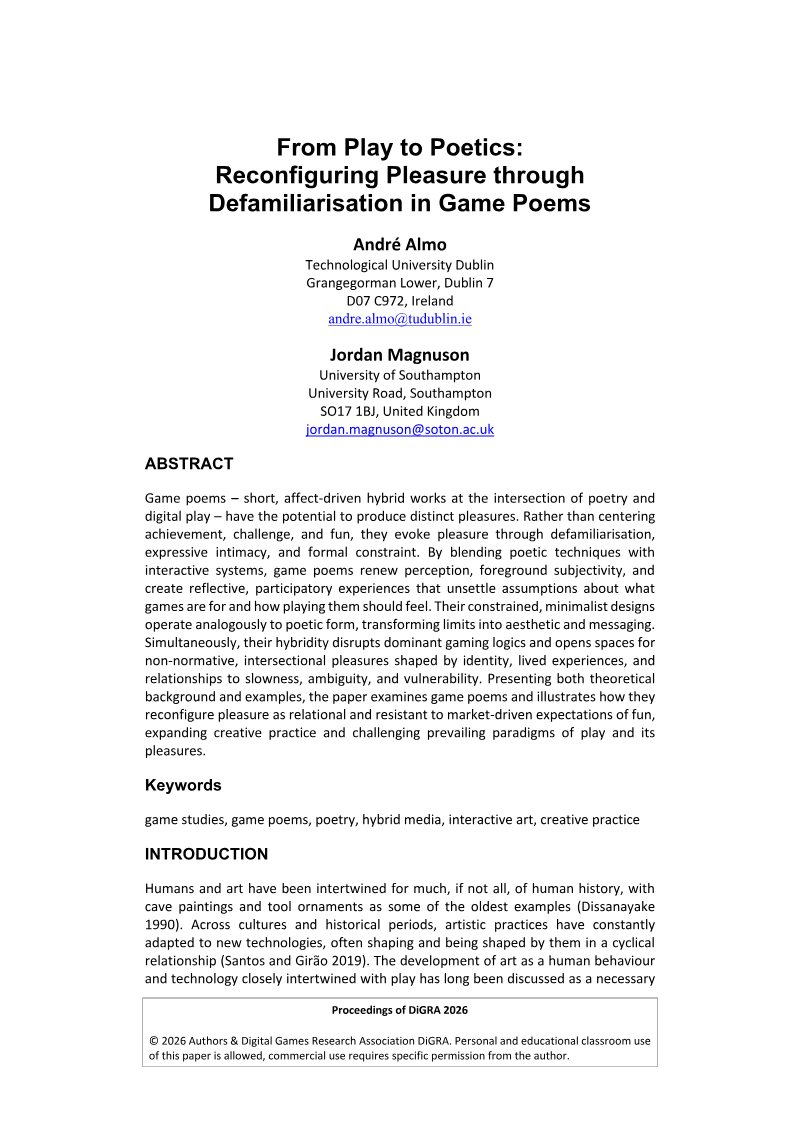
From Play to Poetics: Reconfiguring Pleasure through Defamiliarisation in Game Poems
Game poems, the short, affect-driven hybrids of poetry and digital play examined in this paper, are presented as a distinct poetics of play that locates pleasure in expression, subjectivity, and affective resonance rather than in the conventional goals of fun, mastery, and completion.
- Game poems are presented as a distinct poetics of play that locates pleasure in expression, subjectivity, and affective resonance rather than in conventional goals of fun, mastery, and completion.
- The authors argue that game poems generate reflective, intersectional, and even "no-fun" modes of engagement through defamiliarisation, expressive intimacy, and formal constraint, thereby expanding what counts as pleasurable play and legitimate game design.
- The argument draws on lyric poetry and constraint-based movements such as Oulipo and Dogme 95, contending that mechanical, temporal, or social limits generate intensity and originality rather than diminishing them.



Global Gaming Report Q3 2025
Drake Star's Q3 2025 analysis portrays the quarter as a landmark for gaming M&A and a recovery period for private financing, set against strong public equity performance.
- Investors are heavily favoring platform-centric companies over traditional hardware manufacturers, with high-growth firms like AppLovin and Nvidia commanding EV/EBITDA multiples exceeding 25x, compared to roughly 1x for legacy hardware firms like Dell and HP.
- Roblox led equity performance with a 136.9% year-to-date appreciation, driven by successful user engagement and monetization strategies.
- Unity recorded a 77% year-to-date gain, underscoring the market's high valuation of cross-platform development tools and real-time 3D content adoption.
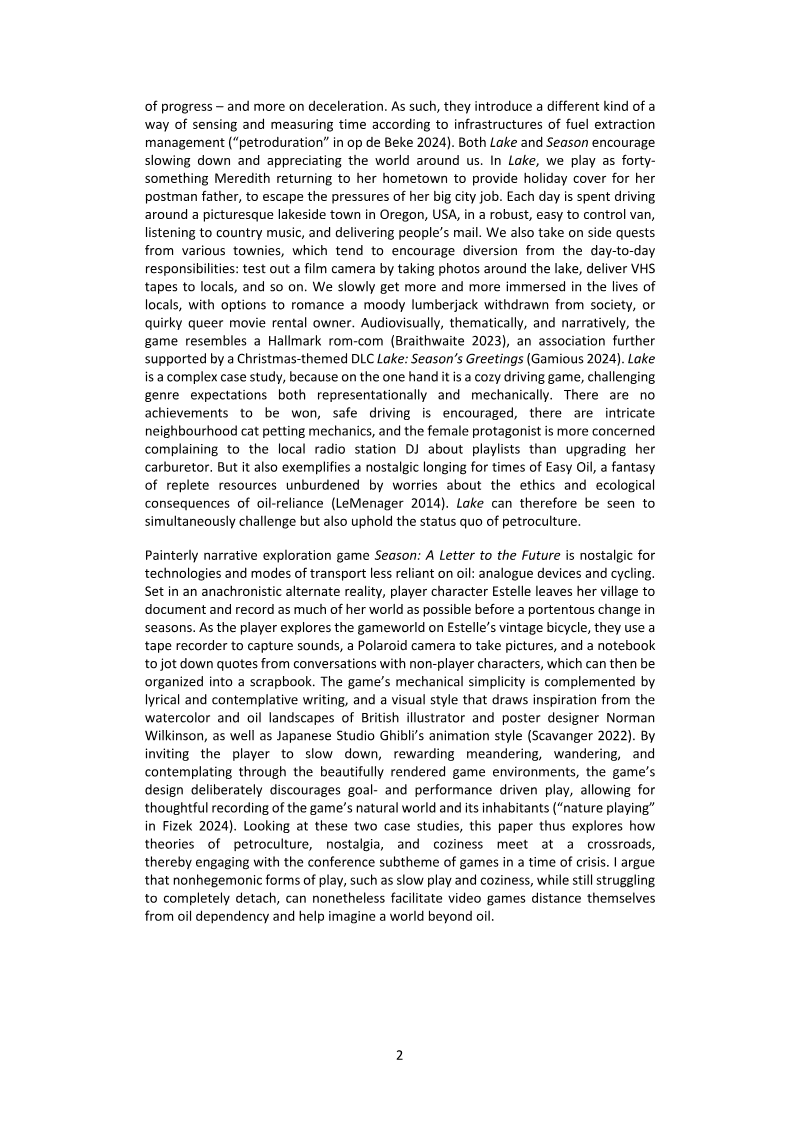
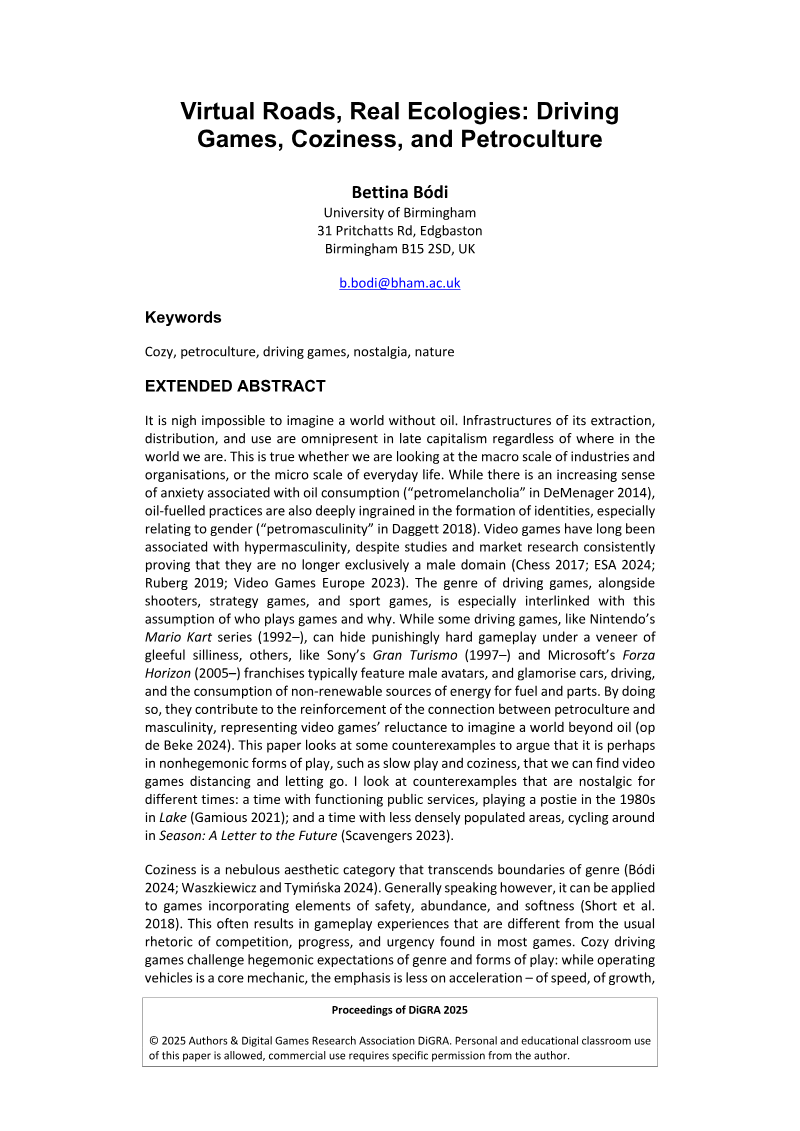
Virtual Roads, Real Ecologies: Driving Games, Coziness, and Petroculture
This paper examines how driving video games, typically associated with petroculture and masculine fantasies of speed and consumption, can be reframed through the aesthetic category of coziness.
- The paper argues that mainstream driving franchises such as Gran Turismo and Forza Horizon reinforce a link between fossil fuel consumption and masculine identity, drawing on concepts like petromasculinity and petromelancholia.
- Its central claim is that slow play and coziness are nonhegemonic forms of play that can help driving games distance themselves from oil dependency and begin imagining a world beyond it.
- The author identifies 'petroduration' as a distinct way of experiencing time not organised around fuel extraction and acceleration, which cozy driving games cultivate by deliberately decelerating genre rhythms of progress and performance.
Is a Board Game Suitable for Teaching Complex Natural Systems?
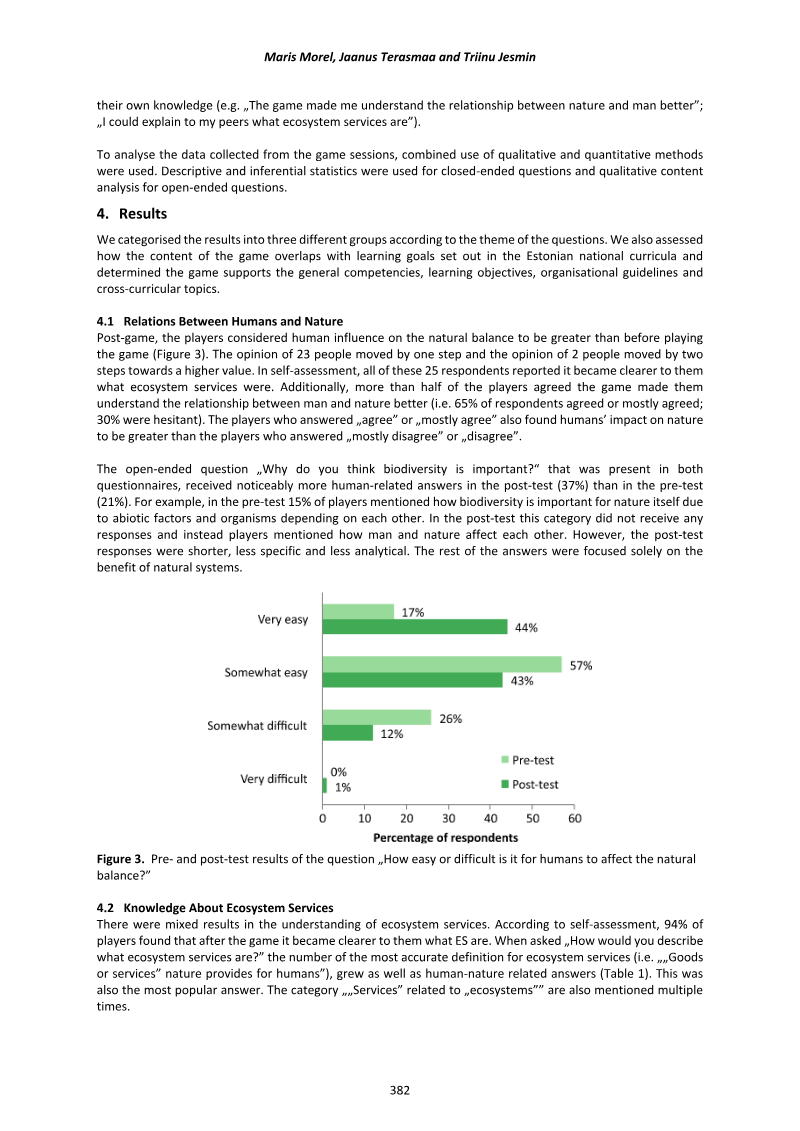
The document examines whether the Estonian board game "End of the World Begins in Kurtna" can effectively teach ecosystem services, which are difficult to convey through conventional text because they operate through nonlinear, interconnected relationships.
- The board game "End of the World Begins in Kurtna" uses role cards, development and ecosystem service cards, and a Doomsday Clock tracking ecosystem health to teach causality, cooperation, and sustainability, using the Kurtna Lake District as a real-world case of human-nature conflict.
- A mixed-methods study of 84 participants aged 12 to 26 found high engagement, with 80% finding the game interesting and 78% finding it engaging, and most reporting a clearer grasp of human-nature relationships and ecosystem services.
- Despite engagement, post-game explanations were shorter and less analytical than pre-game responses, and only 19% of players felt confident explaining ecosystem services to peers.
Blank Arcade: Exhibition of Games and Toys as Art
The Blank Arcade is a recurring exhibition of games, play art, and interactive media, organized by Lindsay Grace of American University in association with the Digital Games Research Association's annual conference.
- The Blank Arcade is a recurring games-and-play art exhibition organized by Lindsay Grace of American University in association with the Digital Games Research Association's annual conference, aiming to bring game art practice and history into the game studies community.
- Prior editions were held in Salt Lake City (2014), Lüneburg, Germany (2015), and Dundee, Scotland (2016), and the abstract proposes a 2018 edition.
- The model is designed to be sustainable for host conferences: organizers handle curation, outreach, advertising, and web hosting, while local hosts provide space, equipment, and logistics, with sponsorships sometimes covering shipping and catering.
Exploring the Potential Impact of Serious Games on Social Learning and Stakeholder Collaborations for Transboundary Watershed Management of the St. Lawrence River Basin
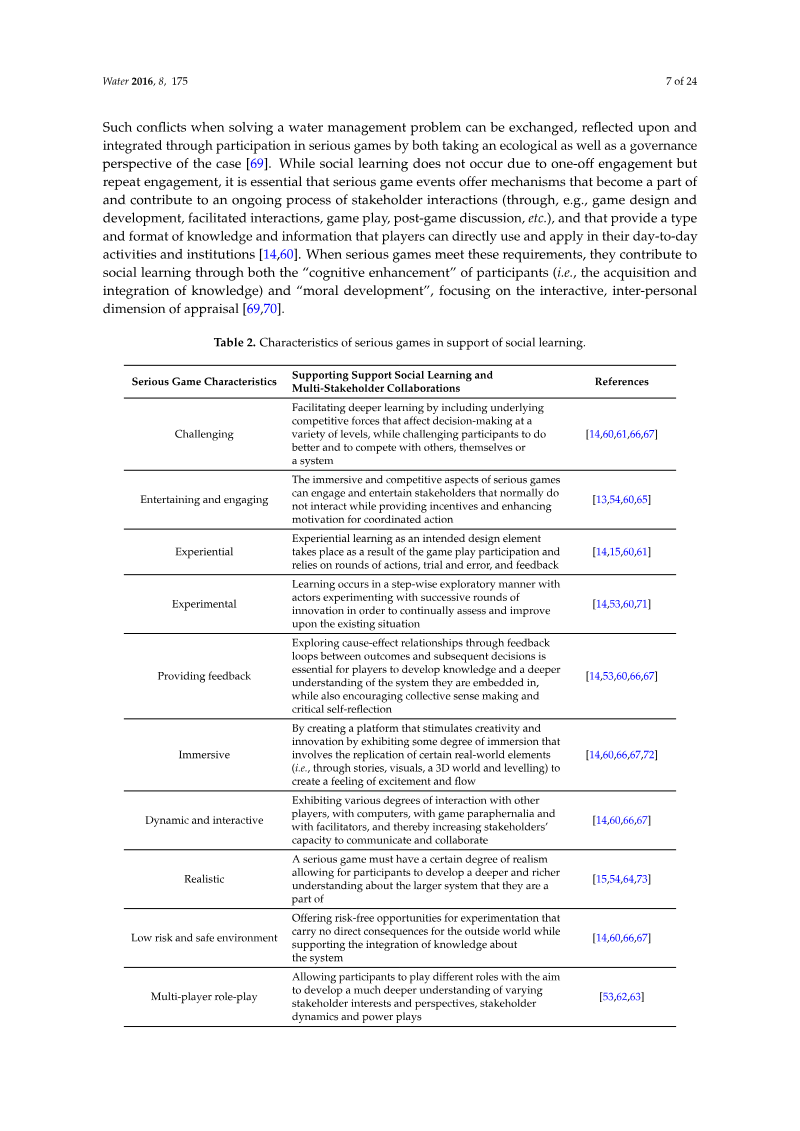
This study examines whether serious games, which combine computer simulation with role-play, can strengthen social learning and stakeholder collaboration in transboundary water governance of the St. Lawrence River Basin, a system spanning two countries, multiple Canadian provinces, and numerous local jurisdictions.
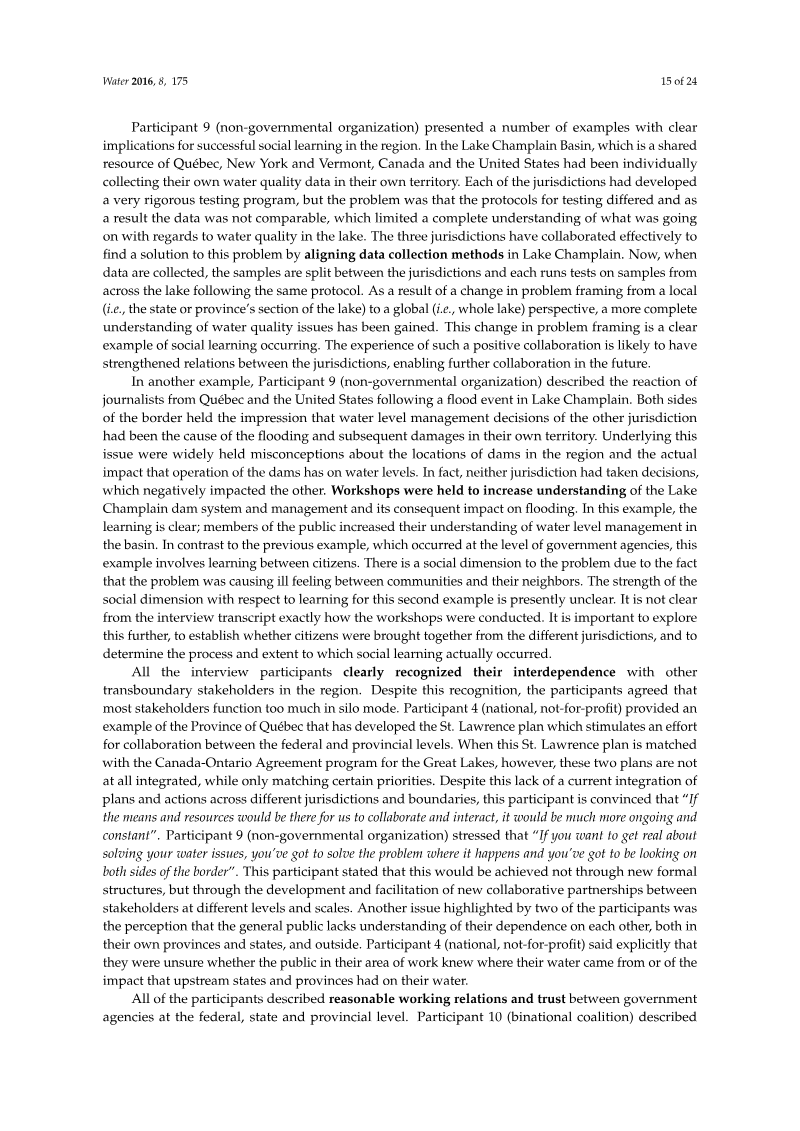
- Social learning in St. Lawrence River Basin transboundary water governance is occurring only in isolated cases rather than as routine practice, and the study proposes serious games (computer simulation combined with role-play) as a bottom-up tool to strengthen it.
- Jurisdictional fragmentation and inconsistent policy are central obstacles, illustrated by the American eel being listed as endangered in Ontario but not in Québec.
- Communication is judged adequate at the federal level but weak between provincial and state agencies, which often operate in silos even where shared Great Lakes Agreement goals apply.