Combat
Game
Documents about Combat
Robocalypse Now: Using Deep Learning to Combat Cheating in Counter-Strike: Global Offensive
Counter-Strike: Global Offensive maintains competitive integrity through a sophisticated, multi-layered anti-cheat strategy that balances technical mitigation with deep learning innovation.
- VACnet, a deep learning model trained on historical human review data, achieves conviction rates between 80% and 95%, significantly outperforming the 15% to 30% success rate of manual player reports.
- The Trust Factor system maintains competitive integrity by isolating suspected cheaters into separate matchmaking pools, effectively containing the impact of malicious actors on the general player base.
- VACnet identifies suspicious behavior by analyzing granular telemetry, including weapon performance, hit results, and player view angles.
Until You Fall: Building Satisfying VR Combat on a Budget
Effective virtual reality combat design relies on prioritizing the core gameplay loop over high-fidelity, physics-based interactions that often introduce unnecessary friction.
- Prioritize the core player fantasy over universal interactivity by cutting secondary VR features that do not directly serve the primary gameplay loop, such as picking up environmental objects or enemy weapons.
- Combat the 'waggle' effect by mechanically incentivizing exaggerated, high-effort movements, ensuring that the most effective way to play the game is also the most physically engaging and visually rewarding.
- Avoid the 'immersion trap' by establishing a baseline for interaction fidelity and removing any features that fall below that threshold, which helps control development scope and prevents gameplay friction.

GAME DEV: I Played Your Games. (Again.)
Solo game development requires a disciplined approach that prioritizes polish and intuitive design over sheer content volume.
- Prioritize high-quality polish and intuitive design over content volume to avoid the negative stigma associated with asset flips.
- Focus on smaller, highly refined projects rather than overly complex scopes to ensure consistent UI and asset quality.
- Improve player focus by placing critical status indicators near the player character instead of in peripheral screen corners.
Learning to Play Magic - Part 1 - Core Concepts - Extra Credits
This instructional overview outlines the fundamental mechanics of the collectible card game Magic: The Gathering, focusing on turn structure, resource management, and combat dynamics.
- The primary objective of Magic: The Gathering is to reduce an opponent's life total from 20 to zero using spells and creatures.
- Players must manage lands, which function as the essential resource known as mana, to cast cards and execute strategies.
- The game follows a structured seven-phase turn sequence: untap, upkeep, draw, first main phase, attack phase, second main phase, and end step.
Authored vs. Systemic: Finding a Balance for Combat AI in Uncharted 4
The development of combat AI in Uncharted 4 represents a strategic shift toward a hybrid architecture that reconciles the rigidity of authored scripting with the flexibility of systemic design.
- Uncharted 4 transitioned to a hybrid AI architecture that blends rigid authored scripting with systemic design to accommodate larger, non-linear, and vertical environments.
- Purely systemic, automated AI was rejected because programmatic navigation and heat-based search behaviors failed to deliver the consistent, human-like performance required for the franchise.
- The development team implemented a 'Hard Points' system, where designer-placed objects provide dynamic anchor points for NPC navigation and positioning.
Hacking into the Combat AI of Watch Dogs 2
The combat artificial intelligence in Watch Dogs 2 relies on a multi-layered cover-selection system designed to balance tactical realism with computational efficiency.
- Watch Dogs 2 AI agents evaluate cover selection based on three primary criteria: distance to the target (optimized for weapon range), line of sight (ensuring a valid field of fire), and proximity to other agents (to avoid clumping and vulnerability to area-of-effect damage).
- To mitigate the player's ability to 'cheese' combat using unreachable vantage points like scissor lifts, developers implemented a special 'unreachable' AI mode where agents prioritize survivability and lateral movement toward cover rather than pathing directly toward the player.
- The AI uses three distinct cover-seeking behaviors: 'first cover' for immediate protection, 'neighboring cover' for repositioning during combat, and 'second cover' for tactical flanking or optimizing weapon range.
Embracing Push Forward Combat in DOOM
The design philosophy behind the modern DOOM series centers on the concept of push-forward combat, a paradigm shift that rejects the defensive, cover-based mechanics prevalent in contemporary shooters.
- The 'Push Forward Combat' philosophy mandates that players must remain aggressive and mobile to succeed, utilizing mechanics like glory kills to replenish resources rather than relying on traditional cover-shooter mechanics like reloading.
- To maintain high-intensity pacing, developers implemented a three-tier enemy control hierarchy—twitch, falter, and stagger—which allows players to interrupt AI behavior and create openings for finishing moves.
- AI accuracy is intentionally tuned to miss when the player is moving, creating a dynamic where players feel empowered by speed and threatened when standing still, rather than relying on purely random accuracy offsets.
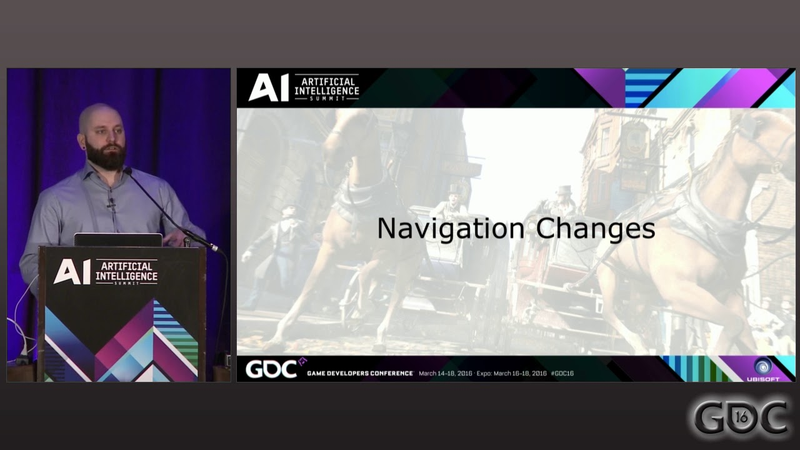
What Are You Driving At? Vehicle AI in Assassin's Creed Syndicate
The implementation of vehicle artificial intelligence in Assassin’s Creed Syndicate was driven by the need to integrate dynamic, physics-based carriages into a world defined by parkour, stealth, and historical accuracy.
- To integrate carriages into Assassin's Creed Syndicate, developers implemented 'navmesh patching,' which dynamically alters the navigation mesh by punching holes in it based on the vehicle's rigid body size to allow NPCs to interact with moving vehicles.
- Due to the high computational cost of navmesh patching, the system was limited to updating only one vehicle per frame and prioritized patching based on the vehicle's proximity to the player.
- The team utilized 'virtual vehicles'—fake entities existing in virtual space—to group NPCs by faction, allowing multiple NPCs to spawn with a single vehicle request rather than spawning individual vehicles for every enemy.
Getting Inquisitive About the AI of Dragon Age Inquisition
The development of Dragon Age: Inquisition necessitated a fundamental shift in artificial intelligence architecture to accommodate the transition to the Frostbite engine and the demands of an expansive, open-world environment.
- BioWare utilized a decision tree architecture with a visual node editor to manage complex combat logic, allowing party members to evaluate and select from over 90 unique abilities dynamically.
- To handle ability selection, the combat system uses a scoring-based evaluation where each potential action is assigned a value, allowing the AI to choose the most effective move regardless of the order in which abilities are processed.
- The AI system incorporates 'fear zones' and 'tether zones' to manage creature movement and combat boundaries, ensuring NPCs avoid environmental hazards like fire while preventing them from being kited indefinitely by players.
Solving Titan-Sized Problems: Evolving Titan Combat in Titanfall 2
The evolution of Titan combat in Titanfall 2 centers on transforming high time-to-kill (TTK) gameplay from a repetitive, bullet-sponge experience into a dynamic, skill-based system.
- Titanfall 2 transitioned from generic, customizable loadouts to distinct, role-based Titan classes inspired by fighting games and MOBAs to foster complex ability synergies.
- The combat model shifted to a high time-to-kill (TTK) system by replacing hit-scan weapons with low-frequency, high-impact projectiles to reward mechanical precision and positioning.
- Developers mitigated the risk of stagnant, unkillable team compositions by removing automatic health regeneration and enforcing unique, character-specific loadouts.

Improving on Pokemon GO - Making Better Augmented Reality Games - Extra Credits
Augmented reality (AR) games often prioritize technical infrastructure over deep gameplay mechanics, leaving significant room for improvement in player engagement.
- Developers should shift focus from technical AR infrastructure to deep, traditional game design mechanics to improve player retention and long-term engagement.
- Replacing simple collection mechanics with Diablo-style loot systems provides greater variety and longevity than creature-based collection models.
- Combat systems should evolve from basic gestures to turn-based RPG mechanics that incorporate strategic equipment loadouts and character progression.

FTUE: Iron Maiden: Legacy of the Beast
Iron Maiden: Legacy of the Beast is a mobile role-playing game (RPG) developed by Roadhouse Interactive that leverages the intellectual property of the British heavy metal band Iron Maiden.
- Roadhouse Interactive developed Iron Maiden: Legacy of the Beast as a mobile RPG that centers on collecting and upgrading various iterations of the band's mascot, Eddie.
- The game utilizes a turn-based combat system featuring elemental advantages, skill-based attack timing, and a 'fury' ultimate ability.
- Progression is driven by a gacha-style summoning mechanic for characters, supported by a resource management loop involving talismans, shards, and energy systems.
Companies behind it

As the documents state it.