
Caves of Qud
GameBy Freehold Games · Released Dec 5, 2024
Documents about Caves of Qud
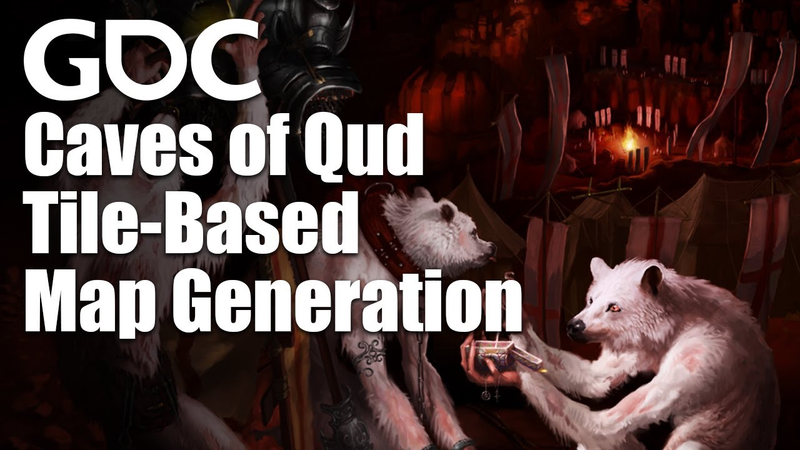
Game Developers Conference23 min
Tile-Based Map Generation using Wave Function Collapse in 'Caves of Qud'
The procedural generation of game environments in the title Caves of Qud utilizes Wave Function Collapse (WFC), a texture synthesis algorithm that generates complex, tile-based maps from simple, user-defined training inputs.
- Wave Function Collapse (WFC) in 'Caves of Qud' uses a 'texture mode' approach, where small training inputs (typically 8x8 or 16x16 pixels) are used to generate arbitrarily large, structurally coherent game maps.
- The algorithm operates by decomposing input images into N x N tiles (usually 3x3), which serve as the basic atoms for calculating valid adjacencies and propagating patterns across the output.
- Adding extra colors to the training input can create essential spatial coherence, such as distinguishing between the 'inside' and 'outside' of structures, which allows for the placement of furniture and plants within generated rooms.
Game Developers ConferenceApr 2022
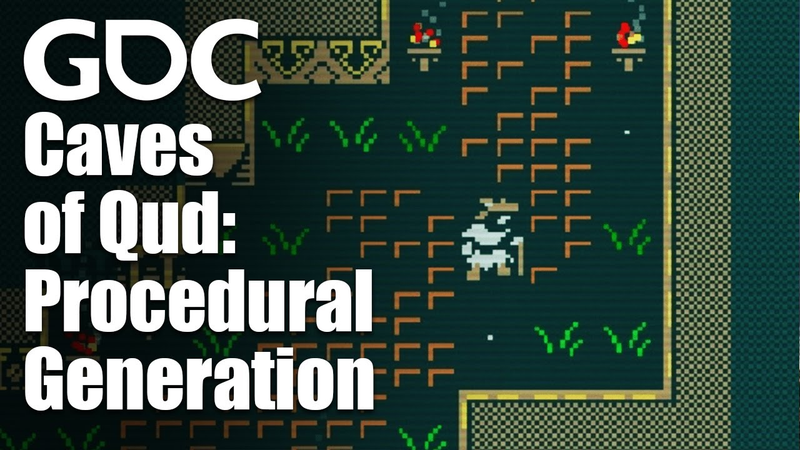
Game Developers Conference65 min
End-to-End Procedural Generation in Caves of Qud
The procedural generation architecture of Caves of Qud functions as a multi-tiered pipeline designed to bridge the gap between abstract historical simulation and concrete environmental manifestation.
- Caves of Qud utilizes a multi-tiered procedural pipeline that translates abstract historical data—such as factional history and religious practices—into concrete game objects like NPCs and architecture.
- The generation process follows a five-step pipeline that converts abstract key-value pairs into specific game states only upon player entry into a map, ensuring memory efficiency and narrative coherence.
- The system integrates advanced algorithms, including Dijkstra maps for pathfinding and Wave Function Collapse for context-aware layout generation, to bridge the gap between cultural blueprints and physical environments.
Game Developers ConferenceJun 2021
Game Developers Conference31 min
Procedurally Generating History in Caves of Qud
The procedural history system in Caves of Qud prioritizes the creation of evocative, mythic narratives over the implementation of a computationally expensive, bottom-up historical simulation.
- Caves of Qud prioritizes evocative, mythic narrative generation over computationally expensive, bottom-up historical simulations.
- The system focuses on the lives of five ancient Sultans, using their biographies as the foundation for world-building artifacts like shrines and paintings.
- Historical complexity is managed through a constrained set of exactly twelve specific triggers that govern life events and faction relationships.
Game Developers ConferenceJun 2018