
Assassin's Creed
GameBy Ubisoft Montreal · Released Nov 13, 2007
Documents about Assassin's Creed
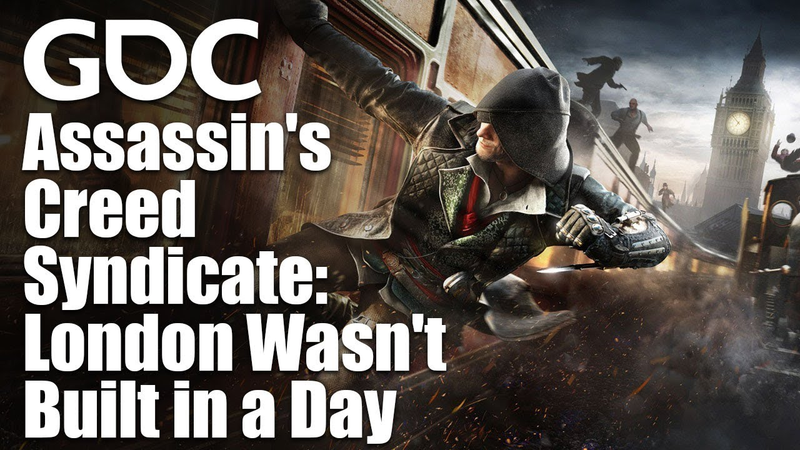
Assassin's Creed Syndicate: London Wasn't Built in a Day
The development of Victorian London for Assassin’s Creed Syndicate represents a significant evolution in open-world production, shifting from rigid, grid-based design to a flexible, procedural toolset.
- The development of Victorian London for Assassin’s Creed Syndicate required managing six square kilometers of urban space, featuring 80 kilometers of drivable streets and 8,000 unique structures.
- The team transitioned from rigid, grid-based design to a modular architecture using standardized 3-meter and 0.5-meter components to enable rapid iteration.
- To accommodate irregular street geometries, developers implemented adjustable building systems that allowed structures to slide or rotate, supported by a specialized street mesh generation system.
Unconventional Wisdom on Creating a Passionate Community
The primary objective of this presentation is to outline unconventional, effective strategies for cultivating a passionate and creative gaming community.
- Community management should be treated as a series of human-centric relationships rather than a transactional marketing function to drive long-term brand advocacy.
- Establishing a zero-tolerance policy for harassment and publicly defending community members against toxic behavior is essential for maintaining a culture of inclusivity.
- Providing a human face for the brand through initiatives like YouTube Q&As creates a 'Senpai noticed me' effect that significantly increases individual fan engagement.
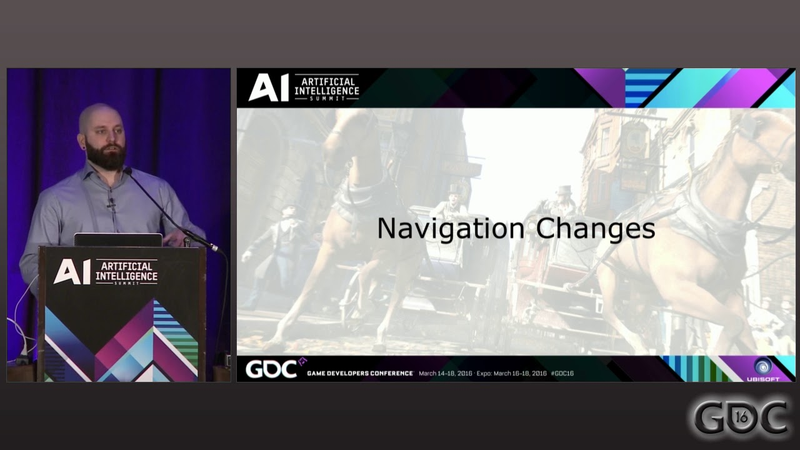
What Are You Driving At? Vehicle AI in Assassin's Creed Syndicate
The implementation of vehicle artificial intelligence in Assassin’s Creed Syndicate was driven by the need to integrate dynamic, physics-based carriages into a world defined by parkour, stealth, and historical accuracy.
- To integrate carriages into Assassin's Creed Syndicate, developers implemented 'navmesh patching,' which dynamically alters the navigation mesh by punching holes in it based on the vehicle's rigid body size to allow NPCs to interact with moving vehicles.
- Due to the high computational cost of navmesh patching, the system was limited to updating only one vehicle per frame and prioritized patching based on the vehicle's proximity to the player.
- The team utilized 'virtual vehicles'—fake entities existing in virtual space—to group NPCs by faction, allowing multiple NPCs to spawn with a single vehicle request rather than spawning individual vehicles for every enemy.
360 Approach for Open World Mission Design in Far Cry and Assassin's Creed
Modern open-world mission design requires a fundamental shift from the linear, scripted progression characteristic of earlier titles like Prince of Persia toward a systemic, radial framework.
- The '360 approach' replaces linear, scripted mission paths with concentric zones of engagement, allowing developers to accommodate unpredictable player exploration in open-world environments.
- Designers should utilize rigorous 2D top-down planning to map out thematic zones and gameplay pillars before beginning engine-based development.
- Gameplay ingredients—such as enemies, environmental cues, and interactive objects—must be distributed spatially to guide players toward objectives while maintaining their sense of agency.
Developing Systemic Crowd Events in Assassin's Creed Unity
The development of Assassin’s Creed Unity represents a fundamental shift in open-world design, moving away from static, scripted sequences toward a dynamic, systemic ecosystem.
- The game engine supports up to 10,000 simultaneously interactive NPCs, anchored by over 500 hand-placed crowd stations that provide spatial context for emergent social behaviors.
- Systemic events are built on a modular three-part framework—introduction, challenge, and resolution—which allows for the rapid assembly of diverse, faction-based scenarios.
- To protect narrative integrity, designers use master switches and exclusion zones to tune or disable emergent events in specific areas without compromising mission-critical objectives.

Trends in mobile game brands and branding
Mobile game branding functions as a strategic lever to mitigate rising user acquisition costs by capitalizing on established intellectual property.
- Mobile game branding is increasingly used as a strategic tool to counter rising user acquisition costs by leveraging established intellectual property to drive organic downloads.
- Successful IP integration now requires deep, collaborative partnerships where brand owners actively participate in the creative development process rather than acting as passive licensors.
- Major gaming franchises, including Call of Duty and Assassin’s Creed, are expanding into film and television to transform gaming titles into comprehensive, cross-media entertainment brands.
Awesome Per Second - Don't Waste Time - Extra Credits
Game design should prioritize the density of high-quality experiences over total play duration, a metric defined as awesome per second.
- Game design should prioritize 'awesome per second,' a metric that emphasizes the density of high-quality experiences over total play duration.
- Developers must ruthlessly edit their projects to remove content that is merely 'good' rather than 'great' to maintain a consistent interest curve.
- The industry-wide pressure to inflate play time to justify price points often leads to the inclusion of mediocre filler content.

Games You Might Not Have Tried: Digital Collectable Games - Find New Games - Extra Credits
This overview explores the landscape of digital collectible games on mobile and tablet platforms, focusing on titles that demonstrate innovative ways to integrate collectibility into various gameplay genres.
- Digital collectible games are successfully evolving beyond traditional card-based mechanics by integrating collectibility into diverse genres including tower defense, match-three puzzles, trivia, and real-time strategy.
- Developers are leveraging digital-only platforms to create combat structures and mechanics, such as those seen in Tyrant Unleashed, that would be physically impractical or impossible to replicate in a traditional trading card game format.
- Hybrid gameplay models are becoming a standard design strategy, exemplified by titles like Puzzle & Dragons and Puzzle Trooper, which utilize collectible monster systems to drive engagement in match-three puzzle loops.

Five minutes with Ubisoft Mobile MD Jean-Michel Detoc
Ubisoft is positioning itself as a platform-agnostic entertainment company, expanding its focus from traditional PC and console markets to mobile devices.
- Ubisoft is transitioning from a console-centric model to a platform-agnostic strategy, prioritizing the development of standalone, high-quality mobile games over simple companion apps.
- The mobile development strategy rests on three pillars: leveraging existing IPs like Assassin’s Creed and Rayman, creating original mobile-first properties, and developing games based on external licenses.
- Ubisoft is shifting away from its historical reliance on external partners like Gameloft by bringing mobile development and strategic oversight in-house.