1 free read left. Create a free account for unlimited reading + AI research.
Create free accountWhitepaper Bina Nusantara University
1 free read left. Create a free account for unlimited reading + AI research.
Create free accountWhitepaperBina Nusantara University
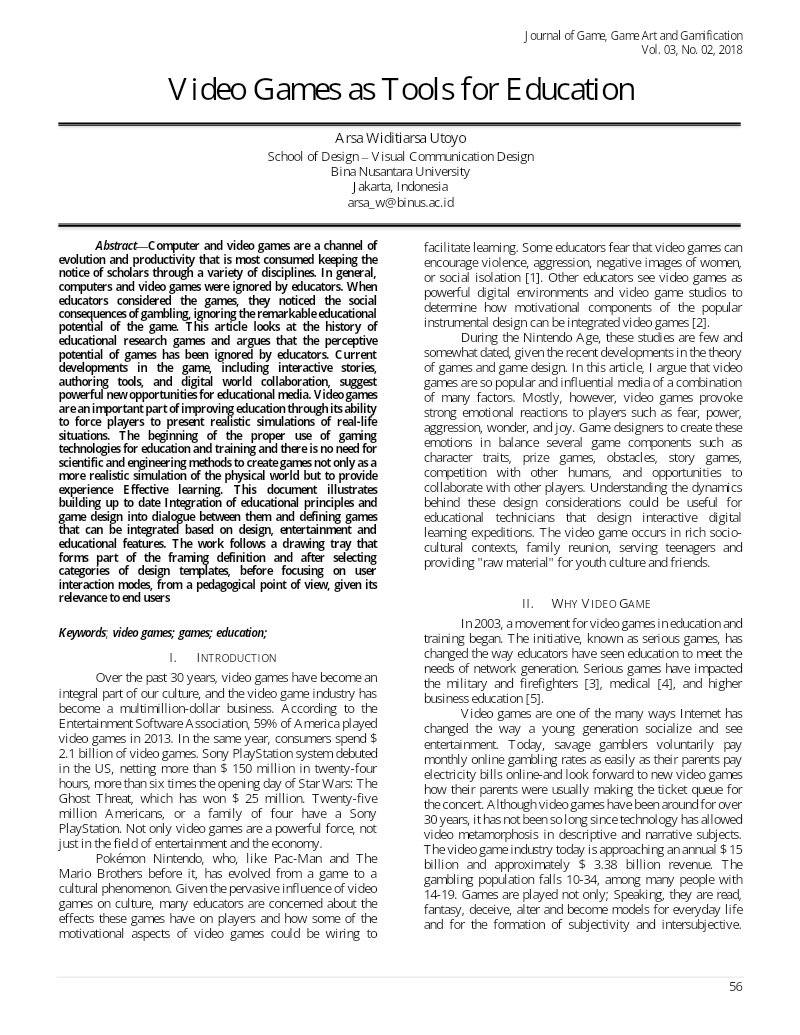
Video games provide powerful digital environments that facilitate learning through realistic simulations and interactive engagement.
Key opportunity. Video games offer untapped educational potential by using interactive simulations to teach critical thinking, problem-solving, and complex system modeling.
Video games represent a significant, underutilized opportunity for educational advancement, offering powerful digital environments that facilitate learning through realistic simulations and interactive engagement. The primary thesis posits that while video games have evolved into a pervasive cultural and economic force, educators have historically overlooked their pedagogical potential due to concerns regarding social isolation and aggression. By integrating educational principles directly into game design, developers can create tools that foster critical thinking, problem-solving, and complex system modeling, effectively bridging the gap between entertainment and formal instruction.
The industry has seen a rise in serious games—specialized software designed for training in sectors such as the military, medicine, and higher education. These tools utilize high-fidelity and low-fidelity simulations to allow learners to manipulate variables, observe system behaviors over time, and explore phenomena from new perspectives. Despite these advancements, the field lacks a unified framework for research, as much existing literature focuses on comparing games to traditional teaching methods rather than analyzing the specific design patterns that drive effective learning.
To address this, the adoption of pedagogically informed design patterns is essential. These patterns serve as a shared vocabulary for educators and game designers, covering categories such as integration, cognition, social interaction, and engagement. By utilizing authoring tools and adaptive experience engines, designers can create flexible learning environments that cater to individual student needs while maintaining appropriate cognitive loads. Ultimately, the successful implementation of video games in education requires closer collaboration between stakeholders and the establishment of standardized models to ensure that digital experiences are both engaging as entertainment and rigorous as educational tools.


Bina Nusantara University · 2026

Bina Nusantara University · 2025

Bina Nusantara University · 2024


Bina Nusantara University · 2023

Bina Nusantara University · 2023

Bina Nusantara University · 2021


Bina Nusantara University · 2021

Bina Nusantara University · 2021


Bina Nusantara University · 2021


Bina Nusantara University · 2021

Bina Nusantara University · 2021
Journal of Games, Game Art, and Gamification · 2021
University of Copenhagen · 2026