1 free read left. Create a free account for unlimited reading + AI research.
Create free accountArticle Ludic Language Pedagogy
1 free read left. Create a free account for unlimited reading + AI research.
Create free accountArticleLudic Language Pedagogy
Despite rapid economic growth, national financial literacy levels in Vietnam remain low.
Key Problem. National financial literacy levels in Vietnam are low, particularly among Gen-Z and university students.
The board game EZWorld serves as an innovative pedagogical tool designed to address the significant financial literacy gap in Vietnam. By simulating ten years of financial decision-making within a 30- to 45-minute session, the game provides an experiential learning environment that helps players aged eight and above navigate complex concepts such as debt, insurance, investment, and interest rates. The primary thesis posits that game-based learning, when integrated into both classroom and home settings, fosters intergenerational dialogue and develops domain-specific communicative practices that are essential for navigating modern, technology-driven financial systems.
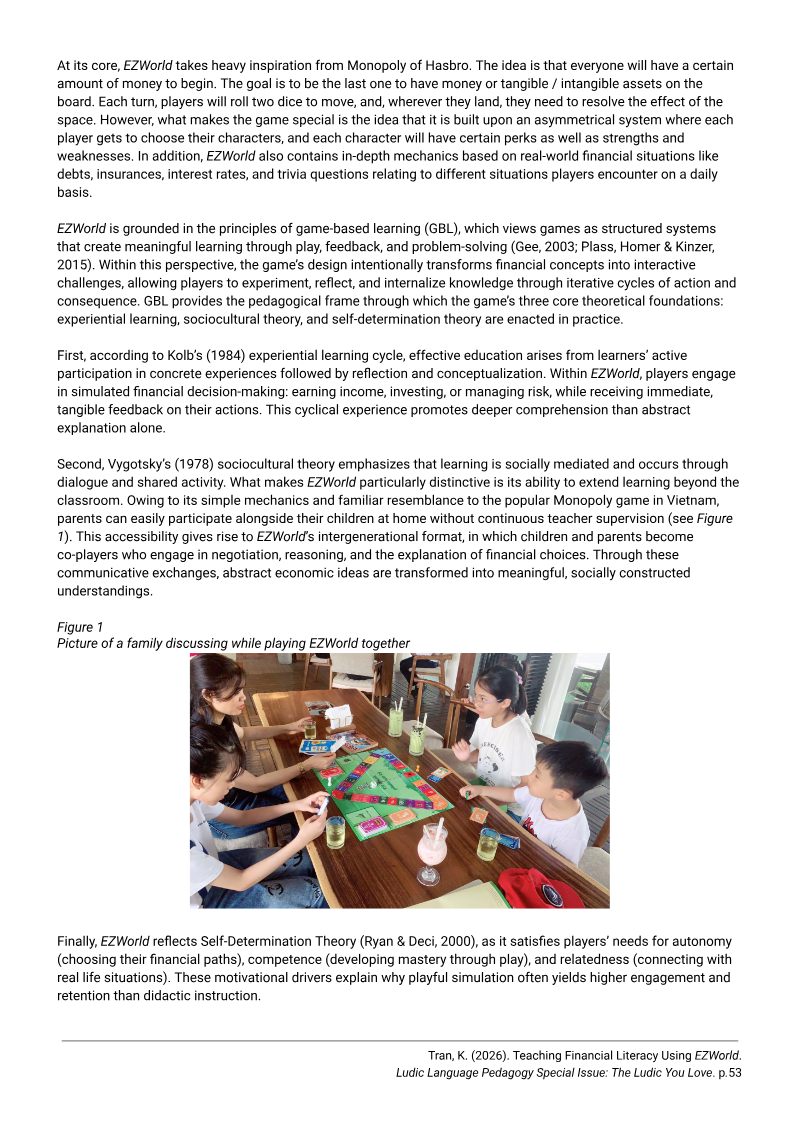
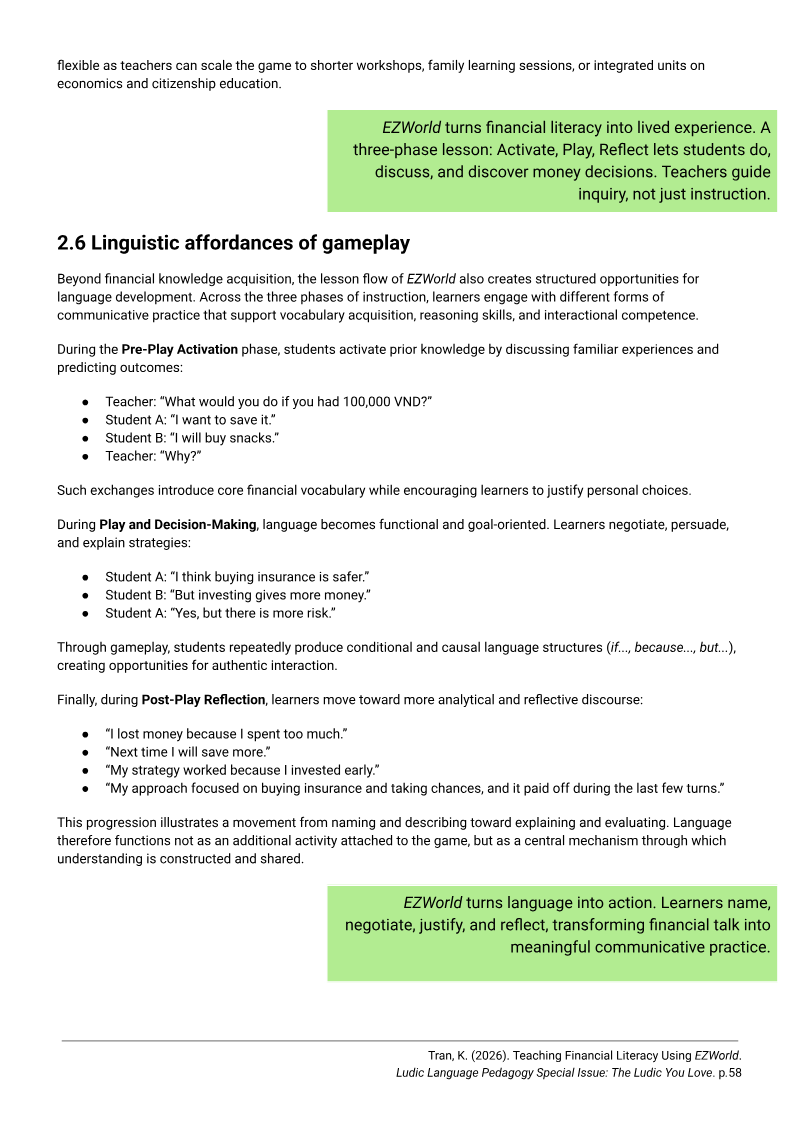
The game is grounded in established educational frameworks, including experiential learning, sociocultural theory, and self-determination theory. By utilizing an asymmetrical design where players choose characters with distinct strengths and weaknesses, EZWorld encourages autonomy, reflection, and social negotiation. The methodology for implementation involves a three-phase lesson flow: pre-play activation to prime prior knowledge, active gameplay for decision-making, and post-play reflection to analyze outcomes and ethical considerations. This structure transforms abstract financial terminology into functional language, allowing learners to move from basic vocabulary acquisition to complex analytical discourse.
Geographically focused on Vietnam, the analysis highlights that despite rapid economic growth, national financial literacy remains low, particularly among Gen-Z and university students. EZWorld addresses this by bridging the divide between formal education and lived experience. Its accessible, family-friendly visual design ensures that financial education is not restricted to experts but is instead an inclusive, shared narrative. Ultimately, the game functions as a social and cognitive bridge, enabling families to co-construct financial understanding through play, thereby preparing participants to engage more thoughtfully and competently in the digital economy.
Each row is a game or company this document names, each column a document, oldest first. A mark means that document names it. Select a row to see those documents.
Ludic Language Pedagogy · 2026
Ludic Language Pedagogy · 2026
Ludic Language Pedagogy · 2026
Ludic Language Pedagogy · 2026
Ludic Language Pedagogy · 2026
Ludic Language Pedagogy · 2026
Ludic Language Pedagogy · 2026
Ludic Language Pedagogy · 2026
Ludic Language Pedagogy · 2026
Ludic Language Pedagogy · 2026



Ludic Language Pedagogy · 2026
Ludic Language Pedagogy · 2026
University of Toronto · 2026