1 free read left. Create a free account for unlimited reading + AI research.
Create free accountArticle Ludic Language Pedagogy
1 free read left. Create a free account for unlimited reading + AI research.
Create free accountArticleLudic Language Pedagogy
Traditional classroom settings cannot replicate the spontaneous language production that physical environments offer. Location-based games transform city streets and parks into interactive learning spaces.
The pedagogical framework presented in "Playing with Place" advocates for the integration of location-based games into language education to transform local environments into dynamic, interactive learning spaces. The central thesis posits that by utilizing physical surroundings—such as city streets, parks, and campuses—as "ludic objects," educators can foster spontaneous, purposeful language production that transcends the limitations of traditional classroom settings. This approach relies on an ecological constructivist framework, where learning emerges through the interaction between students and their environment, mediated by collaborative tasks, narrative structures, and role-play.
The methodology focuses on task-based language teaching (TBLT) and game-based language learning (GBLL), targeting learners aged 18 to 30 with proficiency levels of A1 and above. Typical game sessions last approximately 90 minutes and involve groups of 15 to 30 students. These activities utilize a mix of low-tech tools, such as printed maps and student-generated media, and high-tech solutions like augmented reality (AR) applications to trigger tasks. Key findings indicate that the unpredictability and immersion of outdoor environments significantly increase student motivation and facilitate higher-order thinking, improvisation, and authentic communication.
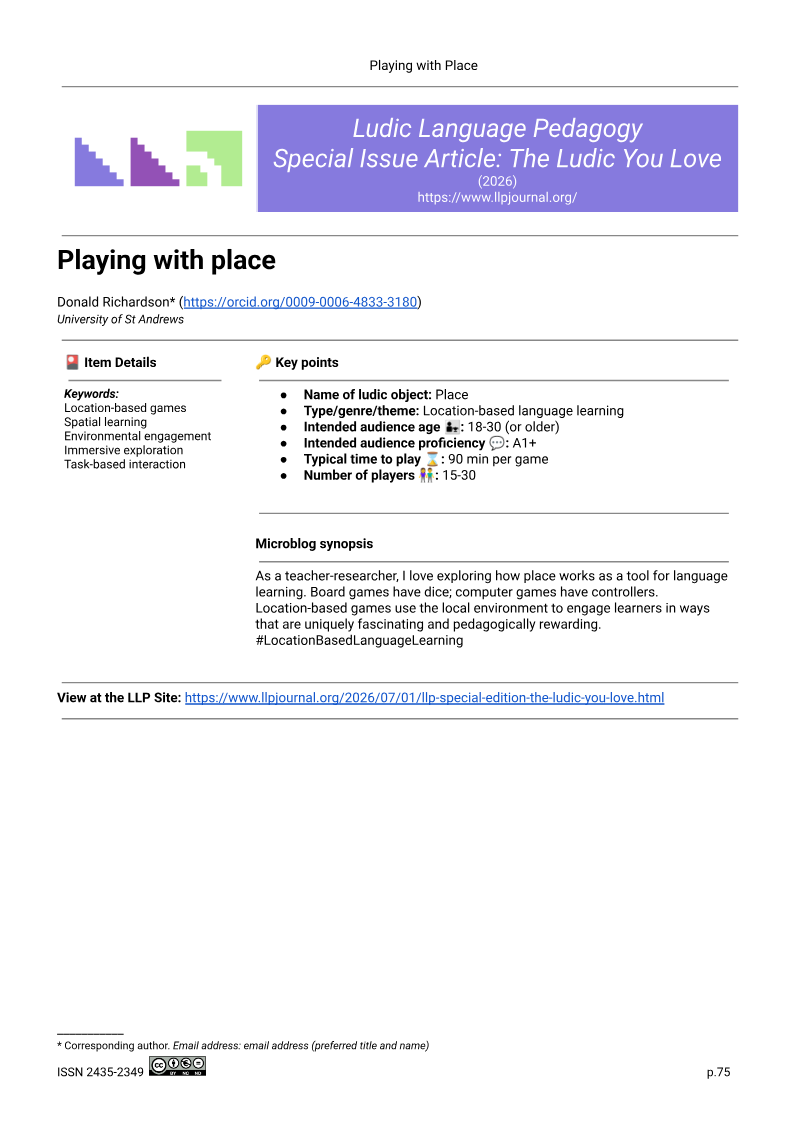
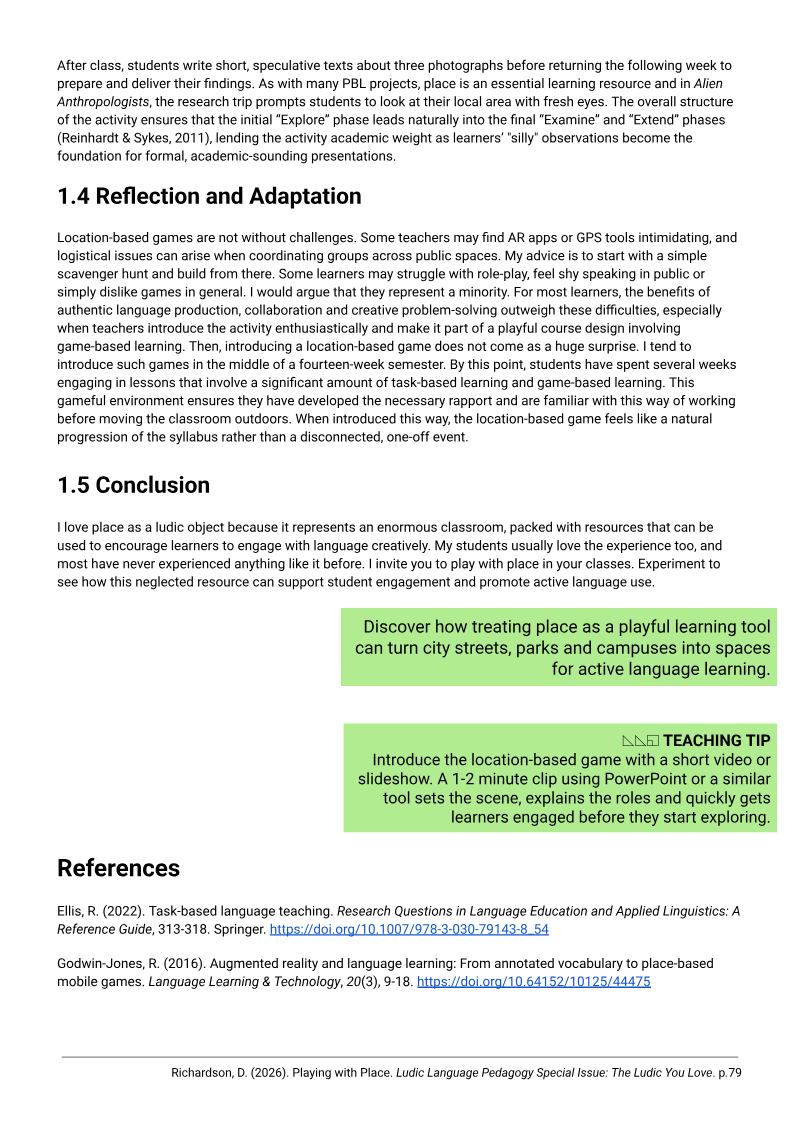
Practical applications include projects like "The P-Team," which embeds exam-prep speaking tasks into a narrative-driven scavenger hunt, and "Alien Anthropologists," which encourages students to use their linguistic resources to describe familiar objects from an extraterrestrial perspective. The author concludes that while logistical challenges exist, the benefits of spatial immersion and collaborative problem-solving provide a powerful, adaptable tool for language acquisition. By transitioning from active outdoor play to structured classroom reflection, educators can effectively bridge the gap between spontaneous language use and formal academic development.
Ludic Language Pedagogy · 2026
Ludic Language Pedagogy · 2026
Ludic Language Pedagogy · 2026
Ludic Language Pedagogy · 2026
Ludic Language Pedagogy · 2026
Ludic Language Pedagogy · 2026
Ludic Language Pedagogy · 2026
Ludic Language Pedagogy · 2026
Ludic Language Pedagogy · 2026
Ludic Language Pedagogy · 2026



Ludic Language Pedagogy · 2026
Ludic Language Pedagogy · 2026
University of Central Florida · 2016