1 free read left. Create a free account for unlimited reading + AI research.
Create free accountWhitepaper University of Jyväskylä
1 free read left. Create a free account for unlimited reading + AI research.
Create free accountWhitepaperUniversity of Jyväskylä
Distilling the key insights…
The meta in competitive gaming functions as a normative social contract that extends far beyond clinical strategy, serving primarily as a mechanism for social control and the reinforcement of existing power hierarchies. Rather than acting solely as an optimized path to victory, these implicit rules regulate player agency by dictating acceptable character roles and skill sets. This framework creates a toxic meritocracy where conformity is enforced through social hostility, exclusion, and, in extreme cases, administrative sanctions. By establishing rigid standards for play, the meta effectively marginalizes non-normative participants and preserves the dominance of established gaming archetypes, such as the aim-based hegemony prevalent in shooter titles.
This analysis, published in the April 2025 issue of ACM Games, draws upon extensive research into esports, gender dynamics, and community reception to examine the sociopolitical landscape of modern competitive play. While developers maintain the formal authority to shape the meta through patches and design updates, the community exerts significant informal power by policing deviations from established norms. Whether a player’s refusal to adhere to the meta is viewed as a disruptive act of toxicity or a celebrated innovation often depends on their existing social status and competitive success.
Ultimately, the meta provides a sense of social cohesion and reduces uncertainty within gaming environments, but it simultaneously functions as a discriminatory structure. By masking unequal access to resources and weaponizing conformity, the meta limits individual expression and maintains rigid social stratification. These findings suggest that the competitive gaming landscape is defined as much by its internal social policing as it is by mechanical skill, highlighting a persistent tension between innovation and the enforcement of traditional community standards.
Each row is a game or company this document names, each column a document, oldest first. A mark means that document names it. Select a row to see those documents.
Association for Computing Machinery · 2026
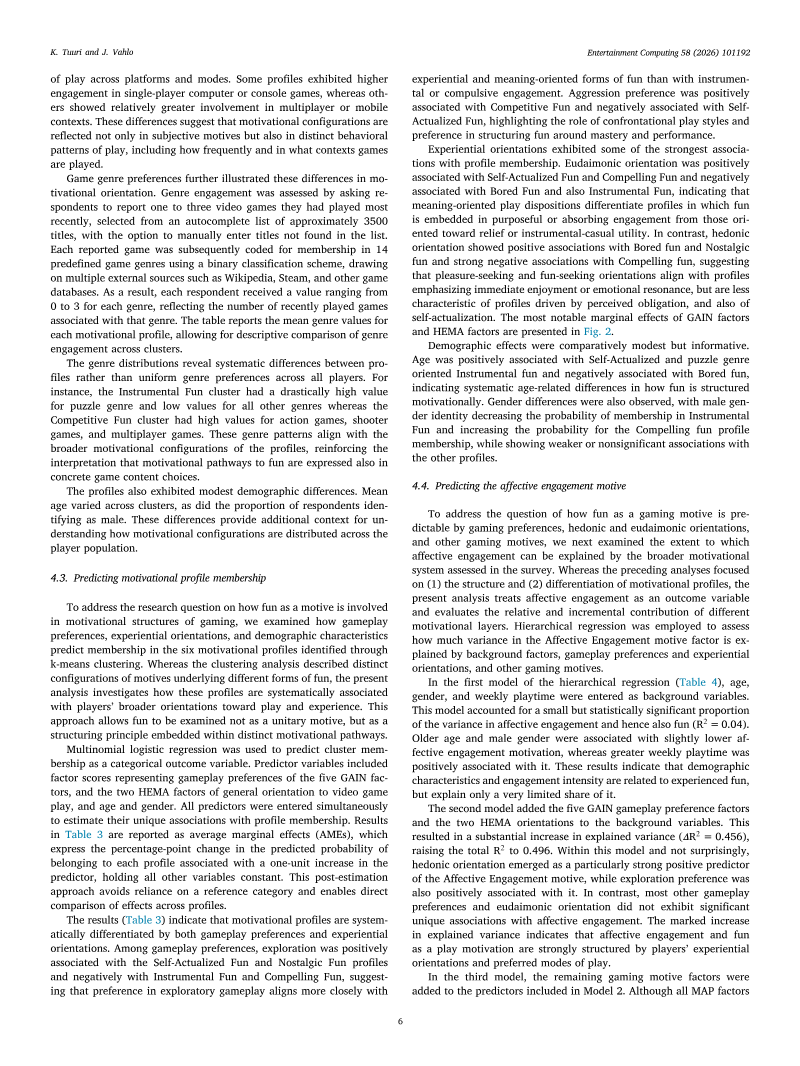
Entertainment Computing · 2026
University of Jyväskylä · 2025
Games and Learning Alliance Conference (GALA) · 2024
Entertainment Computing · 2024
Games and Culture · 2023
Games and Culture · 2021
University of Jyväskylä · 2021
University of Jyväskylä · 2019
Games and Culture · 2018
University of Jyväskylä · 2016
Simulation & Gaming · 2014
Replay. The Polish Journal of Game Studies · 2026