1 free read left. Create a free account for unlimited reading + AI research.
Create free accountWhitepaper University of Jyväskylä
1 free read left. Create a free account for unlimited reading + AI research.
Create free accountWhitepaperUniversity of Jyväskylä
Distilling the key insights…
Playstyle functions as a profound aesthetic phenomenon rather than a static indicator of personality or a mere tool for competitive optimization. By framing gameplay as an embodied habit, this perspective shifts the focus toward the subjective experience of agency and the continuous process of self-cultivation. Rather than relying on empirical typologies or statistical data points to categorize players, the analysis emphasizes that playstyle is a reflective, kinesthetic practice that bridges the gap between mechanical achievement and personal aesthetic judgment.
The core thesis posits that players cultivate a somatic style through their interactions with game systems, navigating the tension between design constraints and individual autonomy. This process is not entirely internal; it is a mimetic experience shaped by social, technological, and environmental factors. Playstyle emerges as a bridge between gameplay practice and the formation of subjectivity, revealing that a player’s agency is continuously negotiated through communal gaming practices and external models. Consequently, playstyle is best understood as a dynamic, evolving habit rather than a fixed trait.
To fully capture the complexity of these interactions, research must move away from rigid categorizations and toward phenomenological and ethnographic methodologies. By prioritizing the study of how players perform and perceive their own actions, analysts can better understand the aesthetic dimensions of agency. This approach highlights that the act of playing is a form of self-creation, where the player’s somatic habits and aesthetic preferences define their unique relationship with the game world. Ultimately, playstyle serves as a vital site for examining how individuals construct their identities through the practical, embodied experience of digital play.
Association for Computing Machinery · 2026
Entertainment Computing · 2026
University of Jyväskylä · 2025
Games and Learning Alliance Conference (GALA) · 2024
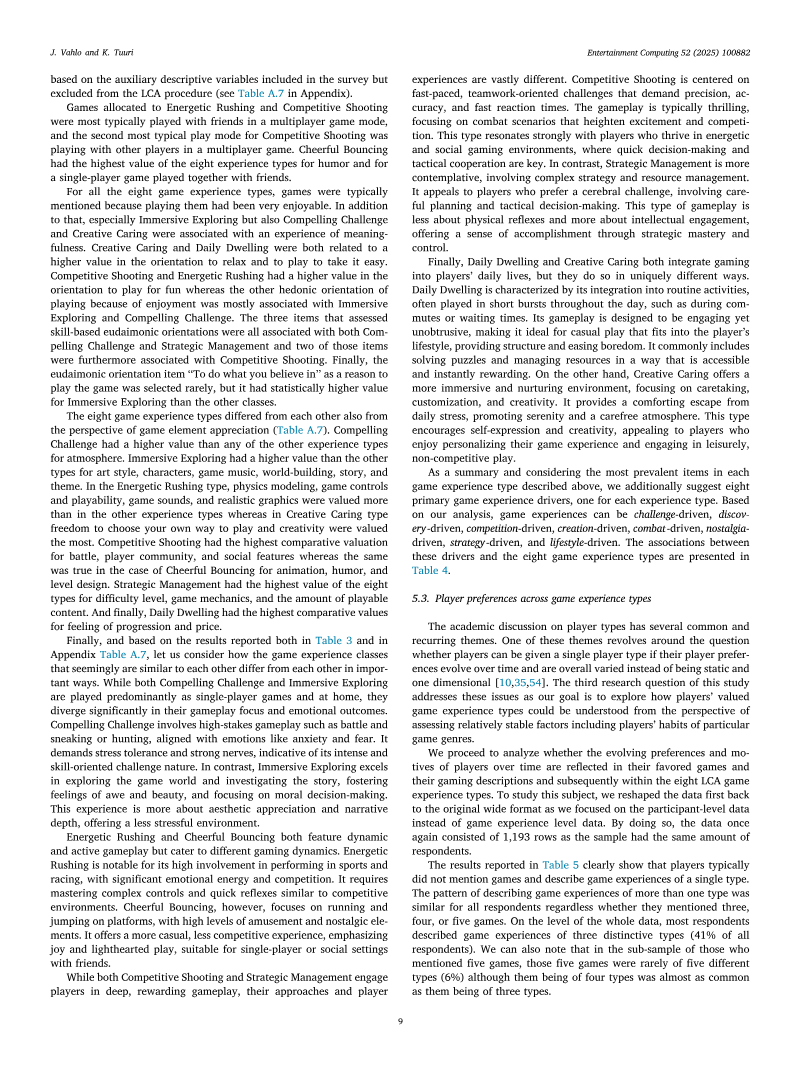
Entertainment Computing · 2024
Games and Culture · 2023
Games and Culture · 2021
University of Jyväskylä · 2021
University of Jyväskylä · 2019
Games and Culture · 2018
University of Jyväskylä · 2016
Simulation & Gaming · 2014
University College London · 2026