1 free read left. Create a free account for unlimited reading + AI research.
Create free accountWhitepaper Springer
1 free read left. Create a free account for unlimited reading + AI research.
Create free accountWhitepaperSpringer
This research addresses the challenge of enabling Go software to provide human-like commentary by automatically assigning appropriate shape names to specific moves. While modern Go programs have achieved high levels of competitive strength, they often lack the ability to communicate game logic using the specialized terminology—such as Atari, Hane, or Attachment—that human players use to describe board patterns. The primary objective is to develop a systematic, reproducible machine-learning method to bridge this gap between raw board coordinates and descriptive Go terminology.
The methodology relies on a supervised machine-learning approach using decision trees (J48/C4.5). The researchers compiled a dataset consisting of 11,526 moves from 60 games played by professionals and top amateurs. Six strong players (ranked 4 dan or higher) labeled these moves using a predefined list of 71 basic shape names. To improve accuracy, the team engineered abstract features, including stone patterns, liberty counts, and R-distance metrics, while incorporating rotation and reflection invariance to normalize the input data.
The resulting algorithm achieved an 82% matching rate with human-assigned labels, performing significantly better than existing rule-based systems. When evaluated by a professional player using a qualitative satisfaction scale, the machine-learning model achieved a total score of 83.8, nearly matching the 84.6 score assigned to human amateur labels. While the model occasionally struggles with rare shapes due to limited training examples, the findings demonstrate that machine learning can effectively replicate human-level terminology assignment. This work serves as a foundational step toward creating more intuitive, communicative Go programs capable of assisting in player education and game review.
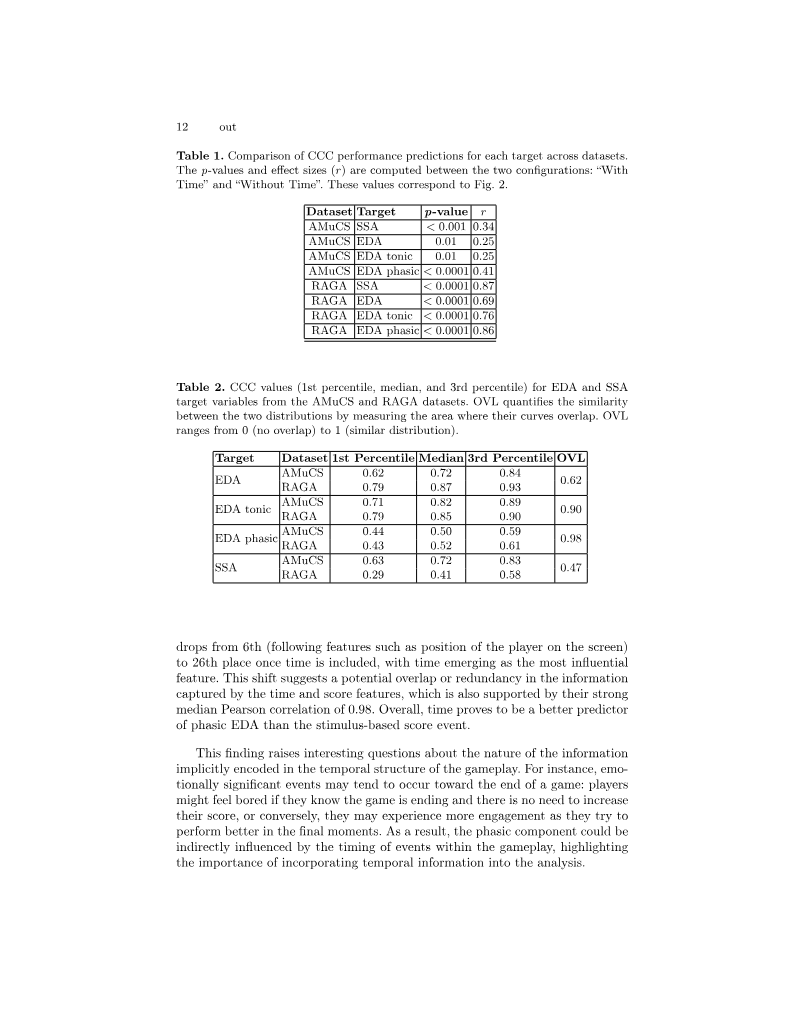
Each row is a game or company this document names, each column a document, oldest first. A mark means that document names it. Select a row to see those documents.
Springer · 2026
Springer · 2025
Springer · 2024
Japan Advanced Institute of Science and Technology · 2024


Springer Science and Business Media LLC · 2024
Springer · 2023
Springer Nature · 2022
Springer · 2021

Springer · 2020
Springer · 2020
Springer · 2018
IFIP International Federation for Information Processing · 2017
Ludic Language Pedagogy · 2025