1 free read left. Create a free account for unlimited reading + AI research.
Create free accountArticle Matthew Ball
1 free read left. Create a free account for unlimited reading + AI research.
Create free accountArticleMatthew Ball
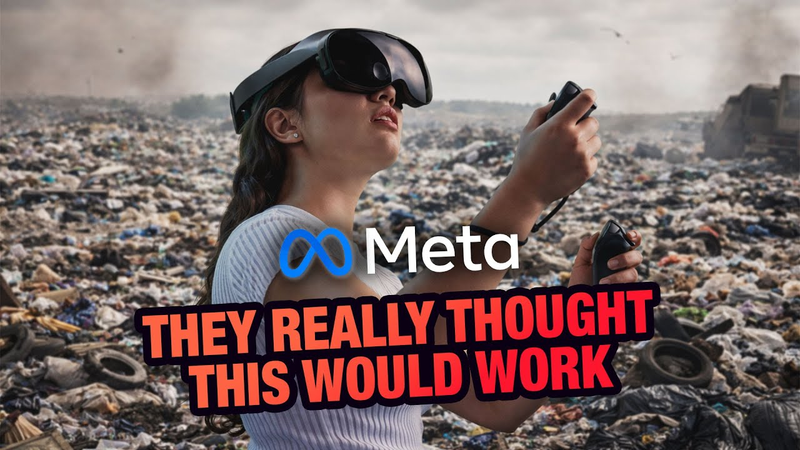
Meta's investment in Reality Labs began with the Oculus acquisition in 2014. Annual spending reached $5 billion by 2019, then exceeded $10 billion annually by Q4 2020.
Meta’s strategic trajectory centers on the transition from tethered virtual reality to a standalone mixed reality ecosystem, with the ultimate goal of achieving 100 million annual headset sales. This objective hinges on overcoming persistent barriers related to content availability, pricing, and physical ergonomics. The Quest 3 serves as the current architectural cornerstone, providing a stable platform that has accelerated internal software development. By prioritizing accessibility and affordability over high-cost, niche hardware features, the company aims to balance technological advancement with the practical requirements of mass-market adoption.
The path toward mainstream optical augmented reality remains contingent on solving complex engineering challenges, specifically regarding microLED manufacturing, waveguide efficiency, and thermal management. To mitigate these risks, a portfolio-based R&D approach is employed, pairing long-term innovation with near-term ecosystem growth. Artificial intelligence serves as a critical catalyst in this process, providing the necessary computational intelligence for devices to navigate real-world environments and offering solutions to long-standing hardware limitations.
Beyond hardware, generative and multimodal AI are fundamentally reshaping the metaverse by democratizing 3D world-building and enhancing user interaction. These technologies address previous difficulties in balancing creative ease with high-quality output, transforming platforms like Horizon into more intuitive spaces. Furthermore, the integration of AI into wearable devices, such as Ray-Ban Meta glasses, signals a shift toward context-aware, personalized agents. By leveraging AI to bridge the gap between digital content and physical reality, the industry is moving toward a future where hardware serves as a seamless interface for highly responsive, intelligent digital experiences.

Matthew Ball · 2025

Matthew Ball · 2024

Matthew Ball · 2024

Matthew Ball · 2024
Matthew Ball · 2024
Matthew Ball · 2024

Matthew Ball · 2024
Matthew Ball · 2024

Matthew Ball · 2024
Matthew Ball · 2024

Matthew Ball · 2024

Matthew Ball · 2023
GameDiscoverCo · 2026