Transcript
You know that saying about like the dog and the mailman of what happens when the dog actually catches the mailman? I am very curious what's going to happen when Xbox catches whatever mailman it is it's chasing. But first, I want to know what even is that mailman. Welcome to Game Discover Co Show, a place where metaphors slip through our hands like sand uh in time. My name is Chris Plant. I am the co-host here and I am joined as always by Simon Carlos. How you doing today, Simon?
I'm doing great. Your your intro was so esoteric when it started. I just thought you were talking to me before you started the intro. So, congratulations on uh on on kind of spinning that one in, but I I get it now and we can talk about it.
Yeah, you know, it it is one of many things that we'll be talking about today. As always, for people who are new here, this is where we talk about the games industry, but really we talk about game discovery. How when there are
seemingly infinite video games out in the world, people are able to get their games in front of the people who will want to play them. Though, how we get there can be as big as a story with Xbox or as small as the tiniest indie developer. Let's start with the Xbox because I am now at the dog chasing the mailman of that metaphor and I now have to reckon with uh catching it. The latest reorg hit Xbox last week. There was over 250 layoffs. I believe there might still be more to come. This is the second of a year's long plan or a year-long plan. Um, the layoffs had a substantial hit to Halo Studios and a bunch of what seemed like weird changes have happened. At least would have seemed very weird three or four years ago. Activision is now the new beneficiary of the Regorg. They are getting oversight of Rare. They are getting uh control of a new Halo game.
There's a lot more to discuss, but let's let's begin with the Halo part. two years ago. It was only 2 years ago when 343 Studios was renamed Halo Studios. Now much of that team is gone and Activision is making a Halo game. What does that tell us about Xbox's current ML?
Yeah, I mean it's it's interesting, right? And I think that um you know Halo as a franchise, I do believe has unfortunately been in a bit of decline for some time. And I think some of the problem has been
uh the core studios working on it just haven't haven't quite managed to make it work. And I think if you look at the end of the Phil Spencer era, the end of the Phil Spencer era was willing I think to reboot within the existing structure. But I think Asher Sharma coming in from outside of games uh is really given a larger remit like a break things remit really. And so I think if I was coming in and I was like, well, there's this
company, they do a game called Call of Duty and we also own them and it turns out Call of Duty is also a first-person shooter. I might be quite tempted to put Halo alongside that and say, "Why don't we, uh, why don't we co-opt a whole bunch of our tech and some of the same people to do that?" So, I think that's what's happening. I think if you're coming from outside the industry, uh, without, you know, sort of seeing what happened before, I think that makes a lot of sense. I think if you're with inside the industry and you've been following this very closely, you're kind of like, well, this just seems very yo-yoey, I guess. So, yeah.
Yeah. And I I guess for me it seems even more yo-yo when I include the Phil Spencer era because on one hand, yes, none of these Halo games were hitting the high highs of the original, but even the remitt of those games seemed to change perpetually. it was Halo 4 or maybe we're going to do the open world thing or maybe it's going to be this Infinite Living game that we'll build on. And it it never felt like the actual plan for Halo was really clear or set or
allowed to, you know, grow from one title to the next. The forever comparison is Assassin's Creed 1 versus Assassin's Creed 2. That series is built on the sequel. It's not built on, you know, the first game. Um, so I I don't I don't know if this is a brand new idea for me or if this is yet another Okay, we're gonna break it entirely. Let's start from the beginning.
Yeah. I mean I mean I'd say that all the changes that Ashra Sharma and her team made are on, if I look at them very dispassionately, pretty logical. Um, I do think that um that that they are essentially saying that Xbox Game Studios is is a failed entity, which I think is interesting because I mean the head of Xbox Game Studios certainly early on when there started to be the layoffs um left because I think he was quite unhappy with all the spin-offs and layoffs. But yeah, I think what they're really saying is unfortunately sort of
the Xbox studios umbrella was consisted of studios that got acquired that hadn't really scaled their games or their games are no longer important with where we are in Game Pass and a handful of studios that were important, but we're actually going to put them in buckets with teams that seem to have more enduring and high-profile IP, and that's Activision and Bethesda. So I think um you know so I it's it's just rough from the perspective of I think clearly Xbox has had uh many years of sort of selling that that we need to buy all these studios uh and we bought all those studios in the last 10 years because they were an integral part of our plan. I think what's clearly happened is they're they're not part of the plan anymore.
A very different plan. Well, well, and it's it's weird because in some way the studios that they acquired are getting more power. In the case of Activision, the the strange one to me, and this is strange for a number of reasons, so I want to break it down with you, is Bethesda is now in charge of Obsidian.
And there's two weird things about that. For for the younger listeners, can you just explain why it's a bit ironic, I guess, or historically unusual that Obsidian would end up being under the Bethesda umbrella?
You're presuming I know enough about the history of the company to do that. Um, my my my take on it, which you can immediately correct if I'm wrong, is that uh there was a there were previous extremely popular 3D Fallout games made by that studio, but then it all kind of got moved all got moved away and back into Bethesda, right?
Yeah. Basically, it was they made a great game when they were not part of Bethesda. Uh, we're going to take our toys back, you go off and do your thing, and now we're all somehow back at at square one. I guess what I find so weird about this also is Obsidian's in the business of shipping games. Obsidian has shipped just an astonishing number of games. It is the ideal of whatever Phil Spencer was
trying to do, right? I'm going to buy up a studio, maybe AAA. I'm going to give them resources. They're going to publish pretty consistently. they're going to make new franchises versus Bethesda which
is in the business of not shipping games broadly speaking
but has but has the properties and I I will be curious to see as those two combine what's the power dynamic there because
I mean I I mean I mean again if I'm in to be honest like I I feel less m because I'm like the data guy and I'm like this is logical guy so to be honest asharma stuff largely I'm like, "Ah, sure." You know, and and also, frankly, I'm less passionate about some of these franchises. So, uh I think that might also make me less like what about it? But, you know, I think I think the thing about this obviously is um you know, if you look at uh if you if you look at the recent output from from Obsidian, that's their own IP. It's not been performing spectacularly well. It's been performing
okay. Um and and they were talking about doing a Fallout thing. My understanding is that Fallout thing was fasttracked as soon as Ashama came back around and and they took a look at it. Especially because and if you look at it from their perspective like Obsidian makes great games and they ship them quickly. Give them a Fallout for God's sake, you know, like I think that's [laughter] so so I I think I think that's sort of I'm sure they'd love uh you know like yearly Fallouts and you know I I don't know if that would be too much. I think they could probably I think that they could probably make it work if if they varied it frankly. So, and they're so far away from early Fallouts at this point that sorry, yearly Fallouts that it's just out of control. So, so yeah, I mean I think the other thing to note here is I think Bethesda really has had some kind of rocket, you know, placed adjacent to them, you know, like Todd Howard known for not talking about anything has been much more talky since this whole thing whole thing went down. And I I I think I think they really are going to try and try and get a handle on this because um you know I think I think they have had the luxury of of long dev times. But um you know I think obviously
in a couple of cases recently it hasn't really worked out. So I think I think they're really I I think we're going to see more Xbox studios making games with Bethesda IP frankly. And so that's probably this is probably the start of that. What I'm hearing is like Activision making rare games, making Halo, Bethesda making just more games in general with the help of all these studios. What do you see as the the dog catching the mailman here? Like what is the end goal for Microsoft with Xbox?
I mean, with half of my cynical hat on, I'm like, this is this is a cleanup operation.
Like this this is a growth operation or a purported growth operation. And I think they're really going to try and get there. But if nothing else, I do think this is this is a cleanup operation. Like the direction of this was not good. And I think if you can at least get everything back. So uh you know, all all the things are in the right places and and and you're keeping the studios who have the potential.
Essentially what happened is Xbox bought a bunch of studios for Game Pass portfolio that were not going to make smash hit games. That was not what even why they bought them. And I think now stepping back, they're like, "Oh, well, we can get a whole bunch of great third party games for almost no money at all. Uh why why would we have these expensive internal studios that don't even ship very often?" And the answer is they don't want them. And that's what's happened with most of the spin-offs. Even some of the spin-offs were for games that should have been a bigger could have been the bigger hit. Like the State of Decay spin-off is interesting
because because it does imply that Xbox has taken a close look at that game and thinks it's not going to be a big hit. Um, but you know, I think I I think the point is that we're approaching the end of the cleanup operation and then the question will be, can the cleaned up Xbox really deliver? And if it can, that's great. And if it can't, what happens to it? And I still think uh there's there's some possibility that it will become some or all of it will become independent of Microsoft at some point in the next three years. Uh, and I
think I think if that's going to happen, uh, everything's everything's cleaned up, right? So, you know.
Yeah. Yeah. There's there's only like one last thing and then and I I do want to move on because we have a lot to talk about, but there's there was one single layoff and it is one. So, like can't take all meaning from it, but one that just very puzzled me, which is the story director on Gears of War Eday was laid off weeks before that game's release. And what's so strange about that one to me is I completely understand like the cold calculus of we have these big properties, we're going to make new releases for them pretty regularly. And I think of the coalition is probably the best positioned to actually do that. Like it has I I don't know if Rod Ferguson's there now. I don't think he is.
No, I think Yeah. But it has experience shipping games cleanly, efficiently with leadership. It's a big property and it it is a little strange to see that and it makes me think we do have
more to come like what is that more to come? Um is there more shakeups for these properties?
Yeah, I think the more to come is they are waiting for some games to come out to see how they do and then they're going to look at that studio and I think people have noted eay is a great example. I think unfortunately Gears of War is probably in my view in a slightly worse state than Halo in in in in some ways because it was it was early to the kind of Xbox pro fan base, but I feel like it's faded possibly even more. So I think they yeah I think they're taking a taking taking a clo a close look at that and then sort of so I think there will be yet another set and they sort of mentioned like there's some stuff happening right with like arcane because they're in France under you know that it's quite difficult to change company structures in in in some parts of Europe. So yeah, I I think there is going to be sort of a third or fourth shoe here, but I still think it's um yeah, I mean it's ultimately the business model was not working for what Microsoft wants. And I think Microsoft wants uh growth and strong profit and
not all out of bleeding less and less people. And that's really what happened with Xbox like like like late Phil Spencer era. They were like, well, we're just going to get more money off the same amount of people or less people. And I think frankly it was strongly less people and then that's and then that's when the when when the transition ended up happening. And so yeah, I mean I still think here's the thing. Xbox has some great people on it. It has an awesome org. Uh if you know like but it it it just got very big and complicated and the revenues particularly on Game Pass don't really justify that for Xbox unfortunately. So, so we'll sort of sort of and obviously hardware is a open question which we haven't even talked about here. So, yeah. So, so I I think we should move on but I think yeah this is not the final shoe. There are there are additional shoes but I think this is probably we're more than 50% significantly more than 50% through this I'd say. [snorts]
Yeah. Yeah. Well, let's let's keep it going. We we are going to talk about as
you uh described uh them trained to analyzing media smart guy Doug Shapiro who posted about basically this idea that the relationship between time and value is breaking down. I found this piece very fascinating because I couldn't tell if the author or you think of this as a good thing or a bad thing. Can you can you summarize this for folks a little bit about this idea of time and value breaking down?
Yeah. And and I'm not really sure whether I think it's a good thing or not, but I I think it's hap it's happening. So really this this guy Doug Shapiro runs a a blog uh called called the mediator and and he is he is a TV and film guy, but he does talk about all media. So he's very interested in what's happening to media in this AI era and this you know short form first era. So, so, so, so, so, so, so really what he's talking about is, yeah, historically, I think the idea was the more, you know, the more time you spent with something,
the more money you would spend on it in in media is sort of the platonic ideal. Like, you spend all your time watching cable TV. So, your most expensive uh output is your is your is your cable TV uh subscription. That's that's that's what you spend all your money on in media. But you know obviously over the past 10 or 20 years this is really changing and you know certainly the rise of Spotify means that you're spending a fixed amount of money on something that you might consume a tiny bit or a lot and I think I think his point is really like um you know like historically uh like minutes of use are sort of he says economically should be economically equivalent. It turns out to be quite quite a low number certainly for games. Uh the number he's citing is 80 cents per hour and he think and I think Boston Consulting Group thinks that across all video games you're paying about 80 cents per hour. I mean obviously if you work that out um you and you go oh for CLB score I I've spent you're not spending 80 80 cents an hour for that game right
you're you're you're spending you know at least I'd imagine two or three bucks an hour for example. So I do but I just think he's interesting. He's pointing out that as things break down and as does more and more free and cheap alternatives, you know, the idea that you're simply uh, you know, monetizing based on hours watched or or played is changing. And and the thing I sort of I think there's all kinds of direction that that that discussion can go. But an area I sort of focused on which I thought was interesting was I'm noting this rise of incremental games on Steam. And incremental games are fairly in quotes cheap. They're 8 to 12 bucks a lot of the time. But actually a lot of them have quite a lot of play time. They're not like a one and a half hour and you're done. A lot of these games are like 8 or 10 hours. So I think you know so my question in games this wasn't quite what Doug was talking about and we can go another direction with this is um you know like like at that point um you know if people are getting a good buck an hour out of these kind of really interesting incremental kind of clickery games then um you you're trying to sell someone else a a 10hour uh story game
that's 60 bucks is that starting to be a problem uh for for some people
see that is interesting because I almost read this like an inversion of that. Like I read this as we think of the time is value era of gaming for me as like the Fortnite era of the living game era of we need to lock you in because we're competing with Netflix and all that matters is we're absorbing as much of your time as possible because that increases the odds of us making a buck off of it. Like even if you scrap out like 80 cents per hour or something, the more you're locked in, the more control we have to get your money versus everybody else. a little bit of like a boxing the enemy out of the paint sort of thing.
And I think that this piece is right that that is coming to an end. One, because it's exhausting, like people just don't like to be controlled and like that's kind of what it felt like to be in those spaces. Um two, the AI of it
all that there's just so much stuff um that value gets gets lost. For me, I hear this and as somebody who makes an independent podcast that is like I think highv value content is something that can't just be aggregated easily and turned into like a post that looks almost like the original post that was written. This is great for me. Like the idea of like somebody only listens to me for 4 hours a month, but they want to pay $5 for that. That is great. where it seems horrible is for the job I used to do, which is at Polygon, which is create a whole bunch of content that who knows what its value is. So, when I think about that in games, I guess what I think could be good about this is a $10 game that's only two hours might have more value now than it did in the past, if that makes sense. I I guess you
could kind of go either way with it.
Well, yeah. And I think I think that's what I like.
Yeah. And I I think that's what I like about this because I just think you're right. There's there's like diametrically opposed conclusions to this. And I think your conclusion is a little bit closer to um what do conclusion actually is than than where I was going with it. But but he does say towards the end, which I think is is super interesting, is he says you you're better off compressing yourself than being compressed. If consumers want to compress your product, you should give them what they want. And then the other thing you said is if your business model depends on duration,
rethink it, which I also think is is sort of what you're going with with the, you know, with the kind of kind of the, you know, if if you need someone on Fortnite to spend 30 hours a month with you in order to spend that 10 bucks,
then that's going to be a problem. You know, like it says if Yeah. If you're consuming your content becomes more time efficient for the consumer, the monetization model has to become more time efficient, too. So, so, um, business models that depend heavily on duration become more vulnerable, increasing the importance of
subscriptions, commerce, transactions, sponsorships, uh, and licensing. So, so I think, yeah, it's it's like,
yeah, I think I think the game is changing here, but it's changing in so many different ways at the same time that it's very difficult to decode, for example, for video games. That's why we came to sort of not quite opposite, but like very different conclusions over the same, I think. No. And I I'm also I'm almost certainly projecting here, but it's like why why I like doing this show. It's why I admire your work. It's like why I do doing my other shows is I just truly believe especially as AI takes over everything. And I think game developers will see the same thing that a thing that has quality and respects you the like the user will feel increasingly precious. It doesn't mean everybody's going to be successful who who pursues that route, but I do think that that feel I mean, I was just watching the NFL yesterday and the commercials that were not using AI were noticeably different from the ones
[laughter] where the burger looked like it was made out of larvae. Um, it is fascinating. Anyway, I I will keep us moving. Uh, another, I think, positive trend is emerging, and this is that demos, uh, specifically ones that we're seeing from places like, uh, Square Enix are allowing people who play them to transfer that, uh, save data into the main game, which for whatever reason reminds me of transferring, the Hideo Kajjima method for for moving data.
Transferring. It's fantastic. Um, where where do you think this is coming from? Because there are a few different signals I feel like I am seeing of why this is a priority for a company like Square Enix to get into their demos. I think it's super super interesting because what I would say is I think as an impulse it's very old school and that's why I'm kind of like Square Enix has done it actually for a while and I find it to be very kind of like weirdly
old school kind of logical and it's kind of like well if people are playing demo of course they want to you know and I actually think my view of my view of demos interestingly historically is they've been far more for increasing discovery as a whole because like streamers play the game than it is people who genuinely play the demo and then full game. So, my initial reaction to this has been like, "Oh, well, that's cute. That that that's cute if you got a screen." And also and and also Konami is doing it for the new uh for new Castlevania 2D, which I thought was cool. And so, those are more traditional, I'd say, Japanese companies. But what we also noticed was Graveyard Keeper 2, which has just come out and done very well, uh released a demo that had notably good CCU. It was about 25,000 demo CCU demo, which is pretty rare. I think it was top 20 all time. And I was talking to someone I know about this and we were sort of trying to work this one out. Uh and we realized um it it the demo came out like a week before the game came out and it's demo transferable to game and so there are a lot of people who are planning to
play the game anyway who are like sure of course I it's effectively like advanced access isn't it? So, so I I thought it was super and I'm not saying that's the only reason why that did well, but I do think uh if you have the kind of game where you can do that. I'm starting to think that uh and also you have to probably release the demo quite close to to release because I think if you break your saves, that's a whole issue. Uh but I actually am starting to think that this demo transferable thing is is is smart and not just for uh its old school reasons. Yes, I mostly love this. I love the idea of AOL free introductory hour discs in my video games that I can like come into a game, play it, and then know that my experience will continue once I pay for it. I also love this as somebody who is scared off of playing demos, especially of story games, because I don't want to replay like a RPG the first 5 hours,
that's atrocious. And I think this is great where time is money. GH, but time has value. And if if you get to the end of a demo and it's like, hey, you really enjoyed that and you've actually kind of already invested in this, like you should go buy the game. I already put three or four hours in and I'm enjoying it. It's like, well, yeah, why not? Like, why not keep the train going? I think all of that sounds great. The only downside that I can see is, and it's not bad for the consumer, it's just bad for the the developers and publishers, is how many people bounce off of a game within, let's say, the first hour. And does this basically create a scenario where people who maybe were going to like knee-jerk buy your game um and then drop off of it and not return it are now going to like not do that because they just play the demo first. They bounce off and they end up not buying it again. That's a perfectly
good that's a great experience for the customer. I just wonder if it will cut into sales at all if those demos are available, you know, a year or two after the game's been out. Yeah, I think it depends how hyped up your game is. I was actually talking to someone who has a big game coming out. I won't say who it is who are asking me should they put out a demo. And actually my comment on that because I think people are going to buy their game anyway is I thought they should put out a demo but for different reasons. I thought they should put out a demo in order to get the feedback that they're going to get if they uh if they release a game on day one. all the stuff people would have told them on on day one. You want to actually get at like during the demo because then you can fix it and then you're then people like your game more when it comes out. So, so I think it's a it's a total double-edged demos always a double-edged sword. But I'm very I'm very pro demo in general because not enough people know about your game and the more you show people your thing. It's funny, we're just we're just rolling out a redesign of the of Giscover Co Pro this week. So I'm uh you
know our I'll stuff and I'm really trying to show it to as many people as we can like like early cuz for exactly the same reasons cuz everyone is suggesting stuff you you might not have thought of. So so for me I think actually I think you should almost always do a demo unless your game is incredibly hyped and you know that people aren't going to dig it at which point maybe you should just keep quiet and sort of just see how it goes. But but I'm hoping that people don't have that. You can also take the control resonant approach which is let the reviewers figure it out for you then hot fix it day one have all your problems solved.
Yeah, that was exactly that was exactly what happened with you're right cuz if you look I know they had some issues there that they day one hot fix but they probably could have done that with a demo before the reviewers got a hold of it if they had enough time but yes. Yeah.
Yeah. But hey I I still think it's great that they had the hot fix. I think it's very clever. Yeah. Um, okay. We got to talk about meta. Uh, uh, okay. There are two stories [laughter] and I I'm not even sure what
to make of either of these. One is Horizon, the virtual world metaverse platform that they have. They seem to be really focusing now on creatormade content. It's AI first with these tools that, you know, promise to turn your ideas into 2D or 3D mobile games. Uh, I'm going to put that I'm just going to put that here and then I'm going to put another one out for us, which is that um, uh, the Meta VR glasses are have been revealed and they cost $1,300 and they're they're VR, but not as you would necessarily expect. They they light gets into them. [laughter] I'm not sure really what's going on. These are two absolutely bizarre announcements and I want to try to take them together and I'll start with the horizon stuff which is what is going on here. Is this a like a prayer for users to make what the company couldn't with all of that investment or like what are they what
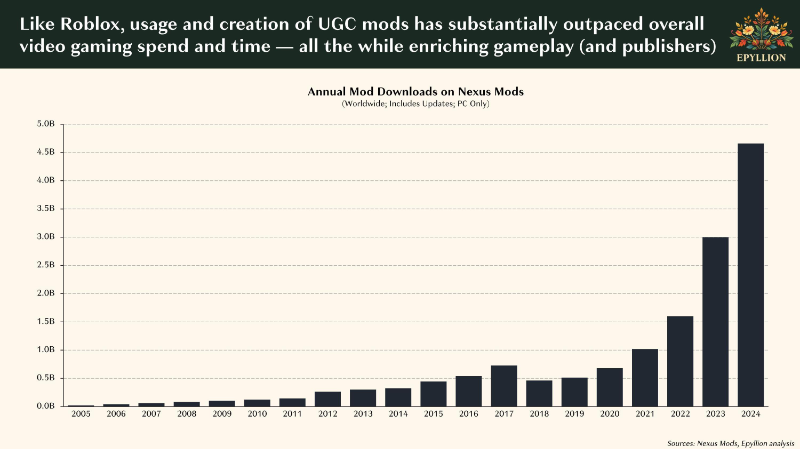
are they chasing and hoping happens here? I mean, at this point, Horizon is one of the pivot, one of the most pivoted products in in in history because Verizon really started explicitly as a VR uh, you know, like virtual virtual world and is now explicitly not very VRy at all and quite a AI first. And I think, you know, it's still got some ideas of having, you know, you've got an avatar and you can make a game, but honestly, I think it's even gone away from avatar first in in in some cases if you can make 2D and 3D games. So really, I think what they what what what Horizon is much closer to now is something that Roblox is also working on, which is we already know about but I think Roblox has a more uh sold in um user base at this point. Um but you know, I mean what Roblox is working on is like we know we have a ton of people who want to make games. we just make it super easy for them to make it by allowing you to like prompt stuff into in in there and and Roblox also has more sophisticated tools. I think that's I
mean you know that that's reasonable but I think uh for better or worse like I think Horizon is trying to do that without a user base to speak of and that's where it gets gets a little bit tricky and I think that's obviously the problem Horizon had in the past and at one point they put Horizon very prominently at the top of the VR store but then they sort of realized it wasn't really making a massive difference so they took it they took it away again uh but you know I would not underestimate Meta's capability to shove stuff in people's faces I've sort of noticed like threads in particular, like you know, I don't personally use threads, but Meta's done a great job of shoving every time I use Instagram, they're trying to get me to sign up sign up for threads. And I do think there are quite a lot of people who just use threads because of that blatant constant cross promotion at this point. So, I would not I would not underestimate Meta's ability, especially since they're saying these games are going to be publishable on Facebook and Instagram. Like I would not underestimate Meta's Meta's capability of getting getting Herizon actually embedded as like playable Facebook and
Instagram games. So sure are a load of people who use Facebook and Instagram, but it's just it's very very very different to what it was before. It's not really the same the same product at all. I guess I'd say
Can I tell you about the game that I'm going to use um these tools to create?
No. So, it's about um it's about a farm uh in a village. Um and I'm calling it Farmville.
And I think um with the help of the Facebook sorry meta platform, I think I'm about to get very rich very fast.
Yeah, you can you can just change your letter to like farm farm evil farm. It can be a horror one.
Agriculture Town Simulator 2027. It's going to be great. Okay, so there's that. Then there's these VR glasses and is [clears throat] with what you see of what's going on in VR is is there a big audience for this? I don't feel like Apple Vision Pro was the hit that Apple wanted it to be. And here are $300
VR glasses released in the year 2026 when spend seems hard to come by. What's the plan here?
Yeah, I mean I mean yeah, these are these are these are expensive right now, right? Yeah, these are these are over a thousand bucks and they're they're the start of something. But I think I think what people are chasing here is, you know, and and and to be honest, games got less relevant. The only interesting thing on the games front for this is they are they are pushing obviously they're controller free. So they're pushing stuff like controller free Beat Saber and their their uh you know they're making it easier to do games like on gesture. You know, I think we are um we are fighting over the interface of the future. And the interface of the future I still believe and I think they all still believe is something that you either have on your glasses or projected and it may look like a screen and it you know you may just not have I have a monitor in front of me as you probably you know do so maybe there won't be a monitor. So I think everyone of the big tech companies is trying to make sure they're not uh left behind whenever that happens. I
think the general indication is that that's not going to happen for a long time. But I think these companies are very willing to keep uh keep incrementing. I mean you just saw like Apple came out with a foldable phone which increases the screen uh you know the screen size because they know that people don't like squinting at small phones. So I think the end the end result of this is possibly uh whatever you're if you wear glasses whatever you're using you know maybe your phone as well will just allow you to project as an alternate thing. And so I I do see I think that's the point of the $1,300 VR glasses. But in terms of who's going to buy $1,300 VR glasses in 2026, uh the answer is absolutely a niche uh a niche right now. And I also think they've had trouble. You know, games has not been the success that they'd hope for on VR. I just think that um games are on much niche on VR than than than people really expected. So I think they are pivoting back as um Apple really did towards this is a superior way to view things. So I a
lot of the pitch for VR glasses for meta was definitely as a you know a really great movie screen and you know maybe some light interaction but I think I think they're going going back in that direction as a viewing platform not not a game platform. It's a strange thing where I have to wonder if the people who are designing these things because they live in Silicon Valley in San Francisco, they have cramped living spaces and also they're flying uh pretty regularly for work to all their different satellite offices. If they are designing hardware for a lifestyle that most people do not have, and it's like, well, of course you're on your plane all the time. You need to have your iMac screen while you're on the plane. Of course, you're sharing an apartment with your roommate because you live in a cramped space. It just seems weird to me this pitch of here is this dream entertainment system for $1,300 when you can now get a 70in TV for
maybe half that price. Um, and it's a nice and social experience and you don't look like a total doofus. Sorry. But like these things, they might get there. They're not there now.
Yeah. But I I mean I think I think what they would always argue and certainly the people who are being paid to do them would do, you know, like these companies have a lot of spare money ultimately. So what are they going to do?
Yeah.
And and and and and what they're going to do is and they worry like obviously Apple is doing as well as it is because it's it's united the hardware and software ecosystem like Meta.
Yeah.
And you know Micros some of these other companies that the the really big tech companies have done a much poorer job on hardware. So I think I think for them they're just like we don't want to be in a situation, you know, imagine in 20 years if the if if if the uh if if if if the Apple device is real, but Apple's the only company making them like all the other technology companies will be destroyed whether I mean they'll probably have too much money, but they'll be destroyed. And so and so I I definitely Yeah, I I think this is classic like future proofing. And I will
say a lot of the underlying tech is pretty cool. Like the fact you can now do gestural BeatSaber, I'm sure it's pretty good.
That's actually kind of cool. I don't like holding dumb controllers to do to to do Beat Saber. So, so, so some cool stuff is happening here. But in terms of actual products that that the regular game player will buy, um, you know, neither of these or or use, neither of these meta announcements in the short term is significant. It's just it's just interesting to see what's happening, right?
Yes. Yeah, it is. Maybe maybe a taste of a future that could come to pass. Yeah.
Um let's talk about things that will come to pass and already have come to pass. Got to talk about those Steam releases. What's going on in the world of video games? What happened last week? What's happening this week? Where were we at?
Yeah. So, so last week was pretty good. There were like I'm just counting. There were basically 1 2 3 4 5 There were six games uh on Steam that had over 8,000 concurrents. And I think 8,000 concurrents is sort of like, you know, you've sold at least 150,000 copies your first week. So that's that's pretty
pleasant. And so going from top to bottom, it was EA Sports FC27, which again is the only soccer game in town. So you'd expect that. Although it looks like it looks like 2K, right? 2K announced something that looks like a soccer studio, right? So uh I think I so I think it'll be funny if they do pick up the FIFA name, which I'm sure they're considering, even though FIFA is kind of horrible right now. Um, so um but yeah, so so so um so certainly for now uh EA EA the only soccer game in town does incredibly well. I think we've we've we've tracked it and we kind of don't believe it but we're tracking it at like 7 million copies already on PlayStation which is absolutely insane but uh and we're checking all our numbers closely before we end of month thing but might actually be true. Um, so yeah, I mean the point is EA EA Sports FC does does incredibly well. And then the other stuff is you certainly Control has done uh really pretty well on Steam. You know, we had it at we had it at 34,000 CCU. I I do have a question. I actually just look at our our numbers in real time here, but I have a question on
console, which is I'm not sure Control is such an international franchise as stuff like Resident Evil, right? So I'm not convinced it's going to do quite well where we have it right this second. We have it at like 150k on PlayStation and like like 50k Xbox. So my point is I think Control Resident is going to do good, but I I think it's not like Resident Evil does for example as well or better on PlayStation than it does on PC. And I actually think Control Control Resident is going to be a little bit more PC first. I I want to put a question out to people who are listening because last week I found out if I say I don't know something like let's say about an indie game showcase people will message me and be like I'm happy to tell you. So, here's what I want to know is what's going on at Annaperna Interactive or Annaperna Interactive and like how are they doing this? Because big indie games kind of a dip and now we had Silent Hill Townfall and Control Resident both launch on I believe the
same day. These are two big games. Control is seemingly going to do very well. Silent Hill Townfall has the dreaded mixed reviews on Steam and it seems like it's mixed because people just don't are having mixed feelings about the game. I personally think it's pretty neat. Um, but something's happening there because these are are much bigger swings than what we saw in the early days of that that publisher.
I I I actually have annoyingly to be the person who will will answer for you. I I actually have a 30-cond version of this. Um so the 30 second version of this is um Silent Hill Townfall was set up like a long time ago when old school um anaperna games management was in uh and and that's obviously the people who went off and did fictions cuz there was a big falling out. So actually Silent Hill Downfall is left over from old management and the control deal is new management. Uh so so the control and they just happen to have come out at the same time and and but the control deal is a little weird because when you said that I started going oh wait is that
really a thing? because of course Annaperna is not listed as a publisher for that game but but but you're completely correct um you know they they have said they've funded 50% of of of the development of that game and so that's one of their more I I don't yeah they're interested in doing much bigger deals because I think they were finding smaller medium indie a bit hit and miss and so um I actually feel like I don't completely understand what what new games management and is doing but they're trying to make more of those I'd say 360 deals as well because I believe the control deal is also a film and TV deal Yes. And I'm very curious to see what happens with Annaperna as this Paramount stuff continues because ultimately it's not a secret there's a lot of family money uh behind these businesses and and Paramount seems very energized to get into games and Sky Dance. Um so curious how separate those two will be. I know somebody at Paramount I'll actually ask directly about that and I'll try to come come back with some information for a
future episode.
Yeah, I mean I think I I think pretty separate because they're different siblings. Uh so I actually I actually feel like they're both doing their their own thing, but but we'll have to see.
Yeah. Um okay, what do we have coming up for next week? Oh, hey, I should say my calendar. My calendar what I have my my best guess Ace Combat 8 is going to be on here. And then if like the in there's Minecraft Dungeons 2 and maybe maybe let's [snorts] go with Nalis Knights. Is that is that trending maybe?
Yeah. Yeah. You you just got three of the four that were in our newsletter on Friday. So that was So Nalis Knights was number one. Ace Combat 8 number two and number three interestingly was Transport Fever 3 which I think has been in in uh on Steam for a long time but actually has over 500,000 wish list. So very old school kind of strategy game and then Minecraft Dungeons 2 was sort of next and and that's just looking at kind of pure wish list but it does seem like but you know because at any given week I think Steam is showing you 10 games like
quite if it's a reasonably if there's a bunch of games with hundreds of thousands of wish list a lot of the time it is going to show you at least 50% of those games. So that's that's what it did in that case. And I think all those all all those games look good.
Nala's nights at number one. Why? Why? What's going on there?
Oh god. I think it's just like cyberpunk games are significantly under under released or funded for some reason. And when I say cyberpunk games, I mean very very Johnny Nemonic like cyberpunk the game kind of. And so I think people just really love that kind of bladeunnery stuff. and and certainly Narus Knights is just one of those. Now, it's got its wish lists over a longer period of time. So, I'm not I'm not sort of uh immediately claiming that it that it's going to go off the chain, but it's got some really good wish list trends and I think people are just very excited and a little bit starved of that kind of like future Neon City game kind of thing. So, um and also is a meant to be a large scale management and sort of it's meant
to be big, but I I don't really know. I don't think there's been a demo for this game, right? So, I I I actually have no idea how how it's going to be received by people, but people are sure interested in it.
I am very very curious. I'm also curious to hear from you. What is new or upcoming at Game Discover Code Plus and Pro for the users since the last time we spoke?
Yes, great. I mentioned it in passing earlier, but yeah, basically th this week probably uh like a couple of days after you see this, everyone who has our game discover co basic, which is what we're going to be calling plus going forward and pro will get a nice a nice redesign of the site and it's really a UI UX. There's not the functionality isn't changing, but we've historically had some quirks with our site. We sort of had our console data off in a different corner and uh you know, I don't think we had necessarily best design practices. So, we've been spending a lot of time on that. We've got some feedback from from from uh members of our community already, but we're looking forward to more feedback after it launches. And yeah, and we're just hoping it's just just easier um
easier for help, more helpful for people to uh to to check out the site. So, looking forward to that.
Nice. I love it. Uh it is about time to wrap up, but as always, I get to have one more bonus question for you, a surprise question. And this week, I have this to ask. What is going on with Disney in video games? Because I'm asking this, I just finished the new uh Star Wars XCOM like uh absolutely adored it. The kind of surprise for me of the year. Uh we have the racing game coming out. These are not Star Wars Jedi games. These are games about just stuff that happens to be happening in the Star Wars universe made by studios that tend to specialize in those games. specifically I would say in both those cases made by newer studios
from built from older teams that specialize in those games. What are is is there like a top level strategy here? Am I noticing a trend?
Yeah, I think my impression of Disney is Disney's been very all in and all out of games at various times and I think they tend to eb and flow on like a fiveyear kind of like cycle and at one point you know they owned I think more studios and stuff but clearly they they've decided that's not a good idea. They do have the big investment right in um in Epic. They put I think a billion dollars into into Epic. So I I think that that their current view of the market is um you know we're really interested in what Fortnite's doing. We're really interested in kind of metaverse Jason stuff. Um, but other than that, uh, we're just going to license the right games to the right to the right people. And I think they've probably been doing, yeah, some somewhat better job of of of doing that recently. I think they've been a little bit more selective. Uh, but but I think the other thing is Disney has a whole bunch of divisions and I think they all all do different things. Um, you know, some of their stuff certainly uh, you know, there's been some more troubled stuff. I don't know what's happening with the uh with the uh with the Marvel game at at Sky
Dance for example, the Amy Hedic title, but that's certainly uh not coming out promptly. So, we'll see what we we'll see what happens with that. And so, I I think the answer is always like they have a bunch of great IP. They've largely decided to outsource it to people who seem to be an expert in the genre that they're picking, which I think is what probably way better if you look maybe 10 or 15 years ago. They were just like much more like, yeah, let's do a let's do a Star Wars party game. Sure, whatever. So I I think I I think they've got a they've got a bit more specific with this stuff, but I think in the end Disney, like a lot of large companies, is always in flux. So some of the stuff we're seeing right now was probably decided a number of years ago. So I have no idea what they're licensing this year, you know, because we won't even see those games announced for like a couple of years, right?
Yes. Yes. I do realize that I have somehow said that I need to know info from the two former Harmonics people, John Drake and Nick Chester, who are now at Anaperna and Disney. I really should just start making some phone calls praying they answer. Um, yeah, it's it's
a very fascinating time. I am less certain about the um the Sky Dance project that you mentioned. I am hopeful about the Blade project getting more of a chance uh especially after um Disney and Marvel leadership saying they uh I guess feel like it was a big mistake uh to cancel the Blade film. So hopefully we still get this Blade game. But overall, at least when it comes to Star Wars, uh very impressed. Anyway, I got to wrap the show up for us. We have places to go, people to see, people to really bug over text message. Um uh thank you all so much for listening. We super appreciate it. We are happy to be here with you every week. Uh, if you enjoy the show, be sure to subscribe to the newsletter if you haven't already and learn more about everything that is going on at GameDever Co. If you want to hear more of me, you can always hear me at postgame. I am wrapping it up. I am Chris Plant and as always, I'm going to
throw to you, Simon, to take us out.
Yeah, I'm Simon Carlos. Uh, this has been the Game Discover Co show and uh, see you next week. Bye.
Key insights
7 takeaways · ~3 min read- 01Microsoft is restructuring its Xbox division to prioritize the profitability of established IP like Call of Duty, Fallout, and Halo, moving away from a broad portfolio toward a model of consistent, high-impact output.
- 02The Game Pass subscription model is driving a shift toward fiscal discipline and organizational streamlining across the gaming industry to address inherent financial constraints.
- 03Disney has shifted its strategy from internal studio ownership to a disciplined licensing model, highlighted by a $1.5 billion investment in Epic Games.
- 04Consumer behavior is moving away from time-spent engagement toward commerce, transactions, and subscription-based models, necessitating a fundamental change in monetization strategies.
- 05Tech companies like Meta are pivoting toward AI-driven, creator-made content to compete with established social ecosystems such as Roblox.
- 06High-end VR hardware is increasingly being repositioned by manufacturers as a general computing interface rather than a niche gaming peripheral.
- 07Game demos with transferable save data are seeing a resurgence, serving as both discovery tools for consumers and critical feedback mechanisms for developers.
Ask AI about this video
Summary
Microsoft is currently executing a significant restructuring of its Xbox division, prioritizing the profitability of established intellectual property such as Call of Duty, Fallout, and Halo. This strategic pivot moves away from maintaining a broad portfolio of internal studios in favor of a more efficient model that emphasizes consistent, high-impact output. This consolidation serves as a direct response to the financial constraints inherent in the Game Pass subscription model, signaling a broader industry trend toward fiscal discipline and organizational streamlining.
The gaming industry is simultaneously undergoing a fundamental shift in monetization. The historical reliance on time-spent engagement is weakening as consumers prioritize efficiency, prompting developers to pivot toward commerce, transactions, and subscription-based models. This evolution is accompanied by a resurgence in game demos with transferable save data, which function as both discovery tools and vital feedback mechanisms. Meanwhile, major tech players like Meta are repositioning their platforms toward AI-driven, creator-made content to compete with established social ecosystems like Roblox, while high-end VR hardware is increasingly marketed as a general computing interface rather than a niche gaming peripheral.
Strategic licensing has emerged as a dominant theme across the broader media landscape. Disney, in particular, has abandoned internal studio ownership in favor of a disciplined licensing model, bolstered by a substantial $1.5 billion investment in Epic Games. This approach mirrors a wider industry movement where publishers seek to maximize the value of intellectual property through specialized partnerships and multi-media deals. As the PC market remains robust and consumer demand for specific genres like cyberpunk persists, the industry is increasingly defined by these high-stakes, long-term bets on platform integration and selective, high-value content partnerships.
Cite this video
Citation
Generating citation…








Comments