1 free read left. Create a free account for unlimited reading + AI research.
Create free account
How Space Ape Games plans its live operations to keep its titles going for years
Key insights
5 takeaways- 01Space Ape Games integrates LiveOps into the initial development phase, evaluating every design decision for its long-term impact on game economies and player behavior.
- 02The studio manages content lifecycles by introducing high-value assets through exclusive, limited-time events before transitioning them into broader bundles and gacha pools.
- 03A disciplined content pipeline and event-rating system are used to maximize the value of expensive 3D assets while ensuring they remain monetizable over an extended period.
- 04To prevent player burnout, the studio categorizes events by intensity—ranging from low-engagement 'one-finger' tasks to high-intensity 'four-finger' competitions—and schedules them in a predictable 'saga' cadence.
- 05Economic stability is maintained by decoupling event-specific rewards from standard gameplay loops, which prevents the hyper-inflation of soft currencies.
Ask AI about this video
Transcript
[Music] all right so I'm gonna be talking about live ups it's just a start why don't we have a show of hands who has a game in live ops or plans to run a game in live ops all right so some of you not many of you hopefully this will be useful for those of you who do we have a lot of learnings that we're here to share for those who don't do it and maybe haven't been planning on doing it maybe this will help you to decide that it's a good idea so I'm a product manager Who am I really I've been in the game industry for six and a half years and free-to-play as a product manager starting way back in the the Facebook days of law lapse falling on with PopCap & EA finally at space ape since 2014 I've been a product manager on rival kingdoms and transformers earth
wars both of these titles from development through launch through their live ops phases space ape has three live games right now starting in September of 2013 we came out with samurai siege followed by rival kingdoms and then transformers earth wars all three of these games are built in battle games all three of these games success is built upon really effective live ops and live ops me in something very specific at space aid but these games are just our past and our present our future is a whole new set of genre as a whole new set of games and it's really important for us to think about live ops with these new genres and games and take the learnings that we've gotten from building battle and apply them to these new games so if you take one thing away from this presentation the TLDR is that if you want to run successful live ops you have to think about it early you have to build it from the very beginning you have to think about during
development and make sure that every time you make a decision it's how it affects live Ops is taken into account so if you're doing this some key questions ask yourself during development during the time when you're thinking about starting your live ops is what is the primary reward for live ops what are you going to give players what are they going to chase what do they want to buy what is it about your game that that really drives players to do something and for space ape in rival kingdoms this was the ancients very expensive content as big picture abilities gameplay in transformers earth wars unsurprisingly it's transformers which are 3d models that actually are both a vehicle and robot form so it's two 3d models expensive animations gameplay VFX all sorts of crazy stuff the second question is how are you gonna deliver this reward what are the vectors by which you give these rewards to players for space ape this is events which are weekend
engagement events where people compete or act with their friends or just on their own turn prizes and also bundles time limited promotions for different crystals and gacho so the last thing is what will this effect be on your game systems so what's going to happen when you put these things out in the world and they're in your game and player behavior is changing and your economies are changing what is the that effect so let's go into it with the content content drives revenue there's there's no two ways about this every single piece of content is a potential for revenue and what people want is new content so this is a revenue graph from rival kingdoms it's incredibly spiky this is something that we see all the time with our live ops and all of these spikes are specific ancients and specific events around those ancients so
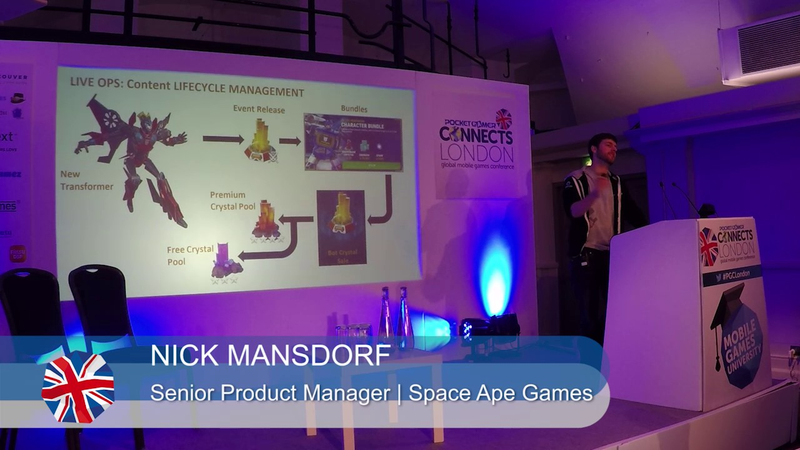
what does this mean for us we have these ancients they're coming out there's an event it's a big piece of content it's a big piece of work it's an event it's out there and then this big expensive piece of content is now used up we need to do the next week something else we need a new ancient we need this pipeline and that problem is expensive and hard to solve and if you don't think about it from the beginning you could be in a lot of trouble so with our second game we came up with a third game sorry transformers we came up with a pipeline a lifecycle management system and every single robot in transformers follows this lifecycle management and it impacts our revenue in in a very positive way and it's a way for us to manage the lifecycle of each piece of content so I'm gonna walk through it what happens is we have any bought big expensive piece of content like I said and the very first thing that happens is it's given out in an event we have various types of events there are only two types of events that you could get a
bot they're the most impactful biggest our marketing hardest to achieve and very limited drop rates once that event has run those bots then disappear they're no longer available in the game the people who that have earned them have them the people that haven't earned them see people who have them but can't get them a couple weeks later the first promotion comes online this is a promotion where there's a bundle only for four dollars that you can buy that has crystals with a chance at earning the spot that is usually paired with a lighter event that doesn't have a bot and after that weekend event and that bundle it's gone again disappears a couple weeks later comes into the store as a gotcha crystal you can buy it for premium currency now in the store as many as you want there's no limit but again disappears finally it comes back now it's here permanently it's in your premium gotcha crystal available all the time it's in the free gotcha pool it's available to the wider audience so what does this do right here we have our
bought ownership rates for one of our BOTS strafe there's an Autobot we do a star system so there's a 3 and a 4 star version of this bot what happens to bond ownership rates and this is spenders only is that the event comes out there's a very strict drop rate we know exactly what percentage of users are going to get it goes away that ownership rate is now flat first bundle comes online people have an opportunity to buy it ownership rates go up then the first crystal appears again ownership rates go up then a couple weeks later finally it makes its way into the gotcha Premium character pool the ownership rates go up by quite a lot it's now in the wider pool but you can see from this graph that at the very top rate even the three-star is only owned 18% of spenders so what this means is that we can do this bundle again we can sell this bot again we can use this spot for a lot longer than we otherwise would have because we've managed that lifecycle so let's talk about events
events change player behavior when you put an event into your game the way in which players interact with your game changes and this has a number of interesting side effects here is a event battle rate so this is battles per player per event day in events specifically so every event has a name and this is the event rates over time and what you can see here is that over time as we ran more and more events players learned that events were good events were cool rewards were great and they wanted to battle more so over time we doubled the amount of battles per player from the very beginning - now that's a big change from their behavior in the start of time but also if you look at this is rival kingdoms now their weekly averages versus their event averages you can see that not only do their events go up over time for the events themselves but compared to a regular day an event has
doubled the amount of battles as as a normal day and that means that these events require a lot of effort by the player and these are averages so you know their players on the far end of that distribution that are doing crazy things hundreds of battles doubles like 200-300 battles in a single weekend and that's a lot of fatigue that's a lot of effort that you're asking of your players so what do you do about that we've created what we call the event rating system the finger system so we classify every event by one finger to finger three fingers or four fingers depending on what we think it's going to do to the player so when we start with this system there's the one finger events which are engagement events low monetization potential not fatiguing at all they have a very strict number of battles that can be fought strict limits players don't tend to like them that much because they don't have great rewards but it's our way of saying it's enough battling you've been very busy for a while let's take an easy time
and have this fun little engagement event two-finger it's a little bit more intense now we're talking about a weekend in which you're working with an alliance of 40 members and you're working to a collective goal still not particularly fatiguing this is something that doesn't have a bot as a reward it has something else that's soft currency or shards or or pieces of lesser crystals and it there is engagement there is monetization there is some fatigue but compared to the one finger it's only a little bit more then we start getting to the three finger this is where we talk about having a new bot something that that you have to grind for that top alliances are gonna get that your average Alliance might not be able to achieve these have a good reward at the top they're very engaging everyone's working together towards a goal they're making money on on the skips of battle and and various in battle memorization mechanics and they are fatiguing and then finally you have the the daddy of all events the
forefinger these are competition events you're working with your alliance competing with other people on a global leader board only the very tippy top players get the best rewards so there's the top amount of monetization the top amount of fatigue and the top amount of engagement and what we do is we classify events like this then we group them into these things we call sagas and we run a cadence in which we manage the player behavior so that they don't get overly fatigued but we can be predictable and that cadence usually follows the very at the bottom here which is a three four to one or that's actually completely wrong that's where that's out of order it's a three to four one so you go three new bot new event hey it's a saga get in here then there's two you've worked off that bot let's let's take a small break for biggest event ever really competitive go at it all all day long and then one relax chill out nothing
going to be this weekend take some time to recoup and reset yourselves so there's another impact of all these battles and events and that on the soft currency economy so what happens is that you you get this system in which you're playing this battle and you're fighting battles and you're earning resources and the soft currency economy starts to get out of whack and what you see here is a is a graph with two different games the blue line is rival kingdoms the orange line is transformers and what's happening here is two different battle loops in rival kingdoms the event loop is the battle loop everything that you earn during a normal battle happens on mass during an event so the soft currency spikes on every single event you're sitting there on a weekend and soft currency is going up going up going up going up going up by contrast the Transformers graph shows dips every weekend and that's a very
specific choice we made was to remove the event loop from the regular Vala loop and to set event specific Awards which were experience and points and battle specific rewards which were soft currency and what this meant is that the rival kingdoms economy gets very inflated over time whereas the transformers economy actually deflates on the weekends because people are spending their time doing other things and then has much more longevity so if you're going to take away from this what do you need to know one content is key so you build content you sell content that's what we do but you need to understand your pipeline and you need to optimize that lifecycle you want to know how each piece of content affects your game what it does to file size what it does to loading times how long it makes it takes to make each piece of content and then you want to deliver content to players in a way that's very manageable second thing is events change everything when you put an event in your game player behavior changes so you need to
adapt to that you have to understand this impact on player behavior and need to manage that fatigue because if you let players battle as much as they want they will burn themselves out and we've seen this with our first game samurai siege we went event event event event event hardcore hardcore we saw revenue go up we were like this is amazing it's never going to end and then all of a sudden turn rates are going up da use going we're not sure what's going on and it was fatigue players just couldn't keep up with the event structure their alliances we're putting too much pressure on them we were putting too much pressure on them so the cadence allows us to be very discerning about how we do that and then the last takeaway is beware of inflation so you're here you're thinking about your economy you're thinking about events the best thing you can possibly do is to give specific rewards for specific actions so do an event get this reward do a battle get this reward if you can separate those game loops you're more
likely to succeed because you can balance one in one way and balance the other in their normal play pattern and have good results and then the second thing is Exponential's are your friend we're in a game economy if you have a lot of headroom and you have events and you can give rewards in those events you can build ridiculous curves of economies that take months and years as long as you know that hey these events are going to change behavior they're going to get a lot more battles so what we're gonna do is we're gonna throw in some extra taps here and there maybe this events going to be triple xp maybe this events gonna be double Cline's or somewhere like that and that lets you get away with it and that is all I have so questions [Applause] [Music]
Summary
Space Ape Games utilizes a structured, data-driven approach to live operations (LiveOps) to extend the lifecycle of mobile titles and maintain player engagement. The core thesis is that successful LiveOps must be integrated into the development process from the outset, with every design decision evaluated for its long-term impact on game economies and player behavior. By treating content as the primary driver of revenue and managing its release through a disciplined lifecycle, developers can maximize the value of expensive assets while preventing player burnout.
The methodology relies on a rigorous content pipeline and an event-rating system. New, high-value content—such as 3D character models—is introduced through exclusive, limited-time events, followed by a phased release strategy involving bundles and gacha pools. This approach ensures that content remains desirable and monetizable over an extended period. To mitigate player fatigue, the studio categorizes events by intensity, ranging from low-engagement "one-finger" events to highly competitive "four-finger" events. These are organized into a predictable "saga" cadence, alternating between high-intensity competition and periods of rest to maintain long-term retention.
Economic stability is a critical component of this strategy. The studio emphasizes the importance of separating event-specific rewards from standard gameplay loops to prevent hyper-inflation of soft currencies. By decoupling these systems, developers can balance the economy more effectively, ensuring that increased activity during events does not destabilize the game’s long-term progression. Ultimately, the studio concludes that by managing the intensity of player interaction and carefully controlling the distribution of rewards, developers can create sustainable, multi-year titles that balance revenue growth with a healthy, engaged player base.













Comments