Transcript
We launched the first online game for Game of Thrones. Every time a Game of Thrones episode came out on Sunday, we wanted to ship content literally by the next day. Hello world. Welcome back to the Pocket Gamer podcast with your hosts me, Brian Baglo, and the Baroness of Backends, the first lady of Live Ops, Miss Peggy Ansults. Hello, Peggy. It's good to see you. How are you?
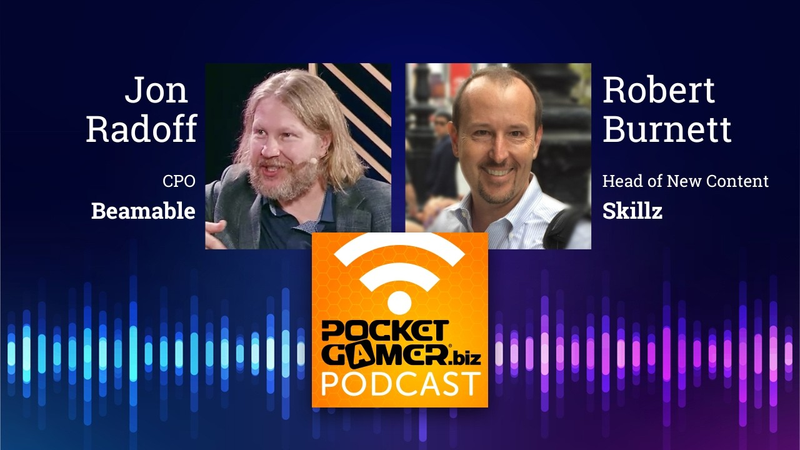
It is great to see you. And I'll tell you what, what's really cool here is Brian, you came right into it. Backend live ops. That's what the show's about. So, it is absolutely on the mark. And what's also on the mark is our show this time in particular because we're looking at the news. You probably saw it yourself. We covered it. Tons of headlines. Skills announced it has acquired Beamable, which is of course the backend and live ops platform. But it's more than a deal. In many ways, it signals something like an evolution
because if there's one thing we've learned and you've learned firsthand is that, you know, growth is not coming from UA. It's all about deeper engagement. That requires live ops. That requires infrastructure. You know, the ability to ship updates, run a live ops, scale without breaking the game. And I am sure that you know that firsthand as well, Brian. the days of a dead product and a disc in a box in a shop, those are gone, baby. It's like we're in the we're in the future now. Um, if you can't understand the data, tell the story, make those practical, actionable, you know, decisions that you need in order to keep your players happy, you are dead in the water, my friend.
Yeah, because it's about what Beamable was built to do, right? It was purpose-built to give studios that backend layer because, of course, devs, they have to operate live games. they have to provide back-end services. Well, they can't do it on their own. And that's what Beeable was all about. You
know, helping and assisting with the content pipelines, the scalable architecture. Skills on the other hand, just by way of background associated with competitive play and identity systems. So, what happens when you put the two companies together? Well, what changes is, in a word, everything because you have studios that don't have time, money, resources, back-end engineers, and now they do, which is why we're so excited to welcome John Rattoff. And there he is, CEO of Bivable. Many people know him as CEO of Beamable, but you, Brian, and I, myself, to us, he is an O of online systems. Long before live ops was an idea or a job title, long before games as a service went went mainstream, there was John doing his thing. So John, great great to have you today.
Thanks. Awesome to be here.
Been doing this for a while. You know, you've been building backend systems since before live ops was even a a
description, let alone a category of of game service. Um, when you talk to small studios today, you know, it's the upcomers, the indies. What's the backend assumption that they're making that just makes you go, you don't quite get it?
Well, I mean, today you shouldn't be spending any of your time and resources on building a backend. You should focus on how am I going to get my game to scale to a million plus players. And if you succeed at that, then you probably will not have built the kind of backend that you need to actually power that level of success. So I really counel developers to focus on aiming high. Take a lot of shots on goal by the way like iterate rapidly, have a high velocity development, really focus on the metrics that are going to matter around engagement with your customers, getting them to spend, getting them to keep coming back. U these are things that I had to learn over time, not only building backends, but running games. So
we built the Game of Thrones theme, we built a Star Trek game. So the Star Trek game is still it's a it's you know and it's and here right now so it's been running for a long time and it's a very live ops driven game. Yeah, I don't own the game anymore but I started it and ran it for a number of years and actually still power the back end for it because Tilting Point who runs on top of our platform continues to go forward with it. I learned a lot about like how do you drive that engagement loop and it really comes down to frequent content updates or the kind of content updates that a player is going to care about and then coupling that with activities, competition and cooperative events where you actually get drawn back into the action of that universe and then you present them with opportunities to continue to monetize and purchase as part of that overall loop. So, it's sort of this constant process of the content train is driving reasons to re-engage and then you find that there's activity to do online and then reasons to monetize and and just deepen your
experience in that game. That's how games like Star Trek have been doing this for 10 plus years at this point. So if you're spending any of your effort building the tech, which by the way is a humongous undertaking, I think at this point we've invested over $20 million US all in on building this this infrastructure. It's always seductive early on in looking at these platforms like, oh, I can just sort of like build these little pieces along way. And yes, no doubt, especially in today's world, you could probably just fire up some AI coding system and suddenly you've got some backend that'll be fine for a handful of users,
but it's not going to scale and it won't be maintainable because there's a couple of dimensions to scale, right? There's the scale of how many people are playing the game. That's one. The other is the scale of data and content and frequency and how your own team interacts with it and keeps it simple for them to keep it updated. and we've really attended to
that over time. I'll tell you the first game that we really started cutting our teeth on this was Game of Thrones. So, we launched the first online game for Game of Thrones
well over a decade ago back when the Remember the iPad? We were like a very early game on the iPad. Like that's that's how long ago that was. But we we had this very unique game in that every time a Game of Thrones episode came out on Sunday, we wanted to ship content literally by the next day. So you watch the episode, next day you're in the game playing with characters and content and items and things that you actually saw in the show. amazingly engaging for the audience because they're watching and then they're playing for the whole week and then they're playing for the whole week waiting to play and watch the next episode, right? So, we had to figure out how do you create the authoring pipeline, the process for getting it updated, all of those things like we had to figure that out kind of from scratch and it cost us millions of dollars to do
this, right? But today, if you're spending millions of dollars to do this, you're kind of putting yourself out of business because those are the millions of dollars that you should be investing in the game,
the experience of the game. Like, the only real differentiator for any game company ultimately is how fun is the game and how engaging is it and are people going to love it and keep coming back? Like, anything you do that isn't that tends to
be essentially debt, right? you're accumulating tech debt and all kinds of operational debt over time that doesn't do you any good. So that's where I've been working on and I have this kind of interesting background where I've done games but I was a pioneer in web development as well. So we had to build like these automation and content management systems for the web when the web was new. And I just started to see all the same problems in game development. Make it too hard for product managers and like non-engineers to update things and keep them going. So that's what we really wanted to do with
Beamable was just make it easy to run your game as a business driven by the KPIs of engagement, retention, monetization. It's like the day of launch was the day that the entire development team could take a Fortnite off and go and lie on a beach. Um, rather than launch day being where the actual hard work starts. I think we're all of a a vintage where the idea of having to build the engine to build the game was was pretty much current. Whereas now,
why would anyone go out and build their own game engine? Why would anyone go out and build their own lives live ops platform
when you guys have spent, you know, the years that you have, the millions that you have actually building something that that
is, I'm going to say it, battle tested. I know I sound like an AI. I swear to God, I am not chatting GPT.
Um,
M dash right in the middle right there.
Oh, it's like so many M dashes.
You see developers struggle. Is it is it that content pipeline on their side? Is it the they struggle to understand the tech? Um, is it once the game is live?
You know, what is the content velocity that you're talking about? You know, weekly updates for Game of Thrones must have been a huge challenge.
Well, first of all, the number one challenge is velocity. Overall, I see too many developers making wrong decisions that speeds them that doesn't speed them up, that slows them down, and they can't get to the parts that actually their customers care about. You're the players of your game only care about how fun the game is. So anything that you do that slows down your velocity in delivering fund to the player is the wrong is generally the wrong thing to be doing. So that's the that's the number one. The second problem is not having an evidencebased mechanism for iterating and improving your game over time because what you are ideally doing is looking at data the evidence of how people interact with your game. How do they retain? How do they engage? What features are they
playing? What kind of features are actually driving the most engagement? How are they communicating their love of the game to other people and using that information to then rapidly iterate? So, the two go hand in hand. It's having this evidence-based approach to game development where you're listening to customers. But by the way, when I say listening, I don't mean like going on to forums and reading all the posts that they make about your game. Some of that is is useful actually. But what's even more important, far more important to that is the behaviors that your players have in a game. Like what are they actually doing? Not necessarily what they say, which has a lot of different incentives around why they say things and what kind of influence they're trying to get, but you really got to pay attention to what are the actions and behaviors. What do they spend money on? What do they play? Are they leveling up? Are they spending time? and using that information to map it back to the types of features, events, content, everything that you
continue to do within that game. So, if either of those parts isn't working, you're not really managing things optimally. If you're collecting data, but you don't have sufficient velocity, then you're in this very frustrating situation that I've seen far too many people in where like you sort of know what you should be doing, but nobody can ever do it and the development team is like a it's so hard like we can't we can't even get to doing these features that or content even they think is so important. You know, similarly, if you've got high velocity, but you're not looking at evidence, then that's just a random walk. Like, and you and you know, hey, it's game development, by the way. Sometimes you'll just have that brilliant at the helm who knows exactly what the player wants.
And that's great. If you have that person who just sort of knows it intuitively and you can see that they always make the right decisions, fantastic. But it's a rarity and even those people make mistakes part of the time. So that person is even more
superpowered when they have evidence and data that can help them think about where to prioritize. So you got to have both, speed and evidence. You put those two together and you're going to have the best chance of success in this business.
I like that. I like that. Speed and signals was what I was thinking about. And that
I like that. Steal that.
What you need
like your name is John. I was reading what you've been saying about this and you've posted that you're very excited and we are to have you because you said you're excited to help make skills quote the definitive platform for live services games. Now definitive that's a big word. That's a big word. What does that actually mean in operational terms for a studio
building a game today? Well, first of all, one of the unique things about Skills is the company and and actually very few people really even understand this at this point, like they have monetization in one really interest scenario, which is cash gaming, which is
a very hard thing to master, but it's it's a specific form of monetization. They've also invested in in ad network. So, they own ARY, which is an ad network. So they've got exposure to advertising which has become hugely important for game developers.
Yeah.
U particularly on mobile and now with Beamable we are really experts on inapp purchases and item economies and currency economies within games. So now for the first time you really have a company that combines all of the really interesting forms of monetization that you can in a live services game. inapp purchases and items, cash deeming and advertising all within one company. So being able to bring all of that together and couple it with an engagement retention platform with all of the analysis, the user management, the ability to deliver back-end features and make it easier for your developers to do that. Like really
we now have a full staff monetization to back-end development platform in play here. So that's what we're working with the broader team at skills to bring that all together ultimately just to help game developers, right? That's the mission here is to help Beam developers get to market faster with great gains and give them all the options that they need. Whether that game is going to need ads, whether it's inapp purchases, whether it's cash gaming, if you want to go down that route, which by the way, the more I've learned about that business, such a wide openen opportunity where you've got these small developers who are making a ton of money, frankly, and it's almost like an ignored category. So really really interesting set of resources that we can bring to together and knit together into one platform here. That's what I'm excited about to be really the platform company for live ops and live services that addresses all the major ways that you can generate revenue within a gaming
enterprise.
So that's huge. Always the platform play, John, just as a followup here. You know, it's always the platform play that wins because what you're doing is you're not just closing a loop or creating that cycle, but you're getting the signal again. So, we're back to our speed and our signal in that life cycle. So, that's huge. I I see what you're what you're talking about here. When you put those pieces together, it's more than the whole.
We hear so often on the podcast, we hear about data, the importance of data, storytelling, actionable outcomes. We hear about um you know hybrid monetization from so many people and the fact that the monetization of a game has now become a design decision for a developer you know I think that's hugely important data design development there's another littleiteration that you can maybe take away but but it's it makes so much sense you know if you no longer have to worry and you now have a set of tools that are essentially um
part of the platform that allow you to decide exactly how you what games you build and how you monetize them. That's massively powerful for developers. This is surely putting hands power back into the hands of the people making the games.
Yeah. And you rais a good point, which is that the way you're going to monetize the game, it's it's more than a design decision. It actually is the thing that decides a lot of what your design options even can be.
Which, by the way, being built at premium games is also totally like you don't have to do any of these in-game live ops things. Sometimes live ops means have great multiplayer experiences and keep engaging people and hope they come back a year later for the DLC that you're going to ship. So like live ops affects every single kind of game. But if you're going to build a game that's premium with DLC, that's a certain kind of game system that you're going to implement. If you're going to require advertising at a certain amount of frequency, then that's a different kind of game because you got to know where you can surface those in a way that that
the players can tolerate. Inapp purchases, very different game design. It has to be built around an item economy has a lot of complexity, intuitive currency systems, figuring out what that player journey is, when they're going to be likely to want to buy to accelerate their progress into the next stage of the game. So all of these things determine how you're going to actually design the game. And one of our goals with Beamable is to always let the developer including the tiniest teams just dream big about what they want to do. So I think in the past I've talked to a lot of smaller developers for example who think about live services and they can't imagine building a live services game. But in fact, you can do that now. Like even the smallest teams can build a live services game and you should because it's actually your opportunity to compete. And I think actually smaller developers are in a better position a lot of the time to
build great communities and have a hightouch relationship with the players of their game and really have a dynamic live services experience for everybody that monetizes over time, keeps them in business and also keeps players engaged. So every developer of any size can do that. That said, this is a platform that scales way up. If you're a AAA studio that wants to have many millions of players playing it, we designed it to be able to have very high loads of customers. We built lots of um protection into the system. We have 99.9% SLAs's. Like the stuff really just works. It's you you said battle tested yourself. I mean it's been proven over time. like the software works, it runs, it's stable, it's trustable, which by the way, that's the number one thing that I hear from studios. They have to have the live ops platform that they can trust and that it'll be around and that it works and it doesn't go down because we go down, they go down in their
business. positive point here particularly for our audience because it's about small studios smaller studios being able to dream big to act big I mean technology gives them that anyway when we talk about what platforms can do but here it's that end to end I think that allows them as you said yourself John to dream bigger what does that mean so we can help them understand because maybe they've just thought I can't do it and they've maybe lost sight of what's possible One of the key things is just embracing the idea of a social fabric within your game that connects the different players of your game in some way. I think once upon a time people thought that meant, oh, I have to build an MMO RPG and all this money went into like these big huge MMO RPGs. And guess what? We have World of Warcraft and Lineage and maybe one or one or two other products in the world. Guild Wars, one or two others beyond that. So, pretty short list of MMO RPGs that have
sustained over time. But if you look at online games and mobile games in particular, you have a lot of games that have social fabric present within them with without having to build massive massive MMRTGS. Like earlier we talked about my own game, Star Trek and Game of Thrones. You wouldn't have called these MMO RPGs, but they were certainly MMOs and they drove them enough social interaction that I know of a couple of cases where people met each other in Game of Thrones, got married, and then happened all over again in Star Trek. So like that only happens because there's this social connectivity between the players. We make that very easy to build a game that starts having that. Now you're going to have to figure out what are the really compelling game mechanics that you then derive from the presence of all these players being within the game. But it doesn't necessarily mean it's like a massively multiplayer online role playing game. It can be done asynchronously. can be done with fairly lighthearted competition and cooperation
elements. We open that to the possible and I really enga I really just encourage people to think about that because we talk about sort of the dopamine loop of games these days is like as if they're sort of like casino slot machines and that is an aspect of game systems but the social aspect of games ts into something much deeper in the way we are as humans. It's not that short-term reward. It's the serotonin system, the longer term reward systems. It's how we incorporate ourselves into social systems. And if you can tap into that in your game, then you're going to have something that's more like a Star Trek timelines where people are still playing it 10 years later uh from the date we shipped. So, this is really what I want game developers to think about. And now you can dream big and think about how do I incorporate social aspects into my game. And sometimes that can mean full-blown multiplayer immersive experience, but it can also mean competition, can mean cooperative
mechanics where people team up in various ways. So start thinking about that. We give you the platform where you can actually begin doing that within your game. And frankly, it could be one solo developer. You they'll long beam and do that. And it's perfectly suitable as well if you're a team of, you know, many, many people in a larger studio or publisher and you just want to tap into the same thing. In either case, the main point is your team is now going to focus on the fun pieces, including that social fabric,
not the distraction of building an R&D project for your back end, which is going to slow you down. And then as you build and launch this product, you're now going to have the KPIs that actually matter. Social engagement, people connecting with each other, retaining, coming back, spending money, and really product management, which is geared towards looking at those numbers and reacting to them in a way that is fast enough that you can learn and implement with high velocity in your game. You
have to solve both problems. It's the information delivery we talked about earlier when you called signal. I I like this uh the the way you conceptual instead of the lock pegy. Um but if you don't have the development process in place that moves fast, you're never going to you're never going to move. So the velocity is equally if not even more important. Is there a an example you can throw at us John or give to our listeners? Is there's something out there you can point to and say that's something a small studio maybe an India one person developer can do that they can ship that they can run that that they couldn't do before that was way out of reach. Yeah. One one example is just start having a regular content cadence in your day and events. Content by the way it doesn't mean you have to ship whole new chapters of your day of your game with whole new content. like maybe it means that should kind of mean. But one of the things I really like encourage people to do is think about the game mechanics you
already have and is there interesting ways you can repackage that in new ways on a regular basis to re-engage people so that there are new ways of winning basically but within the original game design. And a good way to do that is just package it within an event system. makes events really easy. So you can ship it on a schedule. You can program the schedule in. You can identify what parameters change. You can release new items and content that ties directly to that. You can tie it to leaderboards that can be geared towards various forms of tournaments and getting to know score thresholds and all that stuff. Like we already figured that out. So you just have to think about the game mechanic. Now, how do you take that game mechanic and structure it in a replayable way where enough has changed that people find it novel and interesting and compelling enough to work with him? And then you figure out again from either a social cooperative standpoint because people could team up, be on the same team and compete with other people or it
could be head-to-head competition. You have all those options within it. So, we're finding that people that implement events, they really create far more long-term engagement. And this is something that even a small studio could do. And sometimes when I talk to people who have made a primarily single player game, one of the things I tell them to is, you know, you could take that core game loop you already figured out for your single player experience. you were just a few steps away from taking that and making it a competitive experience of some kind. And this is sort of an interesting thing that is that I think skills discovered in its way and beamable also discovered in our way. So in skills for example, a lot of the games are structured around very tight core game loops where you play in like two or three minutes or few minutes at a time
and then it's head-to-head competition using this platform that we've built here at Skill to make it very fair. For example, you play a solitire game. Both
players have the exact same deck and it's all about how do you get through the solitire game as fast as you can and the one who has the most speed and accuracy in that process, you you win, right? So it's completely fair. It's no random chance because you have the same deck. That's one form of competition, but it's around the core game loop and suddenly you've taken something where people would play solitire by themselves. It's literally the name of the game. Um but you've now made a whole new much more engaging structure around it at the meta layer that keeps people playing and replaying and replaying because the power of competition is so compelling for people. Similarly, Deemable did that in a way more geared towards inapp purchases, right? So, you have events with new items and content that players are likely to consume because that experience is novel and they want to compete,
get to the top of the leaderboard in a different way, right? So, it's kind of the same idea of a core game mechanic
that drives that competition through leaderboards and things like that. Um, it's something you could add. so easily to any game. So if you got a cool game mechanic as a small developer, I would say try this. Try try try both. By the way, like you could almost experiment in two parallel ways. You could even ship two different games if you want. Ship one that's cash gaming. See how that goes. Skills has got a great platform for that. Beanbull is a great platform for turning it into more of a, you know, purely social competition where it could be ads or high inapp purchases that that fund, you know, the process around that.
So something anybody can do. And by the way, the very largest publishers and game studios, this is exactly what they do.
You're a force multiplier. even the smallest studios can now actually start to take
those as you call them you know the core loops the really compelling engaging mechanics and look at them differently
um and you know something as simple as a leaderboard makes you inherently you know
online live ops
there's massive opportunities here but I think for our listeners this still might be kind of theoretical so let's let's kind of drill down into the practical side um so if a small studio decided to build and operate its own back end, you know, and not just duct tape something together. What does it demand and how many engineers are we talking about in in terms of wanting to make that and scale that and run it properly? Is is it feasible or should they just be sort of going, you know, beamable and skills are there, let's just
use it as part of our design process. live ops and backend technology is always like death by a thousand cuts. But
so look like there's lots of tech out there today. If I wanted to go boot up a new
machine, download the Unity SDK to it, and then fire up a backend by getting an AWS instance and loading up, I don't know, MongoDB and a web server as the backends might like that would be a way that you could build that and many games are built that way. You can do that like and then you'll have some kind of backend at the first moment. But here's what then happens. Every single thing you start adding to it, and believe me, you're going to start having to add more and more and more. Each of those is its own development project. It's not going to scale. Scaling is very difficult, right? So, we all want to plan for the million player game or the 10 million player game. We don't want to plan for the 50 player game. If you want to have a 50 player game and it's just you and your buddies with a college project, yeah, you can you could probably just build any backend that you want. But if it's going to actually scale to a commercial audience, it has to be able
to support lots of users and be reliable. A lot of the things you have to do that to do to accomplish that is is like not simple. And then every single time you need to change to this because your designers are saying, I want to do this or I want to change in this way. All of those things then requires you to then go back. So it's essentially compounding tech debt over time. So before you know it, this tech is costing you what we often see. It's like 20% of the total R&D that any studio is spending. So you think about that like are you willing to spend 20% of your effort when you really get going on that? And it's not just the 20% by the way like that's just what it looks like on a P&L from a cost perspective.
What you're really doing is you're introducing risk.
Yeah. something works doesn't work, you're out of business,
and you're slowing yourself down, which means opportunity cost, you might not have even shipped the features that the
player is going to care about. When you're building the game, by the way, like that could be the features that actually make a difference because it's rare for me to see a game. This is the funny thing about game development, everything almost always looks like a mess through like 95% of the game and then the last 5%,
the last 5% is actually the last 50%. It looks like you're close. it's always looks tantalizingly close and then it's like that the myth the the mythical 5% right it's it's got another 50% of the game um so there's a lot more ahead of you and that's exactly when tech dad and slowdown like all of that stuff can really kill you because that's when you got to really ramp up the velocity that's when you're engaging with your community learning from them making the most important tweaks that would actually make it a commercial hit instead of just something that limps over the finish line I see it too often with game developers.
Amazing. Amazing. And and again, I I I was there. I don't know if you can see in the background, my first game was Grand Theft Auto.
I've heard of that.
Yeah. Yeah. It's gone on to do quite well. Uh after I left, genuinely for the first four years of that game's development,
it did not work. Nobody knew what it was going to be. Um and everybody, including the publisher, was trying to kill it.
Yeah, it's an amazing thing. make games get shipped at all? How do we ship games whatsoever? If any if our customers saw half of what went on behind the scenes building these things, you'd wonder like you look at it and you're like, "This isn't fun at all. I don't even get it." Like, what's what's happening here? And then how the right teams get it all together at the end.
Exactly. It would make the comments under the YouTube videos all the more inexplicable. People would be going, "No, no, no. Much respect. you actually made it happen. I don't know how, but you did.
It was the CTM GTA. I mean, it was about it was kind of the ironic thing about like this leak that happened two or three years back of like early GTA
graphics
and and then like all these people showed up and they were like the current GTA that that they're still working on saying, "Oh, it doesn't look good." Yeah, of course it doesn't look good. It's not It's not finished yet. Like,
calm down. Like I think these guys are pretty damn good at their jobs. So just like let them do their job. You're going to be happy when this thing shifts.
Very much so.
We were talking about how this looks in reality and I'm just thinking, you know, why would anyone want to have that risk? Why would anyone want to have this this, you know, all the heavy lifting? And uh wondering you must have seen points where studios simply underestimate back end to the point where it's affected their runway. It's affected what they're able to ship even if they're able to exist.
I've seen it firsthand. I've seen where we've talked to a studio. We've shown them what we do. The CTO there has been,
"Oh yeah, we got this. I know how to build backends."
They've a year or two has passed. We come back. The CTO isn't there anymore. The CEO tells me, "We spent two or three million dollars on things that didn't even work. Now I'm worried that I don't have the ability to ship my game and I'm looking for more money." I've seen that exact thing play out too many times. So, it's just not worth taking the risk. The fact is a great platform that does this. There are a couple of others out there that are also do a good job at what they do and can help de-risk it. Our specialty is not only de-risking the backend scale up, but we have the best developer workflow. If you want to work in Unreal or Unity and just make it all feel like native game development while scaling up your back end, that's what we do better than anybody else alongside of having something that will in fact scale up for your millions of players when that happens. Why risk this when you could
just put all those dollars into building a great game? is not only are you going to ship your game, now you have the extra time, runway, and resources to probably find those additional things that could make the difference between a unsuccessful game that chips, like not commercially successful, and maybe even the difference between a good game that some people play and enjoy versus a great game that's a worldbeating success that tens of millions of people are going to enjoy. So give yourself that chance. That's why I started Beamable with my co-founders. That's why we joined Forces with Skills to continue to grow that. Give your company every chance of success to build out and scale that game and and build ahead
because this is a hard business.
It it's what we used to call optimizing for opportunity. You know, you do not want to be a victim of your success
by the fact that you get 150, 250, a
million players piling in and the thing that you jury rigged in the back, all of a sudden can't cope and everybody's having a bad time.
It's like there is a reason that in 2026 we're in the era of the the platforms and partnerships. People out there have spent a lot of time and money and expertise building services that allow game developers to focus on what they want to do which in my experience is make games and nothing else.
Yes, it's about that's the business indeed.
But we are in a business. So it brings me out to look at the macro drivers here and uh we chatted about this a couple times Brian. You know, we are in what sensor tower has called the monetization first era, right? It's all about not just top offunnel. It's about deep funnel engagement, everything you're talking about, John. And so the bottom line is, you know, growth for your game comes from value per player, not the volume of players. And that's where
loyalty is important. And then we come back to your capabilities plus skills. So if it's about loyalty, engagement, you mentioned the competition systems, you know, loyalty, everything comes together, how does that move us more towards this output and this outcome where it's got to be you can be able to compete as a small studio by driving massive loyalty and engagement.
Well, I think there's a couple things to unpack there. Yes, on the monetization side you have to have the ability to do that if you just want to ship a game and forget about it. That's a dying business model, but you can of course do that. But if you want to be running a game business as opposed to just shipping a game and then moving on to the next thing in your life, running a game business now means life services. And you have to have a pretty capable, scalable system for that that
also can adapt to change as you make new things within your game, new content, new features and whatnot. So yeah, that's that's what we do. Well, if we look at the way the market has been evolving over the last couple of years, it isn't just engagement. It's the fact like I think we have a lot to learn from a platform like Roblox. First of all, a lot of novelty in many of the games that are present within Roblox. What is one of the pieces of learning from that? Well, it's when you enable the small developer and the tiny teams just to kind of run with their gut and instinct and produce a lot of ideas at scale, then you can create those additional hits. So, one of the things happening within Roblox is that they're absorbing a lot of the game industry growth right now. More power to them. I think they're doing a great job opening up and democratizing game development to a huge audience of people. It's not just the
fact that Roblox is a creator platform, which is part of it. It's that they have so many more people doing creating and you have a lot more variety in game system and gameplay and things to do. So, what we really need to do is just unlock that creative genius that's out there in the world for game making. do it in the way that Roblox has already proven happens when you do it at scale with millions and millions of people, but continue to unleash that to people that are building in Unreal and building in Unity who have a different vision around the 3D immersiveness or the gameplay systems. Like there's a lot of things you just can't do within Roblox obviously that are unlocked by many of the other technologies that we have available. So let's make it a creator economy for everybody with whatever that creative vision is without necessarily having to be within any of these particular development frameworks.
Auto-generated captions from YouTube — names and numbers may be misheard.
Key insights
Distilling the key insights…
Ask AI about this video
Cite this video
Citation
Generating citation…














Comments