1 free read left. Create a free account for unlimited reading + AI research.
Create free accountArticle Board Game Studies Journal
1 free read left. Create a free account for unlimited reading + AI research.
Create free accountArticleBoard Game Studies Journal
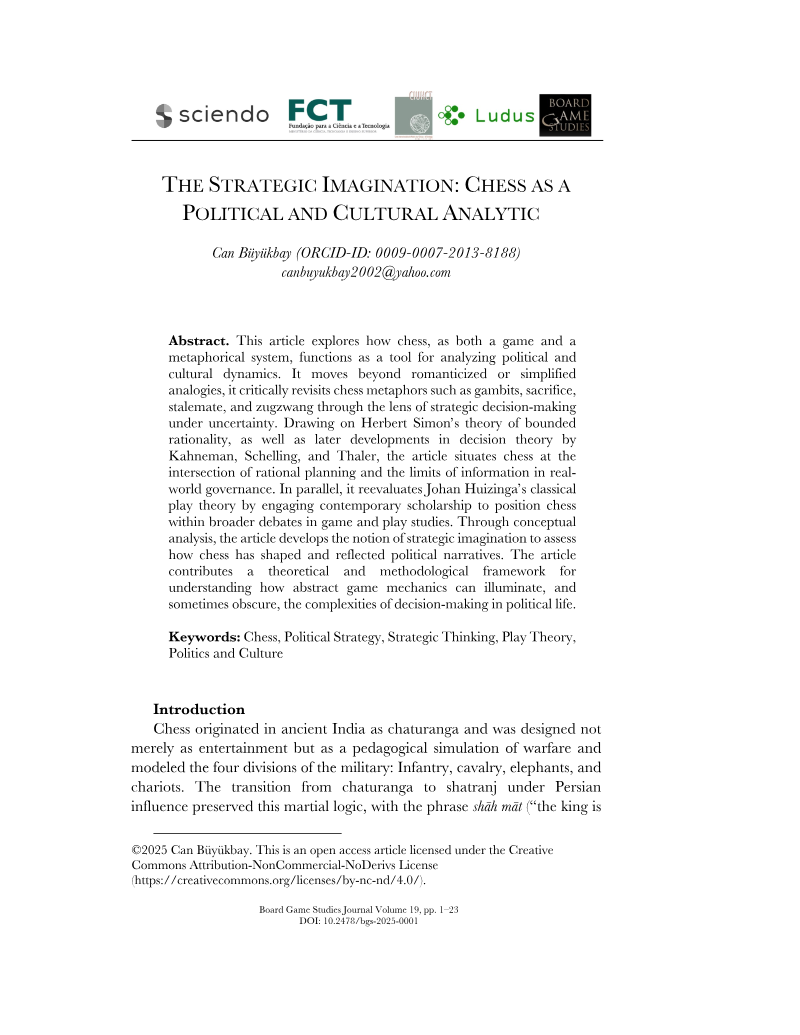
The paper defends four-king chess with dice, known as catura ṅga, against charges that its dice and four-army format are unrealistic.
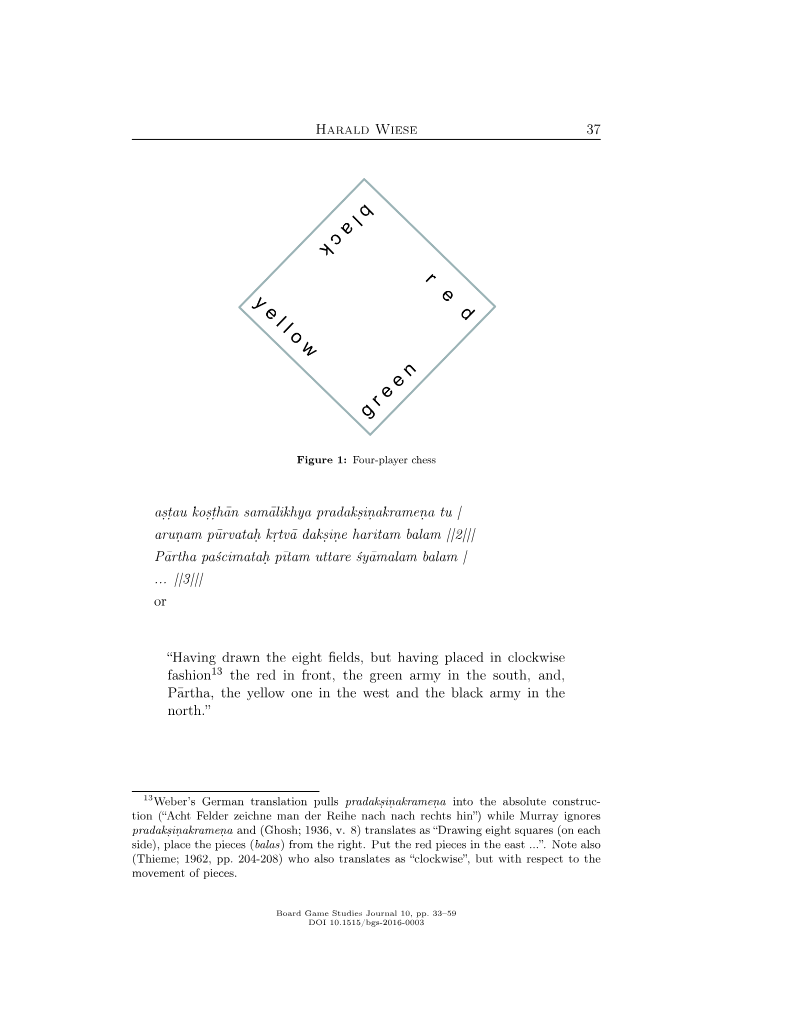
Harald Wiese's paper defends four-king chess with dice (catura ṅga) against the charges that its dice and four-army format make it unrealistic or corrupted. The central argument is that the game may have been designed to illustrate Kautilya's mandala theory of interstate relations, in which the enemy of one's enemy tends to be one's friend. The author is careful to concede that no historical evidence establishes which of the two systems came first, so his more modest claim is that the game and Kautilya's Arthaśāstra share striking structural similarities and may have served as a teaching device for strategic principles among Indian rulers. The Tithitattva and Manasollasa, which describe the board layout and the pairing of allied colors, are treated as supporting evidence for this reading.
The dice receive particular attention. Drawing on the Arthaśāstra, the paper interprets dice as a symbol of the uncertainty of war and peace, consistent with the text's distinction between human policy, which is controllable, and divine fortune, which is not. The work then formalizes the mandala model as a game-theoretic structure, specifying neighborhood and fighting relations, payoff-based friend and enemy classifications, and Nash equilibria in which each of four states chooses whom to attack. Within this framework, the "enemy of my enemy is my friend" conjecture becomes a testable proposition.
The analysis yields twenty equilibria, including trivial, peace, paired-attack, and "horseshoe" configurations. The main result is that Kautilya's conjecture holds in most cases but fails in certain configurations. The author presents the model's cold, strategic framing as consistent with classical Indian political thought and concludes that four-king chess is a realistic, if simplified, formal representation of interstate strategy. The paper acknowledges that its static model omits neutral and middle kings and unequal fighting strength, and its appendix supplies proofs for the theorems.
Board Game Studies Journal · 2025
Board Game Studies Journal · 2025
Board Game Studies Journal · 2025
Board Game Studies Journal · 2025
Board Game Studies Journal · 2025
Board Game Studies Journal · 2025
Board Game Studies Journal · 2024
Board Game Studies Journal · 2024
Board Game Studies Journal · 2024
Board Game Studies Journal · 2024
Board Game Studies Journal · 2024
Board Game Studies Journal · 2023
European Conference on Games Based Learning (ECGBL) · 2025