
Board Game Studies Journal
Open-access peer-reviewed journal on the history and study of board games, published with Sciendo (De Gruyter).
Documents
Face to Face with Argentinian Truco: Origins and Evolution
Truco, the Argentine card game, traces its lineage through a long European and colonial history, and this study situates it within that trajectory while arguing for its cultural significance as the country's de facto national game.
- The study traces Truco's lineage from trick-taking card games that moved from the Mamluk Sultanate of Egypt into Europe, with Spanish games Triunfo and Truque, alongside Putt, Le Truc, and Vitou, and argues Truque was carried to South America with Flor to become the basis of Truco.
- The author argues Truco underwent 'de-Europeanization' in South America, developing local variants, low-stakes wagering, and improvised gaucho-themed rhymed verses with courtly-love themes and irreverence toward authority.
- Colonial legislation, including Charles II's 1680 law De juegos y jugadores and Charles III's 1771 Pragmática, omitted Truque and Truquiflor, suggesting these games went largely unregulated in the Río de la Plata.
Graffiti Games of Central Maharashtra: New Documentations, Revision and Theory
This paper documents ancient etched game boards across central Maharashtra, India, presenting findings from an ongoing fieldwork initiative that combines new discoveries with previously collected data.
- The paper documents ancient etched game boards across central Maharashtra, combining new fieldwork with previously collected data from sites including Buddhist rock-cut caves at Pitalkhora and Aurangabad, the Chalukya-era Shri Hemadpanthi Mahadev Temple in Gautala Wildlife Sanctuary, and temples around Lonar Crater Lake.
- The boards are most commonly mancala-type layouts, alongside Nine Men's Morris, 16 sepoys, and Tiger and Goats boards, and the authors highlight a distinctive "T"-shaped mancala variant at Lonar that they report has no known parallel elsewhere in India.
- The authors argue that the regional concentration of graffiti games indicates a rich communal gaming culture, with boards placed on temple plinths, parapets, floors, and stepwells suggesting play held ritual or communal significance.
The Strategic Imagination: Chess as a Political and Cultural Analytic
"The Strategic Imagination: Chess as a Political and Cultural Analytic" argues that chess, both as a concrete game and as a metaphorical system, can serve as a productive analytic tool for understanding political and cultural dynamics, provided its limitations are acknowledged.
- The report argues chess can serve as a useful analytic tool for political and cultural dynamics, built on the concept of "strategic imagination" (grounded in Simon's bounded rationality, chunked pattern recognition research, and conceptual metaphor theory), but only if its limitations are acknowledged.
- Chess's full observability and zero-sum structure underrepresent the ambiguity and affective weight of real-world decision-making, so the analogy must be applied with caution.
- Chess motifs such as the gambit, castling, zugzwang, and stalemate are operationalized as analytic categories and applied to cases including Obama's 2008 campaign, Gandhi's Salt March, Amazon's reinvestment strategy, Luther's Ninety-Five Theses, Poland in 1939, and Nixon's opening to China.
Sophus Tromholt (1851–1896): A Neglected Danish Games Inventor
Sophus Tromholt (1851–1896), a Danish schoolteacher, northern lights researcher, and photographer, emerges in this study as a largely overlooked inventor of board and puzzle games.
- Sophus Tromholt (1851–1896), a Danish schoolteacher, northern lights researcher, and photographer, is credited with at least four or five board and puzzle game designs, including Mona, Samson, Yum-Yum, and Rocco, with Rococo probably also his.
- Most of Tromholt's games were published by Otto Maier Verlag in Ravensburg, and between 1891 and 1894 by the Danish and Norwegian firms Schlichtkrull and Nygaard.
- Mona was Tromholt's most commercially successful design, with reprints extending into the 1930s, while none of his games appear to have been patented despite some copyright claims.
A Study on the Late Antique Board Game Duodecim Scripta/Alea from Stratonikeia and Lagina
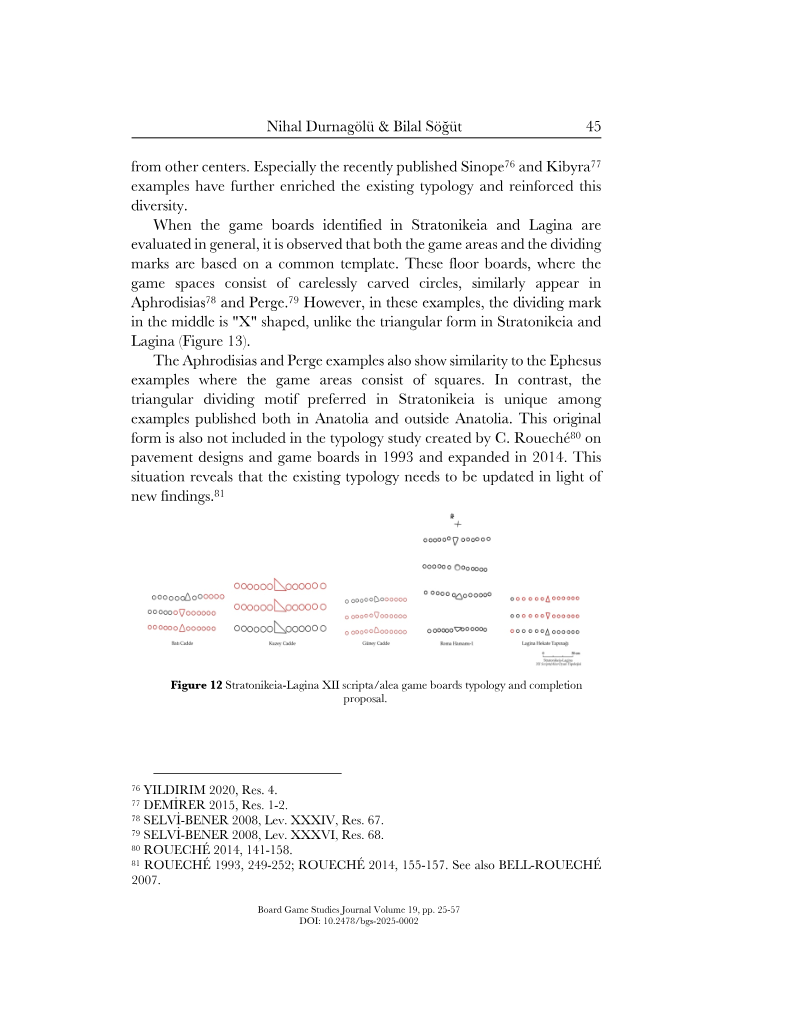
This study examines five late antique graffiti boards of the Roman game duodecim scripta, also known as alea, carved into marble surfaces at Stratonikeia and Lagina in southwestern Anatolia.
- The study examines five late antique graffiti boards of the Roman game duodecim scripta (alea) carved into marble at Stratonikeia and Lagina in southwestern Anatolia, dated broadly to the 3rd–6th centuries AD, and argues board games remained a common social pastime in Imperial cities even as pagan belief declined.
- The game evolved from a three-row board (XII scripta) into a two-row alea or tabula form by about the 5th century AD, which the authors describe as a related branch of the family rather than a direct ancestor of modern backgammon.
- A reused architrave from the Stratonikeia Roman Bath "Honor Hall", dated to the late 5th or 6th century, shows a four-row arrangement that is rare among the usual three-row forms and is paralleled only at the Didyma Apollo Temple, possibly hinting at movement toward the two-row tabula layout.
Shinfuseki: Go's Modern Revolution?
Ian Rapley's article reassesses shinfuseki, the 1933–34 opening revolution in Go led by Kitani Minoru and Go Seigen, arguing that it should be understood as the culmination of earlier experiments and mounting pressure for opening innovation rather than as a sudden rupture.
- The study argues shinfuseki (1933–34) was the culmination of earlier opening experiments and mounting pressure for innovation, not a sudden rupture, based on analysis of more than 120,000 game records alongside textual sources.
- Its stated aims centered on balance, harmony, and the doctrine of the mean, rather than the speed and central control that later interpretations emphasize.
- The movement is traced to the 1933 Yomiuri match in which Go Seigen debuted 3-3, 4-4, and tengen opening moves against Hon'inbō Shūsai, though 4-4 and tengen openings had earlier histories and Go and Kitani had tested 3-3 openings during 1933.
Chess and Freedom
This essay examines the relationship between chess, a rule-bound and historically elite pastime, and the concept of freedom, tracing the theme through three episodes of the twentieth century.
- The essay traces the phrase "Free Chess" through three twentieth-century episodes, showing how a single slogan was used across the political spectrum rather than belonging to any one movement.
- At the end of the Weimar Republic, the radical Greater Berlin section's journal Frei Schach!, aligned with Red Sports Unity, used "Free Chess" as a revolutionary battle cry against both middle-class clubs and the social democratic leadership.
- The same rhetoric was appropriated by rival factions, the reformist Free Workers' Chess Association, and ultimately the National Socialists, whose suppression ended both working-class chess movements.
Discovering Dadu: A Ludemic Enigma from South Asia
"Discovering Dadu" by Jacob Schmidt-Madsen introduces a little-documented two-player race game played almost exclusively within the Dawoodi Bohra Muslim community of South Asia, a game absent from major encyclopedias and scholarly literature.
- Dadu is a little-documented two-player race game played mainly within the Dawoodi Bohra Muslim community of South Asia and absent from major encyclopedias and scholarly literature.
- Using ludemic theory, the author argues Dadu is a hybrid: a South Asian cowrie-dice race game closely resembling Pancha Keliya that has absorbed structural features of the West Asian Tab family, notably the 17th-century Palestinian Kiôz and the Turkish Kös.
- Evidence for the blend includes Dadu's king-and-pawn pieces, perpendicular track, and opposed movement, while Backgammon and Chess are rejected as direct sources.
Cultural Transmission in Printed Games of Cupid: Tracing Lines of Descent
The study traces the descent of printed Game of Cupid versions, a dice-based race game derived from the Game of the Goose, across France, the Low Countries, and Britain between roughly 1600 and 1850.
- The study models the printed Game of Cupid (a dice race game derived from the Game of the Goose, c. 1600–1850 across France, the Low Countries, and Britain) as a single tree of descent driven by vertical transmission from a common prototype, not by horizontal borrowing among publishers.
- Twelve surviving examples were analysed using thirteen markers (such as entry-gate icons, toll payments, and the "death" space) plus more than fifty high-level attributes of rules, layout, numerology, and iconography.
- At least three quarters of the attributes examined show no variation across the sample, which the authors interpret as direct copying rather than independent invention.
Early Mancala and Tāb Boards Found in Israel (and in Some Other Countries)
Thierry Depaulis's article argues that a number of stone boards found in Israel and elsewhere in the eastern Mediterranean and Near East, long labelled as mancala, are more plausibly tāb boards, a race game, and that the Arabic game known as "arba'ata 'ashar" (fourteen) was likely tāb rather than mancala.
- Depaulis argues that many stone boards from Israel and the eastern Mediterranean long labelled mancala are more plausibly tāb boards, a race game, and that the Arabic game 'arba'ata 'ashar' (fourteen) was likely tāb rather than mancala.
- Tāb appears to have been established well before its first literary attestation in 1310, so the chronology of the game is older than the written record suggests.
- The evidence for early mancala in the region is weaker than previously assumed; the earliest securely dated mancala boards are from Matara in Eritrea, dating to the 6th–8th centuries.
Quantifying the Vices and Virtues of Snakes and Ladders Through Time
Across three historical and modern Snakes and Ladders boards, this study uses large-scale simulation to measure how much each snake and ladder shapes the time needed to win.
- A game element's influence on play length cannot be predicted from its physical length, because placement and interaction with other elements, especially near the endgame, produce non-proportional effects.
- Across 100,000 simulated games per board, the 1998 Milton Bradley 100-square board averages about 40 spins per game, with chutes lengthening play far more than ladders shorten it.
- On the 72-square Vaisnava board the full game averages roughly 100 spins, snake K has an outsized slowing effect, and the longest ladder B contributes only modestly because it carries players past the winning square and forces a return.
Ludus Regularis: The Clergy Game
Ludus Regularis, a 10th-century dice game attributed to Bishop Wibold of Cambrai, is presented as a clergy game designed to offer members of the Church a form of dice play free from the vulgar associations that made such games objectionable for the clergy.
- Ludus Regularis, a 10th-century dice game attributed to Bishop Wibold of Cambrai, was designed as a dice game for clergy that avoided the vulgar associations making such games objectionable for churchmen.
- The game's structure (three cubic dice and a tetrahedron with a board of 56 virtues) is argued to express Catholic doctrine, with its apparent obscurity attributed to scholarly neglect rather than genuine difficulty.
- A probabilistic review finds no relationship between a virtue's point value and its likelihood of occurrence, and only Faith and Hope can be obtained from every cubic triplet, while Charity requires a special two-roll rule.