Dice Game reports and market data
2 documents·1 writer
2 game industry reports, presentations and talks about dice game from writers such as Board Game Studies Journal, newest from 2022. Every document has a summary and key insights with the page they come from.
Documents
Whitepaper29 pages
Board Games Equipment from Archaeological Contexts in Archaic Attica
Archaic Attic gaming equipment, including dice and painted gaming tables from burial and other contexts, is examined in this study of board game equipment from the Archaic period in Attica (roughly the 7th to early 6th century BC).
- Attic tombs began containing board game equipment in the early 7th century BC, with the earliest securely dated examples from Vari and Anavyssos belonging to the second quarter of the 7th century, making Attica the most precisely dated group of such finds in Greece (though dice appeared earlier in tomb deposits at Eleutherna in Crete).
- The study's empirical core is a catalogue of black-figured gaming tables from the Kerameikos, Vari, Copenhagen, Merenda, and La Tour-de-Peilz, plus black-figured pottery dice from Sounion, Heidelberg, Brauron, and the Acropolis.
- Outside the Attic funerary examples, gaming boards are found overwhelmingly in public or sanctuary settings rather than in tombs.
Board Game Studies JournalApr 2022
Whitepaper34 pages
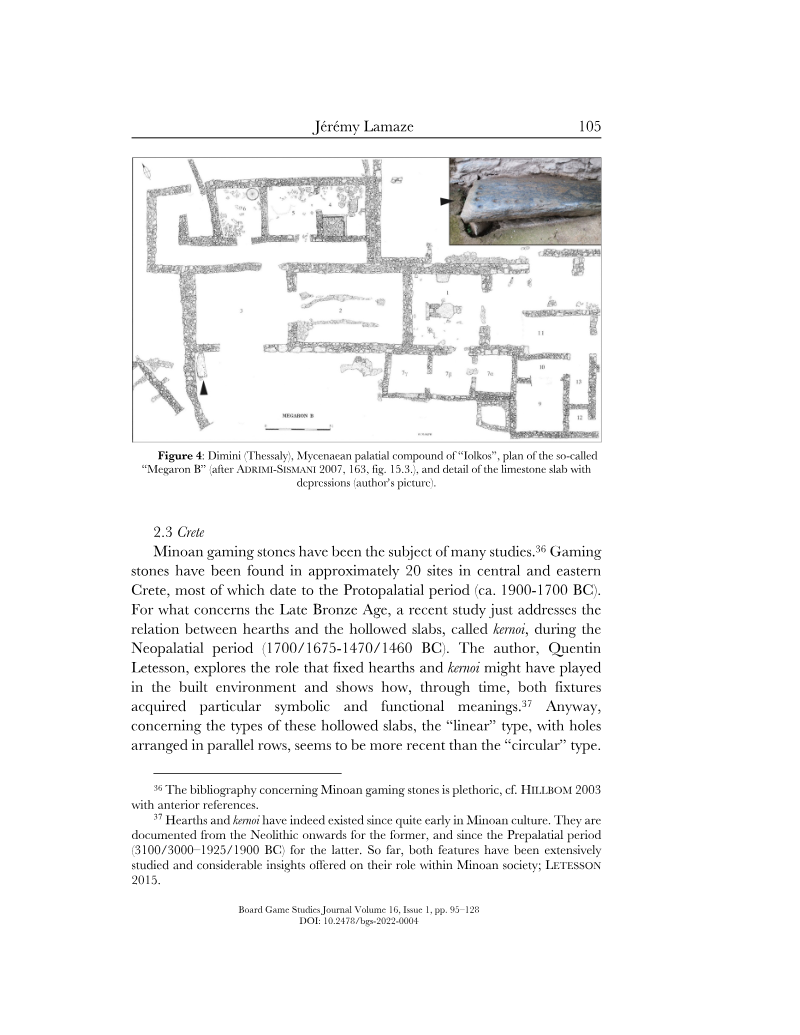
Games and Oracular Practices Around the Hearth: The "Table of Offerings" from the So-Called Temple 4 at Kition-Kathari (Cyprus)
At Kition-Kathari on Cyprus, the so-called Temple 4 is re-examined in this study as a multifunctional building rather than a purely cultic space.
- The so-called Temple 4 at Kition-Kathari on Cyprus is reinterpreted as a multifunctional building combining domestic, commensal, and ritual activity, with a trapezoidal stone table (once read as an offering table) reinterpreted as a gaming surface.
- The chronology of Floor I remains unresolved, with dates ranging between the traditional 1050–1000 BC and the revised 1000–850 BC.
- Over a hundred pierced anchor stones, seven from Temple 4 alone, are interpreted as mariners' ex-votos, alongside ship graffiti likely invoking safe passage.
Board Game Studies JournalApr 2022