1 free read left. Create a free account for unlimited reading + AI research.
Create free accountWhitepaper Board Game Studies Journal
1 free read left. Create a free account for unlimited reading + AI research.
Create free accountWhitepaperBoard Game Studies Journal
Dice and painted gaming tables first appear in Attic tombs in the early 7th century BC and are revived in the early 6th century.
Earliest examples. The earliest securely dated examples, from Vari and Anavyssos, belong to the second quarter of the 7th century.
Archaic Attic gaming equipment, including dice and painted gaming tables from burial and other contexts, is examined in this study of board game equipment from the Archaic period in Attica (roughly the 7th to early 6th century BC). The work argues that these objects, first appearing in Attic tombs in the early 7th century and revived in the early 6th, acquired symbolic meaning tied to elite leisure rather than signaling a hope for a happy afterlife. The earliest securely dated examples, from sites such as Vari and Anavyssos, belong to the second quarter of the 7th century, making the Attic material the most precisely dated group of such finds in Greece, although tomb deposits of dice had already appeared earlier at Eleutherna in Crete.
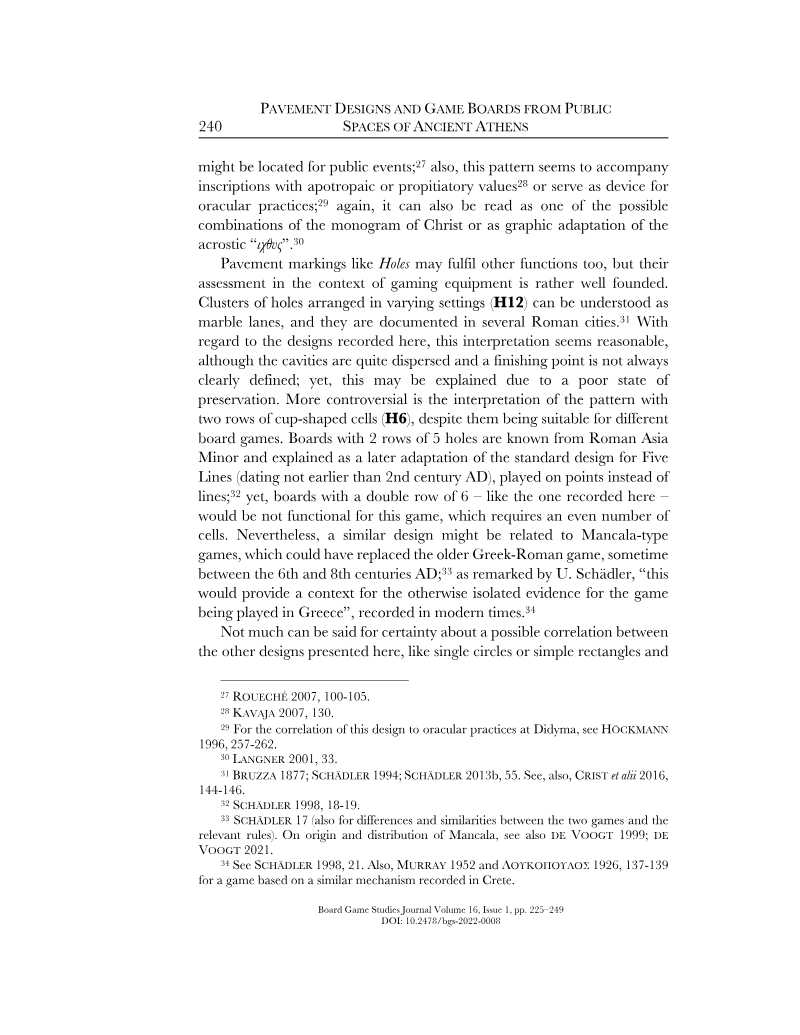
A catalogue of black-figured gaming tables from the Kerameikos, Vari, Copenhagen, Merenda, and La Tour-de-Peilz, along with black-figured pottery dice from Sounion, Heidelberg, Brauron, and the Acropolis, forms the empirical core of the study. The author reassigns several tables to a nine- or eleven-line variant of the Five Lines game requiring two dice, while single-die tables are linked to the simpler form, and corrects the earlier identification and dating of the Merenda table, which had been taken for an offering table. A central conclusion is that, apart from the Attic funerary examples, gaming boards are found overwhelmingly in public or sanctuary settings rather than in tombs, and that isolated dice cannot reliably be assigned to either gambling or board games.
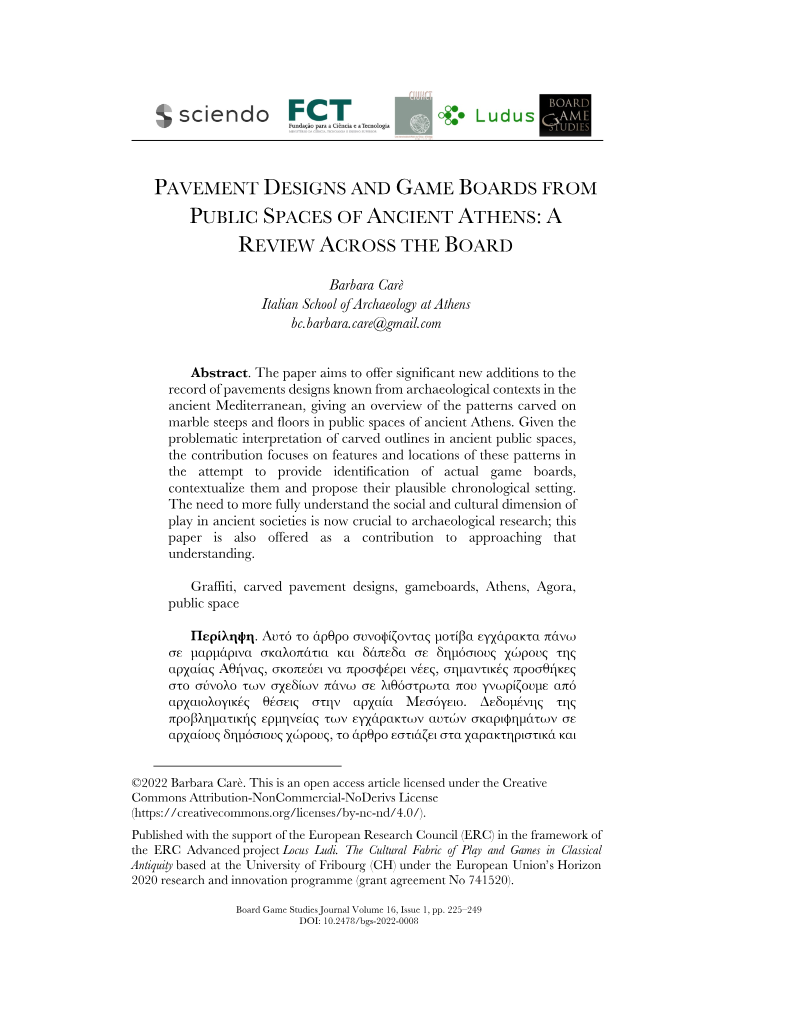
The study also considers how depictions and miniaturized versions of gaming equipment were produced for a specific clientele in eastern Attica and major sanctuaries and were sometimes elaborated with added mourner figures, detaching them from their practical use. By the 6th and 5th centuries board games moved beyond an exclusively aristocratic domain and appeared incised in public spaces with civic associations, while in Etruria and Macedonia they continued to mark elite and gender status.
Board Game Studies Journal · 2025
Board Game Studies Journal · 2025
Board Game Studies Journal · 2025
Board Game Studies Journal · 2025
Board Game Studies Journal · 2025
Board Game Studies Journal · 2025
Board Game Studies Journal · 2024
Board Game Studies Journal · 2024
Board Game Studies Journal · 2024
Board Game Studies Journal · 2024
Board Game Studies Journal · 2024
Board Game Studies Journal · 2023
Board Game Studies Journal · 2022



European Conference on Games Based Learning (ECGBL) · 2026



European Conference on Games Based Learning (ECGBL) · 2026