VideoThe Game Business
Epic's Tim Sweeney: "We can build an economy that's bigger and better than the one in Roblox"
5 Jun 202529 min video
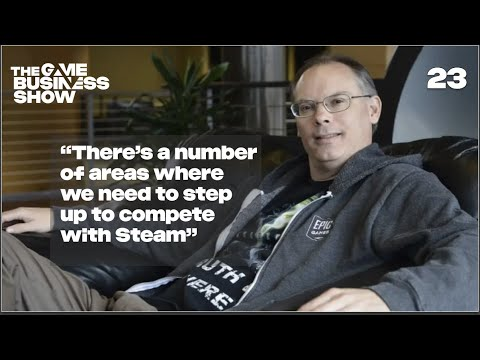
Hello and welcome to the game business show with me, Christopher Drake. This week, Epic shows off a host of new updates and features for both Unreal Engine 5 and Unreal Editor for Fortnite. And we speak to CEO Tim Sweeney. I think everything we develop in the future is going to be socially and economically interconnected to this thing we have here, currently known as Fortnite. Nintendo releases its Switch 2 games console, but is it going to deliver the results? And Kingdom Come Deliverance Studio Warhorse opens a brand new office. To begin with, we're going to talk Epic Games. The firm held its State of Unreal address during its Unreal Fest event in Orlando and made a number of announcements. It showcased a tech demo of The Witcher 4 alongside development partner CD Project Red. This is a technological showcase set in the world of The Witcher 4. The demo was designed to showcase Unreal Engines 5's capabilities with open world. It looked impressive. It had faster loading. The game ran at 60 frames per second and was on running on standard PS5 hardware. Now, it was a tech demo. It wasn't
actually The Witcher 4, but it was it was pretty it was a pretty it looked great. A lot of those open world features are included in the newly launched Unreal Engine 5.6, which is available now. Another big announcement on the technical side of Unreal Engine 5 is their Metahuman. It's left early access. Now, if you don't know what Metahuman is, it's a way to create realistic digital humans for real-time 3D games, but also film and TV as well. Uh, there was a fancy demo on stage showcening just how easy it is to do it. I think perhaps uh the big one for developers is that it's no longer tied to Unreal Engine. Developers can now use Metahuman in other engines such as Unity. But the news I found most interesting is what Epic is doing with Unreal Editor for Fortnite or UEFn as people call it. You may have seen last month that Epic featured Darth Vader in Fortnite and players could actually talk to him and he would respond not using dialogue trees but using conversational AI. Yeah. What do you think of that guy Cipher PK? Cipher PK. I do not concern
myself with minor streamers apprentice. Why is he roasting me? And we've seen things like this before. I went to GDC in 2024 and Ubisoft showed me there a similar concept. And it was certainly entertaining to watch players try to break AI and get Vader to say the darnest things. Now Epic is sharing that technology behind this with Fortnite's creators. And later this year, users will be able to create their own AI powered NPCs. That was cool. There was another AI element added to UEFN in the form of Epic Developer Assistant, which will help creators actually write code as well as offer guidance and speed up the development of experiences within Fortnite. There's actually a quote from Tim Sweeney on IGN about how he feels this will enable developers to be able to make Breath of the Wild with just 10 people. Um, which is uh horrifying to think about or exciting. I don't know which word to use. Sticking with UFN, Epic has signed some new IP deals for its creators. There's a Lego brick editor and soon we'll see Squid Game, Avatar the Last Air Bender, and Star Wars IPs coming to the platform which creators are able to play with. And finally, Epic shared a few stats as
well. Players have spent nearly 1.2 2 billion hours across 260,000 live creator made islands within Fortnite. Islands is the things that uh people build in that game. In total, 722 million has been paid out to third party creators. It sounds impressive, but obviously the stats in isolation don't really tell us too much. And Epic also shares some updated figures for Epic Game Store. It says it's paid 2.1 billion out to partners, and it now has 70 games in its mobile store with 40 million installs. It expects to hit 70 million installs by the end of the year. Again, the numbers sound good in isolation, but really there's still a lot of growth and opportunity there. The Epic Game Store and and Fortnite's creator mode. Now, the state of Unreal address was interesting enough. It was nothing too huge. Um, Epic boss Tim Sweeney talked about uniting its two engines, you know, the Unreal Engine and the Unreal Editor for Fortnite into a into a sort of cohesive hole. Uh, he was talking about Unreal Engine 6 at some point in the future, but we're not there yet. Ultimately, Epic is uh at the heart
of so many conversations happening in video games today. We've spoken on this show a lot about user generated content as a growth area for the industry. We've talked about opening up of the app stores and what that might do for the industry. We've talked about the impact of AI in video games, both the positives and the challenges. We've also talked a lot about life service titles, games like Fortnite, and the impact they're having on the market in terms of the hours being spent on them. Epic is a big big voice in all of those conversations. So, I was very excited when Epic kindly offered me the chance to chat with Tim Sweeney shortly after their address. We didn't have long, but we did manage to talk AI, Fortnite, Epic Game Store, and we even touched upon consoles. Now, I do apologize for the quality of the video. Epic kindly accommodated me by setting up a video link, but uh well, you'll see. Please enjoy our chat. Well, hello Tim, welcome to the show. You talked about AI. was AI was a big element of of your state of Unreal uh address an event and I liked it you said AI as having a multiplying force on
human creatives which is obviously the way we should look at it and I think that's that's the way the future of AI is probably going to be but have you identified any potential downsides or threats you think the industry should be mindful of well I think there's a lot that could go wrong in general but in the areas where we're adopting AI both in our hill set and our games I think They're just positive productivity improvers for developers. You know, coding assistants which we demonstrated here at Unreal Fest. In the future, there will be opportunities to accelerate 3D art creation of various sorts. You can imagine AI helping with scene layout or object production as well as infinite conversation for personalities and possibilities far far beyond. You have the limitations of fixed recorded dialogue from the past. Yeah, in all cases here all the usual gav that the AI companies jumped the gun and used all kinds of data that they didn't get any permission um to use from the creators of the data where as we approach AI and building AI systems ourselves. We're all purely using data
that we have the rights to use purely working with the originators of the data to make sure that they're okay with what we're doing and how we're doing it and to lead to an overall more productive tool set and more interesting game overall. Yeah, I I was going to ask about Genaii tools that don't have the consent of the authors the data was trained on, but it good to know that that's that's your position on it. And I read your interview with IGN. You were talking about how you think that in the future we might have 10 people making a Breath of the Wild style game because of these these tools, which is startling. And my cousin uh recently showed me a game. He's 12 years old. And you know, he's a programmer and he managed to make a game and it was through AI tools already, which I thought was terrifying and amazing. I want to talk a little bit about UEFN. You shared some greatl looking figures, but then you look at things like Roblox and and what that what we saw happen with Grow a Garden there. What's your perspective on what they're doing considering your own efforts in the UGC space? Well, they're they're really different games with different audiences at the moment. You see, Roblox is predominantly played by
young children. Fortnite is predominantly played by teenagers and 20somes. And uh you the expectations of games are are really quite different by those two audiences. Fortnite gamers generally expect games you know with identifiable gameplay and really you know generally high production values. Um ros players seem much more accepting of you lower levels of graphical fidelity and games aren't uh as polished. Um and uh yeah you just see different different genres emerging as well Fortnite. There's two massive audiences here. You have Fortnite's 100 million monthly active users at its recent peak and robots 150 million monthly active users at its recent peak. But you know with the exception of the one astonishing success in Roblox game lately, mostly games are aiming for a specific audience which is a group of players who really favor that sort of experience. I think both both places provide a massive massive audience as
large as any single console platform audience and they're you provide awesome opportunities for creators when you're deciding what to do with your time, you know, and like you you look at both audiences and asking where's the best outlet for my my particular idea of work. Hm. So I I speak spoke to a load of devs at GDC about um UFN and one of their chief perhaps issues or little little peaks was um has been the control Epic has over the monetization and there's not the variety of revenue streams I think some of them would like. Is there any view on changing that or any plans to change that? You Fortnite's built for players first and foremost. Players love the ability to buy outfits and then use them everywhere they go. And love the fact that Fortnite is a a game where everybody has an equal chance. You know, there's no pay to win and there is no scenario in which spending a lot of money gives you a benefit over other players that haven't spent money. It's all entirely a merit based game system. I think if you look at how Roblox monetization works, when you're spending money in an experience, you're mostly buying items that are
allowed to only work there. you go play another mode or go into another island or another Roblox experience and it doesn't work there. Yeah, it's something we really are worried about as a concept. If that becomes the way gaming works, then it fuels there's going to be a lot of offers made to customers that are just poor deals. H idea that like, oh, somebody bought a a better game in the Toronto and now I'm going to go to that game and have to buy everything again. Yeah, that's not not what players want. And then you get into pay to win mechanics where people who spend more money have a better chance of winning. you get into a lot of scenarios where they're loot boxes or things that resemble loot boxes and you play paying for a chance at something rather than buying some specific identifiable thing, you know, and generally we've rejected those forms of monetization for our own games. And we really think that we can build an economy that's better for players and that rewards creators more as a result of the increased player trust and kind of avoid falling into the pitfalls of the pay to win and loot box mechanic games, right? And if you like Roblox is still in the pretty early
stages of developing monetization at scale, you know, it's increased dramatically the last three years, but it's not really played out or reached the stasis. If you look at mobile platforms, you really see where that path ultimately leads. And it's not a pleasant place. It's a place in which the most greedy games with the most aggressive pay to win mechanics and you know the most luboxy mechanics almost outright gambling in some cases make the most money per user in the economy where Apple and Google and others have driven it to be dominated by advertising to reach user must spend a lot of money on ads and they show up more and more of the revenue through advertising. You find the greediest games spit the most money on ads and then move up and up the charts until they completely dominate the ecosystem and now the entire ecosystem is well to use Cory Dr.'s term initified but just the pervasive inset of of developers to adopt commercial bracketses. So we're really really worried about that inification loop that emerges in systems like that. The ads are already emerged in app stores and I think we're starting to see some aspects
of that in robots. were very much in tune with keeping the Fortnite economy fair and welcoming to everybody and avoiding those sorts of practices. And if you look at how people do play Fortnite, how people spend in Fortnite, you know, it's one of the most effective game economies that's ever existed. The average player is quite willing to spend money on outfits because of the generosity of outfits and the fact that they work everywhere you go and their style transferred into different experiences and they're interoperable within all of the Fortnite a rounds. I think that there's an opportunity to build an economy that's bigger and better than the one in robots by explicitly steering everything towards good commercial practices. I spoke to um a developer at GDC over dinner and actually I found out afterwards you were actually sitting on the table right next to us. He'd worked on time splitters. He worked on the original time splitters and he worked on the reboot that never came out. and he said that he thinks if the reboot was commissioned now, it would make sense to just build that in Fortnite because it's the genre, the type of game it is, which I thought was interesting. But I have to ask, do you
really see UFN as a playground for professional developers like that or is it more a place for small teams and aspiring creators? It's both. uh you know you're going to see uh you already see the community of Fortnite developers populated by both people who began as hobbyists and Fortnite creative and then moved on and learned to program and learn to use the more advanced tools and are now building businesses around their experiences you know but they completely bootstrapped within the environment Fortnite and then it's being uh populated by indie developers and double A or even AAA developers who who have moved from that space into this uh into Fortnite seeking opportunity because everybody's realized it most of the segments of the game business are extraordinarily crowded. Releasing a standalone PC game, uh, you're facing a very crowded market. Releasing a standalone console game, it's a very crowded market and mobile is even worse. Not only is it crowded, but you can't afford to advertise your product because of the bidding up of prices by the games with bad practice. So, everybody's
looking for the next big chance. And you know you see every decade it's pocket of opportunity for developers uh to adopt. You when I came online in my team is I was building standalone games for computers because you know there we've reached an audience that have a chance and later generations it was releasing mobile games or releasing web games and now I think the big opportunity for game developers is building games that launch within a huge successful ecosystem like Fortnite or Roblox. I think more and more developers will migrate there and we'll see success. And I think the the best teams are the ones that combine both generations of new and old, each kind of bringing their own areas of expertise to build the best possible games. Oh, good. Well, I hope I do see time splitters on on there someday. Um, switching subjects, um, what needs to happen for Epic Games Store to sort of compete more more effectively, I guess. Not sure if that's the right word, but with Steam. Well, there's a number of areas where we need to step up. Um number one is filling out the feature set um of traditional store features with gifting you better promotion
opportunities for developers to sale publisher pages and developer pages and all sorts of mechanisms for you developers to drive customers to the store and build upon wish lists that are built up and market the products. Um and then there's a much bigger effort underway uh which we've been working on for several years now but is to bring a entire whole and robust set of social capabilities uh to the Epic Game Store and you know so these being social capabilities that operate across all all platforms and all stores so that when you're playing Fortnite you have this awesome friend list and you have the ability to form a squad and do voice chat and go from experience to experience without leaving your squadmates line. We're bringing that to the Epic Game Store um and every third party game through the Epic Online services multiplatform overlay. So, if you've used Steam and you've seen the Steam overlay, every console platform has their own similar thing. And we basically build a multiplatform UI for all game social features. Um it's used
by Epic's own games, but it's used by their store and it's used by increasing number of third party games. And this has a huge advantage over Steam Works and Xbox Live and PlayStation Network and that um it aggregates all of your friends from all the different platforms. It's not bogged down to just one one device because most people playing games nowadays are playing with friends across lots of different devices. And so this opens up to social and we think it's going to be one of the superpowers of the Epic ecosystem. Um that's going to be increasingly important in the future as gaming becomes more multiplatform. Well, that's interesting. I want to can sort of finish by sort of talking about Fortnite a little bit. I mean, I know it's early days, but what impact have you seen from the return of Fortnite to iOS? You seeing good growth? Um, yeah. Yeah, we had uh about 10 million installers so far and we're starting to rebuild our our mobile user base and mobile capabilities and you the users who are missing. We basically have two types of mobile players in Fortnite. There are people who play on a variety of platforms and they tend to play at whichever screen is best in front of
them, right? If they're at their TV, they're playing a PlayStation. Yeah, if they're on the move, then they're playing on mobile and then there are mobile only players and um Apple's removal of Fortnite from the app store was an inconvenience to the multiplatform players, but it just outright blocked all the mobile only players. Um and so rebuilding that of the audience and rebuilding their friends uh you know, friend connections which were left behind uh due to the blockade is is the big opportunity now. So we're back on iOS in the United States through the app store. We're back on iOS and Europe or the Epic Game Store and yeah, we're we're now, you know, working on extending the fight to every country in the world so that we can come back everywhere and rebuild everybody's relationship with Fortnite everywhere we go. Do you find, and this this is a bit of a funny question really because Fortnite dominates so much player time and that's such a conversation at the moment about these live service games being so popular. Do you find it sometimes conflicts with your, you know, when you because you support other studios, you're all about supporting other studios and you've got this game that everyone's having to try and compete with no matter what sort of game they're making. Do do you find it
conflicts at all? Well, you know, every game developer's mission is to make the most fun game possible. And uh, you know, the development of Fortnite since it launched in 2017 has been the pursuit of fun. Mhm. But both, you know, ways that we at Epic can create fun and ways that we can empower the community with our, you know, tools we give them to create their own forms of fun within Fortnite. And, you know, to some extent, that's causing players to switch from other games into Fortnite because there's just so much cool stuff there. On the other hand, we're creating opportunity for all developers to come and potentially move their business into this interconnected world of Fortnite and pursue new revenue streams. They often find that this is found that this is very complimentary like when the Borderlands game launched a couple of years ago and we added an entire Fortnite point of interest dedicated to Borderlands and people who are had only come of age as gamers playing Fortnite suddenly learned about Borderlands and then saw they could buy it in the Epic Game Store on the console and you would often ride Borderlands and Borderlands players, oh there's a Borderlands area
in Fortnite. We should go check it out. I think a lot of the things we do with our partners are are highly complimentary. God of War characters coming into Fortnite, Halo characters coming into Fortnite and all these crossover events are really cross-promoting and enabling everybody to benefit from the rising tide let's talk ships. I think there's a lot more we can do in this in the future. The problem with gaming right now is you have a whole lot of disconnected experiences. You have one set of friends who you might play Halo with and you have another set of friends you play Fortnite with and they have different names because they're on different platforms and uh you know it's all very disconnected. Well, our aim is to connect everything together through Epic online services social features so you have the same gamer identity everywhere you go and then over time to open up the Fortnite outfit system and Fortnite items out to every other engine game so that multiple games released by different companies can potentially interoperate. Maybe you can play with your Fortnite outfits and some good third party games and you can use their outfits in Fortnite and uh create an economy where everybody's linked together and everybody has access to the
same social audience and has much greater player mobility, right? Wouldn't it be great if uh while you're in Fortnite you can decide to, you know, switch to another game and goes there with all of your friends in tech and your voice chat session continuing, right? Yeah, there barriers to that right now. But those are all solable problems that a multilatform developer like us can solve. Hm. It's a notable week. My Nintendo Switch 2 apparently has just been delivered. What do you make of the new Nintendo? But actually, I also ask more generally, how what's your view on the console market at the moment? It seems to going for a bit of a challenging time. I think that what's really going kind of challenged now is the game development and publishing business because we're seeing players increasingly drawn towards social experiences. that seeing a rise in games like Fortnite and Roblox, but a decline in single player games and a decline in smaller multiplayer games as well. I think that that's a real challenge that the industry is facing and you know I think there's not a solution to that other than getting every standalone game much more socially connected and economically connected to an
interoperable you know metaverse like ecosystem. It doesn't have the traditional barriers that you have between games today. And I think the console business is going to remain strong because as a gamer uh you know the wonderful thing about being a gamer today is everybody has access to some device they can play games on. You at least have a hand me down iPad or Android tablet as you're growing up and you can start playing games on that and then once you realize I'm a gamer I want to do this. I want more. you have a natural choice to move up and you know the easiest way to move up is to move up to a console, buy a Switch or PlayStation or an Xbox and play on a bigger screen with more hardware performance and better graphics and uh it's entirely a moving up experience or move to PC especially if you're like a programmer or a technical person or you really want to get into hardcore tools usage because you're a computer artist or you're into AI it's either console or PC and I think both of those are are really attractive and console is especially attractive to the whole generation there and I think console is somewhat ill by the just the turmoil
that the traditional game industry is going through and the decline of many genres of games and many publishers but you know this is a transitory event and you know the game industry molding back stronger than ever but it will be shaped somewhat differently than it shaped right now h I'm conscious of the time but I'll ask I'll have to ask one more question and it's more out of interest than anything else um because you have all these wonderful studios and a lot of them are making content in Fortnite Do you have plans for these studios at all to work on projects not tied to the Fortnite ecosystem or is that your full focus now? Well, we have somewhat of a of a challenge because you when you think of Fortnite, you think of the Fortnite characters and battle royale and that what we're building is actually something quite a bit larger uh than Fortnite. It's a tool set and an ecosystem in which any content can exist, including photorealistic content or totally differently stylized content than Fortnite itself. you know, the ability for developers in the ecosystem to build content that looks nothing like Fortnite and yet it's called Fortnite. And so what we're we're really thinking
about is how do we either redefine Fortnite or how do we redefine the place where Fortnite lives to create, you know, a much greater realization that there's many different kinds of games that can exist here and Fortnite is not just battle reality anymore. I think the future of Epic is in developing huge variety of awesome games in different genres. I think everything we develop in the future is going to be socially and economically interconnected to this thing we have here which the app currently known as Fortnite. But yeah, if this were the web, you'd have like Fortnite would be a place you go on the web, but the web browser itself would be, you know, epic metaverse explorer, whatever. That's probably the future configuration of this business is something more like that where there's an open metaverse and there's a tool we use to go from place to place and explore it all. And Fortnite is a place just as Disney is going to have a place in the metaverse. It'll be separate from Fortnite of the highly connected and other companies with their own places. and you'll hopefully with your social group going from place to place without leaving your your friends or your
purchases or you know cosmetics or appearance behind. I think that's the future of gaming and that's what Epic's really signed up for. I wouldn't say it's making Fortnite forever, but it's you know it's actually building out this connected gaming world. Very exciting. But thank you so much Tim. Thank you for your time. I appreciate you taking time out to speak with me. That was Epic CEO Tim Sweeney there uh painting his visions for the future of the video games industry. But the past week has not been all about Epic. Today is the day Nintendo Switch 2 is released. We don't have any data yet for the console, of course, but as soon as we do, you'll be able to hear about it and read about it on the game business. Leading data firm AIA has given us its updated estimates and believes we'll see 30 million Switch 2 units sold this year. The data firm also believes the rise of PC handhelds isn't a particular threat to Switch 2. If its estimates prove correct, and you may have seen me put this on social media, Switch 2 would have sold more in its first 6 months and the PC gaming handheld landscape has sold in its entirety. Ampair says that while 56% of Steam Deck owners use a
Switch, only 1.3% of Switch owners consider Steam Deck to be their primary console. Now, despite all that, I don't like talking about feelings, but everyone seems to be having the same feeling. It is a bit of a muted launch. At least it feels that way. It's a pretty simple concept Switch 2, really. Uh, a far more powerful Switch, a number of nice new community features, and a big ambitious Mario Kart to sell it all. But there's been some discontent around the console. First, it was about the price of the console and the games and the accessories. Then, we've had these game key cards, which has upset preservationists. Nintendo isn't really using these cards themselves, but a number of third party publishers, in fact, most third party publishers are using them. These key cards are cartridges that don't have the game on them. You put them into your console, the game downloads, and as long as you're using the cartridge in the machine, you can play the games. The key cards can be shared and sold to other people, it's not the same as a single-use download code. But preservationists are unhappy because in theory eventually the service will go offline and you can't download the games
anymore, which means the cartridge will only work if the machine has the game on it already. I mean, it's quite a niche issue, but it's been a part of a series of small things that's created a bit of negative noise around Switch 2. Um, there's even some people being hyperbolic around the fact the console needs updating on launch day. All this coupled with tariffs, wider economic challenges, and political unrest. I think all of that has dampened the mood around the launch of Nintendo's first console in 8 years. I also think, and we talked about this last week, that the Mario Kart world, Mario Kart as a franchise, isn't necessary one to get people really excited about a new console. It's not quite Zelda. But of course, most of this doesn't really matter. The key for Switch 2 is going to be on the games. If they deliver, they will really enable Nintendo just to shrug off a lot of the negative conversations around the console. Of course, we don't know if the games are any good because we don't have any reviews yet as the press have only received their units and software today, which is somewhat unprecedented really. The critical reviews will come just a little bit later. But do stay tuned to the game business of course as we delve further into where Switch 2 goes from here and we will have early data on how
that console performs over the weekend. Our final story of the day is Warhorse Studios. The team behind Kingdom Come Deliverance and Kingdom Come Deliverance 2 has opened a new office. The firm has opened up in Berno in the Czech Republic and the office will be led by Petra Kar who previously served as the managing director at Ashborne Games. Uh we had Warhorse on the show a few weeks ago about a month ago now and they basically dodged the question we asked about whether they might end up working on multiple projects in the future. Kingdom Come Difference 2's done so good. Um Daniel Vavra who is the creative director there says he's got more ideas than time. So I that's what led to that question. I would speculate this is the direction they're heading in. But speculation aside, this is obviously good news for the Czech games industry, uh, with a big big player continuing to invest in the market there. That's it for today's episode of the Game Business Show, but there is so much more to come from us. It's an absolutely rammed week. We recorded this episode just before PlayStation State of Play broadcast, which would have happened by now. Uh, my business partner Jeff Keley takes the stage tomorrow to announce new games and
reveal new trailers at his event. There's the PC gamer show, the future game show, the Xbox showcase on Sunday. There's the green game showcase. IO Interactive is showcasing its new James Bond game tomorrow and I'm secretly hoping to see their fantasy game as well. IGN has its consumer show, IGN Live, with a bunch of panels at that uh taking place there over the weekend. There's Day of the Devs as well. So, it's a big weekend of game reveals, most of which sit under the Summer Game Fest umbrella. And indeed, we have our own event which also sits under that umbrella. The Game Business Live takes place in LA at the Grammy Museum on Monday. This is the first big business event to take place as part of Summer GameFest. Now it's nearly here. I'm starting to feel a little nervous. Uh we've got Twitch coming, Wizard of the Coast, Blizzard, Netflix, Build a Rocket Boy, Matt Piscatella from Sakan will be sharing some data as well. It is possible we've still got some tickets left. We were very close to closing applications when we were recording this, but if you go to the gamebus.com now, click on TGB live at the top of the site, you can apply for tickets there if we have any left. It is free for TGB
readers and it would be delightful to see you there. But if I don't see you, if you're not in town, stay tuned to the gamebus.com. We're going to be covering all of this from the business side through our newsletters and our show. So, do make sure to subscribe. It is free. But that's it for today. Until next time, thank you for tuning in.
Auto-generated captions from YouTube — names and numbers may be misheard.
Epic Games is strategically positioning its ecosystem—centered on Fortnite and Unreal Engine—to lead the transition toward an interconnected, metaverse-style economy. CEO Tim Sweeney emphasizes that the company’s primary objective is to build a creator-friendly, merit-based platform that avoids the predatory monetization tactics, such as loot boxes and pay-to-win mechanics, often found in mobile gaming and competing platforms like Roblox. By integrating Unreal Engine 5’s advanced technical capabilities with the Unreal Editor for Fortnite (UEFN), Epic aims to empower developers to create high-fidelity, socially connected experiences that allow for cross-platform asset interoperability and persistent player identities.
Key data points highlight the scale of this ambition: Epic has paid out $722 million to third-party creators within Fortnite and $2.1 billion to partners via the Epic Games Store. The company is also aggressively expanding its technical toolset, including the release of Metahuman for broader engine compatibility and the introduction of AI-powered NPCs and developer assistants designed to streamline production. Sweeney argues that these tools will enable small teams to produce AAA-quality content, effectively lowering the barrier to entry in an increasingly crowded and competitive global market.
The broader industry landscape remains in a state of flux, characterized by a shift toward social, live-service experiences and a decline in traditional single-player genres. While the recent launch of the Nintendo Switch 2 faces a muted reception due to economic pressures and concerns over game preservation, industry analysts project strong initial sales of 30 million units for the year. Meanwhile, studios like Warhorse are expanding their footprint in the Czech Republic, signaling continued investment in regional development. Ultimately, the industry is moving toward a future where standalone games are increasingly integrated into larger, interoperable ecosystems, prioritizing player mobility and shared social infrastructure over isolated, disconnected experiences.

The Game Business · 2026

The Game Business · 2026

The Game Business · 2026

The Game Business · 2026

The Game Business · 2026

The Game Business · 2026

The Game Business · 2026

The Game Business · 2026

The Game Business · 2026

The Game Business · 2026

The Game Business · 2026

The Game Business · 2026
Naavik · 2023

Naavik · 2026

Deconstructor of Fun · 2026

Naavik · 2025
Deconstructor of Fun · 2025
Naavik · 2025
Naavik · 2024
Naavik · 2024

Two & a Half Gamers · 2026

Naavik · 2026

The Game Business · 2026
Deconstructor of Fun · 2026
Comments