VideoDeconstructor of Fun
Epic’s State of Unreal: Building the Future of Games or Just Selling More Tools?
10 Jun 20259 min video
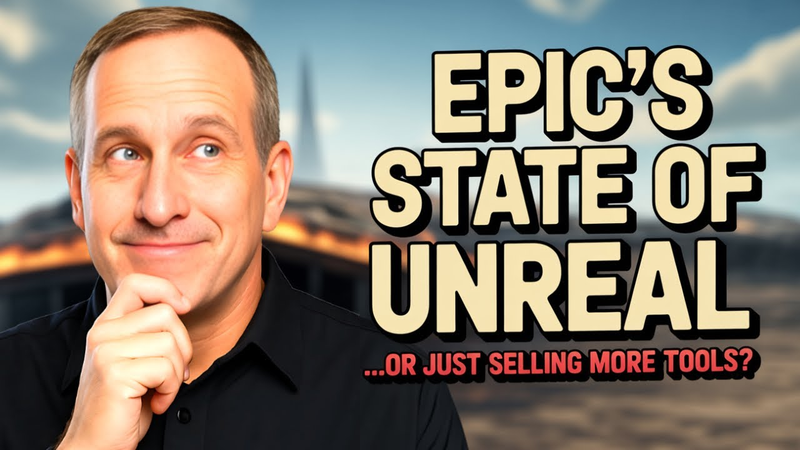
[Music] Epic Games hosted its annual state of Unreal keynote yesterday and they provided some updates on a few things primarily like the Fortnite update, Unreal Engine and the Epic Game Store update. And obviously we saw some partners including Disney, CD Project as well. So actually this was really kind of uneventful to some degree like as far as these things go but like they had AI tools for UFN which were quite cool which I think we'll come online and see what people do with that. They gave an update on the Epic Store. You know, they paid like $2.1 billion to devs and publishers and UFN has generated like 722 million for third party creators. And just to be clear, UFN is a [ __ ] train wreck disaster right now. Like there's no mincing words on this. This is not working and people are are very frustrated. So like all the PR and fluff around this is complete [ __ ] Um to
the best thing on UEFN is that they've given access to all the data so we can see it clearly. You can watch, you can see it, especially even for the first party. You can see Fortnite's retention right now. You can look see Fortnite's base mode CCU versus UAF. Yeah. So anyway, so I don't want to I don't want to actually broadcast the fact that this has been successful. 722 million of [ __ ] right? But the coolest thing and the best thing about this whole [ __ ] thing was this Witcher 4 demo, right? Unbelievably beautiful like in terms of like what they showed that was possible with the engine. Now, of course, all the fans remember Cyberpunk and their false flags about how well that thing was going to look and perform. And so, people were are calling foul on this demo. But they were first to admit that this is a tech demo. This is not gameplay. This is not the way the game and the game is going to be. This is literally a tech demo that they do all the time to showcase the new technologies that are unreal. And it was actually unbelievable. Like absolutely unbelievable. It always is. like they do a really good job of these tectum. So
that was kind of the biggest thing that came out of it that people are talking about. Well, one is like this Unreal 5.6 bundles all of this together that you just said. There's also the metahuman creation tools which is like this realistic NPCs that you can do in the large scale open worlds. The AI tools that were cool. They help you write the verse code in UFN which is great for more non-gaming folk to you know help figure out verse or even if you're transitioning over. So, I thought some of this Epic Game Store stuff was cool, Chris. I wanted to get your thoughts. So, it is going to include preloading, so you can that's coming in September. You can do game gifting for the holiday season, self-publishing tools for Android and iOS in also in Q3. The revenue share model is updated to 0% for the first million in revenue, and 12% web shops coming in July. And then I thought this was kind of interesting, especially given the Apple's upcoming announcement around whatever the game
center thing is. So Epic has revamped social features that will connect its PC and mobile players with game independent voice chat, text chat, parties along with robust game invites for third party games seem kind of interesting. Anything in here sound good to you? This has come up a lot like whe whether or not a thirdparty store can actually be successful from the consumer perspective and so like to the extent that they do cool things for discovery and user acquisition like I think that would be really interesting. The question is are consumers really going to adopt third party stores no matter what right? So there was some announcement that they did 44 million downloads of the store. Again that's a total vanity metric right because it's not a question of actually downloading the store and using it for a launcher for [ __ ] Fortnite. It's a question of how many people are engaged with the store to actually purchase other [ __ ] right? And so it's like I just have my doubts that consumers are going to be moving to something like this on a Apple or Google devices because the store is so integrated and their usage patterns are so set that I
don't know it's going to be hard. And what's the differentiated offering here? Like what are they offering that's going to be different than the app store? Well, what I liked was the last bullet, the revamped social features because that is starting to be something that players are going to care about and I think that's going in the right. So, and this gifting idea I can give I can give something. Okay, like listen, they are trying they are going in the right direction. They are giving players things that are differentiated from the other stores. It is unclear if these will actually move the needle to your point. But isn't this the right thing to be thinking about and doing if you are going to try to compete? Question mark. Yeah. So my problem is I want them to be successful because I want I want Apple to eat it every day. I think they should die. I hope they generate no more revenue from the app store. I want them to be successful. But from a consumer perspective, I just think it's going to be very very challenging to justify it. Like I remember Origin was like really hot. They were spending a gajillion
dollar. I'm not exaggerating. Hundreds of millions of dollars they were spending on building out the Origin platform and it became a launcher for Battlefield, right? That's what it would became. And so like if you looked at the social features they had, you could argue that it was actually in some ways superior to other platforms, not Steam necessarily, but others. They had like 0.5 friends per customer, right? like that no one was using it for the social features that they were creating. So, they were blowing spending all this money to try to build it out, but it wasn't getting any traction because that's not what people do, right? That's not what consumers do. They don't want another social platform, right? They have their social platforms. They have their game launchers. And so, it's like just really hard to convince them. And I think actually mobile may be harder than PC like in that way. Absolutely. PC console is a squad-based ecosystem, right? Like Elder Ring Night Reign is successful because I play it with my friends, right? Yeah. But on mobile, I'm not gonna like, "Oh my god, we got to
get on and play Kingshot together. Wow, it's a new game that's coming to this new store." No. Yeah, that's a really good point. Like my 65-year-old grandma is not going to like hang out with her buddies online, you know, on Game Center, right? Or [ __ ] go to the store and start chitchatting about Bridge the night before. They will. Like in casual games, there are end games with guilds. Yes. Yes, but then that is an endgame thing, right? They have started off as a solo player and eventually transition to that solo play and they're not going to want to use another app to do that. Game developers are going to want to keep that in their own ecosystem. Yeah. And I'm not even sure that would be the immediate target audience for EGS, but you know. Anyway, let's keep going. So, Star Wars Jedi Director is now on a D&D video game. All right, so other news was that this Star Wars Jedi director guy spun out his own company to make a D&D style video game, which I think is super cool because I think Dn D has been completely underutilized as a license, an IP for
what it's known for is RPGs. They had the MMO ages ago that did not do well. I think they tried to tie it too closely to the D&D rule set. But anyway, so we're going to get more details on this in the Summerfest Gamef Fest on June 9th. But this seems really exciting because a game like Jedi Survivor merged with Dn D could be very very very very cool and something I would get excited about. So anyway, like but Balders's Gate 3 was massive, right? Which leaned into the rule set and was a turn-based RPG which definitely tapped in the real D&D audience, right? But this is an action adventure game. So you're saying like, hey, this audience actually wants to take that like they're in love with the stories, the IP. They want to be able to play that in a action combat, not a turnbased Yes. D&D. I hear the notes of cynicism in your voice there, Mr. There's an underlying concern there. Yes, there's an underlying concern. I'm just suggesting that I'm excited about
it right now. Whether it's successful or not, we'll see. But like at least this is the guy who has done it well for Star Wars. Totally. Maybe he could do it well for D and D. That's why I put it this You want more action adventure games? Yep. Absolutely. In in the fantasy. Yes. Action adventure fantasy. Yes. In D and D. Yes. Yes. I just want like the D and D quiz that helps me understand am I chaotic good or like what's my D and D personality? That's the game that I want. [Music] There we go.
Auto-generated captions from YouTube — names and numbers may be misheard.
The annual State of Unreal keynote highlighted Epic Games’ ongoing efforts to expand its ecosystem through Unreal Engine 5.6, the Unreal Editor for Fortnite (UEFN), and the Epic Games Store. While the presentation showcased impressive technical demonstrations, including a high-fidelity tech demo for the upcoming Witcher title and new AI-assisted coding tools for UEFN, the event underscored a strategic tension between Epic’s desire to empower developers and the practical challenges of platform adoption. Despite reporting $2.1 billion in payouts to developers and $722 million generated by third-party creators, UEFN faces significant criticism regarding its current stability and user experience.
Epic’s strategy for the Epic Games Store involves aggressive feature expansion, including preloading, game gifting, and self-publishing tools for mobile platforms, alongside a competitive revenue share model that offers 0% fees on the first million dollars in revenue. To drive engagement, the company is introducing cross-platform social features, such as independent voice and text chat. However, analysts remain skeptical about the store's ability to displace established consumer habits on mobile and PC. Historical precedents, such as the struggle of the Origin platform to gain social traction, suggest that consumers are often resistant to adopting new launchers or social ecosystems, regardless of the technical features offered.
Beyond platform infrastructure, the industry continues to explore the potential of major intellectual properties in gaming. The announcement that the director of Star Wars Jedi is developing an action-adventure Dungeons & Dragons title signals a shift toward leveraging the D&D license for high-budget, action-oriented gameplay rather than traditional turn-based formats. This move reflects a broader industry interest in adapting established fantasy IPs to meet modern player demand for immersive, action-heavy experiences, though the long-term commercial viability of such projects remains to be proven.

Deconstructor of Fun · 2026

Deconstructor of Fun · 2026

Deconstructor of Fun · 2026

Deconstructor of Fun · 2026

Deconstructor of Fun · 2026

Deconstructor of Fun · 2026

Deconstructor of Fun · 2026

Deconstructor of Fun · 2026

Deconstructor of Fun · 2026

Deconstructor of Fun · 2026

Deconstructor of Fun · 2026

Deconstructor of Fun · 2026

Naavik · 2026

Naavik · 2026
Naavik · 2026

Naavik · 2025
Naavik · 2025

Naavik · 2024
Naavik · 2024
Naavik · 2024
Deconstructor of Fun · 2024

Naavik · 2023

Naavik · 2026

The Game Business · 2026
Comments