1 free read left. Create a free account for unlimited reading + AI research.
Create free accountWhitepaper DiGRA
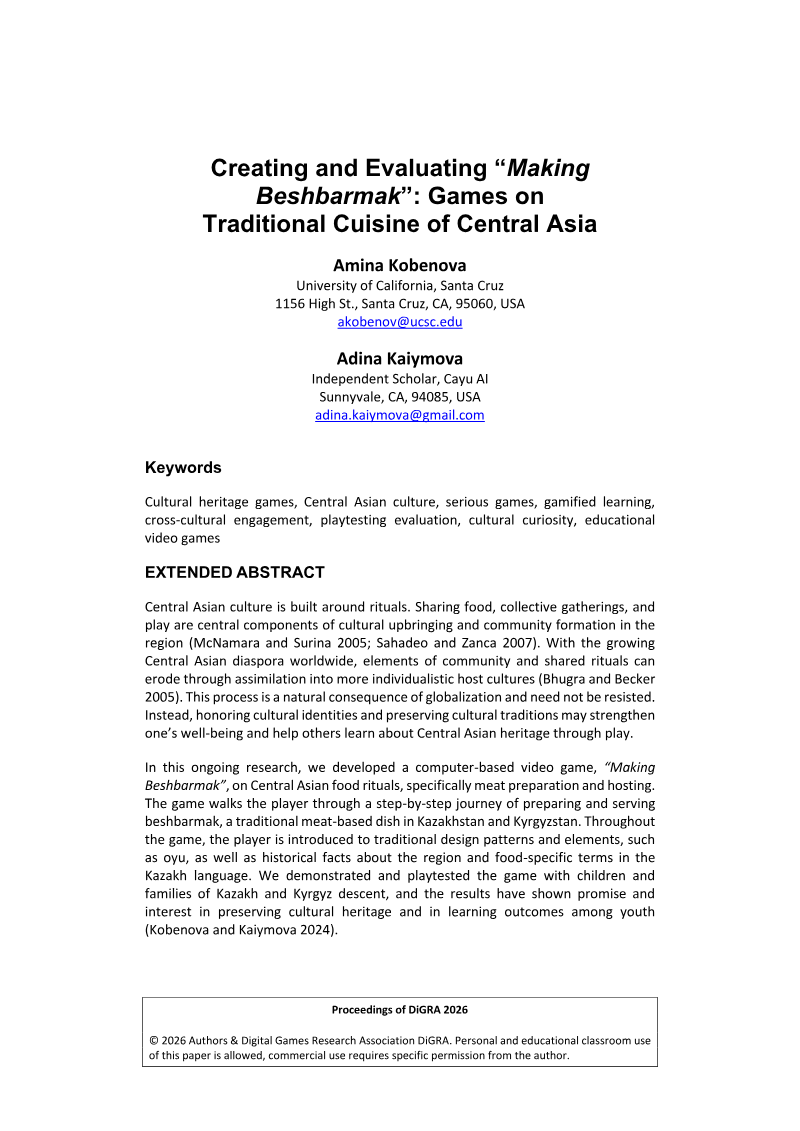
1 free read left. Create a free account for unlimited reading + AI research.
Create free accountWhitepaperDiGRA
"El Niño's Finger" uses conceptual metaphors to convey the idea that everything is interconnected. It does not rely on overt environmentalist messaging.
This paper presents "El Niño's Finger," a lightweight HTML5 game designed to foster ecological awareness through conceptual metaphors. Its central argument is that video games can communicate ecological thought, specifically the idea that "everything is interconnected," without relying on overt environmentalist messaging. The authors focus on the effect of El Niño on sea turtles, whose hatchling sex is determined by incubation temperature, and frame the game around players attempting to keep sand temperatures within a range that supports balanced gender ratios while an invisible figure representing El Niño disrupts their efforts.
The design maps real ecological mechanics onto gameplay: temperatures below 27 degrees yield mostly male hatchlings, temperatures above 31 degrees yield mostly females, and the intermediate range produces both. The authors ground this in research indicating that sea turtle embryonic development occurs within roughly 25 to 35 degrees Celsius. The paper argues that interaction design can position humans and nonhuman elements as mutually influencing rather than as a zero-sum relationship, with player input and El Niño's influence both shaping the virtual environment.
The literature review identifies a gap in research on games addressing El Niño specifically, and notes that many commercial games treat environmental issues as backdrop while prioritizing complex mechanics and graphics. The authors position lightweight, accessible games as a means of reaching broader audiences across age groups. The paper is primarily conceptual and design-oriented, drawing on existing ecological, psychological, and game studies scholarship rather than reporting empirical user testing, so its claims about public acceptance and effectiveness remain projections rather than measured outcomes.

DiGRA · 2026

DiGRA · 2026



DiGRA · 2026



DiGRA · 2026



DiGRA · 2026



DiGRA · 2026



DiGRA · 2026



DiGRA · 2026

DiGRA · 2026



DiGRA · 2026



DiGRA · 2026

DiGRA · 2026
DiGRA · 2024