VideoTwo & a Half Gamers
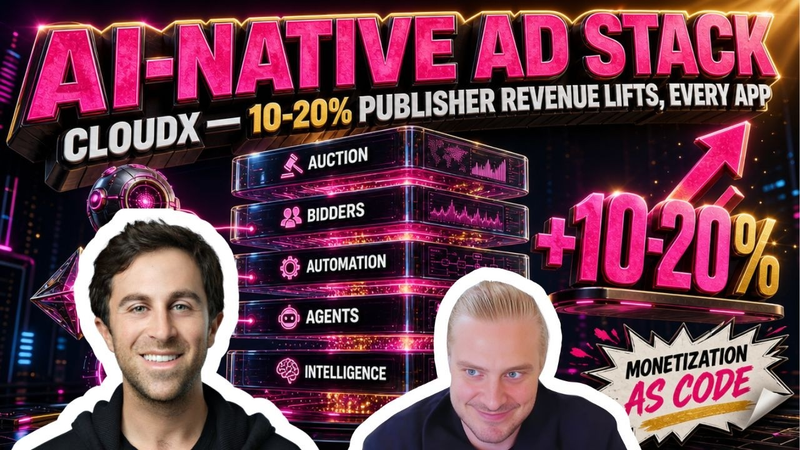
🧠 CloudX just hit 10-20% Revenue Lifts in 90 Days: The First AI-Native Ad stack for publishers
18 May 202636 min video
That's an interesting point. I think So, first of all, we've got we've got publishers. I have a publisher off the top of my mind, for example, a a publisher who makes dating apps, and they're running us parallel and a lot of their maybe a third of their revenue is is banners and a third is MREC. And this publisher's live on our platform with six apps, and revenue is up I think I think it's 14%. It's 4:00 a.m. and we're rolling the dice, but they dropped [music] knowledge made of gold and ice. Felix with ads making those coins rise. Checkup designs world chasing the sky. We're the two and a half gamers the midnight [music] crew talking UA adverts and game design, too. Matej feeling checkup bringing the insight. We're rocking those vibes [music] till the early daylight. Matej UA master eyes on the prize tracking data through the cyberspace skies. Feeling stats dollars like [music] a wizard in disguise. Checkup scripts the rules lifting us to the highs. Two and a half gamers talking smack. [music] Slow hockey stick got your back. Ads are beautiful they light the way. Click and fast. Don't [music] delay.
[music] [music]
Hello everyone and welcome to another fabulous podcast of the two and a half gamers podcast where we stay two and a half steps of the mobile industry. Today we have a very very special guest with us and it's actually round two. It's Dan Sack from Cloud X and he's joining us 3 months after recording once before. So, very excited to have you here. For those of us who missed the last recording, do you just want to give a brief introduction about yourself? Yeah, yeah, sure. Glad glad to be back. The last time we recorded found out 2 hours prior that I'd torn my ACL and meniscus. So,
um I'm in much better spirits for this one. Uh But, background on me, I've uh been in the space basically my entire career. Uh started off in 2011 at MoPub. Uh worked with publishers back then. Found my way to Twitter with MoPub. Uh left to work on Max with Jim and some other talented folks over there. Joined AppLovin, spent some time over there, took some time away from the space, and then I was drawn back into it once again with Jim and our third co-founder Jack um about a year ago now to work on uh CloudX. A torn ACL? I know most of our listeners are either working in the app space or the gaming space, but I'm sure everyone wants to know, will you ever dance again? You know, I'm a pretty, you know, like low-key dancer. I'm not busting out crazy moves. This was a basketball injury. So, I guess yeah. I guess yeah. Yeah. Yeah. Yeah.
So, I guess the reason we kind of wanted to ask you you back again because it's been a very busy quarter for CloudX since we recorded last time. There's gossip of some ruffled industry feathers kind of in the other mediation platforms. There is also a lot of chatter amongst publishers about you guys. So, what has actually the last 3 months looked like for publisher onboarding and what's been going on here? Yeah, I know. Thanks. It's It's been a great great few months. So, all the things you'd want to see for us inside the company we're we're happy to report are progressing nicely. So, the the team has grown. We've got a great team. The product's developed. We've got great product still in the early days realizing the vision we have in mind, but it's moving along quickly. On the adoption side, so last we spoke we were in a private beta. We GA'd the platform in February. We uh are now working with dozens of
publishers. We have five bidders fully fully live. We have about a dozen others either live in a beta state or integrating and soon to be live. So, we've got publishers in gaming, we've got publishers in non-gaming, and I want to say the team has 35 people or so. So, it you know, it feels it it feels like an eternity that we last spoke, but it's been a it's been a good good stretch. Yeah. Been a busy month a couple of months then, right? So, just for the listeners that missed the first episode, what is exactly that you guys are building? Yeah, sure. Good question. So, CloudX is a is a Yeah, right. Good place to start. Is a CloudX is a full programmatic stack for mobile publishers. And so, we run verified ad auctions. You've got a transparent fee business model, aligned incentives, no competing ad network. What What makes us different? We've We've built the platform so that it can be operated by
people or AI agents. So, you know, your entire setup lives in code. We call it monet- monetization as code, and you can manage your inventory manually or you can leverage agents to do cool things. The thesis here is that mobile publishers deserve ad infrastructure for for for this day and age, for the intelligence era as we call it. And so, we we were drawn back into the space about a year ago uh to build this out. And of course, while we've been working on uh building the platform, there's been you know, insane pace from you know, the Anthropic's and and OpenAI's of the world. So, all that's moved along quickly, and so today we've got a platform with with a lot of cool features and we're starting to introduce agentic capabilities and
And that's that's Exactly if you can expand a bit on agentic capabilities because you know I'm from the era where I live either in
AdMob level play or AppLovin Max where I do everything and I need to look at stuff and you know if I'm losing a lot of money I need to log on and find that out like what is it here you're trying to solve here for cuz I can see being super helpful. Um I think a lot of us at this point have used Claude code or co-work to change the way we work in our day-to-day and so you know if you've created agents in Claude co-work for example that help you out with work that was previously manual and help you to be more efficient and automate things and keep an eye on things and do things. That's that's what I mean by agentic capabilities. So being able to lean on agents to do work on your behalf work that you were previously doing manually work that you didn't have time to do work that was too tedious to do work that a human being could never do
it's that layer of agents um and giving publishers a platform where you've got all of the tools and functionality that you'd expect from world-class publisher platform but it's also designed in a way where you can lean on agents to um lend a hand as many of us have today with Claude co-work for example. So in theory where you want to get to is I can make a command to say for example if Digital Turbine ads are causing a lot of churn exclude Digital Turbine from X type of users that are making in app purchases for example. Yeah, definitely. So that that that's that type of thing or maybe it's not your maybe the agent's actually the one saying, "Hey, you should keep an eye out for this and I'll let you know." So the situation you just described is you
Felix as you know, king of AdMon who knows the playbook. And so you Yeah, there you go. And so you can actually create your your task force of agents cuz you you know what you want them keeping an eye out for and and doing on your behalf. So for you it's more like automating what you have in your head. A lot of people don't have what you have in your head in their heads. I think we see an explosion of of mobile apps being created. So long way of saying there's there's a lot of app makers out there who would stand to benefit from both automation and then also agents that can be intelligent too and come up with the ideas and then execute the ideas and provide you a bunch of leverage that way. So that's that's the thought with with agents. So right now Cloud X, you guys are focusing on something called a first look product when you're going out to publishers. First of all, what is a first look product and can you share some results that you actually been getting on some real world clients? Yeah, so we we're actually at time of
recording we're publishing a blog post. It it may go up while we're recording and so the blog post walks through how it's going. We're in Q2, how's it going? And we touch on a number of different publisher case studies. Um to get back to your initial question about first look and then I'll talk about performance. So first look is a call to Cloud X with a floor and if we clear the floor, it's over. That's it. It's not prebid. It's a true first look. If we don't clear the floor, then the request would then go to a next-in-line platform. Whether that's MAX, or Level Play, or Google, or an internal thing, whatever. So, that's that's the true first-look integration method that's been working well for publishers. We also have publishers that run us as a parallel auction. So, they'll call us and another platform at the same time in silos. Both platforms will generate will run
the auction, generate a high bid, and then there'll be this last final round where the winning bid from each auction is compared. At no point does either of the auctions know what the other auction generated generated as a high bid prior to generating its own high bid. So, those are those are the common integration methods today. True first look and parallel. We are weeks away from launching our first standalone integrations as well. So, these will be instances where a publisher's only calling CloudX for certain apps or certain inventory. So, that's that's a cool new step for us. First look, parallel, and alone. These are These are the integration methods today. In terms of results, we generally see lifts in the 10 to 20% range. And And that that that's been pretty consistent across parallel and first look, banners and full screen. Uh
Uh ba- basically every app we launch, we see a lift of roughly 10 to 20% in overall ad revenue. Nice. And we get like all types of listeners that listen to some of people who are very advanced and some people are just starting out in their monetization journey on mobile. Can you just like explain where the gains actually come from when you're running in parallel or with a first look? How does it actually work? For me, it goes back to what What are the tools you're providing the publisher and what sort of work have you done with the sources of liquidity on your platform to empower them which then flows back to the publisher in the way of a higher bid. All all of the product level and partnership level work we do so that our platform generates a great bid for the publisher in aggregate that today surfaces as incremental revenue.
So, if if you take us away you have what you would have had with uh you know what what whatever setup you had in place before us where other platforms are going through the same motions and trying to generate the same high bid on this through through this or that auction. So, we drop in and the uh net impact of all the work we do is what bid did we generate for this auction for this publisher. It's it's it's today it's it's primarily product level work or in other words, the tools we provide the publisher. So, we've designed the platform so that publishers can run their businesses however they want. So, that's that's one of our core pillars is is it's your traffic, it's your inventory, we're going to build tooling so that you have optionality and you can do what you want. You can do what you want with this cohort of users, you can do what you want with this cohort of users, banners, interstitials, whatever, it's your traffic. So, it's our job to build the tooling and so we we've invested deeply
in you know what we think is is the best publisher platform, best publisher product in the market. So, by way of examples, you you know our platform is designed where you can run multiple rounds of auctions um for a single impression opportunity. That's that's a core feature of of the platform. You can set a discrete price floor for each um each each auction. You can uh prioritize certain buyers for one reason or another. And you can work out commercial terms with network partners where in exchange for superior first look access in our platform because we we do multi-round auctioning, there's some benefit that flows back to the publisher. So, there are million different things you can do at the product level to generate better outcomes for the publisher. We We run our auctions inside of what we call TEE
or trusted execution environment. So, these are secure, verifiable auction environments. Um and both the supply side and the buy side can see what data's going in, what data's going out, they can verify each auction, look under the hood. This is something that gives the buy side confidence. And so, there's a lot to it, but in aggregate, if you do a good job at all these things, you're able to generate incremental revenue for the publisher. If I can translate that into a TL TLDR, right? I think from my perspective, right? If you only if you only run programmatic bidders, over time, they will go down because they're profit optimizing. If you have something that keeps it up, you'll earn more money. Is that correct or am I simplifying it too much? Yeah, it's it's that's yeah, good good TLDR. I mean, you you as you as the inventory owner, you know, you need to There's value in being a price maker. There's value in protecting the value of There's value in
protecting the value of your inventory. So, it's it's an it's an active it's an active job. You You know this well. You know, if you just sort of let it go, then uh you'll become a price taker. But you you know this best. I mean, usually how you have to do it now for the last 2 years is you have to get angry at your networks, and usually the grumpiest publisher wins, right? So, this is actually a mechanism or a lever, right? But, let's let's focus on what you said about banners, right? Because I have written blog posts about this, and my take is that they kind of been slowly dying since 2014. And the thinking here is that rewarded videos and interstitials have gotten so much better at converting users. So, they're driving so much more spend because the end cards are getting longer, the videos are getting longer, people are clicking on them more. Banners are the same, so there's less spend going in there. So, sometimes I don't even add banners anymore cuz they're so not bringing any incremental revenue. How have you seen
results from banners in the last 3 months on CloudX? That's an interesting point. I think So, first of all, we've got we've got publishers. I have a publisher off the top of my mind, for example, a publisher who makes dating apps, and they're running us parallel, and a lot of their maybe a third of their revenue is is banners and a third is MREC, and this publisher's live on our platform with six apps, and revenue is up I think I think it's 14%. Those with banners and MRECs. And so, we have seen lifts with banners. I think going back to the last question, what are the features that are critical to squeezing as much value as you can out of banner inventory? Dynamic flooring is huge. So, there's um there's apps with long sessions with tons of banners being refreshed in and out. You know, if you're not careful about price flooring, each
subsequent banner, you know, you can really get to some abysmal CPMs really quickly. So, dynamic flooring is a key feature. Being able to AB test different refresh rates and dial that in, and then on the buy side. So, the marketplace is today, I guess I would say, largely shaped by big SDK networks whose sweet spot is gaming and big involved rewarded video ads, interstitial ads. So, it's not to say that they overlook banners, but it's not it's not the main thing for them. But, there is still a substantial amount of demand in the world for banner inventory. We launched a program I want to say some sometime in Q1. There's a blog post up we call it leveling the playing field for non-SDK buyers. And Mhm. there's a whole segment of market demand that lives with omni-channel
programmatic buyers who don't really have SDK footprints. They've been focused primarily on web and CTV. But, now in-app is more of a focus for them. So, so they hold a ton of the banner demand that exists. Historically, they've been structurally shut out from the in-app space because really in order to be competitive as a buyer, you need to have an SDK, you need to be supported as a certified blah blah blah. So, um we've launched this new program where we're giving buyers that don't have SDKs the ability to compete on equal footing with the the big SDK buyers. So, this is this is basically bringing a lot of the banner demand that exists in the world into the auction in a way that enables them to be competitive. Maybe you can throw in a a a TLDR, but my TLDR would be I I don't think banners are dead. We are seeing the lifts. It it comes down to making it a focus at a product level and then, you know, bring bringing into the fold the buyers that actually want to buy this traffic.
Yeah. So, I know banners are probably not the most interesting thing, right? But, is there anything else from either like interstitial or rewarded video that surprised you a lot in the last 3 months? Anything that surprised you the most? Candidly, I was a little surprised at the magnitude of and consistency of the lifts without much I mean, our thesis was that a neutral pipe with a useful set of tools for the publisher where pubs could exercise pricing power. Our thesis was that this would help. I don't know that I expected to see 20% overall revenue lifts this quickly. Um So, there's that. Guess I've also been surprised by the consistency across formats, across platforms, across gaming and non-gaming. We're to a point now if you had asked me 3 months ago, "Hey, if I use your platform, what sort of results am I
going to see?" I I wouldn't be able to really tell you anything with confidence, but today I we we can now go to publishers and say almost every time an app launches, the lift is 10 to 20% today. You know, it doesn't surprise me that much cuz I've worked in two DSPs and one ad network, right? And here's a little anecdote for you. So, every time I worked in a DSP or in the ad network, we always operate on something called a bandit model. Every company had a different word for it, but basically if you sent a thousand ad requests to one app, a hundred of those ad requests will be at lower levels at different percentiles. And basically, the algorithm is always just trying to see if it can close like impressions at lower prices, right? So, if every network is running only the bandit or bandit models and you're only have bidders, over time you are going to lose a percentage. And the percentage that I've seen that got lost when everything moved to 100%
header bidding about two and a half years ago was 20%. So, I I a feeling that it's related to that. So, doesn't surprise me that much at all. It's the same number.
Interesting. Yeah. No, makes sense. So, networks. Which networks are live right now? I know it's a pain to get in front of networks and get approved. I guess you can't comment on that because you still have to be nice to them. But, which networks are integrated and which ones are going to be integrated? Yeah, so we we we this business was catalyzed by some big networks who we we had an idea a year ago. We had an idea. Jim had an idea really. And around that time we we had some conversations heat up with some big networks. So, we've actually had a warm reception from the buy side. I think I may have said this on the last pod. When we started Max, it was really catalyzed by a group of publishers. This business actually more so catalyzed by a group of buyers. But, anyway, today we have fully
fully fully live. We have Meta, we have Liftoff, we have InMobi, we have Mint Integral, we have Unity, we have Magnite. And then, either in like live beta or going to be live in a matter of you know, like weeks, couple weeks, we have a next wave that includes Moloco and Pangle and DT, bunch of others, MobileFuse, Verve. We've got non-SDK buyers joining the platform for for that program I talked about. Companies like Smadex and media.net and um start.io. And there's a huge The other thing is we just hired uh our former colleague in Aja. Aja joined MoPub early on to build out the demand side of MoPub. She she scaled up MoPub marketplace. That was her her crew, her leadership. And then, she actually went on to run all of MoPub, the entire business unit inside of Twitter for several years and
did a great job. So, she's just joined us to lead up the demand side of the house. So, I expect things to to really rip over there. We also have I can't say names yet, but we've got some big omnichannel buyers set to launch with us. I'll say realistically Q3, but I'm very excited to to talk about those buyers when we can. So, it's been it's been I don't know if I've missed any any other buyers we have, but it's been a it's been a warm reception so far. So, I'll translate that for anyone who's not worked in ad monetization. So, omnichannel buyers usually means the demand that's actually behind these big agencies in New York, London, Paris, right? And usually you need an army of expensive dinners and schmoozing to get access to these budgets. So, yeah.
That's right. We've we've been doing this through various different companies now for 15 years. These These are relationships that have the stuff that's happening commercially is is the consequence of many years of of
doing business together and relationship building. Yeah. Well, it's true. The the the longer you know someone that works at an agency, the less lobster dinners you need to buy them to actually do something. So, that's a valuable currency, right? Yeah, so I got a little pickle to pick with you though. So, I've been testing CloudX, as you know, on one of my clients and after the calibration period I agree with you, we're seeing somewhere between 10 to 20% on 30% on rewarded video and interstitials on both Android and iOS. I'm very happy, but the tuning period I'm still doing a lot of manual input there to get it to that point. It's not very feeling very AI right now. What's the kind of plan moving forward? Yeah. No, no, it's it's it's it's a good point. So, basically today the platform you think about the sequencing of the platform, you build the platform and you build all the all the knobs and the tools that you know that the agents will eventually have access to and be able to manage in a
automated fashion. We're just now starting to introduce some of that automation. We launched a CLI which we could talk about if you want, but basically the the is still too manual today. This is this is well known and this will change in a matter of weeks. So, that's basically it. The sort of road map is for getting the platform off the ground. It was basically create the infrastructure, connect the liquidity, develop all the publisher levers. So, those are like the three legs of the stool, infrastructure, liquidity, and levers. And we have a lot of that in place now. And then on top of that you can start to fold in automation and then intelligence. So, what you're going to start seeing in your dashboard soon and what a new publisher will see when they launch in call it a month or so is you'll it'll be a much more automated onboarding process. It'll be a much more automated optimization process going forward. So, imagine you
set up your account and you you know, it asks you, you know, is this a first look? Is this a parallel? Is this a standalone? What data are you comfortable sharing? Because when we're talking about tuning, I don't know if this is clear to everybody, we're really talking about getting the the floors tuned. So, it's like for this inventory, this geo, what should the floor be given your setup? If it's first look, if it's parallel. And we're we're doing work now where the onboarding flow will be kind of like guided and then if if it's this integration method, then in an automated way we'll say, "Here, start with these floors. Do you approve?" Yes, no, AB test. And then in a couple days, blah blah blah. So, so anyway, all that all that automation is is basically a few weeks away, but I completely agree. It's it's it's too manual today. But but the good news is obviously that the performance is good. It's just too much work. And so, next is automating the work. Yeah. So, it took me about 3 weeks caveat to get to that point if anyone's listening, right? And there's a lot of
ups and downs when you get to that point, but then after that it gets consistent, right? So, I guess my question then is like when do you would you be willing to go like over under September 1st to Cloud X going to be set and forget or is it going to be a bit longer or a bit sooner? So, I think I think sooner than that much sooner than that. I think in a month there'll be a substantially different Yeah, I think I think in a month there'll be a substantially different onboarding flow with automation at every step. And that'll basically get a publisher to an initial launch sort of setup. So, like, okay, you join, you launch, here's where we start. And then, they're still going to be tuning, but it shouldn't be manual. It should be okay, we see all the data. Let's Here Here's what we suggest the floor should be actually. And And so, there'll be some automation and some experimentation through AB testing with the help of
agents. Um that's I Like in my mind that's the next step, and I think that's going to be there this quarter. And then, the other product to to really dial in is dynamic flooring. At that point, you're getting into I would say, I mean, maybe what I just described is is like a V0 or V1 of dynamic flooring, but like true dynamic flooring, I think as as we think about it is like the system figures out what the floor should be for this auction very discreetly on its own. And uh we we've We're already doing work on that. It's It's in like a early state. It's not I I I don't know that I would say it's ready for prime time, but I I expect that in Q3 that will be ready for prime time. Ipso facto, next quarter substantially more automation and intelligence. You you you need you need you need volume to basically get these products dialed in. And now we're at a stage where we have volume. So, off we go. Okay. So, set and forget Q3. There we
go. I I I like that. I mean, automated Q3. Okay. Cool. So, multi-round auctions. I read about it, but what the hell is it and how is it going to drive gains for publishers? Yeah, multi-round auctioning is cool with uh you know, it's like um we we did a blog post on it, you know. There was There was waterfalling and waterfalling gave way to the unified auction. We think the unified auction is too simple. Uh the uh best of both worlds is when more publisher has uh the ability to set multi uh round auctioning and it's and it's still all uh predominantly in-app bidding. So, you get the benefits of bidding, but you have control in a way as a publisher. So, why or who cares? So, today it's not uncommon that publishers hack their try to hack their way into this in legacy systems. So, a common tactic is to run multiple ad units per impression
opportunity in a legacy system. That that it is at this point a tried-and-true you know, incremental revenue generating tactic that every sophisticated publisher uses in legacy systems. That that is basically a hack into a multi-round auctioning. So, we know it works and therefore it should be a use case that's supported at the product level explicitly. So, there's that. There's more flexibility and and because it's supported at the product level, obviously there's going to be benefits to it being supported at the product level rather than being a hack. So, that's one use case. They're also this also multi-round auctioning also creates the I mean so it generally introduces more flexibility and control for the publisher. So, a common complaint in the space is the ads ad quality is is not good to put it lightly. You know, and it's not great for attentions. Publishers want to Some
publishers on some traffic want to put more of an emphasis on ad quality. So, with multi-round auctioning you can back your way into that. You can create a P1 auction with specific buyers with higher quality creative. You can create uh basically a deal with a network where you offer to include them in the P1 round if they commit to a higher quality creative. So, it it it shifts the incentive structure there. It shifts it shifts the incentive structure there. And so, that's for me that's a step one. A lot of people ask us how are you going to solve the creative quality issue? And and I think in my mind step one is giving publishers the ability to to provide the buy-side a different set of incentives where you can actually be rewarded for quality creative rather than being punished. So, anyway, long way of saying there's there's a lot of different use cases, but in general provides the publisher more control, more flexibility, opportunity create driving incremental revenue, opportunity
to prioritize specific buyers, higher quality creatives. So, Interesting time. I'm also glad you have a dog. It'd be weird if you had a lizard, you know? It's like more Bond villainy, right? I totally Yeah, yeah. No no no lizards. No lizards, yeah. Yeah. Anything you want to say kind of what else you have in mind before we wrap this up on the overall product road map? What else we should expect to see from Cloud X in the coming months? Yeah, totally. So, so you you kind of got to it. We've we've laid the foundation. And now it's time to introduce automation, intelligence. Basically, our mission is to build something, you know, that that really feels AI native. We're now at the stage where we've got the liquidity, we've got the volume, we've got the foundation laid, we can start to layer in automation and intelligence. So, that's you know, that's that's maybe the main thing you could say at a product level, but all the things you'd expect, you know, more publishers, more buyers, more
features, intelligence and automation. We launched our CLI last week at time of recording. I encourage everyone to check it out. There's a blog post about it and it's it's 20 bucks
for the listeners? So, so you define it. What is a CLI?
that's that's the answer, command line interface. So, rather than going into a dashboard and and hitting buttons, you can you can manage everything through through in in terminal. And so, for for for non-engineers, I'm a non-engineer, this like in my mind, I I would think of this is like more of like a cloud code kind of thing. And you can imagine in the future a cloud co-work type of thing. But, I think like my my vision and where I think we'll be 6 months from now is you or maybe sooner, maybe 3 months from now is really the product really starts to feel AI native. So, you log in your dashboard, "Hey, what's going on? What should I know? What's happening? What did I miss? If Felix Brueckner were managing my ad inventory, like what would he be looking at? You know,
and okay, here's some things. Okay, here's some experiments you could try. You want to try, I'm sure. Let's do it. Do it at low volume. Okay, how did it go? Blah, blah, blah. So, like that's where things are going and I think we'll be there pretty soon. Sounds great. Very excited to see it. Um I think we should wrap here. This has been another fantastic episode of the Two and a Half Gamers podcast. If anyone wants to reach out to you and speak to you, Dan, do you have an email address people can reach you on? [email protected] Perfect. We'll put that in the show notes as well. If anyone wants to have have any questions from this conversation, they can reach out to you, I guess, and then hopefully, yeah, give Cloud X a try. So, this has been, like I said, a great episode. We're looking forward to hearing more about Cloud X because what this industry desperately needs is more competition, and competition makes things great. So, thank you so much for coming on, Dan, and we're looking forward to seeing you
at MAU next week. So, we'll be live before then, but everyone will be at MAU, so can reach out to you then. But, yeah, that's it for today. Thank you. Bye-bye. Thank you, sir.
Auto-generated captions from YouTube — names and numbers may be misheard.
CloudX is establishing a new paradigm in mobile advertising by deploying an AI-native programmatic stack designed to reclaim publisher revenue lost to opaque bidder algorithms. By shifting from legacy workarounds to integrated, product-native solutions, the platform consistently delivers revenue lifts between 10% and 20% within 90 days of implementation. This performance is achieved through a transparent, multi-round auction environment housed within a secure, verifiable trusted execution environment, which effectively restores pricing power to publishers while facilitating access to non-SDK programmatic demand.
The platform’s core innovation lies in its monetization-as-code architecture, which empowers publishers to manage inventory through both manual oversight and sophisticated AI agents. Current capabilities include dynamic price flooring and a developer-focused command-line interface, both of which replace inefficient industry hacks with robust, scalable infrastructure. These tools allow publishers to maintain rigorous control over ad quality and creative standards while simultaneously optimizing performance through automated, agent-driven experimentation.
Looking toward the third quarter, the strategic roadmap focuses on transitioning from manual tuning to fully autonomous, agentic workflows. By automating the onboarding process and refining the intelligence behind its ad operations, the platform aims to achieve a set-and-forget operational model. This evolution is intended to reduce the administrative burden on mobile publishers while ensuring that monetization workflows remain highly responsive to real-time market fluctuations. Ultimately, this approach seeks to modernize the programmatic ecosystem by replacing fragmented, manual processes with a unified, intelligent stack that prioritizes publisher profitability and operational efficiency.

Two & a Half Gamers · 2026

Two & a Half Gamers · 2026

Two & a Half Gamers · 2026

Two & a Half Gamers · 2026

Two & a Half Gamers · 2026

Two & a Half Gamers · 2026

Two & a Half Gamers · 2026

Two & a Half Gamers · 2026

Two & a Half Gamers · 2026

Two & a Half Gamers · 2026

Two & a Half Gamers · 2026

Two & a Half Gamers · 2026
Two & a Half Gamers · 2025
Two & a Half Gamers · 2026

Deconstructor of Fun · 2026

Two & a Half Gamers · 2026

Two & a Half Gamers · 2026

Two & a Half Gamers · 2026

Two & a Half Gamers · 2026
Two & a Half Gamers · 2026
Two & a Half Gamers · 2026
Two & a Half Gamers · 2025
Two & a Half Gamers · 2025
Two & a Half Gamers · 2025
Comments