Transcript
The great part of this ad placements, which is like one of my favorite parts of this, is that it's not giving you direct power. It's just giving you more chance to win the level. You can still lose the level, so you're not giving direct resources, which all always pretty much differentiates the great and the good ad placements that are in
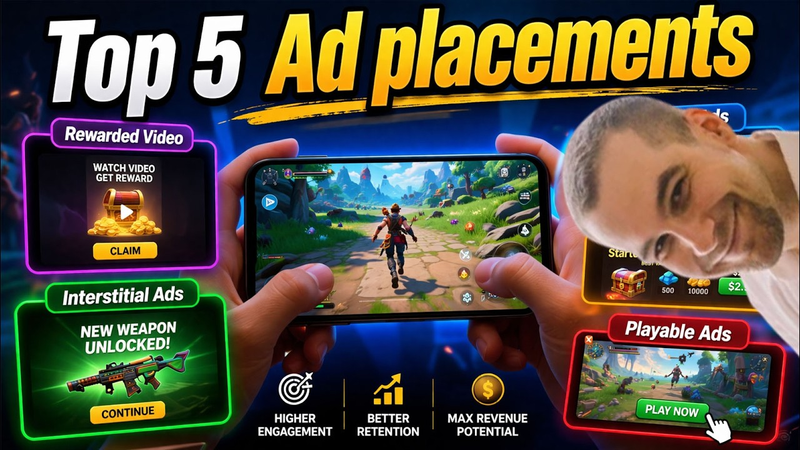
Hello, hello. This is two and a half gamers, one of the solo episodes where we pick topics and talk about them in monologue voice. Yeah, so this I'm it's my turn here and what I'm going to talk about is going to be extremely practical this time. So, no more anime waifu gacha style things. Maybe if you got chest, cuz again, gacha is great. So, today I want to talk about one of the top five advanced ad placements today seeing around the games kind of working out if I'm helping studios and pretty much like one of my favorites pretty much. So, again, let's go fast and quick and hopefully you can learn something and you know, apply something also to your arsenal of things to kind of use. And there's going to be a secret at the end, of course. Let's roll with it. Before level
boosters are one of the best kind of conversions because again, especially for the hard levels. So, what you do here, you see that you have these ad placements there. This is mob control and you pretty much select which of the categories you want to boost for the specific level. The great part of this ad placements, which is like one of my favorite parts of this, is that it's not giving you direct power. It's just giving you more chance to win the level. You can still lose the level, so you're not giving resources, which all always pretty much differentiates the great and the good ad placements that are in the game because usually people just throw resources at you for ad placements, which is nice, but then you run out of your economy and cannibalize IPs. And the best ad placements are the ones that just give you more chances, give you more something, but in the end they give you anything tangible. You still need to work it out with your engagement. So, this is great and this is perfect. And as I have the screenshot here from match three game, uh I think
Township especially. This is being prevalent also in puzzle games, not only hybrid games or mid-core games. Uh pretty much everything that has levels that you can work with and you can again slot in few of those ad placements right here for to kind of get the boosters if you want. You know, you need to segment them, of course, because you can't just give it to everybody, but it's very, very handy, very, very good. And again, if you have levels, this is one of the best ones that you can use for sure. Next one, idle mechanic. So, idle mechanic itself is mostly done in idle economies because this is great and I'm not really talking about this one, which is the usual idle one where you come back and you can double the resources and you can double the resources because it's the resetting economy which has inflation, so they don't care anyway. That's there, but the one that I'm actually talking about and again, we'll be borrowing this from Golden Goblins, one of the top idle games on the market, is the ad boost mechanic. I've seen it in like all sorts of other idle games, but it still works
even in non-idle games that you if you have some kind of idle generation side mechanic loops there or something that can generate stuff, you can you know, throw it even behind the subscription to kind of give double the resources for something or some stuff like that. But what's really important that of course, it's offline generation because again, you can watch a short video to double the profit of like all the generation sources pretty much and you can stack it. The stacking part is actually the important one because again, of course, you can double it for three hours, but you can stack it up and watch four ads basically and double it for 12 hours and then go to sleep, which is the thing we're doing. So, this is more of a impression count pretty much conversion mechanic where it's trying to multiply as many impressions as possible, which is really nice. And as I said, the stacking part is the important part. Moving on, uh random moving placement. This is literally one of my favorite because again, you can do very, very interesting stuff with it. So, how it works is that
you have this kind of a random moving object, which could be anything like in this case, we're borrowing Adventure Communist and there's this airplane here that kind of goes from time to time around the screen and then you click on it, you need to click on it otherwise it runs away, nothing happens. An airdrop pretty much happens where it's like a special offer and watch a short video game free resources. This is the the thing that I was saying like one of the good ones, not the best ones. But the killer here is that this is all dynamic, so it can be completely dynamic. You know, all these offers are pretty much generated on the fly based on the user history, progression, whatever. You don't only send them the pretty much like watch an ad for resources, you also send him just direct resources that are completely free in order to reinforce the user to click on the actual plane random moving placement. It catches your attention, so it's pretty good already because again, change the screen and what's there. But you also need to send him free resources to him
from time to time to kind of, you know, make a habit on it. Once you have it, again, you start sending ad placements. And the other killer thing is that you can do with this, oops, is that you can change these and you can change the amount of resources for the ads, different resources, different discounts, different values, which means that you can gradually pretty much discover the user's threshold for conversion offering him more and more resources. And once you find it, you stop kind of increasing the value to not going to kill your economy and stuff like that. But it's very, very good in like a conversion mechanic where it's pretty much trying to pinpoint as much as like how much it really costs for this user to watch an ad because somebody is like really no-brainer for like we just double it. And games do this all the time, so this is this is great.
[snorts]
Moving on, gacha box placement. Uh it's pretty much like a
normal gacha roll where you have multiple items that are coming from a gacha and you can get one more of that items of those items and it's shown already. So, it's not random usually. Still, I think it works better if it's like given even though it's kind of breaking a little bit the rules of the gacha, but still you have rolled it anyway. And you can get it for an ad. So, again, the example I'm using here is from Pocket Champs that again, all these games we review on the podcast, where you see that you can get one more pretty much running point thing that's dropping from the gacha there for an ad or direct hard currency, which is really, really nice push because again, if you close it, it goes away. So, there's very, very big urgency in this placement. Usually, uh people just do as you see here on the left. This is an example from Frag where you're just doubling your currency, which is also good. Like don't get me wrong, this is also pretty good placement because again, it's urgency, especially if you don't have like levels or like
like doubling currency at the end of the match or something doesn't really work for you. This is one way to kind of circumvent it to put in the gacha. But uh yeah, the gacha one is just much more attractive because it's not currency. It's actually the roll point and especially in this case, you see it's pretty much epic one, not just like because again, these have rarities, so rarities of course, increase the attractiveness of this. So, this is also very, very good. So, if you have gacha boxes, you can do this for sure. Especially if you're running on shard gachas or or gachas that are not like solid token like the Asian ones. If you have those, yep, this is not for you. I'm sorry, it'll break your economy. Okay, real talk before we start. This episode is brought to you by Potensic. And if you're a mobile game publisher tired of leaving money on the table, I'll be signing up. Potensic is a premium ad network built by people who have actually been on both sides of this industry, game publishers, agencies, successful exits. So, they get it. Here's the thing. Potensic has direct deals with Amazon, Apple, Coca-Cola,
Vodafone. It's not programmatic. It's direct. Those budgets land in your game at premium CPMs, no middleman tax. And they handle everything with their in-house team in terms of the creatives. Plus, they've partnered with Playable Maker. Ding ding. So, they will take brands' YouTube videos or static images and actually turn them into playable ads or reward video. Proper interactive format built for gaming inventory. Brands getting a gaming native creative, are getting higher CPMs. Everyone wins. Head to potensic.com to get started or check their creative portfolio in the link in the show notes. Thank you very much, Potensic, for sponsoring this episode. Um last one is rewarded interstitial. And the rewarded interstitial it's not really an ad placement, it's more of a like the execution of the interstitial itself.
And as you see here, where we have this kind of a example, so you see that there's this kind of rolling pretty much fulfilling bar there which says like add in 2 3 seconds. Yeah, something like that and there's a reward like direct currency reward. So, what this does is pretty much tells you like if you will stay at the end, you will watch this and you don't choose it because again, as you know, interstitials are basically forced by this way, by again showing this to the to the user, uh you can get again, a little bit more information what happens afterwards, which kind of helps. And this this gives you pretty much the increased conversion on the interstitials because users will stay as they know, okay, I I'll get this much resources if I watch it. Which is which is great. So, yeah. Again, here's an example that what you do get afterwards or like whatever kind of happens after, but again, it's the information before that's really really important. And not
really a lot of people are using this even though I think it's going to like save you like a lot of conversion. I think say games are using this a lot in in their games as I've seen it, but yeah, let's see. Anyway, moving on. This was the fifth one, but we have a hidden one. So, this is more of a game design mechanic than a placement, but it's still it's all about ad placement. So, let me throw in this on top of it, which is the rewarded ads hub, which I also really really like. This is coming from Legend of Slime where I first saw it, where pretty much is based on the progression mechanic. Uh usually you can do these mostly in like mid-core HP damage scaling economies. I think like with idle is a little bit more problem, but you can still it even with idle. If if you find the properties that are the ones that you can scale like, you know, the parameters, the vectors and and systems. So, in this case, what you're scaling here like increase gold amount gain, increase attack, and decrease skill cool downs, which are
just three stats that they were taken from the like the design space that the Legend of Slime character has. And what's happening here that we can boost those through these blessings. And through these blessings, uh again, you not only level up these blessings because like again, those are just like three boost into one. There's also this kind of a counter which tells you how many ads you have watched throughout the whole thing, which is great because it literally counts all the ads which again is nice cumulative gains and effects throughout the whole game and gives you actual gameplay power based on like how much have you leveled up. So, you see that slowly you're fulfilling this bar by watching all those ads. This is this is really perfect. So, again, the ads hub is not only these kind of boosts like 20-minute boosts that you have here, which is great, but the tracker is even more important because everything compounds together in into things. And and these ones, of course, because you
see these levels here, even these level up also. They're like the the more you watch those, the the bigger they get, but again, you need like a specifically designed like economy or game design vectors for this to be able to apply, but this is really really good in heavy ad games. Like I think this is one of the best features that you can get, especially this kind of a tracker because again, it gets cumulative rewards and you expect people to be heavy ad watchers. So, that's that's there. Anyway, um that was it for today. Very short, very effective. Seen those, you know the reference game, you know what to do now. If you have any questions, feel free to, you know, join our Slack or call us as we are helping companies all around the world, me, Felix, and Martin, and so on and so forth. Or, you know, join the Slack channel as you can also ask questions directly there. Anyway, have a nice day. See you next time. Ciao.
Auto-generated captions from YouTube — names and numbers may be misheard.


















Comments