VideoTwo & a Half Gamers
🎙️ Mobile Ad Monetization basics: What every studio gets wrong by Felix Braberg
18 Feb 202619 min video
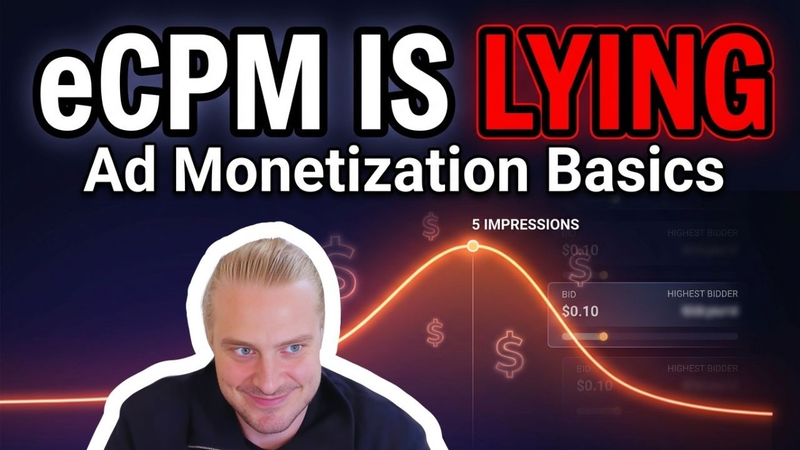
starting with your Admon activities for the first time, you're probably going to see some of the highest eCPMs that you'll ever see if you set it up correctly because there's not that much historical data for your new app or game. Meaning that eCPMs usually or ad revenue usually goes down after a while because then actually networks have more time to find
it's dice world the two and a half gamers the midnight crew talking UA advers and game design too mate feeling shak bringing the insight we're rocking those vibes to the early day master eyes on the prize tracking data through the cyerspace skies. Felix stacks like a wizard in disguise. Jack lift us to the highest. Two and a half gamers talking smack. Slow hockey stick got your back. Ads are beautiful. They light the way. Click it fast. Don't delay. Uh-huh. Uh-huh. Ah.
Ah. Hello everyone and welcome to a special episode of the Two and a Half Gamers podcast where it's just me, Felix, and I'm going to be talking about mobile ad monetization basics. So, what is this? This is exactly a course for you that will take about 20 minutes that's thinking about monetizing with mobile ads inside of either your mobile application or your mobile game. And what this is kind of destined to do is just give you a brief introduction on how everything actually works once you plug in the SDKs and once you have everything going showing ads. It's actually a bit more complicated than you think and actually knowing these basics saves you a lot of hassle. So who am I? My name is Felix Braberg. Uh I've been in mobile for close to 10 years of my life right now. I've actually worked in two DSPs, one ad network. Uh if you
don't know what those two things are, you'll definitely learn it by the end of this presentation. But essentially, these are the two main sources of demand that buys inventory in the mobile space. After that, I was the head of ad monetization for Tetris, East Side Games, and a couple of other studios. And now I'm a full-time ad consultant. I've managed about half a billion dollars by now in ad earnings throughout my career. I do know my way around mobile ads. All right, so let's get started. So the first thing that you need to know when you're starting to deal with mobile ads and earning ads with mobile ads monetization are these main metrics. So if you're going to take anything away, just remember what this is. So first you have eCPM. So, eCPM or effective cost per mele is the revenue that networks or DSPs pay for you for basically showing a,000 impressions inside of your inventory. So, this is
actually the money that you earn or the worth of your impressions, right? So eCPM a lot of people tend to focus on this metric quite a lot and tend to give it the most important value but I would say it's actually not the most important metric because the most important metric that you should actually care about is ad revenue. So to understand ad revenue we also need to talk about fill rate. So what is fill rate? That is the percentage of impression opportunities that you have that are actually sold to networks or DSPs, right? So, you could have 100,000 impression opportunities, but if you only sell 2% of those or a filler rate of 2%, that means you're missing out on pretty much 98% of ad revenue, right? So, the most important metric is actually when you combine these two. That's eCPM plus fill because that actually gives you ad revenue, right? So eCPM plus how much networks
actually buy from you is the ad revenue, right? So a good fill rate these days, I guess on video in mobile should be about 98%. There's no excuse in a modern day and age why you shouldn't be filling at least 98% of your impression opportunities. So there's another big misconception in this industry and that is that eCPM is better. I just talked about it, right? But I would gladly take a lower eCPM if it meant a higher fill because that essentially means I earn more ad revenue. And that essentially brings us to one of the most important metrics in the space which is ad arda or ad revenue per daily active user. So this is one of the most important metrics because it's the only metric that gives you a clear line of sight or a clear channel on actually how your ads are performing. Right? So if you look at it on a user level, that's usually when you can see if your ad monetization
efforts are actually increasing the revenue per user or decreasing it. Right? So this is the only metric that matters when you actually look at things because it gives you also a clear line of sight on how your UA is affecting your ad monetization. So you can sometimes see eCPM go up but Phil go down vice versa but basically ad arow is the clear line of sites. So these are the most important four metrics. remember them. They're quite simple, but basically when talking to ad networks, you always want to talk about ad art because if you only talk about eCPM all the time, they think you're not very knowledgeable in this space because essentially you're only talking about one component of ad revenue and you're not talking about it on a user level. So always when interacting look at ad arow and talk about adar out because it's the most important metric. So moving forward, how is actually eCPM calculated by ad networks? So all different networks have access to different
amounts of data that they can use to calculate how much they're willing to bid to show a particular user one impression. It's rumored that the Google algorithm has 92 different parameters that it looks at. One of them is temperature because they get that data from their weather app and they look at all these things to decide in real time how much they're actually willing to pay for a user. I think Applement is rumored that the biggest weighted weighted thing in their eCPM formula is device type. So basically how expensive your phone is. But there's a couple of things that everyone gets from the different auctions. So usually what networks look at is they look at how many times have we basically like seen installs from this app. How many times have we lost historically over the last seven days when we actually bid on users in this application? What's the geoloccation? Very important one. It's going to be higher in the US than it will be in Ghana for example. And then one of the
most things that people don't really understand is how many impressions have I previously shown to this user in the session and throughout the day. So they calculate this on a rolling 7-day average. Meaning that when you first start with your application starting with your admon activities for the first time, you're probably going to see some of the highest eCPMs that you'll ever see if you set it up correctly because there's not that much historical data for your new app or game. meaning that eCPMs usually or ad revenue usually goes down after a while because then actually networks have more time to fine-tune and actually get the results from the campaigns that they've been running. Right? So let's talk about this numbers of impressions previously shown to a user. So all networks work on something called a recency model. Now what is a recency model? this fancy network speak for I'm willing to pay more because I assume that when I show a user a lot of impressions, what essentially happens is
that people lose their interest and they lose their focus. So I'm willing to pay a higher per unit price on the first impression than I am on the fifth impression, for example, for the same user. So what does that actually mean in real time? That usually means that on full screen video, let's say interstitial or rewarded, you usually see the per unit price of a impression to a user usually starts dropping off quite a lot after the fifth impression. Different networks mean different thing and different apps do different things. So if you have a high amount of payers in your app, this typically will slow down, but there still will be a drop off. So that essentially means that if you look at the per unit value of impressions you're showing, sometimes it might not actually be worth showing that seventh or eighth interstitial impression because every interstitial you show will have a tradeoff on retention, right? So always look at the perunit value of the impressions you're
showing. I've done this with many clients where essentially I'm working with them and we improve the impressions per daily active user and we don't see that much of a boost on the overall revenue because basically the curve goes down and then essentially that eats all our gains. So remember the recency model and always look at that as well. So here comes probably one of the main things to also look out for when you're setting up a mediation platform and adding new ad networks. We have a couple of videos on those already. So, I'm not going to waste your time on it. But the most important thing that you need to keep an eye out when you're adding new networks is you need to keep an eye on ANRS and crashes for Android in particular. So, Android have this rule that you need to keep crashes and ANRS below a certain threshold. I believe it's point uh 0 uh 2 0.3% of overall baseline. And if you don't if you basically go over that, you lose a lot of your organic traffic
because Google Play rewards apps that have a stable infrastructure. So what we've also talked about this on this podcast quite a lot of times. What actually happens is that SDKs are built by networks and sometimes these SDKs have a lot of errors, right? So you never want to be the first studio to update a new SDK, right? Usually what I recommend clients to do is when a new network comes out with an SDK, they're usually incentivized that these salespeople or account managers are incentivized to get as many people as possible on the new build, right? Because it usually performs better. But you don't always want to do that. So usually what I recommend to do is wait two or 3 weeks, look up online with this SDK, just do a quick Google search and basically see if there's people complaining about crashes. If you don't see that, then you can go ahead and actually update the SDK and move forward. So, the other thing that's kind of been a hot topic that we talked about
so far on the podcast many times is that over the last 6 years, we've seen in mobile how ads are getting longer and longer. So, rewarded ads are no longer 30 seconds. Interstitial ads are no longer skippable after 5 seconds. And it's harder and harder to click out of these, right? So usually when you start working with networks before you even speak to them, you're usually on the most aggressive end card formats without even knowing it or even asking for it, right? And that's because networks earn money on conversions. So they're running UA campaigns and essentially the more conversions they have for those UA campaigns, the more money they earn. So they have an incentive to make ads hard to click out of because basically increases the amount of misclicks and true clicks of people actually wanting to download games or apps. This is not good for you as a publisher because essentially what happens is that ads that are long and annoying usually sees
higher churn rates. So basically users leave your app or game quicker. And I've actually seen this firsthand. If you actually remove these end card templates, you actually have a lower churn rate. Right? So the first thing that you need to do whenever working with a new network or when starting on the new mediation platform is agree with the networks that you're working with on what's acceptable to you. Now here you can see the recommended yeah the recommended times and clicks that I usually tell my clients or that I usually like to operate on. 30 seconds rewarded ads plus 5 seconds to close and three clicks to close or interstitials 5 seconds to close. So keep that in mind here right now is as of 2025 largest networks that I see in order of the largest to smallest but these are pretty much the main ones. How I usually recommend people to start working in mobile ads is that you pick a mediation platform. We have a couple of videos on
the main ones. It's pretty much ADM Mob, App Max, and Unity Level Play. But if you work with pretty much the top three or four of these networks inside that you see basically here listed from largest to smallest, then essentially you can't really go wrong with that, right? So, usually I recommend three or four networks until you get to about a grand or $1,200 a day and then basically building it out from there. But yeah, keep it this in the back of your head. So let's talk about what is an ad network. So when I first tried to join this industry, I was asked this in an interview and I actually didn't know how to answer it perfectly. But basically an ad network is basically a company that has the direct relationship with a publisher. So basically they have the SDK integrated in a game or in an application. So they have the direct integration and that's what makes Amazon an ad network instead of an exchange which we'll talk about later. So how it
actually works with ads is a lot of people assume it's like a beer tap where essentially all the beer coming from the tap comes from let's say airl. So integral is a large network. So when I plug them in I'm only getting integral demand. No no no that's not how it works. So basically networks own the relationship with you right? So they connect the SDK inside your game or application. So what they can also do to earn more money is work with something called resellers. So resellers come to in this case Mint integral and they go like hey Mint integral we see that you have a lot of connections on your SDK. We also want to be able to access your publishers. Are you able to come up with a fee where we can access all of that inventory as well? and they go like absolutely let's charge 30% for all the impressions that we show through the resellers and that means that you actually get a lot of demand that's not listed directly from mint integral. So this is exactly why you have a long
something called adapts txt file which I've made many videos on as well on this channel but essentially this is why you need to keep it up to date as much as possible because if you don't you're actually losing out on a lot of money. So usually when you work with a network depending on the network actual direct traffic that you get from a ad network is only somewhere probably around 30 to 60% in that region unless you're working with let's say a Google or a meta where it's 100% their own demand. And that brings us very elegantly to exchanges. All right. So exchanges are not ad networks because they don't have their own direct demand. They're pretty much only making money on being a reseller. So the biggest exchanges right now in mobile is DT and Bid Machine. And essentially how they earn money is just owning the relationship with you and essentially bidding it in with only reseller demand. Right? So it's only DSPs that you get demand from here. And that's the main difference. How does actually a mediation platform works?
Once you start working with ads, you absolutely have to choose a mediation provider. Like I said, we've covered this a lot on this channel before. So, just search mediation channel uh mediation provider on this channel and you'll find a lot of videos on it. But how mediation actually works, if you think about it, it's like a market. So, if you as a publisher just go to one seller, let's say one ad network, and try to sell your inventory at one place, you're going to get paid a bad price. It's actually better to bring into a marketplace where multiple ad networks at the same time bid for your inventory. So what this means like in real life is essentially if you uh go and let's say you earn $100 a day and if you don't have a mediation platform, if you add a mediation platform, in my experience, you double your ad revenue when you set this up. So you'll be earning $200 instead. So mediation platforms work pretty simply. You plug in a bunch of adapters that are all the networks and
then basically that whole transaction is facilitated on these platforms. How they work is pretty much the same. If you look at it like a visualization, you see pretty much that an ad request comes in. All the bidder networks that you have set up in real-time bidding. They together come up with the highest price that they're willing to pay for that particular user and then basically it travels down that price down the waterfall to see if it can be beaten. So, this is kind of only true if you're on ADM Mob or Level Player these days because most of all the impressions now served on AppLab and Max are through only header bidding. If you want to learn more about that, watch more videos. We're not going to go into that today cuz this is a basic introduction course. Um, and that is all I had for you guys today. If you guys have any questions on how to monetize your inventory on mobile, please don't be afraid to leave a comment. We love getting your comments. If you have any more advanced questions, my email is
down below if you want to ask me anything. But until next time, thank you for stopping by and uh we hope to see you monetizing your inventory on mobile very soon. Thank you very much. Bye-bye.
Auto-generated captions from YouTube — names and numbers may be misheard.
Mobile ad monetization requires a shift in focus from vanity metrics like eCPM to a holistic understanding of revenue generation. The primary thesis is that ad revenue is a function of both eCPM and fill rate, and the most critical performance indicator is Ad ARPDAU (Ad Revenue Per Daily Active User). Relying solely on eCPM is misleading because high eCPMs can be offset by low fill rates, resulting in suboptimal total earnings. Furthermore, increasing the number of ads shown does not guarantee higher revenue; due to recency models, the value of impressions diminishes significantly after the first five to seven views, and excessive ad frequency risks damaging user retention.
Operational discipline is essential for maximizing revenue and maintaining app health. Developers must prioritize stability by monitoring Android ANRs (Application Not Responding) and crash thresholds, as poor performance negatively impacts organic distribution. Additionally, developers should exercise caution with SDK updates, recommending a two-to-three-week waiting period to ensure stability. Aggressive ad formats, such as long, non-skippable end cards, are identified as significant drivers of user churn, and studios are encouraged to negotiate acceptable ad duration and closure standards with their network partners.
The industry landscape relies on a mix of ad networks, which hold direct publisher relationships, and exchanges, which function as resellers. Implementing a mediation platform is a critical step for any studio, as it creates a competitive marketplace that can effectively double revenue compared to working with a single network. The scope of these practices covers the global mobile gaming and application industry, with a focus on technical implementation and strategic optimization for studios ranging from small startups to those scaling toward significant daily revenue.

Two & a Half Gamers · 2026

Two & a Half Gamers · 2026

Two & a Half Gamers · 2026

Two & a Half Gamers · 2026

Two & a Half Gamers · 2026

Two & a Half Gamers · 2026

Two & a Half Gamers · 2026

Two & a Half Gamers · 2026

Two & a Half Gamers · 2026

Two & a Half Gamers · 2026

Two & a Half Gamers · 2026

Two & a Half Gamers · 2026

Deconstructor of Fun · 2026
Two & a Half Gamers · 2026
Two & a Half Gamers · 2025
Two & a Half Gamers · 2025

Two & a Half Gamers · 2025
Two & a Half Gamers · 2025
Naavik · 2024

Deconstructor of Fun · 2024

AudioMob · 2021
Two & a Half Gamers · 2026

Deconstructor of Fun · 2026

Two & a Half Gamers · 2026
Comments