VideoTwo & a Half Gamers
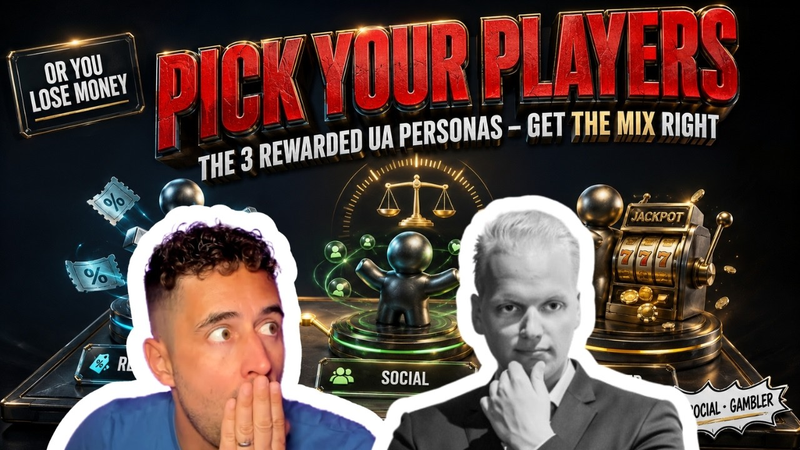
🎮 The 3 Rewarded UA Personas: Reward Hunter, Casual, Gambler. How TyrAds Segments for Profit
10 Jun 202634 min video
Day 7 to day 30, right? We want to maximize that curve as quickly as possible, right? So that we can get the return towards you also much quicker, right? And then the social user is the one that's going to be playing for two, three, four, five, six months, right? So we want to get the curve up as quickly as possible
Why?
because then you get higher returns quicker, right? So the quicker you get returns, the more you can spend on UA.
[music] [music] [music] [music]
[music] [music] [music]
Hello everybody. This is MAU day two. I'm already dying.
[laughter]
I mean, it's Vegas and it's MAU. Welcome everybody. My name is Matej Lancaric and I have Zeno from Tierras over here. Welcome again.
I thank you. Awesome to be here, yeah. And I hope we're both surviving day two of Vegas, right? This is heavy times over here. Jet lag and hangover, everything combination of it all together, right?
It makes it a great time.
I was walking through MAU conference and it was like half dead anyway.
Yeah. I'm usually leaving on day two, you know. Here we are.
Here we are, yeah. You still wanted to have a quick chat with me.
Yes, of course.
Yeah.
Can you introduce Tierras and actually you as well for the listeners that they don't remember. You were here already
but still.
Great. So yeah, my name is Zinove, CEO of Tier Ads. Tier Ads are Tier Ads is a company specialized in rewarded platforms and rewarded traffic. What we do is we basically reward users to play games or reward users to to do certain actions like subscriptions. And what we do is we're integrated into third-party apps, games, and with our monetization solution so that helps us monetize users and gamers to play those games and then we also get those users at the same time. And then we also have our own products, our own apps, Try Rewards, right? So that is almost the same name but a little bit one letter difference, right? And we got that our own products as well where we promote that with our own UA and and grow that out as well.
Last year we talked about fraud, about long-term player progression as well. Then we talked about your offer wall solutions and then we touched that in in a different podcast. So what's new?
Yeah, so a lot of things actually really have changed. First off, we launched our own platform and that platform is completely built in-house so it gives us
a lot more capabilities of testing, experimentation, and really understanding where the audiences are performing well.
[snorts]
Right? So last year we talked a lot about long-term progression, right? So that was really of a singular structure, a singular offer wall setup, right? And understanding how to engage users with that. But we sprinkled a little bit on top of that with segmentation of those audiences and then being able to experiment on those audiences as well, right?
Can you Can you okay, can you unpack pretty much all of what you just said?
Yeah, sure. No worries. So basically we've seen that within the rewarded space we have like different types of users that engage with offer walls, right? So you don't have a singular user that engage with an offer wall. Each user will have a different type of behavior and that behavior basically dictates how they will perform and how what your LTV curve will be, right? So meaning that if you're promoting a your own game, right? You need uh those users, but you want to make sure that you're giving them the right user the the the right engagement, the
right rewards to actually engage that segment of users. So, what what does that mean, right? So, let's say we have those segments of users, right? We basically see on high level three main different types of users.
Yeah.
One is a reward hunter that just wants to go for rewards, maximizing his uh his own earnings that he can get.
a different app.
Exactly.
Okay.
Yeah. And you know, he'll jump from one app to the other app to uh just maximizing his own capabilities, right? Just like you have the coupon hunters, right? Where you had like you had these shows where you had these ladies and uh going and getting the coupons and that all that stuff. That's the reward hunter, similar similar to that type of user. The other one is the casual user. Right? So, this is just a user that just casually wants to play some games, wants to look for a community really, wants to engage a little bit, and is one that will play a game for a very long period of time, but might not be the most aggressive of users. And the third one, that is the gambler. That's it. The gambler one is the one that will go for the the big rewards, right? Just like you have in a slots machine, you have like a big jackpot on the top, right?
You know, that a big amount that really attracts you to go for it. That user is the one that will actually spend whatever they need to do to get to the the big rewards because they're in it for the game, right? And these three users have a very different behavior.
Yeah.
Right? So, understanding that behavior and understanding what they do basically allows us to understand that we need to give them different types of rewards to maximize their value.
Yeah.
Right? And uh that's basically what we've built on our side is to be able to target those different segments of users and AB test on those segments of users with different funnel structures.
Okay.
Right? And then allow us to actually pinpoint exactly what kind of reward structure really works for that type of persona.
And how does it work in in practice? [clears throat]
So, the in practice how that works, right? Is that we have the capability of segmenting audiences.
Is that capability thanks to the new platform?
Yeah. Okay.
Yeah, so on our new platform we label all our users, right? And that the labeling system is automatically done based on the data that we receive from
users.
AI?
Yeah, with AI, yeah. So fancy pantsy, yeah.
[laughter]
Yeah, so we basically label those users, right? And that's with our machine learning operations and basically ensuring that whenever a user comes in based on the behavior that they have, we label them, we try to categorize them into specific segments of users. And with that labeling, right? That's what we allow to target in our platform, right? So we can see, okay, this is this type of user, that's that type of user. We want to be able to segment that user and actually engage that user with different reward structures. And what we built on our platform as well is that you can actually use that audience and select that audience and then experiment with different funnels based on that audience. So the AB testing of different reward structures.
Okay, it sounds pretty hard to do.
Yeah, it wasn't easy, yeah. Yeah, so it's a there's a lot of things that come with it, but its core functionality is experimentation and AB testing.
Okay, again, do you see any kind of results already? Or
Yeah, we see a lot of results in terms of the performance, right? In terms of
specifically mixing the right audience together, right?
Yep.
Making sure that we don't have too many reward hunters, for example. We don't have too many users that are just social, right? And we don't have just lonely gamblers because then we the gambler one is going to lose us a lot of money, right? We don't make any money on these type of users because they spend like crazy and they cost us a lot of money. But the other three different types of users and segmenting and connecting that together basically makes it profitable for the advertiser, right? Makes it profitable for us. And then also makes it profitable for the user, right? And that's really where the the the crux lies. That's right.
Do you have also segmentation for like ad whales or only IAP?
Yeah, yeah. So ad based games, right? So ad based is more on the engagement side, right? So, that's really very very heavy engagement. That's really where the the gambler segment will come in too as well, right? But, they will be less of a percentage coming into that because they will go for the deeper reward, but they will just keep going until they're there, right? This they're very driven users going for the maximum reward and
earning the earnings that they generate is is going to be purely based on ads, but
But, it will be less of like on an IP based game.
Yeah, but how do you come up with those these three personas? Based on the data. So,
No [ __ ]
Everything's based on the data there. We started looking at Well, we started launching campaigns.
Yeah.
We had a lot of users in the beginning that were reward hunters, right? That's really users that are just looking for the incentive, right? That's really why incentivized never really grew to a big area in the beginning, first off. Because it was the old model. They were only looking for reward hunters.
Yeah, okay.
And that changed with the adoption of widening the audience towards bigger types of users for more attracting more types of users, right? Where they social user and the gambler comes in. And combining these three, that's really where everything will come together as a good performance, right? Where your long-term performance will also be there. So, the what we found out was that we were
we were having some users we would be very unprofitable on some users cuz we are being paid out by InMobi and we're paying out for the rewards. And when those type of users we would get too much of them, right? The results would be great for the for for the advertiser, right? But, for us we would be losing a lot of money. So, we would be like, "Okay, hey, how do we make sure that we can actually combine these segments together, right? How do we make it so that we can get these users
How How do you make it then?
Yeah, and that's really where the models come in on our side, right? Our recommendation models is where we will push certain games, certain games that we see that need higher performance automatically with this type of segment.
Yeah, based on the data. So, it's also based on the KPIs that the client has, right? So, let's say you have like an Google Ads campaign or Facebook campaign you set a day seven target, right?
Yeah.
If we see that those targets are below what we need to have, right? We know that we need to get certain audiences sent to those games to actually achieve those results. And that's all automatically done by by the models now.
Okay. How do I get on the platform then?
Yeah. So, the the platform is still managed by the team, okay? Right? So, it's we launched it about a month ago and we're still managing that in-house because there's a lot of capabilities, right? And we show it to the people
They do a lot of things can
a lot of different things, right? If you take in the audience segmentation, the AB testing, and then all the other things that we've added on top of that, you can it's a lot of different things.
Come on.
So, we're we're still working on that internally with the team, but we are going to be looking at potentially launching that in Q3 or Q4 of this year where self-serve where you where can actually set up yourself and then we'll we'll be a much more minimized version, a lot easier.
Are you Are you not worried if you do self-serve that just people don't get it?
That the goal is
it's pretty complicated.
Yeah, the goal is actually to automate that fully, right? So, the
it What does it mean? What do you What do you want to automate?
So, that you set your day seven target, right? And Yeah, see you later, yeah. Basically, right? So, that is the that
is the objective, right?
the dream.
Yeah, so you set up your day seven target, right? You want you want to achieve, right? You we set up a different funnel structures that are there and the system will automatically select what funnels work best for what audience segment. Right? We're not there at the moment, right? That's still on our side, right? But that is really where we're seeing that our models will start recommending not based on what game they should do, but also what funnel will work best for that user segment.
Yeah.
And that's where the self-serve will actually be able to launch because you You up maybe funnel A, B, and C. You set your day seven target, and our systems will automatically say, "I'm going to go give this reward funnel to the reward hunter, that funnel to the social user, and that funnel to the gambler, and then see how we can maximize the results and volumes at the same time."
Okay. Then, like how did you come up with like the fact that you want to launch a new platform? Because from what you just said, like it's really a lot of work.
Yeah, it's a lot of work. Having a third-party tracking system is, I think,
one of the worst choices you can make in rewarded.
Yeah, so rewarded is an industry by itself, and a lot of the tracking platforms, they really are just not built for rewarded. So, they're, you know, it's a very event-based system, meaning that, you know, you optimize for an event.
Yeah.
And it's CPA or CPE based, and it's you can't really do a good analytics to understand exactly what funnel works well. And the core what we wanted to have with building our own system is that we can actually give insights towards our advertisers a lot more in granular in granularity of like what is actually working, right? What demographics work for what type of funnel? And being able to give the exact information with just a report that takes me two minutes instead of trying to talk to my data team for an hour, trying to explain what kind of report I want to have. So, the the building of our own system was basically there to serve our clients a lot more effectively. Right? And that and that gives us more capabilities, more options to actually do that.
Yeah, but you need to then track pretty much everything.
Yes, everything.
Can you give me example of like an AB test for for a funnel that I can can AB test pretty much on the on the platform?
Yeah, so
Roughly.
Yeah, we have different AB tests. So, we have the AB test that can be on just a normal event structure compared to different features of events, right? So, for example, we have like shorter max time events where we reward users to achieve events in a shorter max a shorter event time.
Yep.
Right? We also have activity-based events, right? Based on engaging users to actually engage with the offer, and if they hit a certain level that they can actually get paid out for that. And experimenting on those different features, right? That is one feature that we one event that we see that it works really well. But we also have the capability of using our live ops setup that we have built into the system. And the live ops basically allows us to engage users at any time from where whenever the user is actually engaging with the offers. Meaning that we can just like you have with the live ops environment with the user starts purchasing, you want to give them certain journeys to follow.
Yeah, yeah.
Right? That live ops environment
basically allows us to actually engage those users with those live ops setups. After a user does a purchase or actually after a user has done a specific event or after we've labeled them with a specific particular label, right? So, if we see this user has been now been labeled as the gambler, right? We can then target them with even more aggressive rewards, even more aggressive structures. So, we see those are the three main types of AB tests where we do normal structure, one with different features, and then one with live ops. And the live ops one works really, really well because we can see exactly where people are dropping off. And then based on those drop off points, we can actually engage them more aggressively with different
How how do you engage them?
And so, there's different things that we see. So, usually you have what called aggregator events. And that is like an event that is usually connected with a particular value the user needs to generate to achieve that. And those aggregator events can be something like achieve level 200 in date in 7 days, for example. Right? And we can see that if a user
starts engaging uh towards that event that they generate a certain value to get towards that point. And so, what we can see with our live ops setup is that when a user does like level 100 in 3 days we can then push that user to say, "Okay, you just did level 100 in 3 days, right? That's amazing. Why don't we try level 200 in 7 days?" But we don't tell them, the user is just an extra surprise that comes in. And that's really where the live ops environment comes in. We can trigger that on specific events, but also can be triggered when they start purchasing very much, right? So, let's say the user starts purchasing very aggressively. We see that this user has now been labeled as a gambler. Let's give this user now the incentive to achieve a much more difficult event that we don't give to the normal users. To actually engage that user, to actually get them to push even further, engage more, activate more, and just go that extra mile just to maximize the value for uh that that we can generate from that user.
So, I have a game and it's 50/50 split IAP versus ads. I come to you. Where do
I start?
Yeah, so if you're 50/50, so you'll need a mix of users that are actually engaging based on the ad behavior and the purchase behavior, right? So, you're going to be looking at engaging enough users to uniquely purchase, right? And start purchasing.
enough?
So, that's be about 10 to 15% user base to actually start purchasing and then that actually aggregates to a factor of two to actually get them to purchase double, right? Two to three times and actually engaging those users to purchase more, right? So, that's that gambler segment. And then you need a lot of social users and reward hunters, which will be be actually maximizing the value in terms of ads. So, you want to have one segment of targeting that you want to focus primarily to push the purchase behavior, right? To maximize the value that we can get from users that are purchasing. Uh at the same time, we want to maximize the engagement of users by watching ads and doing the other things that actually make the entire LTV curve work well, right? So, the segment one, the reward hunter and the gambler, those are going to give you very quick
Okay.
Right? Those are the ones that are going to make the ROI much easier for you.
Quick ROI meaning day 7, 30, or day 60, or
Day 7 to day 30, right? We want to maximize that curve as quickly as possible, right? So, that we can get the return towards you also much quicker, right? And then the social user is the one that's going to be playing for 2 3 4 5 6 months, right?
Okay.
So, we want to get the curve up as quickly as possible
Why?
because then you get higher returns quicker, right? So, the quicker you get returns, the more you can spend on your wave. And then we want to have the the social user that will make sure that that will actually generate and compound to very good results over longer period of time.
Okay, but then the like what's the scale between all those three different segments? Because then if you should up the quick ROI, is it also scalable?
Yeah, well, it really depends on the bid, right? So, the bid is always going to be the biggest thing that's going to result into that. And it's also the the target that you set, right? So, the day seven target. So, if you want day seven 100%, right? We can only get certain
segments of our users, right? So, if we
limiting the inventory the player.
So, it's the bid and the and the KPI that would determine how aggressive we can scale, right? So, we will always want to make sure that we get enough of those early segments of users, right? So, that we can maximize the volumes the profitability in the beginning, but we want enough of the social users that are there to actually make sure that we engage users for a longer period of time, right? So, that the LTV doesn't stop at 30 days, right? But it keeps progressing over time. Right? So, you get a quick much quicker return on the dollars that you spend. And but the compounding effect of those social users
Why is that important?
Because then if you if you get results for longer periods of time, right? And those users keep engaging, right? That will eventually compound. It makes It makes it possible that you can actually bid more aggressively. Right? So, if I only have those first two segments and I get you results, but it stops after 30 days, right? You're going to be limited in terms of how aggressive you can actually bid.
Yeah.
Right? And and if we get enough users that keep compounding on that and you look back six months from now, you say like, "Okay, I had 70% on day 30, right? But on day 90, I had that to 120. And then from day 60, it was 150, right? If you see that compounding and growing there, right? You're going to be a lot more comfortable to spending of course more because you know that you're actually you'll be able to generate that with the the compounding effect.
Because if I see after 30 days they're dead, then that's not really that great.
Yeah. No, then you're done. You'll be like, "Yeah, it's like a great system, man." It's like, "Well done." Yeah, so you know, you want to have the combination of those users, right? And the more you can combine that, the better it will be, right? If you have too much of one segment, right? It's either not profitable
What's the ideal mix? Like, how do you weigh all of these?
It depends on the the IA or IAP split, right? But, let's say we take a year case. Yeah, let's say we take the year case, right? It would be much more evenly split, right? But, the gambler segment is always much lower, right? It's by 5 or 10% of users, right? It's the same as
like the whale user, right? And then the social and the the reward hunters, that's really where the split will be a lot more equal, right?
Okay. It sounds like I need to spend like $10,000.
Yeah, if you can, that would be great.
So, but then So, the minimum budget is not 10,000, but I guess what? Like 500?
Yeah, 500. Yeah. Yeah. So, it's Yeah, it's very cool, right? So, the new platform, everything that we worked on has been given a lot of different capabilities, a lot of different things.
What does the the platform change for like your current clients?
So, the the main change is that we just have a lot more capabilities.
I mean, like in terms of, let's say, a technical perspective, like do they need to do anything else?
No, it's just a new integration, right? It's a new setup and so and you
Integration sounds, well, for me as a UA UA manager, I I don't care. It sounds great.
Yeah. Yeah, it's just, you know, it's not it doesn't take it's just an AppsFlyer integration, that's it. But, just press a couple buttons and map the events and that's it. And then everything else is it's all set from that side. So, it's an
easy integration. Usually takes like 30 minutes with the client to move everything over, right? So, it's it's it's it's a uh small thing in the big
Okay, nice.
If you need, you know, platform access, definitely talk to Zedo.
Uh I also heard that you started working with uh like interesting company from from Europe.
Yeah.
Those guys we know for a long time from Pixel Federation cuz we went to their offices for many times, Nordeus.
Yeah. Yeah, Nordeus uh we just signed them exclusively with us, right? For our monetization solution. And that's a partner that we've been working on for a while, right? We're making everything customized for them, right? Helping them out with our integrating our monetization solution. So, those capabilities that we talked with on the advertising side, right? They all also progress into our monetization solution now. And that's really where we see a lot of potential because with gaming partners and gaming audiences in general, it's already a segment of users that like to play
games. And by definition, their social segment, right? Is a lot more inclined to stay within games much longer because they already like playing games at already. So, they're just getting rewards to play other games, and then they find new games, and then they can play on those games as well. And that's a segment of users that are very very interesting for us, and that's where where our focus is going to be for um this year and the remainder of time next 2 3 4 years. Is our main focus is on gaming supply and gaming publishers.
Okay. Do you have Well, let's let's say with Nordeus. Like you said, exclusively with you. I mean
Yeah, meaning that we're the only offerwall
Okay, nice.
Meaning that they they don't have any other offerwall partners there.
Very good.
Yeah.
Good job.
Yeah, thank you.
Good job.
It's it's a big company and a big game as well.
Yeah.
It's on the market for a long time.
Yeah, very long time, yeah. It's a great team. It's been an amazing time getting everything set up with them. They're very knowledgeable as well what they do, right? And there's a lot of cool things that we worked on together, right? To make it possible with them. And that segmentation part, right? It's also
very cool that they have their audiences as well. And we're looking and and we've integrated their audiences into our platform, right? So that we can also segment on their audiences that they have, right? So it's not only the audiences that we have that we know from our side, but they also have their first-party data. And understanding that part and and how we can connect that, that's really where a lot of our capabilities come.
Okay. But why do focus on gaming and not on apps and other verticals like everybody else?
So, as I said, right? Yeah, there's three different segments, right? The reward apps are the reward hunters, right? So there's a big chunk of users that are just there for rewards, right? So if there we have too many of one segment, right? You're not going to have a good LTV curve because you need to mix of all three, right? The casual player is someone that's more related towards the user that's actually on gaming, right? And the gambler is where the whales are, right? Like still a gamer, right? So, you know, the concept of whales and dolphins, right?
Is very well known within right? And what you want to have is you want to have some of these whales, right? That already get that already love their games, right? And they will go for everything. And gaming is where we see that those audiences are much more prevalent than in a rewards app, right? Because why are you doing something in a rewards app? Why are you playing in a rewards app, right? You're doing it for a reward, right? So it's the the the segment of reward users and reward hunters is much bigger on reward apps than we have, for example, on a gaming app. Because they're not doing it for any incentive. So the reward hunter is basically non-existent in gaming.
Yeah, fair enough.
And you have only casual and gamblers there, as we call it on our side, right? So we see that as a very good mix towards the overall health and the overall traffic that we can provide towards our advertiser. It's that mix of our own apps and reward apps that we have in general, but also in general that those other segments of users as well.
So you're going to onboard more gaming studios like Nordeus?
Yeah, we have a quite some more lined up that we're working on right now, but I can't really talk about just yet.
Yeah. That's nice. So, what's the what's the focus? I mean, you you mentioned you what you're going to do until the end of the year and then like next 2-3 years, but overall for Deerats what where where do you want to go?
I think the focus on gaming is our biggest biggest priority, right? Really customizing and connecting with gaming companies with their audiences and really making what my dream really is is to connect our live ops environments and gaming live ops environments together. So, when gaming gaming live ops environments come in, right? And they're engaging their users, right? To with their own live ops, that we can connect their live ops environments with our live ops environments and make it one unified product. Is not as a as an offer wall that is just an offer wall external that is just part of it the experience, but it's integral to the experience. And connecting those audiences and connecting their their live ops environments with our live ops environments, we see we think that there's there's huge potential in that area.
How do you want to achieve that?
Yeah, that's that's a technical thing and that's where you need your own platform to be able to build these kind of things. But, it's really connecting their back ends and our back ends, right? So, a lot of platforms I work with AB testing analytical tools, right? And where you segment and you test like different journeys with users, right? For example, you have amplitude for example, you have other tools that you use. And you know, you test a lot of features from that from that. You also probably have live ops environments that you can connect with that you activate your own live ops setups. And those are all tools that all have a back end and that can connect towards our back end, right? So, giving the the capabilities of APIs and connecting that from their back ends and our back ends to actually make that happen, that's where we see that there's a lot of potential for connecting these kind of environments together.
Okay, but people still I think they're still allergic for Uh, like uh, when they hear the word offerwall.
Yeah. Yeah.
Are we moving somewhere from the the past and but we discussed I think last time that incentives and whatnot and now
it's rewarded UI nobody's nobody's calling it incentivized traffic.
I think the the the whole industry is moving right now. It's from last year to this year I would say a lot has changed in terms of the rewarded space a lot right? There's also a lot more partners connecting with each other right? And M&A happening right now. Um, a lot of a lot of advertisers are actually looking at it in terms of like okay hey, how do I make sure that I maximize that engagement for longer periods of time right? Like how do I actually set up the funnels correctly? How do I actually optimize the different platforms there correctly? But it definitely has found its place in the industry right? It's as you can see right? It's not
It's at least 30% of the budgets almost every day.
Yeah, so it has definitely found its place but still we're right now it's looking to evolve right? So we've been through this hype phase right now right? Where everything was fancy and everybody was looking at oh this is the new shiny object.
Everybody was just founding like rewarded UI channels.
Yeah. Yeah. It's like the it was like the crypto days right? Everybody was founding a new hype token you know?
Yeah, everybody and their mothers like they have their rewarded
Yeah. Yeah. Yeah.
[laughter]
So the yeah, I think the the big thing and the big part there was that everybody was trying out different offerwalls right? And a lot of a lot of understanding that offerwalls have evolved a lot and the market is maturing right now.
Yeah.
I think we're seeing a consolidation but also maturing of a lot of
You mentioned it last year like oh we're going to see consolidation because well you you will have like five six main players.
Yeah, basically yeah. Are you seeing that happening right now right? So this is where you start seeing partners coming together right? They're trying to integrate their ad tech solutions and we're going to see how effective that is right? You never know when you're integrating two ad tech solutions right? We've seen it with Unity for example.
That went well.
That went a really good one. But yes you also seen it with Digital Turbine right? So it's also the same case, right? Where they bought like three different platforms, right? AdColony was there, right? 5 years ago. We still remember the end name, AdColony. Nowadays
No, not anymore.
But you know, when you have tech partners integrating with each other, you never know if it's actually going to work well, right? It's It's not a given,
especially
Are you Are you looking at like any M&A activities?
No, I I when I looked at the Unity and the Digital Turbine cases, I was like, "Yeah, I don't think that's that easy." And I just finalized my migration from a third-party tracking system into our own tracking system. I'm I'm done with migrations for a bit of time.
You mentioned last year the consolidation, so what's what's 2027 then for everybody in the UA?
I think at the crystal ball I think that's where you're just going to consolidate even further.
Ah, give me something more than that.
Yeah, so I think the I I think this year, well, let's see. What we're going to really see this year is uh
You're talking a lot about segmentation.
Yeah.
A lot.
Yeah.
Okay, that's that's one thing. What else?
Yeah, so the segmentation part, definitely. That's going to be one of the really how do you connect your audiences correctly to actually target correctly, right? So it's all going to be in the in the technology really, right? So it's the models and the technology that's really going to make everything or break everything, right? So if I would say consolidation was the
first part, I would say the second part would be really is the recommendation models and moving everything to ROAS-based campaigns.
Yeah.
Right? That's really where I see the industry going to now. So everything's going to be on that day seven performance. Everything's going to be on ROAS-based targets. And it's going to be a lot more like an AppLovin platform or a Google platform, right? Where the the the partners are going to become much more knowledgeable about what really works and what doesn't work, and being able to automate that with ROAS-based campaigns.
If that happens, do you see a world where there is like a mediation for this where you plug in the rewarded UA channel, and then based on your targets, you will get different traffic from different sources?
I think mediation is extremely difficult and because mediation it it also depends not only on it's like you have the creative, right? Right? It's like when you make different creatives, right? Like every brand has a the creative strategy is a very different strategy than mediation, right? Like how to serve what creative, right?
It is like when you look at mediation for rewarded, it's like you combine the what ad to serve and the creative together in one. Because the offer wall structure is the creative basically, right? So you're combining a creative strategy and a mediation strategy into one. It's a extremely complicated product to mediate on. So I don't think that would be really where the mediate where it will go into the market because it's not this year, right? But maybe as the market progresses, right? That might go into that direction, but it's a very complicated product to build. It's because you're you're looking at a creative strategy and what creative to serve strategy as [snorts] as one whole solution in one go.
So segmentation and technology and data and recommendation models.
Okay.
Yeah, that's basically it, right? So the
We we look at AppLovin and I guess it works.
Yeah. Yeah, so AppLovin is a definitely the example, right? Of like how to make something that actually works, right? Same as Google, same as Facebook, right? You know, a lot of the advertisers spend
most of their budgets there, right? And nobody wants to be bothered by, you know, looking up different site IDs or different this optimization and that and that, you know, you just want to put in your targets. You set your set up and you're like, "Okay, let me let me go sit on the beach for the rest of the day, right?" So You know, that's that's really the objective and that's really where the platforms will be building towards. And anybody that doesn't build towards that type of platform will have a very difficult time.
I would say it's two and a half steps behind.
[laughter]
Exactly, two and a half steps behind.
Nice. Anything else you want to share with the with the guys in the audience?
Yeah, so with with gaming focus that we've had, right? We also did a full revamp on our own product lines, right? So, we had our own app that we we branded from a and a name from Tier Rewards to Tribe Rewards now. So, yeah, our Tribe Rewards product has been something that we've been focusing a lot on and that's something that we have been building
a lot more of those engagement features on that we talked about with live ops, but also adding a lot more additional engagement layers towards that, right? So, we have a lot more control over our own products and what we can engage with. Now that we have our own systems, right? we have a lot more of creative freedom basically to build what we want to build. And we we'll just launch that as a completely redesigned product. It's a product that foremost our model is serving the different games that we have on the platform, but we also have built we're heavily investing into all of the engagement, the live ops setups that we have additionally towards what we already built in our system within the games. And that's something that yeah, we just launched the a month ago that full revamp of that product and that's something that we are we're going to be scaling a lot more heavily now. Yeah.
Thanks, man. It was great again. Yeah, I hope to see you see you soon here on the on our podcast as well. And thank you guys for listening. See you later. Bye-bye.
Thank you. Bye-bye.
Auto-generated captions from YouTube — names and numbers may be misheard.
Rewarded user acquisition has evolved into a sophisticated, data-driven sector that currently commands approximately 30% of total advertising budgets. The industry is undergoing a period of consolidation, shifting away from manual optimization toward fully automated, ROAS-based models. Modern platforms now prioritize long-term value, specifically focusing on the day-7 to day-30 LTV curve, to ensure sustainable growth and profitability for gaming publishers.
Central to this evolution is the implementation of AI-driven user labeling, which categorizes traffic into three primary personas: reward hunters, casual social users, and gamblers. Each segment requires a distinct strategic approach, as relying too heavily on high-cost gamblers can erode return on investment. By applying granular A/B testing and event-based incentives, platforms can dynamically adjust reward funnels to balance the user mix. This segmentation allows for precise monetization strategies that align with the specific behavioral patterns of each group.
The future of the industry lies in seamless integration and hands-off automation. Leading platforms are increasingly embedding their backend systems directly into the live operations environments of gaming studios, creating a unified experience that optimizes user engagement in real time. As manual campaign management becomes obsolete, the focus is shifting toward systems that allow advertisers to set high-level ROAS targets while the platform autonomously manages the complexities of audience segmentation, reward structures, and funnel optimization. This transition marks a maturation of the rewarded traffic ecosystem, emphasizing efficiency and long-term retention over short-term acquisition metrics.

Two & a Half Gamers · 2026

Two & a Half Gamers · 2026

Two & a Half Gamers · 2026

Two & a Half Gamers · 2026

Two & a Half Gamers · 2026

Two & a Half Gamers · 2026

Two & a Half Gamers · 2026

Two & a Half Gamers · 2026

Two & a Half Gamers · 2026

Two & a Half Gamers · 2026

Two & a Half Gamers · 2026

Two & a Half Gamers · 2026

Two & a Half Gamers · 2026
Two & a Half Gamers · 2026
Two & a Half Gamers · 2026

Two & a Half Gamers · 2026
Two & a Half Gamers · 2025
Two & a Half Gamers · 2025

Two & a Half Gamers · 2025

Deconstructor of Fun · 2025

Deconstructor of Fun · 2025
Two & a Half Gamers · 2025
Two & a Half Gamers · 2025
Two & a Half Gamers · 2025
Comments