Transcript
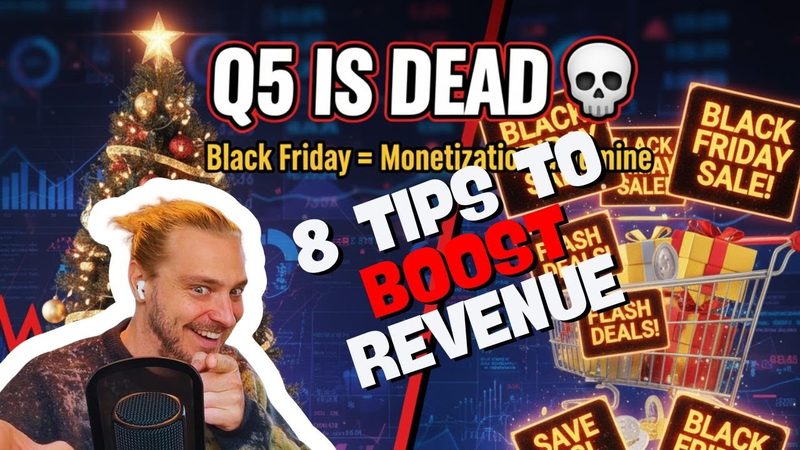
The Q5 has moved and disappeared and is actually called Black Friday weekend now, right? Which starts ramping up on kind of the end of Thanksgiving. What actually happens here is that normally you have a baseline of, you know, inside of the mobile ecosystem of games running UA, brands running UA, anyone trying to get anything sold in e-commerce running drops knowledge made of golden eyes. [music] Felix with ads making those coins rise. Jack up designs worlds chasing the sky with the two and a half gamers. The midnight crew talking UA adverts and game design too. Mate feel [music] bringing the insight. We're rocking those vibes till the early day master eyes on the prize. Tracking data through the cyerspace skies. Felix stats like a wizard in disguise. Jacks [music] lift us to the high. Two and a half gamers talking smack. Slow hockey sick got your back. [music] Ads are beautiful. really like the way. Click it fast. Don't delay. Uh-huh.
Uh-huh. [music] Ah. Ah. [music] Ah. Ah. Hello. Hello. And welcome to another very special episode of the Two and a Half Gamers Podcast, where you can stay two and a half steps ahead of the mobile industry. Today, like I said, a very special episode. Why? Because just me alone talking about my favorite subject, and that is Q4 ad monetization. I have eight tips for you today on how you essentially can turn this Q4 into a very successful and festive season and boost your ad revenue. In order to boost your ad revenue, I have four tips that basically are related to increasing your supply. And then I have four tips relating to increasing your demand. And together they work and basically work in a beautiful, beautiful cohesion to
increase your ad revenue. So four tips on the supply side and four tips on the demand side. But before we get into that, I wanted to talk about something very very sad and tragic. And that is of course the fact that Christmas unfortunately for ad monetization is now dead. What do I mean by that? So when I started in this industry, what actually happened was we actually talked not about Q4 but we talked about a beautiful phenomenon called Q5. Now what the hell is Q5? 5 was this magical time where essentially for the last two weeks of December, eCPMs increased so much that you could actually earn a whole quarter of revenue in just 2 weeks because there was so much buying going on that it increased all of the value of the impressions which essentially meant that you could earn so much money. That unfortunately doesn't happen anymore. My theory on why
this is is essentially is that people's purchasing behaviors has actually shifted away from right before Christmas to actually be around yeah a couple of weeks before because there's a new phenomenon that started happening a couple years ago which of course is the weirdness that is the US holiday Thanksgiving holiday weekend. So the 27th of November this year, we have Thanksgiving, which is followed by this weird date called Black Friday, which is on the 28th of November this year, which is followed by something I didn't even know what it was, called Small Business Day, which on the 29th of November. Then there's the Sunday on the 30th of November this year, which actually doesn't have a name. So, I'll call it lay on the couch Sunday because you've been shopping for the two days before in America, which is followed by December 1st, which is Cyber Monday where you have all the online sales. So, the Q5 has moved and disappeared and is actually called Black Friday weekend
now, right? Which starts ramping up on kind of the end of Thanksgiving. What actually happens here is that normally you have a baseline of, you know, inside of the mobile ecosystem of games running UA, brands running UA, anyone trying to get anything sold in e-commerce running UA. And this kind of works really well and we have a nice even level. But what happens on this weekend usually is that brands want to get way more exposure to boost sales even more. E-commerce commerce companies want to have that extra boost to basically boost sales. And then you have gaming companies that need to keep up with installs. So what happens is that usually on average the whole ecosystems average for eCPMs move up by anywhere between 15 to sometimes I've seen 55% increases in eCPMs. Last year was a bit different. I only think I saw about 25% increase and it wasn't for as long as usual but there definitely was an increase. So, what am I doing
with my clients right before this time period to essentially focus on getting the most of this increase in eCPM? So, there's two main things that you can do in this weekend. So, I usually recommend that everyone should treat this weekend completely different from any other weekend and actually plan around it because you can actually boost your revenues by quite a lot. Not as much as the stupid Q5 that doesn't exist anymore, which I really do miss, but you can still increase it quite a lot. So let's talk about the two ways. You could either temporarily increase supply or you can increase demand or you can do them both in tandem. So let's talk about increasing supply first. So the first thing that you can do to increase supply is basically temporarily from the end of like Thanksgiving when the east coast kind of starts winding down after Thanksgiving dinner. That's when you actually start tweaking your cooldown period. So if you have interstitials or if you have banners popping up, this is the time where actually you would
probably decrease those by maybe about 15 to 20%. Not too much that it does like hurts and basically causes people to leave. But essentially, usually this time is actually when usage of mobile games goes up quite a lot. So that's when you want to show a little bit more ads than normal just because they're worth so much more. So the next thing that I actually recommend as well to set up for this weekend is if if you have interstitial ads and rewarded ads, you actually set up something called serving logic. And what does that mean? You actually set up a little logic that basically looks at the cached ad ecpm and essentially determines what is more valuable to show one rewarded video or two interstitials. So then you actually what you can do is when you request rewarded ads you see what the most valuable thing is and if interstitials two together are worth more and essentially in a rewarded ad slot you serve two interstitials that users can skip after 5 seconds which means that you earn more money. Also, what you can
do is basically if you have a lot of interstitials and if you don't have a lot of interstitials, some people actually tend to add a couple of more interstitial placements during the weekend just to get that extra boost of ad revenue. And the last thing that you can do to increase supply here is around refresh rates on banners. So, normally people keep banners on a 15 or 20 second refresh rate to not harm anything on the retention side. What I usually re recommend on this weekend is that you actually lower it to maybe five or 10 seconds because banner inventory is probably where you see the highest percentage increase sometimes in the inventory because basically it's a high frequency type of unit where you actually have a lot of impressions. So to summarize, you can lower the cooldowns. So basically show more impressions on interstitials over the weekend. You can add ad serving logic that basically looks at the cache DPCM ecpm of both rewarded ads and
interstitials that basically compares if it's more valuable to show one rewarded ad for two interstitials. I've even had a couple discussions last year when basically we were looking at hey let's serve three interstitials because you can skip them after 5second in a rewarded odds slot for this weekend and essentially then you're making usually more money on average and serving logic can also be set up so basically you look at if you have a high frequency for example of rewarded ads sometimes what happens because of the recency effect is that it actually goes down quite a lot so after the fourth or fifth impression the eCPM might only maybe 40 or 50% of the worth that you saw before. So what you can do then is actually look at if you serve two interstitials instead if it's actually worth more. Also sometimes what I've talked about is actually you stack two interstitials on top of each other. So basically serving two interstitials in a row instead of one and then lowering the refresh rate on
banners. So those are the four things that you can do on the supply side. So that's to increase the amount of supply that you have. So, let's move and shift the gears a bit to talk about how to increase your demand for Black Friday weekend. So, I have four tips here again for increasing demand. And I think two of them are a bit boring, but two of them are kind of interesting. So, the first boring tip that I have here, which is classic, but you can't forget it because it's still quite important, and that is to update all your app ads txt files and info.p lists. So what am I talking about here? So people make the mistake quite frequently to think like when you plug in a network that basically all you get is like a beer tap of basically let's say if I plug integral then you assume that you turn on the beer tap and it's only integral ads that's actually being served. But actually what's happening behind the scenes here is that mint integral is growing and saying hey I have all this access with my SDK to all
this publishers which is actually quite valuable real estate if you think about it like piping and what they do is they go to resellers that also have demand campaigns that say hey I want to talk and show ads to some of these publishers but I don't have the SDK so what I'm going to do is I'm going to be a reseller. So, in order for resellers to actually bid on inventory inside of Mint Girl's Demand, they have to be approved inside of the publishers's actual website to actually show these ads, which is an anti-fraud solution. And if you're not listed in the app ads txt file, then essentially you're not allowed to show any ads in these games or apps because it's an anti-fraud tool. Before it existed, it was the absolute wild wild west. But that means that if you don't update these frequently, that means you're not able to get access to all the demand that you otherwise wouldn't get access to. So that means you need to have this txt file updated for Black Friday and Thanksgiving Day weekend because this is when the demand
matters the most. This is when you want to have an absolute plethora of really strong demand with your increased supply which basically pushes up that ad revenue as much as possible. And what is the info list? Essentially, that's the same thing, but just for iOS, it's a bit more complicated to set up, but it does the same thing. But the info.p list and the app ads txt files, you want to make sure that you have them updated. So, what you do there is you pretty much go in and log into all the ad networks that you're working with and make sure that you just go into the dashboards, copy paste all of the Adapse TXT entries, and make sure that they're up to date before you go into the Thanksgiving weekend. So, that should be done latest on the Wednesday on the 26th. But don't wait. Just do it. Just do it. And don't miss out on that sweet, sweet, sweet Black Friday revenue. All right. The second thing, and this is the second boring one. The next two ones are way more interesting and way actual better. Well, the second one here is make sure that your CMP is running correctly. And what
am I talking about here? And this is of course the consent management platform that everyone is everyone in the EU is now mandatory to have which basically means that you need to have approval of all your users before or consent in something called a consent management platform which means that you actually show writing uh to all your users. basically have the consent that they are showing tracking. But the annoying thing that most people don't know is that essentially Google basically went another step beyond everything beyond everyone else or all the other networks in the industry and said hey I am going to go a step further and basically do treat everyone in the world as not opted in unless they have a CMP which means that US traffic as well on Google is now subject to CMP because they basically just don't show any tracked ads to nonCMP traffic anymore. more anywhere worldwide. So, enough for these boring ones. So, basically, just make sure it's
running correctly and that you're showing targeted ads to as many people as you possibly can because this has a much higher eCPM than non-targeted ads. All right, two kind of straightforward, a bit more boring things here, but now we're going to move on to the last two interesting points on demand. So, the third one here is around bid floors. So, usually I say don't experiment too much with bid floors, but this weekend is a great time to experiment a bit with bid floors. So, I'm going to talk about bid floors on banners, bid floors on interstitials, and then bid floors on rewarded video, which is a bit more complicated, right? So the first thing on banners, what I would say here in the US, I would say start with a four to 5% bid floor on banners of the average CPM that you're seeing inside of the US. So if you have a $10 eCPM, I would start with a 50 cent bid floor. Start with that on uh Thanksgiving Monday and
basically see what happens. Does the average go up or down? Usually what happens on this weekend cuz people are buying so much inventory. If you push up the floors, that essentially means that you're increasing it and basically see more revenue. So in tier one regions, I probably say you can stick to this four to 5% rule. In tier three, I would never go above 1 cents bid floor because essentially what happens is you lose quite a lot of inventory if you do this. Interstitials, the same thing applies, right? So, it's actually quite good if you think about it. If you actually followed my advice in increasing supply so you have more of it. It's actually quite a clever thing for interstitials to put bid floors in this weekend because essentially you want to push up the biders so they bid higher prices. But also what you want to do is you don't want to serve too much inventory that actually doesn't make any sense if you're not getting paid enough. So generally for the US I'd recommend on bid floors anywhere between 7 to 10% as a starting point. Basically seeing if
the average ad goes up or down during Thanksgiving weekend. Usually what happens is this pushes up the average quite a lot. In tier ones I probably go with a five or 6% of the average eCPM. And then in kind of tier three geos I would probably just go maybe around 20 cents to maybe 50 cents. not more than that because you don't want to lose out on impression. So that brings us to the beautiful ad unit that is rewarded ads. And what do I recommend here in terms of bid floors? This is a bit harder, right? So the discussions I'm having now is basically bid floors can increase your average revenue by quite a lot. Sometimes it can be double digit growth in terms of ad. But on rewarded ads is a bit of a double-edged sword. Why? Because if you have bid floors, that means that people like request rewarded ads and they actually don't get rewarded ads served, which means they can't get the rewards because there's no inventory if the bid floors are there, right? So, there's always going to be a drag on your reviews, which is not great, right?
So, this is when we get back to the bidding bid floor or to the serving logic that I talked about before. So, what I'm actually did last year to great effect was actually put quite high bid floors in the US. I put 10 to 15% which pushed up average which usually gets a lot of users really angry. But what we did we added serving logic was when there was no fill on rewarded ads we served interstitial ads and we actually forent the luxury of actually serving uh or actually putting bid floors on interstitials to make sure there was always interstitials available. We served them through the rewarded ad slots worked amazing. Now, the fourth tip was a tip I'm a bit hesitant actually to say because it's quite good. So, there's a couple of networks and how it essentially works is that when you make a new bid unit or a new ad unit with a different networks that you plug into your mediation platform, usually what happens on the first 24 to 36 hours
is that this network cuts margin and basically pushes more demand for that time period to essentially test your inventory quicker to know what kind of eCPM pricing they should place on this inventory. So what this usually means is that when you start a new network, you usually see a really big increase of revenue from that network, but then basically falls down after 24 to 36 hours and then basically goes to where you start seeing it average throughout the time. What I can tell you is that maybe some publishers tends to update these bid placements, which sometimes you need to do just to refreshen the algorithm. But I've seen basically in the last couple of years that there's been publishers that have focused on updating a lot of these placements from a lot of the networks around let's say 3:00 in New York on afternoon. So that's the 27th of November because generally the biggest spike comes then and on Black Friday
that's when the biggest spike is. You didn't hear it from me. Uh it can be quite good. Just be quite careful. Some networks if you do it too often they will flag you and you will be in a bit of trouble. But if this is the only time in a year that you do it usually they don't have too much to say. So these are the four tips that I have for increasing your demand for the Thanksgiving and Black Friday weekend. So the first one was updating those info.plist and appad txt files. A boring one still good. Then is making sure your CMP is running correctly. Another boring one but still good to do. Then the third tip was playing around with bid floors on interstitials, banners, and rewarded ads. Making sure you're actually adding some serving logic on rewarded ads. And the fourth one is updating those placements on some networks during probably I say around 3:00 on the 27th of November. So those are the are the four tips from increasing demand which basically coupled with the four tips from increasing your supply should
guarantee that you have a really holly jolly cyber like Black Friday and Cyber Monday, right? So I'm going to throw in right here before I finish off a bonus point which is that you should also listen to two and a half gamers to stay two and a half steps of the mobile gaming industry. And that means that maybe you can even get more tips to increase ad revenue even more. So, I'm going to finish it here. Thank you so much for listening. Please send me any questions if you have them. And I wish you a jolly and happy ad monetization Q4 time. All right, that's everything from me. Thank you so much for listening. Bye-bye. Heat. [music] Heat.
Auto-generated captions from YouTube — names and numbers may be misheard.




















Comments