1 free read left. Create a free account for unlimited reading + AI research.
Create free accountArticle DiGRA
1 free read left. Create a free account for unlimited reading + AI research.
Create free accountArticleDiGRA
Hong Kong's spatial politics form the central concern of this analysis, which uses the mobile game Pokémon GO as a lens for examining shrinking public space, urban density, and the "right to the city." The paper highlights a striking statistic: public space per resident in Hong Kong fell to as little as 0.5 to 1.5 square meters in the late 1990s, compared with roughly 4.5 square meters in Singapore, and that government accounting has counted privately owned amenities such as mall piazzas toward public space totals. Against this backdrop, the game's launch is treated as a revealing moment in which nostalgia, urban anxiety, and concerns about "mainlandization" converge, most visibly in the localist backlash that followed the 2016 change of Pikachu's name from its Cantonese to its Mandarin form.
The analysis then turns to the language of dehumanization that has accompanied these tensions. Terms such as "cockroaches" and "locusts" have been deployed by police, Chinese state media, and local nativist groups against protesters, mainland Chinese residents, and other groups, with the paper drawing explicit comparisons to historical genocidal rhetoric. The 2019 protests reappropriated the insect imagery, and Pokémon GO served as an organizing tool that tied the game's spatial logic to this self-identification. The paper situates these dynamics within a wider pattern of spatial and identity contestation in the city.
The central conclusion is that Hong Kong identity and collective nostalgia remain deeply contested, with both pro-Beijing and localist camps drawing on competing visions of the city's past and future. The author argues that the failure of the "One Country, Two Systems" framework is a shared premise across these positions, even as each side reads that failure differently. The scope is Hong Kong specifically, focused on the period surrounding the game's 2016 release and the 2019 protest movement, and it draws on urban studies, political communication, and media analysis.
Each row is a game or company this document names, each column a document, oldest first. A mark means that document names it. Select a row to see those documents.
DiGRA · 2022
DiGRA · 2022
DiGRA · 2022
DiGRA · 2022
DiGRA · 2022
DiGRA · 2022
DiGRA · 2022
DiGRA · 2022
DiGRA · 2022
DiGRA · 2022
DiGRA · 2022
DiGRA · 2022
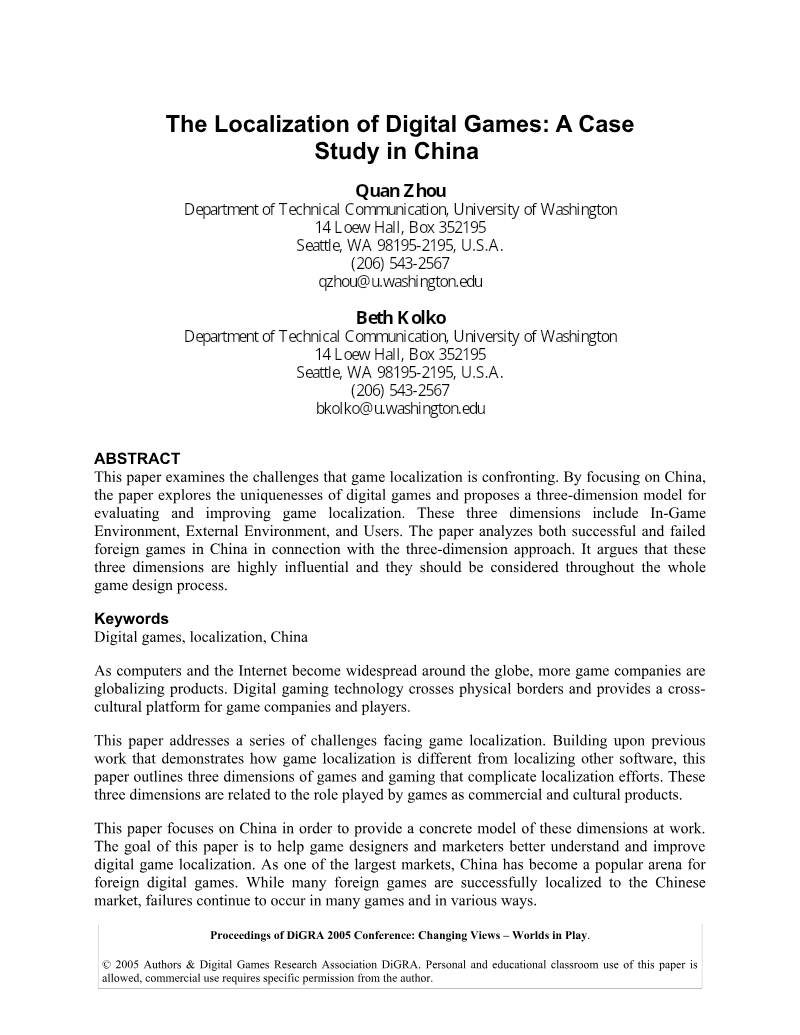
DiGRA · 2005