1 free read left. Create a free account for unlimited reading + AI research.
Create free account
Google Wants You to Make Games With Prompts
Key insights
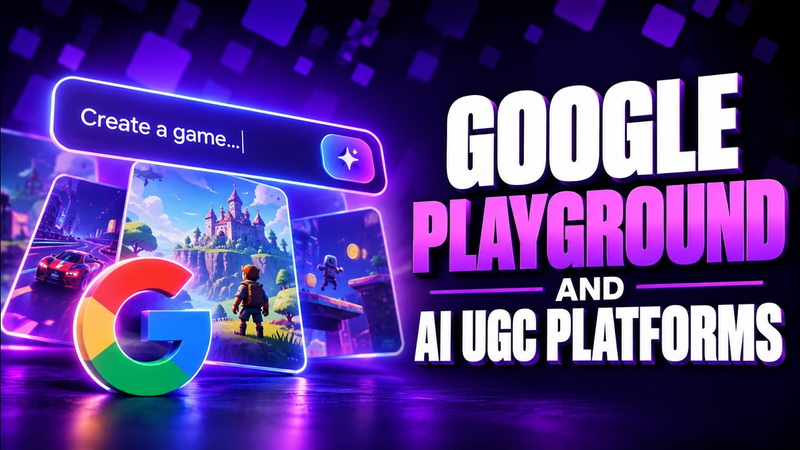
7 takeaways- 01Google launched Playground, an experimental web-based, prompt-driven game creation platform on October 7 in the US, requiring no coding, with mobile support and creation access tiered by Google One membership.
- 02Playground's planned Unity Spark partnership would add professional-level mechanics and high-fidelity 3D, though the product is still early and its marketing is seen as stronger than the platform itself.
- 03Playground's creator community is restricted to users 18 and older, which critics argue removes the platforms' most active creator base.
- 04Competing prompt-to-game platforms include Roblox Build (an alpha in New Zealand that has reportedly produced around 9,000 published games, with 71 percent of creators new to Roblox Studio), Meta's Horizon Create (launched at Meta Connect in September, with creator payouts unannounced), and Astrocade (about 5 million monthly users and 75,000 games).
- 05Speakers estimate that only 1 to 3 percent of AI-generated games are worth playing, making discovery and curation the central challenge rather than tooling.
- 06Critics argue these platforms have a backwards business model because none yet offers developers a way to earn money, while Roblox already pays creators through DevEx.
- 07Google's gaming track record is viewed skeptically, with Stadia cited as a notable failure, and Facebook's VR efforts are said to have damaged developer trust.
Ask AI about this video
Transcript
[music]
All right, let's go on to our next AI story which was announced today as we record on Wednesday, October 7th. So the guys haven't had a really a chance to play with anything. Uh Google launches Playground an experimental prompt-based gaming platform where players can create custom games in minutes. No coding required. They also announced a partnership with Unity. Unity Spark integration coming soon. So not in there right when this comes out. So here's a little bit more about this. Creators type what they want then change physics, rules, characters, and environments by prompt. No coding required. Finished games can stay private. They can go out by link or get published to the explore gallery with leaderboards, creator follows, and multiplayer in select genres. This even is like prompt to multiplayer. Coming soon, Unity Spark adds professional-level mechanics, high-fidelity 3D, and Unity runtime. Unity Spark games will be playable
inside of Playgrounds. The Playground platform is web-based and you can do it mobile and mobile web. Playground launched today, October 7th, in the US for users 18 and older with creation access tiered by Google One membership. So here's my take. The race to the AI UGC platforms is really heating up. So let's talk a little bit about some news we didn't get to the last couple of weeks. Roblox puts prompt creation inside of an audience of 132 million DAU and creators there can already earn through DevEx. Roblox build is a tab in the Roblox app that turns text prompts into playable games and it's launched in Alpha New Zealand in July. I think it's rolling out to some other countries like I don't know, Serbia, Singapore, and they have some early stats that like 9,000 games have been published. 71% of creators are new to the Roblox studio saying that hey this is unlocking the
ability for creators to come in and then last week at Meta Connect on the 24th of September Meta launched Horizon Create an app that turns text prompts into playable 2D and 3D games games published straight to Facebook Instagram and Horizon. With no app store and creator payout terms remain unannounced on that platform. So this is also reminiscent there's like another web-based platform I've seen called Astrocade a prompt to game startup that's actually backed by Google AI's future fund reported 5 million monthly users 75,000 games in May of 26 per Pocket Gamer and Fortune. So when you think of these kinds of platforms on the pro side it's absolutely amazing that you can unlock your creativity you can make a game just by talking to a machine. You'll get a lot of people feeling like they can enter the world of gaming that you know I don't have to be a coder I don't have to be an artist I can just make something up. And you know while being however it's maybe not appropriate for kids since you have to technically be 18 to do it I'm sure
they'll fix they'll figure that out soon. On the other hand the challenge with UGC platforms is you know only about 1 to 3% of the games are actually worth your time. Most of this is going to be AI slop or sloppy games just that's true of any creator platform even YouTube even Tik Tok. So the real challenge is going to be discovery and curation of these things. Not to mention the business model and sharing creators creators are benefiting from their work it looks like Horizon and and this Google playground haven't yet announced how creators will benefit. I do see the word experimental everywhere which is a tech company way of saying that they're early on and we're going to change things and we might not know everything. So Chris wanted to get your thoughts especially on the Unity piece it feels like Unity wanted to be involved in this since it got hit really hard when Google Labs announced project Genie a few months ago and all of the game engines took a hit. It looks like they're getting ahead of it by being involved it which is probably a really good idea.
So, what what are you seeing?
Well, first of all, I mean, this business model for this this back to the Google thing is completely ass-backwards, right? Like Roblox creators are are earning money through developing games, right? This is like you have to pay for the privilege of making games on Google. So, that doesn't make sense. And there's no mechanism by which developers can make any money. So, this is a UEFN problem. Like at least UEFN problem had a model, right? But it sucked, right? Clearly, but anyway, I don't understand.
Well, they have a free tier so that so you can get free credits to play and then you unlock like unlimited credits if you're in the the system. But yes, right? But Horizon create you don't make money either yet. It's just like make it for fun.
I know our friends at Google probably not going to hear this. But the this is not the way you make a platform. Like this is just not the way you do it.
Yeah.
Period. You know, it's like it's beautiful. It's great. Okay, the second point is that 18+ I know it eliminates
all these problems with COPPA but or COPPA whatever you call that but like that's where all the creators are.
[laughter]
I mean, like they're the ones that are building all this [ __ ] you know? It's like okay, you're just eliminating your entire [ __ ] creator audience by just right from the get-go, right? The Unity thing, look, you know, they're they're participating but Unity it's all about [ __ ] ad tech, right? All this Unity is just [ __ ] noise in the background like doesn't mean [ __ ] They don't make any money. Like if they had pivoted and tried to create a platform like this like 10 years ago when John Riccitiello took over, we'd be having a different conversation on Unity, right? But they are not an engine company really, right? They are the de facto engine company, which is a [ __ ] commodity, and they're building ad tech on top of it, right? And the it's all about the ad tech. If that does well, Unity does well. And the final thing, and I'm going to repeat this 1,000 [ __ ] times about
Google and anybody that supports what the [ __ ] they're doing, everything is experimental at Google. Everything. They have [ __ ] done a gazillion things in gaming that have gone [ __ ] nowhere, including spending hundreds and hundreds and hundreds and hundreds of million dollars on this [ __ ] streaming platform that never had a chance of being successful.
What was that called?
I don't even care. I'm not even going to give it names. Stadia, right?
[laughter]
He who will not be named, Stadia.
Yeah, exactly. So, it's like every gaming initiative has failed at at Google, and I've said this a million times before. So, pro creators will not invest the time into doing this. And then you look at Facebook, which has the same problem. Like, anybody that spent a nickel on VR, besides the ones that were acquired by Facebook, I guess, are just [ __ ] licking their wounds, right? They're like they got destroyed, right? And now you're going to have a bunch of people making [ __ ] for Horizon? Like, come on. Like, you guys have once bitten, twice
shy. You've already damaged that relationship. There's no trust there, you know? And so, I think it's a tough tough hill to climb, generally speaking.
Oh. I have a funny story about Google Stadia. I I remember that. I don't remember what I exactly was doing with Google at one of their offices, maybe a speech, maybe a workshop, whatever it was. Google is super nice, the people are nicest. They give you the gift back. And when I was giving me the gift back, he was like, "Would you like to have a Stadia?" And I was like, "Nah, I'm good." And he was like, "Yeah, makes sense."
[laughter]
So, so what I want to say is none of this is a people problem. The people at Google are the nicest, the smartest, and you know, all the compliments. I think this is an organization problem because this is the classic way corporation launches a product. You go like the product team makes a presentation, they go into a boardroom, then you know, executives agree, then legal comes in and they neuter us the product fully like in this case not under 18 year old because like, you know, legal went in,
too much of a risk, so not that. Okay, we don't want any, you know, raunchy games, that's bad for our image. Then marketing comes in and that kind of creates sort of like a generic marketing campaign around it and then comes comes in and tells a story that is kind of about the original product but not really what they're delivering and in the end it the product they probably wanted to make is not exactly the product that comes out and even if it's a miss, even if they lose hundreds of millions of dollars, who cares? Google has infinite money. But nevertheless, like I'm really confused of like why these projects are popping up, whether it's meta, whether it's Google or somebody else because there are tons of engines in development. There's all these startups that are being funded with their AI engine. Some of them have been on the podcast. Open AI made a big push on their gaming engine with Astra and Soned by Claude is actually even better than Astra, at least when I'm talking to game developers and working with the clients. Yeah, Opus, sorry, Opus is even better. Always forget Claude names, they're too difficult. But but that is that is
already better than something that is dedicated to it. So I'm just confused of like why do we need these engines? What are we doing with these platforms? I know the distribution is a problem but you don't solve distribution by creating a walled garden with nobody in it. Like it's confusing.
Sorry, that's the other point I forgot to put on here is it's it's still a distribution problem, right? You still need an audience, right? You can't just [ __ ] create an audience from scratch. I mean, at least like Facebook has like tons of distribution capabilities across the social media but that doesn't necessarily translate to interactive. I really. And Google's nowhere, right?
Yeah.
Yeah, and they look at their audience, where the audience goes. It's like it's not like they can just move the audience. It What what makes sense to them as a company?
Yeah, I think people assume that because Google's everywhere, that Google can be everywhere. You know what I mean? Like the fact that that everyone has a phone, that means that Apple can be a gaming platform. It just It doesn't work that way, right? It's like Yeah, anyway. And nevertheless, it is.
I want to defend marketing on this one
cuz you said marketing makes it feel generic. I actually think it's reverse in this instance where if you watch the trailer that they released, the trailer is fantastic. Like it really highlights this ability for anyone to come up with an idea for a game and make it come true. And it's like this aspirational, you know, vision of what this is. And then the product itself, you know, it maybe it's not It's experimental, right? Like this thing Have you ever tried to make anything with AI and how many prompts it takes for you to actually get something to do what it wants you to do. It takes forever. And so I actually think the marketing is is ahead of probably where the product is at this moment in time for all of these platforms. I think people are going off of the UGC is awesome. How do we complete with compete with Roblox? How do we give the tool democratize game development? You know, like all of these like, you know, aspirational things that people say, but you know, ultimately
players don't want to play other people's [ __ ] They want to play really good games.
Yeah.
That's what I struggle with with last year.
different. But I mean Roblox is or Steam games like where you have in the Well, people want to play these games from from other creators. Like it is very creator specific. Like people actually fanboy the creators and follow them. Yeah, children all the people. Uh and then the same thing with the Steam like you have these individual But anyways, like I'm I'm just confused like why do we need this? Like I don't understand. Like we have so many of these giant technology companies and like it's not I don't like who's who's out here like I just want to make a game and I don't have any tools.
I want to be clear. I am actually not against this idea in concept at all because I think there is a notion that interactive Tik Tok could be really interesting, right? Like if you build interactive experiences that are really like easy to play and fun and some figure out how to monetize that. Like I I think that's whether it's advertising or other ways there's there's lots of ways of skinning
this cat, right? To some degree. It's just and the marketing I'm not even actually saying the marketing the the visuals on this thing are amazing. Like everything they're doing is good, right? And the problem is they have no follow through, right? They're not actually building a platform. They're just building tech, you know, and they're just throwing it out there. Right? For gazillions of dollars, you know, that's different. It's completely different than making a platform. Like, you know, Roblox took [ __ ] 20 years before they were making money, right? Like Dude, it took them for and sorry to say that this not a Roblox rant, but like it took them forever and then they're building games that are like stealing [ __ ] from kids, right? That that's what's making money, right? That's crazy. Like it took them 20 years to come up with that [ __ ] right?
But they're not building they're not building that.
No, they are. They do they are they are not building it, but they are supporting that [ __ ] right? Because that's the only thing that made money on the platform, right? And so like anyway, that's where they got after 20 years. People can do better, right? I I'm hoping that people can do better and AI should help enable that, but you need to
build a platform. You just can't build tools and tech and hope that oh, let's let's make this thing work, right? Even if the tools and tech work, right? So anyway, I don't
I mean, we didn't even get into like the legal aspect of this is like can you type in an IP and is Mario now inside, you know, one of these games? Um you know, we we call it TTP, time to penis. Like how how quickly is some kid going to like
Time to what? Time to what?
time to penis? How quickly will a will you or a 10-year-old a 10-year-old boy put a penis inside of a video game? This is from the great Mythic Quest show. Exactly. Well, my my point is you are all 10-year-old boys at heart who who want to do that. So, [laughter] there have to be safety constraints, and I think they announced that there's safety constraints, and I know you can kind of like white label or black label certain things. It has a little bit of a challenge in the US, not as much in the East or other countries, and will this be a positive
for people? Will it keep people from learning how to code? I mean, I guess no one's going to code in 10 years anyway, cuz you're just going to prompt everything. It's your fault, by the way, now that I'm going to say it. You remember Peter Molyneux when he did this game in 2012 that was called Curiosity, What's Inside the Cube?
No.
What was inside the cube? You didn't You remember? So, he made this box game, the cube game, and then and it was like really interesting. Peter Molyneux has great ideas, but inside the cube, because it was very UGC, there was a PP, as always, cuz people got to draw.
[laughter]
Aw, of course there is. Of course there is, cuz yes.
Yeah, people got to draw things, and what did they draw?
A PP. Yeah, yeah. We're all
Welcome to the box.
Welcome to even the room. Oh my god, it reminds me of the [clears throat] the room, which was a great Okay, so that Thank you for that AI chat. Let's talk about your other favorite topic, which is investing. Mishka, take this one.
You did it. You made it to the end of the episode. As a fan of the show, it
would help us out if you'd subscribe and leave us a review on the podcast service of your choice. Those stars and likes will help
Summary
Google has launched Playground, an experimental prompt-based gaming platform that lets creators build custom games by typing descriptions, with no coding required. Creators can adjust physics, rules, characters, and environments through prompts, keep games private or share them by link, or publish them to an explore gallery with leaderboards, creator follows, and multiplayer in select genres. A partnership with Unity, called Unity Spark, is planned to add professional-level mechanics and high-fidelity 3D. Playground launched October 7 in the US for users 18 and older, with creation access tiered by Google One membership, and the platform is web-based with mobile support.
The discussion places Playground within a crowded field of AI user-generated content platforms. Roblox Build, an alpha feature in New Zealand, has reportedly produced around 9,000 published games, with 71 percent of creators new to Roblox Studio, and Roblox already pays creators through DevEx. Meta's Horizon Create, launched at Meta Connect in September, turns prompts into 2D and 3D games published to Facebook, Instagram, and Horizon, with creator payouts still unannounced. Astrocade, a prompt-to-game startup backed by Google AI's Future Fund, reportedly has about 5 million monthly users and 75,000 games. The speakers estimate that only 1 to 3 percent of such games are worth playing, making discovery and curation the central challenge.
Critics argue the business model is backwards, since none of these platforms yet offers developers a way to earn money, and excluding under-18s removes the platforms' most active creator base. They also contend that Google has a long record of gaming initiatives that failed, most notably Stadia, and that Facebook's VR efforts have damaged trust among developers. Several speakers suggest that organizational processes, with legal and marketing constraints, dilute products, and they question why so many engine and tool projects are emerging when distribution, not tooling, is the real barrier. Others note that the marketing for these platforms is strong, though the product is still early, and that interactive short-form experiences could still be promising if a platform and monetization model are built around them.



















Comments