Updated Jun 10, 2026 by Tencent
Financial
Published by Tencent
Tencent Holdings Limited delivered a robust fiscal year in 2010, reporting consolidated revenue of RMB 19.65 billion—an increase of nearly 58% over 2009—and net profit attributable to equity holders of RMB 8.05 billion, up 56% year‑on‑year. Growth was driven primarily by the online gaming segment, which generated RMB 15.48 billion in revenue (up 62%) and by a rapidly expanding user base, with instant‑messaging accounts reaching 647.6 million and Qzone users at 492 million. Mobile services, value‑added telecom offerings, and advertising also contributed to the revenue mix, while operating margins improved to 50% of earnings. Liquidity and capital structure remained strong. Total financial resources rose to RMB 22.1 billion, with cash and equivalents at RMB 10.4 billion and net financial resources of RMB 17.8 billion after short‑term borrowings. Capital expenditures doubled to RMB 2.01 billion, reflecting investment in infrastructure and new platforms. Share‑based compensation was significant; the company granted 4.85 million award shares in 2010, with no director awards, and maintained a share‑option pool of roughly 43 million shares. Governance structures were reinforced through independent remuneration, audit, and investment committees, and the board maintained a majority of non‑executive directors. Financial risk exposure was dominated by foreign‑exchange and interest‑rate sensitivities, with a 5 % currency swing estimated to affect profit by RMB 83 million. The gearing ratio increased from 30% to 39%, driven largely by bank borrowings, while fair‑value assets—primarily equity securities—remained level 2 instruments. Overall, Tencent’s 2010 performance underscored its ability to scale user engagement and diversify revenue streams while maintaining solid liquidity, disciplined capital allocation, and robust governance practices.
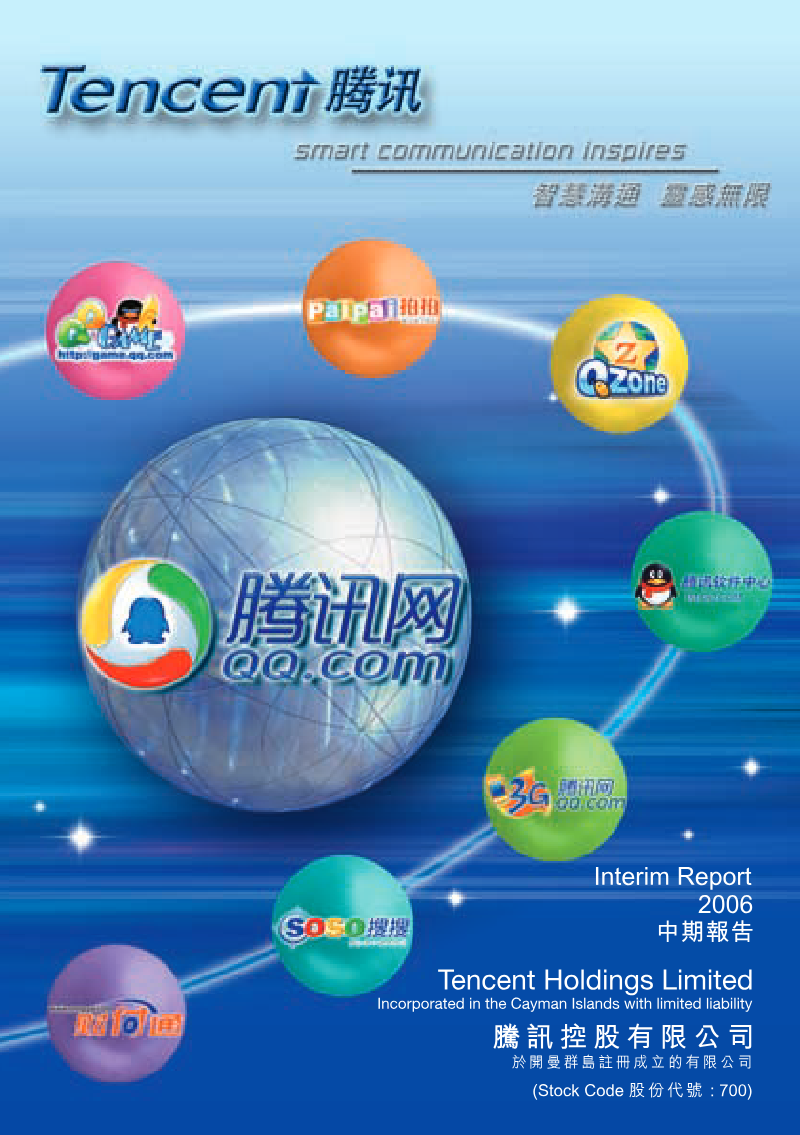
Tencent ifl Tencent Holdings Limited Incorporated in the Cayman Islands with limited liability 騰訊控股有限公司 於開曼群島註冊成立的有限公司 (Stock Code 股份代號 : 700) QQ.com ANNUAL REPORT 2010 smart communication inspires
Annual Report 2010 Contents 2 Corporate Information 3 Financial Summary 4 Chairman’s Statement 12 Management Discussion and Analysis 24 Directors’ Report 47 Corporate Governance Report 62 Independent Auditor’s Report 64 Consolidated Statement of Financial Position 67 Statement of Financial Position 69 Consolidated Income Statement 71 Consolidated Statement of Comprehensive Income 72 Consolidated Statement of Changes in Equity 74 Consolidated Statement of Cash Flows 76 Notes to the Consolidated Financial Statements 190 Definitions
Annual Report 2010 Corporate Information DIRECTORS AUDITOR CAYMAN ISLANDS PRINCIPAL Executive Directors PricewaterhouseCoopers SHARE REGISTRAR Ma Huateng (Chairman) Certified Public Accountants AND TRANSFER OFFICE Lau Chi Ping Martin Butterfield Fulcrum Group (Cayman) Zhang Zhidong PRINCIPAL BANKER Limited Butterfield House Non-Executive Directors The Hongkong and Shanghai Banking 68 Fort Street, P.O. Box 609 Corporation Limited Grand Cayman KY1-1107 Antonie Andries Roux REGISTERED OFFICE Cayman Islands Charles St Leger Searle Cricket Square HONG KONG BRANCH Independent Non-Executive Hutchins Drive, P.O. Box 2681 SHARE REGISTRAR Directors Grand Cayman KY 1-1111 AND TRANSFER OFFICE Li Dong Sheng Cayman Islands Computershare Hong Kong Investor Iain Ferguson Bruce HEAD OFFICE AND PRINCIPAL Services Limited Ian Charles Stone PLACE OF BUSINESS Shops 1712-1716, 17th Floor AUDIT COMMITTEE Hopewell Centre Tencent Building 183 Queen’s Road East Iain Ferguson Bruce (Chairman) Kejizhongyi Avenue Wan Chai, Hong Kong Ian Charles Stone Hi-tech Park Charles St Leger Searle Nanshan District COMPANY WEBSITE REMUNERATION Shenzhen, 518057 www.tencent.com The PRC COMMITTEE (Chairman) PRINCIPAL PLACE OF BUSINESS STOCK CODE Antonie Andries Roux IN HONG KONG 700 Li Dong Sheng Ian Charles Stone Room 3002, 30th Floor Far East Finance Centre 16 Harcourt Road Hong Kong
Annual Report 2010 Financial Summary CONDENSED CONSOLIDATED STATEMENTS OF COMPREHENSIVE INCOME Year ended 31 December 2006 2007 2008 2009 2010 RMB’000 RMB’000 RMB’000 RMB’000 RMB’000 Revenues 2,800,441 3,820,923 7,154,544 12,439,960 19,646,031 Gross profit 1,983,379 2,703,366 4,984,123 8,550,492 13,325,831 Profit before income tax 1,116,771 1,534,503 3,104,895 6,040,731 9,913,133 Profit for the year 1,063,800 1,568,008 2,815,650 5,221,611 8,115,209 Profit attributable to equity holders of the Company 1,063,800 1,566,020 2,784,577 5,155,646 8,053,625 Total comprehensive income for the year 1,063,800 1,568,008 2,815,650 5,221,611 9,936,338 Total comprehensive income attributable to equity holders of the Company 1,063,800 1,566,020 2,784,577 5,155,646 9,874,754 CONDENSED CONSOLIDATED STATEMENTS OF FINANCIAL POSITION As at 31 December 2006 2007 2008 2009 2010 RMB’000 RMB’000 RMB’000 RMB’000 RMB’000 (Restated) Assets Non-current assets 916,138 2,090,312 3,359,696 4,348,823 10,456,373 Current assets 3,734,434 4,835,132 6,495,861 13,156,942 25,373,741 Total assets 4,650,572 6,925,444 9,855,557 17,505,765 35,830,114 Equity and liabilities Equity attributable to the Company’s equity holders 3,717,756 5,170,396 7,020,926 12,178,507 21,756,946 Non-controlling interests – 64,661 98,406 120,146 83,912 Total equity 3,717,756 5,235,057 7,119,332 12,298,653 21,840,858 Non-current liabilities 64,969 40,770 644,628 644,033 967,211 Current liabilities 867,847 1,649,617 2,091,597 4,563,079 13,022,045 Total liabilities 932,816 1,690,387 2,736,225 5,207,112 13,989,256
s – 64,661 98,406 120,146 83,912 Total equity 3,717,756 5,235,057 7,119,332 12,298,653 21,840,858 Non-current liabilities 64,969 40,770 644,628 644,033 967,211 Current liabilities 867,847 1,649,617 2,091,597 4,563,079 13,022,045 Total liabilities 932,816 1,690,387 2,736,225 5,207,112 13,989,256 Total equity and liabilities 4,650,572 6,925,444 9,855,557 17,505,765 35,830,114
Annual Report 2010 I am pleased to present our annual report for the year ended 31 December 2010 to the shareholders. RESULTS The Group’s audited profit attributable to equity holders of the Company for the year ended 31 December 2010 was RMB8,053.6 million, an increase of 56.2% compared with the results for the previous year. Basic and diluted earnings per share for the year ended 31 December 2010 were RMB4.432 and RMB4.328 respectively. BUSINESS REVIEW AND OUTLOOK 2010 witnessed another year of steady development in the Internet market in China. According to the CNNIC, the total number of Internet users increased by 19.1% on a year-on-year basis to 457.3 million at the end of 2010, compared to a growth rate of 28.9% in the previous year. Internet penetration increased to 34.3%, exceeding global average for the first time. Although the growth of China’s Internet user base has been slowing down as its scale continues to increase, the Internet has increasingly become an integral part of people’s everyday life as users spend more time online. We expect future growth of the industry to be increasingly driven by rising level of Internet usage by users and businesses, as opposed to user growth. In addition, advertising and e-commerce will become more important business models for the industry, in addition to revenue generated from users. The industry witnessed several significant developments during 2010. First of
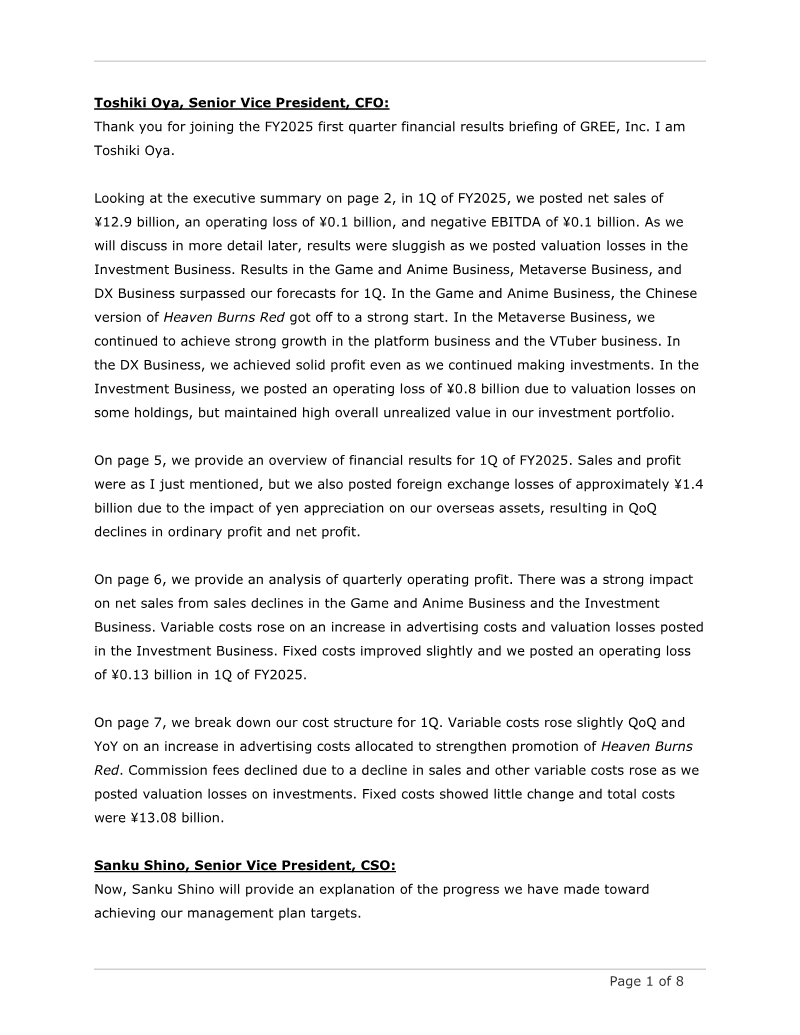
The briefing presents FY2025 first‑quarter results for GREE, Inc., highlighting a net sales figure of ¥12.9 billion and an operating loss of ¥0.1 billion, largely driven by valuation losses in the Investment Business and foreign‑exchange impacts from yen appreciation. While Game and Anime, Metaverse, and DX segments exceeded forecasts—thanks to strong performance of the Chinese version of *Heaven Burns Red*, continued growth in platform and VTuber services, and solid DX profitability—the Investment Business posted a ¥0.8 billion operating loss due to crypto‑asset valuation declines and write‑downs on maturing funds. Variable costs rose from advertising spend and investment losses, whereas fixed costs remained relatively stable. Geographically, the company operates globally with significant overseas assets; the report notes a ¥1.4 billion FX loss affecting ordinary and net profit. The management plan positions Metaverse and DX as continuous‑growth businesses targeting a 120–140 % CAGR in operating profit, while Game and Anime are treated as long‑term investment assets. Medium‑term targets emphasize aggressive investment in VTuber talent and DX product development, with expectations of profitability from the VTuber segment by FY2026 and accelerated growth in DX by FY2027. Methodologically, the briefing relies on quarterly financial statements, segment‑level performance data, and investment portfolio valuations. The Investment Business’s dual GP/LP structure is explained to contextualize volatility, with an emphasis on long‑term stability despite short‑term losses. Overall, the company projects FY2025 results in line with prior forecasts but anticipates slightly lower Game and Anime sales, offset by higher operating profit from continuous‑growth segments.
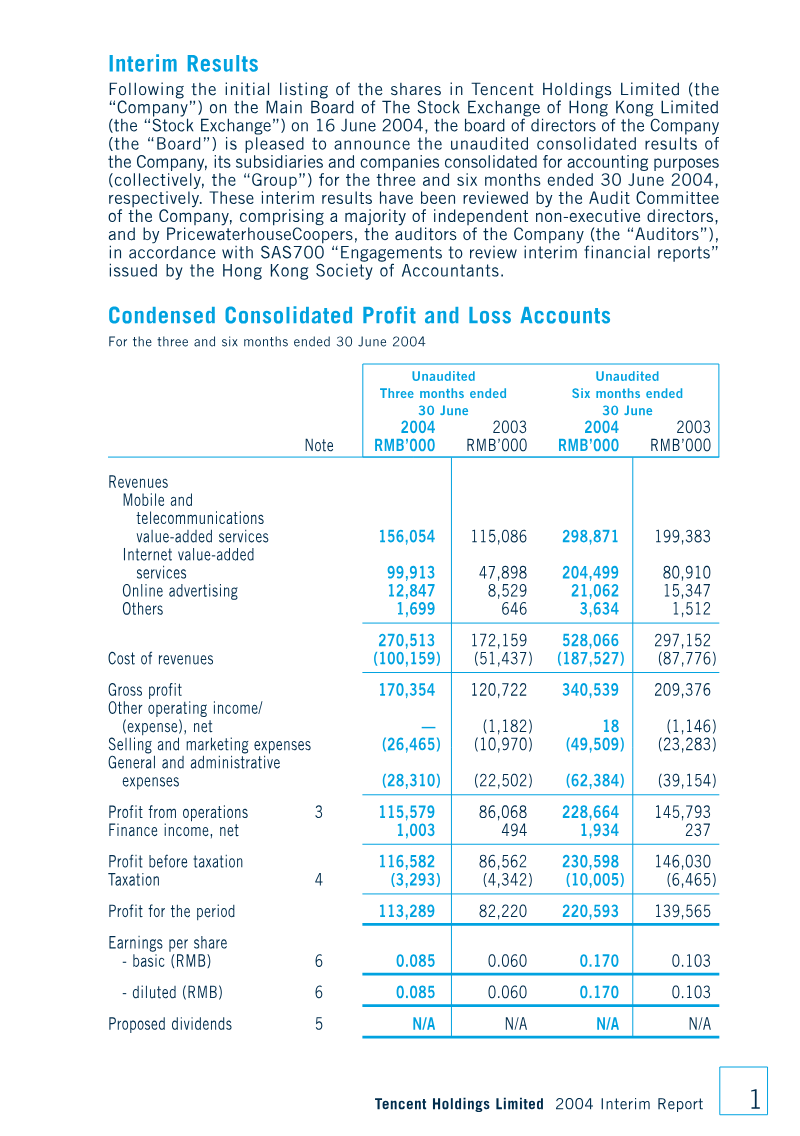
Tencent Holdings Limited demonstrated robust financial expansion during the first half of 2008, characterized by an 84.8% year-over-year revenue increase to RMB 3.03 billion. This growth was underpinned by a significant rise in active user accounts, which reached 341.9 million by mid-year. Profit for the period climbed to RMB 1.19 billion, reflecting a strong 40.8% profit margin. The company’s performance was primarily driven by the scaling of internet value-added services, particularly online gaming and community platforms, alongside sustained growth in mobile telecommunications and online advertising. Operational scaling necessitated increased investment in human capital and infrastructure, leading to higher employee benefit costs and research and development expenditures. The workforce expanded to 5,168 employees, with total remuneration costs reaching RMB 593.6 million. Despite these rising operational expenses and the transition to a unified 25% PRC enterprise income tax rate, the company maintained a solid balance sheet with total assets of RMB 8.20 billion and a stable gearing ratio of 24%. Strategic initiatives during this period included the acquisition of mobile value-added service providers and equity interests in various international and domestic gaming entities, further diversifying the company's portfolio. The company navigated a complex macroeconomic environment, including the appreciation of the RMB against the USD and HKD, which resulted in exchange losses, and potential headwinds from a slowing Chinese economy. Governance remained stable, with MIH China (BVI) Limited serving as the largest shareholder at 35.08%. Through a combination of share repurchases and a share award scheme, the company continued to manage its capital structure and incentivize staff, ensuring alignment with long-term growth objectives while adhering to International Accounting Standard 34.
Tencent demonstrated robust financial health and operational expansion during the first half of 2005, characterized by a strategic pivot toward Internet value-added services. Total revenues reached RMB 634.1 million, representing a 20.1% year-over-year increase, while net profit for the period climbed to RMB 283.9 million. This profitability was bolstered by a significant one-time deferred tax credit of RMB 88.6 million and a 92.8% quarter-over-quarter profit surge in the second quarter. These gains effectively offset a decline in mobile and telecommunications value-added services, which faced headwinds from regulatory shifts and billing adjustments. The company’s growth was underpinned by massive user engagement, with registered instant messaging accounts reaching 438.4 million and peak simultaneous online users hitting 16.2 million. To support this scale, the organization doubled its workforce to 1,648 employees, leading to a corresponding doubling of remuneration costs to RMB 134 million. Increased investments in research and development and new product launches remained central to the company’s strategy, even as operating expenses rose. The financial reporting for this period marked a transition to International Financial Reporting Standards, specifically adopting IFRS 2 to account for share-based compensation via the Black-Scholes model. Geographically focused on the Chinese market, the company navigated a changing macroeconomic landscape, including the decoupling of the RMB from the USD in July 2005, which introduced new foreign exchange risks. Corporate governance remained stable, with MIH QQ (BVI) Limited maintaining its position as the largest shareholder. Although the company deviated from standard governance practices by unifying the Chairman and CEO roles, the board maintained that this structure was essential for maintaining agility and operational stability within the rapidly evolving information technology sector.
Giant Network’s 2025 annual report demonstrates a robust year‑over‑year performance, with total revenue escalating 72.7 % to ¥5.05 billion and net profit attributable to shareholders rising 23.1 % to ¥1.76 billion. Operating cash flow surged by 188.6 %, underscoring strong liquidity generation. The company’s dual‑core strategy—leveraging the MMORPG IP “征途” and the casual title “超自然行动组”—drives growth, supported by AI‑enabled development and cross‑platform expansion. Despite these gains, recent non‑recurring losses have yet to turn positive, creating some uncertainty about long‑term profitability. Regulatory developments in China have accelerated a focus on original IP and digital‑culture products. Government policies encourage embedding traditional culture into game design, boosting AI and cloud R&D, and expanding overseas digital content. Giant Network aligns with these directives through a research‑and‑operations model, heavy IP investment, and compliance tightening under new child‑online‑protection rules. Financially, operating profit rose 54 % to ¥829 million, while net profit increased 93 % to ¥947 million, largely due to higher investment income and lower tax expense. R&D spending more than doubled, reflecting intensified product development. Other comprehensive income swung from a positive ¥219 million to a negative ¥220 million, driven by fair‑value changes and credit impairment losses. The group maintained a conservative asset‑liability ratio, rising from 12.76 % to 18.67 %, and retained over 80 % voting control through founder‑controlled entities. Key findings highlight that core gaming revenue remains strong, investment income is mixed, and non‑recurring items significantly impact overall profitability. The report covers China exclusively, focusing on the 2025 fiscal year and encompassing gaming operations, IP development, regulatory compliance, and financial risk management.