Updated Apr 30, 2026 by Tencent
Tencent demonstrated robust financial health and operational expansion during the first half of 2005, characterized by a strategic pivot toward Internet value-added services. Total revenues reached RMB 634.1 million, representing a 20.1% year-over-year increase, while net profit for the period climbed to RMB 283.9 million. This profitability was bolstered by a significant one-time deferred tax credit of RMB 88.6 million and a 92.8% quarter-over-quarter profit surge in the second quarter. These gains effectively offset a decline in mobile and telecommunications value-added services, which faced headwinds from regulatory shifts and billing adjustments. The company’s growth was underpinned by massive user engagement, with registered instant messaging accounts reaching 438.4 million and peak simultaneous online users hitting 16.2 million. To support this scale, the organization doubled its workforce to 1,648 employees, leading to a corresponding doubling of remuneration costs to RMB 134 million. Increased investments in research and development and new product launches remained central to the company’s strategy, even as operating expenses rose. The financial reporting for this period marked a transition to International Financial Reporting Standards, specifically adopting IFRS 2 to account for share-based compensation via the Black-Scholes model. Geographically focused on the Chinese market, the company navigated a changing macroeconomic landscape, including the decoupling of the RMB from the USD in July 2005, which introduced new foreign exchange risks. Corporate governance remained stable, with MIH QQ (BVI) Limited maintaining its position as the largest shareholder. Although the company deviated from standard governance practices by unifying the Chairman and CEO roles, the board maintained that this structure was essential for maintaining agility and operational stability within the rapidly evolving information technology sector.
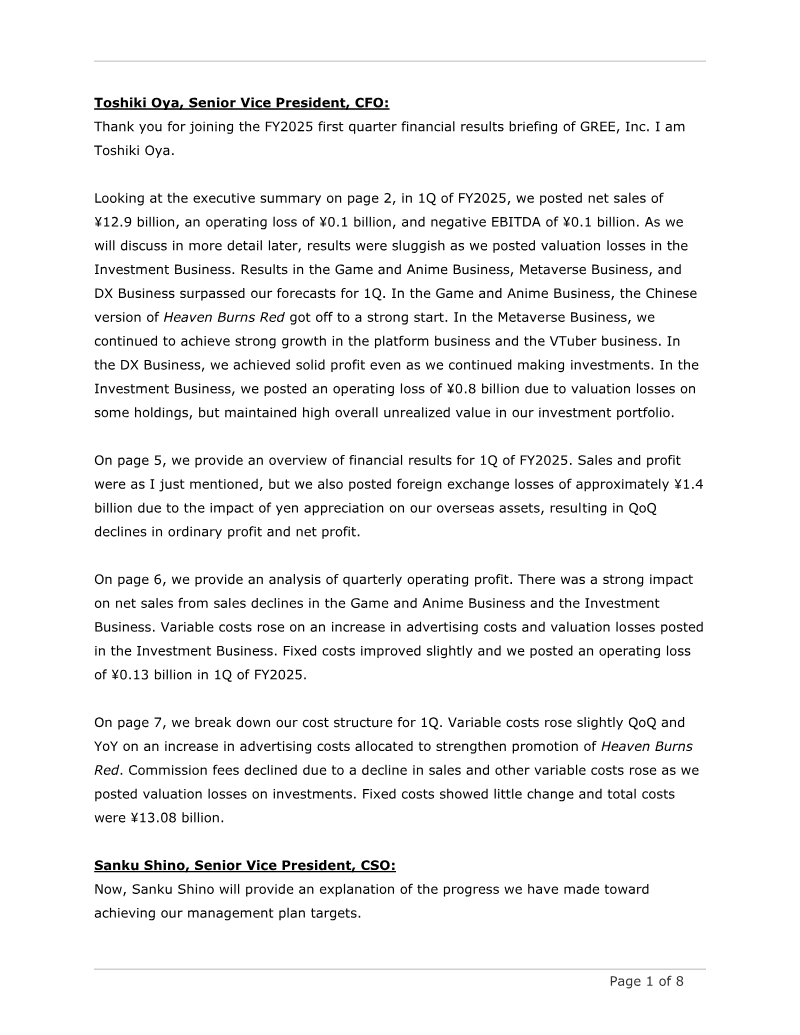
The briefing presents FY2025 first‑quarter results for GREE, Inc., highlighting a net sales figure of ¥12.9 billion and an operating loss of ¥0.1 billion, largely driven by valuation losses in the Investment Business and foreign‑exchange impacts from yen appreciation. While Game and Anime, Metaverse, and DX segments exceeded forecasts—thanks to strong performance of the Chinese version of *Heaven Burns Red*, continued growth in platform and VTuber services, and solid DX profitability—the Investment Business posted a ¥0.8 billion operating loss due to crypto‑asset valuation declines and write‑downs on maturing funds. Variable costs rose from advertising spend and investment losses, whereas fixed costs remained relatively stable. Geographically, the company operates globally with significant overseas assets; the report notes a ¥1.4 billion FX loss affecting ordinary and net profit. The management plan positions Metaverse and DX as continuous‑growth businesses targeting a 120–140 % CAGR in operating profit, while Game and Anime are treated as long‑term investment assets. Medium‑term targets emphasize aggressive investment in VTuber talent and DX product development, with expectations of profitability from the VTuber segment by FY2026 and accelerated growth in DX by FY2027. Methodologically, the briefing relies on quarterly financial statements, segment‑level performance data, and investment portfolio valuations. The Investment Business’s dual GP/LP structure is explained to contextualize volatility, with an emphasis on long‑term stability despite short‑term losses. Overall, the company projects FY2025 results in line with prior forecasts but anticipates slightly lower Game and Anime sales, offset by higher operating profit from continuous‑growth segments.
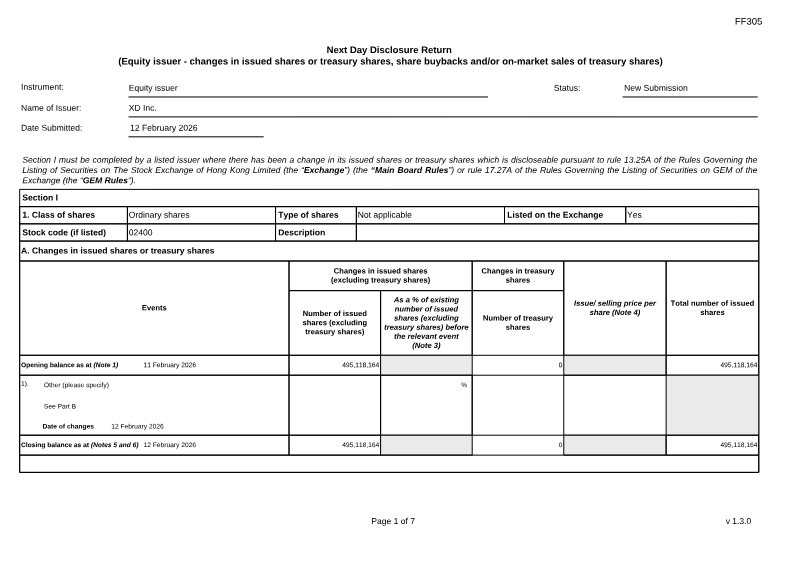
This Next Day Disclosure Return, submitted to the Stock Exchange of Hong Kong on 12 February 2026, details the share repurchase activities of XD Inc. (Stock Code: 02400). The primary purpose of the filing is to disclose changes in issued or treasury shares in compliance with Main Board Rule 13.25A. As of the submission date, the company maintained a total of 495,118,164 issued ordinary shares, with no shares held in treasury. The data reveals a consistent pattern of share buybacks conducted on the Exchange between 13 January 2026 and 12 February 2026. During this period, the company executed 21 separate repurchase transactions. On the final reporting date of 12 February 2026, XD Inc. repurchased 24,000 shares at prices ranging from HKD 78.75 to HKD 81.65, resulting in an aggregate daily expenditure of HKD 1,923,420. All shares acquired during this window are designated for cancellation but had not yet been cancelled as of the closing balance date. Under the repurchase mandate authorized on 29 May 2025, which allows for the buyback of up to 49,167,523 shares, the company has repurchased a cumulative total of 447,600 shares to date. This represents approximately 0.091% of the issued shares at the time the mandate was granted. Consequently, the company is subject to a moratorium period for the issuance of new shares or the transfer of treasury shares lasting until 14 March 2026. The filing was formally submitted by Executive Director Huang Yimeng, confirming that all transactions adhered to the Exchange's regulatory requirements.
Sea Limited’s third-quarter 2024 financial results demonstrate a strategic return to high growth across its core business segments while simultaneously improving overall profitability. The company reported a significant turnaround in consolidated performance, swinging from a GAAP operating loss of $127.7 million in the third quarter of 2023 to an operating income of $202.4 million in the same period of 2024. Total adjusted EBITDA rose dramatically from $35.3 million to $521.3 million year-over-year, supported by a robust cash position of $9.9 billion. The e-commerce segment, Shopee, achieved a pivotal milestone by reaching positive adjusted EBITDA in both its Asian markets and Brazil. GAAP revenue for the segment grew 42.6% year-over-year to $3.2 billion, driven by improved monetization through higher commission take rates and a 25% increase in ad-paying revenue per seller. Operational efficiencies also improved, with half of SPX Express orders in Asia delivered within two days and a reduction in cost per order. Digital Financial Services saw a 38% increase in GAAP revenue, reaching $615.7 million. The segment’s loan book expanded significantly, with principal outstanding growing over 70% year-over-year to $4.6 billion, while maintaining a stable risk profile with a non-performing loan ratio of 1.2%. Growth was particularly strong in the off-Shopee lending sector in Indonesia, which now accounts for over 50% of the local loan book. In Digital Entertainment, Garena’s performance was bolstered by the continued strength of Free Fire, which saw a 25% year-over-year increase in daily active users. Segment bookings rose 24.3% to $556.5 million, leading the company to raise its full-year 2024 bookings growth guidance for Free Fire to over 30%. The segment remains a primary profit driver, contributing $314.4 million in adjusted EBITDA for the quarter. These results reflect Sea’s successful integration of content ecosystems, logistics improvements, and credit expansion across Southeast Asia, Latin America, and other global markets.