Updated Jun 10, 2026 by Tencent
Financial
Published by Tencent
Tencent Holdings reported a robust 2005 performance, with revenue rising 24.7 % to RMB1.426 billion driven by a 79.2 % increase in Internet value‑added services and a 105.9 % jump in online advertising, while mobile‑telecom services declined 19.3 %. Net profit climbed 10 % to RMB485 million, yielding earnings per share of RMB0.274 (basic) and RMB0.267 (diluted). The QQ instant‑messaging platform expanded to over 200 million active users, and new services such as Qzone, QQ Pet, and the MMOG QQ Fantasy contributed to revenue growth. Operating profit margin improved modestly to 33.8 % in Q4, though full‑year operating profit increased only 3.3 % due to higher selling, marketing and general administrative costs. Financially, the group’s assets grew from RMB2.863 billion to RMB3.427 billion, largely through increases in cash and held‑to‑maturity investments. R&D expenditure surged to RMB162.5 million, while employee‑benefit costs more than doubled to RMB344.5 million. A net tax benefit of RMB48.3 million offset a modest tax expense, reflecting favorable Chinese enterprise income‑tax incentives. The company recorded a foreign‑exchange loss of RMB47 million on U.S. dollar investments, and no dividends were paid to equity holders during the year. Governance structures remained transparent: a balanced board of five directors, independent audit and remuneration committees, and compliance with Hong Kong listing rules (except for the chairman/CEO dual role). Share‑option schemes were detailed, allowing up to 40.5 million shares post‑IPO with a ten‑year life and board‑determined vesting periods. No material conflicts of interest or significant director‑held contracts were disclosed. The report covered IFRS adoption, noting minimal impact from revised standards; IAS 39 reclassified certain financial assets to fair value, IFRS 2 introduced share‑based compensation charges, and IAS 38 governed goodwill from acquisitions. Accounting policies for financial instruments, derivatives, inventory, receivables, and employee benefits were outlined, ensuring consistency with IFRS. Overall, Tencent’s 2005 results demonstrate strong growth in core internet services, disciplined financial management, and robust corporate governance within the Chinese market.
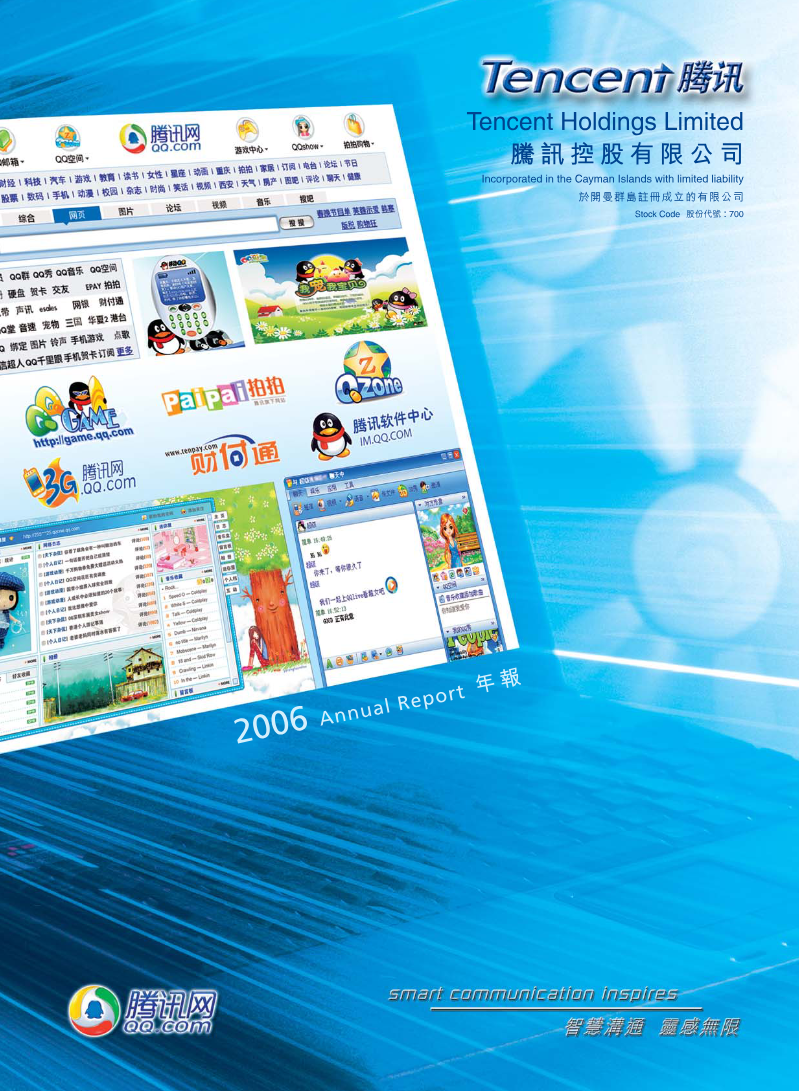
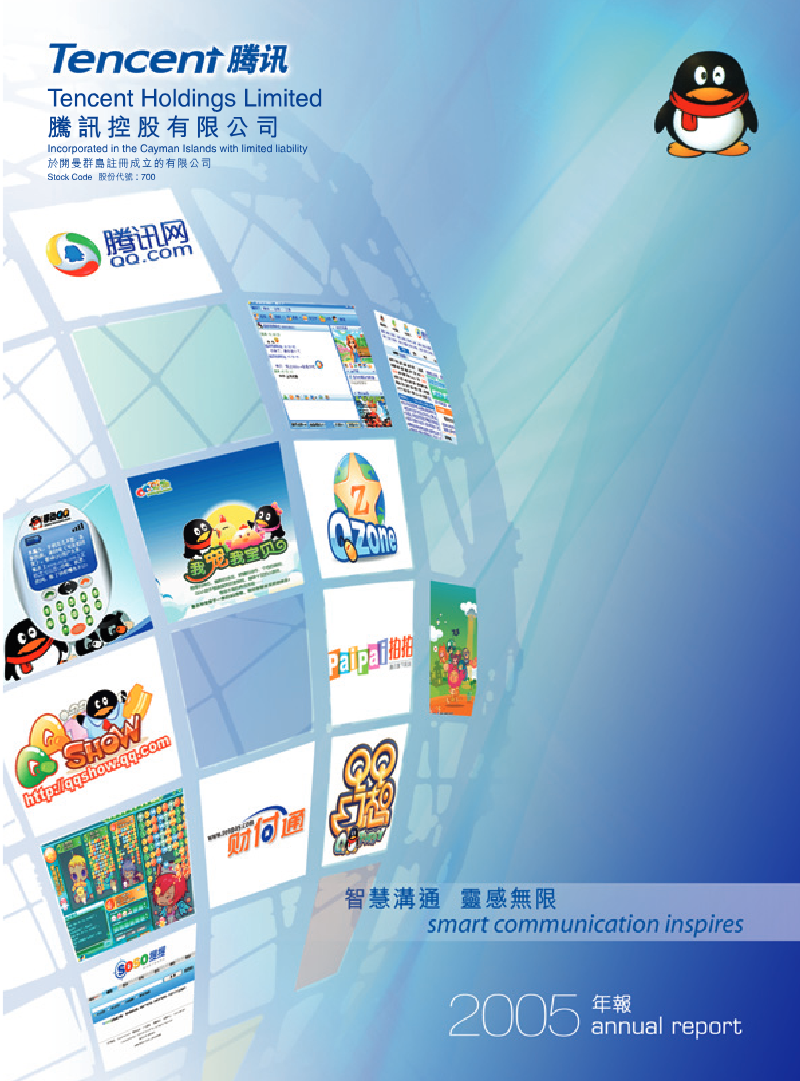
Tencent Holdings Limited TBA Incorporated in the Ca man Islands with limited liabilit BAH##A Stock Code 700 RFTUR Qa.com wiil PelpaTIH SHOW Gi nT T# #P smart communication inspires SoSOM ‡#&
milthi- 000+ 004- 0o.com *+O- QQshawi- 1h | 84| R |R|K | 0 10*| | |8|8 |A |199 |8|T |48 | 1 13 | | --- | --- | --- | --- | --- | --- | --- | --- | --- | --- | --- | --- | --- | --- | --- | | 47 1 65 14 178 1 88 134104 1615 124 1T1107 104 1 84 1T8 139| BE I IFieI HE |F4 BELH TA iBtz 1E 3t3 CO#HE:MANE 4 ROSIAATIUHE 00t21# 459 #8 90t7 003 t19 we1 AMEAt t9#8t OO40T #EE 1Arm3 COR O PM we 9F x EAT 1 BRHTTBDEOHFQQA COfMAA1 -EHF RH 00l7at s09 9922 tit stthᵘᴱ #thHEB SH I#Ete #6300 154 47 85 1F7 STM0 RU41 so1P B Bx H Jm WAA J6 10-CO10cO1 H8CTHE CONTENTS Page Corporate Information 2 Financial Summary 3 Chairman’s Statement 4 Management Discussion and Analysis 7 Directors’ Report 19 Corporate Governance Report 35 Auditors’ Report 44 Consolidated Balance Sheet 45 Balance Sheet 47 Consolidated Income Statement 48 Consolidated Statement of Changes in Shareholders’ Equity 49 Consolidated Cash Flow Statement 50 Notes to the Consolidated Financial Statements 51
CORPORATE INFORMATION DIRECTORS HEAD OFFICE AND PRINCIPAL PLACE OF BUSINESS Executive Directors 5th to 10th Floor Ma Huateng FIYTA Hi-tech Building Zhang Zhidong Gaoxinnanyi Avenue Southern District of Hi-tech Park Shenzhen, 518057 Non-Executive Directors The PRC Antonie Andries Roux Charles St Leger Searle PRINCIPAL PLACE OF BUSINESS IN HONG KONG Independent Non-Executive Directors Room 3002, 30th Floor Far East Finance Centre Li Dong Sheng 16 Harcourt Road Iain Ferguson Bruce Hong Kong Ian Charles Stone CAYMAN ISLANDS PRINCIPAL SHARE REGISTRAR AUDIT COMMITTEE AND TRANSFER OFFICE Iain Ferguson Bruce (Chairman) Butterfield Fund Services (Cayman) Limited Ian Charles Stone Butterfield House Charles St Leger Searle 68 Fort Street, P.O. Box 705, George Town Grand Cayman, Cayman Islands REMUNERATION COMMITTEE Antonie Andries Roux (Chairman) HONG KONG BRANCH SHARE REGISTRAR AND Li Dong Sheng TRANSFER OFFICE Ian Charles Stone Computershare Hong Kong Investor Services Limited Shops 1712-1716, 17th Floor, Hopewell Centre AUDITORS 183 Queen’s Road East PricewaterhouseCoopers Hong Kong Certified Public Accountants WEBSITE PRINCIPAL BANKER www.tencent.com The Hongkong and Shanghai Banking Corporation Limited STOCK CODE REGISTERED OFFICE 700 Century Yard, Cricket Square Hutchins Drive, P.O. Box 2681 GT, George Town Grand Cayman, Cayman Islands Tencent Holdings Limited
> **[Chart page]** This page contains visual data — view in PDF for the best experience. MANAGEMENT DISCUSSION AND ANALYSIS FINANCIAL SUMMARY CONDENSED CONSOLIDATED INCOME STATEMENTS Year ended 31 December 2001 2002 2003 2004 2005 (Restated) RMB’000 RMB’000 RMB’000 RMB’000 RMB’000 Revenues 49,076 263,107 734,957 1,143,533 1,426,395 Gross profit 31,032 191,433 505,409 725,408 956,526 Profit before income tax 10,216 143,765 338,209 463,653 437,055 Profit for the year 10,216 140,707 322,196 441,119 485,362 CONDENSED CONSOLIDATED BALANCE SHEETS As at 31 December 2001 2002 2003 2004 2005 RMB’000 RMB’000 RMB’000 RMB’000 RMB’000 ASSETS Non-current assets 16,868 38,851 91,139 309,454 763,495 Current assets 48,674 174,815 484,577 2,553,867 2,663,627 Total assets 65,542 213,666 575,716 2,863,321 3,427,122 EQUITY AND LIABILITIES Shareholders’ equity 48,324 197,950 471,957 2,652,238 2,928,413 Non-current liabilities — 3,058 988 — 810 Current liabilities 17,218 12,658 102,771 211,083 497,899 Total liabilities 17,218 15,716 103,759 211,083 498,709 Total equity and liabilities 65,542 213,666 575,716 2,863,321 3,427,122 Annual Report 2005 3
CHAIRMAN’S STATEMENT LIQUIDITY AND FINANCIAL RESOURCES Gen T ga BR gI00m o0.com HHE 00.20m1 MMS T Mobil Zone Ma Huateng Chairman I am pleased to present our annual report for the year ended 31 December 2005 to the shareholders. OPERATING RESULTS Total revenues for the year ended 31 December 2005 increased by 24.7% to RMB1,426.4 million compared with the same period last year. Revenues from our Internet value-added services (“IVAS”) increase by 79.2% to RMB786.7 million, revenues from our mobile and telecommunications value-added services (“MVAS”) decreased by 19.3% to RMB517.3 million and revenues from online advertising increased by 105.9% to RMB112.8 million. The Group’s audited profit after tax for the year ended 31 December 2005 was RMB485.4 million, an increase of 10.0% compared with the results for the year ended 31 December 2004. Basic and diluted earnings per share for the year ended 31 December 2005 were RMB0.274 and RMB0.267 respectively. BUSINESS REVIEW Our R&D investment and the successful execution of product strategies in 2005 have laid solid foundation for the long term growth of our businesses. In 2005, we achieved new records for peak simultaneous online user accounts for our Instant Messaging (“IM”) platform and QQ Game portal, as well as drove significant traffic growth on QQ.com portal and our 2.5G/3G WAP portal. We have also broadened monetization by rolling out a large collection of value-added service, including online identities products such as Qzone and QQ Pet; online games such as our first self-developed advanced casual game, QQ Tang, and our first self-developed Massive Multi-player Online Game (“MMOG”), QQ Fantasy.
ened monetization by rolling out a large collection of value-added service, including online identities products such as Qzone and QQ Pet; online games such as our first self-developed advanced casual game, QQ Tang, and our first self-developed Massive Multi-player Online Game (“MMOG”), QQ Fantasy. In addition, revenue from our online advertising business increased by more than 100% during the last 12 months. To position us for market opportunities in the longer term, we ventured into e-commerce via the launch of a C2C auction platform, Paipai.com, along with an escrow online payment system, TenPay. Tencent Holdings Limited
Tencent Holdings’ 2011 financial year was marked by a sharp expansion of its core internet platform, with consolidated revenues rising 45 % to RMB 28.5 billion and operating profit increasing 24.6 % to RMB 12.3 billion. The growth was driven primarily by internet value‑added services (IVAS) and mobile telecommunications services, which together accounted for 80 % of sales. Online gaming revenue surged 66 %, propelled by flagship titles such as *Cross Fire* and *League of Legends*, while social networking platforms—QQ.com, Qzone, Pengyou and Tencent Microblog—expanded user bases to 373 million registered users and 68 million daily active users. Total assets doubled from RMB 35.8 billion to RMB 56.8 billion, largely due to a jump in current assets and non‑current investments, including significant equity stakes in eLong, Kingsoft and other associates. Capital expenditures more than doubled to RMB 4.16 billion, reflecting investment in infrastructure and acquisitions such as Riot Games and Gamegoo, which generated goodwill of RMB 3.8 billion. Net profit attributable to equity holders rose 26.7 % to RMB 10.2 billion, with earnings per share reaching RMB 5.61 basic. Governance remained robust: the board met quarterly, retained a majority of non‑executive directors and three independent members, and maintained COSO‑based internal controls with no material deficiencies. Share‑based compensation expanded markedly—over 7 million options exercised and a share award pool of nearly 16 million shares outstanding—while dividend policy remained conservative with a final dividend of HKD 0.75 per share. Geographically, operations were concentrated in China through subsidiaries such as Tencent Computer and Tencent Technology, with the group’s legal domicile in the Cayman Islands and listing on Hong Kong. The period covered 2011, with a focus on internet services, mobile telecommunications, online gaming and advertising within the Chinese market.
Giant Network’s 2025 annual report demonstrates a robust year‑over‑year performance, with total revenue escalating 72.7 % to ¥5.05 billion and net profit attributable to shareholders rising 23.1 % to ¥1.76 billion. Operating cash flow surged by 188.6 %, underscoring strong liquidity generation. The company’s dual‑core strategy—leveraging the MMORPG IP “征途” and the casual title “超自然行动组”—drives growth, supported by AI‑enabled development and cross‑platform expansion. Despite these gains, recent non‑recurring losses have yet to turn positive, creating some uncertainty about long‑term profitability. Regulatory developments in China have accelerated a focus on original IP and digital‑culture products. Government policies encourage embedding traditional culture into game design, boosting AI and cloud R&D, and expanding overseas digital content. Giant Network aligns with these directives through a research‑and‑operations model, heavy IP investment, and compliance tightening under new child‑online‑protection rules. Financially, operating profit rose 54 % to ¥829 million, while net profit increased 93 % to ¥947 million, largely due to higher investment income and lower tax expense. R&D spending more than doubled, reflecting intensified product development. Other comprehensive income swung from a positive ¥219 million to a negative ¥220 million, driven by fair‑value changes and credit impairment losses. The group maintained a conservative asset‑liability ratio, rising from 12.76 % to 18.67 %, and retained over 80 % voting control through founder‑controlled entities. Key findings highlight that core gaming revenue remains strong, investment income is mixed, and non‑recurring items significantly impact overall profitability. The report covers China exclusively, focusing on the 2025 fiscal year and encompassing gaming operations, IP development, regulatory compliance, and financial risk management.
The survey, conducted by Aream & Co., gauges executive optimism regarding consumer spending on gaming in 2025 across multiple channels and functional areas. Overall, 49 % of respondents view spending as “more optimistic,” another 49 % see it as unchanged, and only 2 % are less optimistic. When broken down by platform, mobile spending is perceived as more optimistic (49 %) while PC and console views are split between “more” (15–33 %) and “about the same.” In‑app purchases are viewed as more optimistic (80 %) versus in‑app advertising (41 %). Key challenges identified include content saturation and over‑supply, with 33 % citing these as concerns; marketing environment issues affect 49 %, and macro conditions are a worry for 17 %. Despite these, 54 % anticipate more new games in 2025, and 37 % expect higher average budgets. Marketing spend is expected to rise for 48 %, while engineering and game development are seen as more optimistic (71 % and 42 %). The survey also highlights a strong appetite for mergers and acquisitions, with 71 % expecting more M&A activity. Advanced integration across multiple functions is viewed as more optimistic (49 %) but limited implementation remains a concern. The data derive from a global sample of gaming CEOs, reflecting perspectives across mobile, PC, console, and various functional departments. The findings suggest a cautiously optimistic outlook for 2025, tempered by supply‑side pressures and marketing challenges.
• 2024 market size: $188bn (+2.1% YoY) Total gamers in 2024 by region (millions): • Public markets: leading public gaming ETFs up 22- • 36% YTD (vs S&P 500 = 21%) Middle East & Africa Venture funding in Q3‘ 24: $517m across 92 deals 559 (funding +1% QoQ, number of deals -14% QoQ) (16%) • Epic sidesteps Apple in the EU, sues Google Europe (454 3,422m • Discord launches Activities ...