Updated Mar 21, 2026 by Tencent
Financial · March 1, 2024
Published by Tencent, Games Workshop Group
Tencent Holdings reported a robust financial performance for 2023, with total revenue reaching RMB 609 billion—a 9.8% increase year‑on‑year—driven by value‑added services, online advertising and fintech & business services. Gross profit rose 23% to RMB 293 billion, lifting the gross margin to 48%, while operating profit surged 44% to RMB 160 billion, delivering a 26% operating margin and a 19% net margin. Net profit attributable to equity holders fell to RMB 115 billion, reflecting a 39% decline, yet non‑IFRS profit grew 36% to RMB 158 billion, and basic earnings per share were RMB 12.19. Operating cash flow improved to RMB 221.96 billion, offset by RMB 125 billion of investing outflows and a modest increase in total borrowings to RMB 197.4 billion. Strategically, the company set 2027 targets that include R&D investment of USD 78.5‑94.1 billion, overseas expansion of USD 31.4‑47.1 billion, and new product and service development of USD 15 billion. Cash is held almost entirely in RMB‑denominated accounts on the mainland, and the firm judges foreign‑exchange movements unlikely to materially affect results, monitoring leverage through a debt‑to‑adjusted‑EBITDA ratio. Governance remained a focal point, with the board adhering to the Model Code for securities transactions, an insider‑information framework, and comprehensive directors‑and‑officers liability insurance. Share‑option programmes granted roughly 58 million awards without performance conditions, while dividend policy stayed flexible, proposing a final dividend of HKD 3.40 per share. The board composition featured eight members, including one executive director, and operated five specialised committees that oversaw risk, audit, remuneration and governance. A three‑lines risk‑management model identified ten material risks, highlighting heightened concerns around market competition, innovation and business continuity. External auditors emphasized three key audit matters: revenue recognition for permanent virtual items, goodwill and investment impairment testing, and fair‑value measurement of Level 3 financial instruments. Overall, internal‑control, risk‑management and financial‑reporting systems were judged effective, supporting Tencent’s continued focus on user‑value creation, technological innovation and sustainable growth within the Chinese and global internet‑technology landscape.

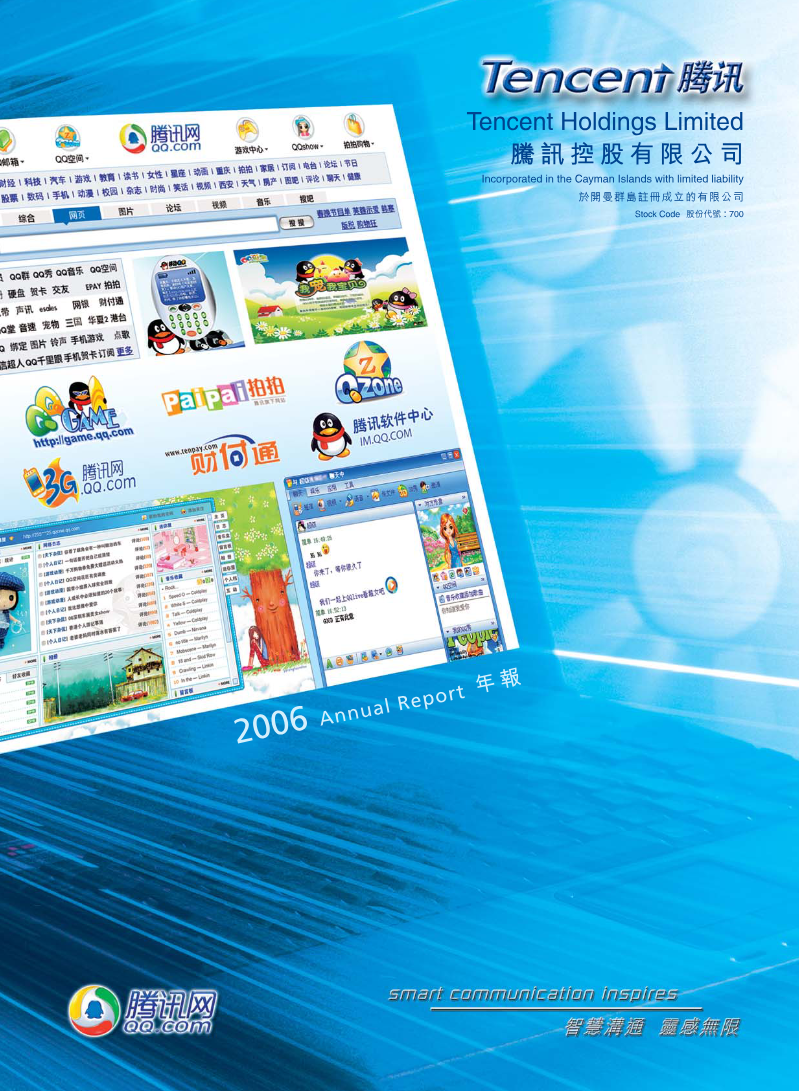
CONTENTS CONTENTS CORPORATE INFORMATION 2 CORPORATE INFORMATION 3 FINANCIAL SUMMARY 4 CHAIRMAN’S STATEMENT 7 MANAGEMENT DISCUSSION AND ANALYSIS 26 DIRECTORS' REPORT 26 DIRECTORS’ REPORT 85 CORPORATE GOVERNANCE REPORT 85 CORPORATE GOVERNANCE REPORT 119 INDEPENDENT AUDITOR'S REPORT 119 INDEPENDENT AUDITOR’S REPORT 128 CONSOLIDATED INCOME STATEMENT 128 CONSOLIDATED INCOME STATEMENT 129 CONSOLIDATED STATEMENT OF COMPREHENSIVE INCOME 130 CONSOLIDATED STATEMENT OF FINANCIAL POSITION 133 CONSOLIDATED STATEMENT OF CHANGES IN EQUITY 137 CONSOLIDATED STATEMENT OF CASH FLOWS 139 NOTES TO THE CONSOLIDATED FINANCIAL STATEMENTS 139 NOTES TO THE CONSOLIDATED FINANCIAL STATEMENTS 273 DEFINITION DEFINITION
Corporate Information Model Code for Securities Transactions by Directors of Listed Issuers The Company has adopted the Model Code. The Company has also adopted an insider dealing policy to govern and regulate DIRECTORS NOMINATION COMMITTEE PRINCIPAL PLACE OF BUSINESS securities transactions by employees who are likely to be in possession of inside information relating to the Company, the terms Executive Directors Ma Huateng (Chairman) IN HONG KONG Ma Huateng (Chairman) Li Dong Sheng 29/F., Three Pacific Place Lau Chi Ping Martin Ian Charles Stone No. 1 Queen’s Road East (ceased to be a director Yang Siu Shun Wanchai with effect from 17 May 2023) Charles St Leger Searle Hong Kong Each non-executive director, whether independent or not, is appointed for a term of one year and is subject to retirement Non-Executive Directors REMUNERATION COMMITTEE CAYMAN ISLANDS PRINCIPAL Jacobus Petrus (Koos) Bekker Ian Charles Stone (Chairman) SHARE REGISTRAR AND Charles St Leger Searle Li Dong Sheng TRANSFER OFFICE Directors and Officers Liability Insurance Jacobus Petrus (Koos) Bekker Suntera (Cayman) Limited Independent Non-Executive Directors Suite 3204, Unit 2A The Company has arranged appropriate directors and officers liability insurance in respect of legal action against the directors Li Dong Sheng AUDITOR Block 3, Building D Ian Charles Stone PricewaterhouseCoopers P.O. Box 1586 Yang Siu Shun Certified Public Accountants Gardenia Court Ke Yang and Registered Public Interest Camana Bay Zhang Xiulan Entity Auditor Grand Cayman, KY1-1100 Cayman Islands
ction against the directors Li Dong Sheng AUDITOR Block 3, Building D Ian Charles Stone PricewaterhouseCoopers P.O. Box 1586 Yang Siu Shun Certified Public Accountants Gardenia Court Ke Yang and Registered Public Interest Camana Bay Zhang Xiulan Entity Auditor Grand Cayman, KY1-1100 Cayman Islands AUDIT COMMITTEE PRINCIPAL BANKERS HONG KONG BRANCH SHARE Yang Siu Shun (Chairman) Bank of China Limited REGISTRAR AND TRANSFER Ian Charles Stone The Hongkong and Shanghai Banking OFFICE Charles St Leger Searle Corporation Limited Computershare Hong Kong Investor to risk management and internal control review. Please refer to Note 7 to the consolidated financial statements for a breakdown CORPORATE GOVERNANCE REGISTERED OFFICE Services Limited COMMITTEE Cricket Square Shops 1712-1716, 17th Floor Hopewell Centre Charles St Leger Searle (Chairman) Hutchins Drive, P.O. Box 2681 183 Queen’s Road East Ian Charles Stone Grand Cayman KY1-1111 Wan Chai, Hong Kong Yang Siu Shun Cayman Islands framework sets out the procedures and internal controls for the handling and dissemination of inside information in a timely Ke Yang COMPANY WEBSITE Zhang Xiulan TENCENT GROUP HEAD OFFICE www.tencent.com INVESTMENT COMMITTEE Tencent Binhai Towers Lau Chi Ping Martin (Chairman) No. 33 Haitian 2nd Road STOCK CODES Nanshan District Ma Huateng Shenzhen, 518054 HKD counter 700 Charles St Leger Searle The PRC RMB counter 80700 be disclosed to the public pursuant to the SFO. The framework and its effectiveness are subject to review on a regular basis
Chi Ping Martin (Chairman) No. 33 Haitian 2nd Road STOCK CODES Nanshan District Ma Huateng Shenzhen, 518054 HKD counter 700 Charles St Leger Searle The PRC RMB counter 80700 be disclosed to the public pursuant to the SFO. The framework and its effectiveness are subject to review on a regular basis 2 Tencent Holdings Limited
Financial Summary In order to ensure that shareholders' interests and rights are adequately protected, a separate resolution will be proposed for each substantially separate issue at the general meetings, and all resolutions will be voted by poll pursuant to the Articles of CONDENSED CONSOLIDATED STATEMENTS OF COMPREHENSIVE INCOME Year ended 31 December 2019 2020 2021 2022 2023 Restated* Restated* Restated* Restated* RMB’Million RMB’Million RMB’Million RMB’Million RMB’Million Revenues 377,289 482,064 560,118 554,552 609,015 Gross profit 167,533 221,532 245,944 238,746 293,109 Apart from participating in the Company's general meetings, shareholders and other stakeholders may at any time contact Operating profit (Restated for prior years) 96,501* 126,197* 124,656* 110,827* 160,074 or send enquiries and concerns to us via the Company Website, or by addressing them to the Investor Relations teams, Profit before income tax 109,400 180,022 248,062 210,225 161,324 and sending them by post to the Investor Relations teams, Tencent Holdings Limited, at 29/F., Three Pacific Place, No. 1 Profit for the year 95,888 160,125 227,810 188,709 118,048 Profit attributable to equity holders of the Company 93,310 159,847 224,822 188,243 115,216 Total comprehensive income for the year 119,901 281,173 200,390 59,564 107,182 Total comprehensive income attributable to equity holders of the Company 116,670 277,834 200,323 60,699 102,130
,709 118,048 Profit attributable to equity holders of the Company 93,310 159,847 224,822 188,243 115,216 Total comprehensive income for the year 119,901 281,173 200,390 59,564 107,182 Total comprehensive income attributable to equity holders of the Company 116,670 277,834 200,323 60,699 102,130 Non-IFRS operating profit (Restated for prior years) 108,052* 143,241* 152,729* 143,203* 191,886 The Company endeavours to maintain sufficient working capital to develop and operate the business of the Group and to Non-IFRS profit attributable to equity holders of the Company 94,351 122,742 123,788 115,649 157,688 CONDENSED CONSOLIDATED STATEMENTS OF FINANCIAL POSITION As at 31 December 2019 2020 2021 2022 2023 RMB’Million RMB’Million RMB’Million RMB’Million RMB’Million Assets Non-current assets 700,018 1,015,778 1,127,552 1,012,142 1,058,800 Current assets 253,968 317,647 484,812 565,989 518,446 Total assets 953,986 1,333,425 1,612,364 1,578,131 1,577,246 The Company is required to disclose certain information pursuant to the Listing Rules and the CG Code. Set out below is the Equity and liabilities Equity attributable to equity holders of the Company 432,706 703,984 806,299 721,391 808,591 Non-controlling interests 56,118 74,059 70,394 61,469 65,090 Significant Change in the Constitutional Documents Total equity 488,824 778,043 876,693 782,860 873,681 Non-current liabilities 225,006 286,303 332,573 361,067 351,408 Current liabilities 240,156 269,079 403,098 434,204 352,157 Total liabilities 465,162 555,382 735,671 795,271 703,565 Total equity and liabilities 953,986 1,333,425 1,612,364 1,578,131 1,577,246
The 2023 fiscal year represented a strategic "reset" for tinyBuild, characterized by a transition from aggressive acquisition-led growth to a leaner, internal-production model. Facing a challenging macroeconomic environment and a sharp decline in large-contract deals, revenues fell 29% to $44.7 million. The period was marked by a comprehensive loss of $62.8 million, primarily driven by $48.1 million in asset impairments related to studio closures, game cancellations, and the write-down of software development costs. Despite these headwinds, the company maintained a strong back-catalogue performance, which accounted for 92% of total sales, and leveraged its owned intellectual property for 68% of revenue. To stabilize its financial position and address a year-end cash low of $2.5 million, the company executed a $12.3 million fundraise in early 2024. This capital injection, which included investment from Atari, resulted in CEO Alex Nichiporchik becoming the majority shareholder with a 57.9% stake. Operational restructuring involved the divestment of several titles and studios, the settlement of a $3.5 million legal claim regarding the Versus Evil acquisition, and a pivot toward "games as a service" and high-potential emergent gameplay titles. The geographic and operational scope remains global, though the company is actively mitigating geopolitical risks associated with its workforce in Ukraine and Eastern Europe. Moving forward, the strategy emphasizes "canon-commercial" multimedia expansions and a data-centric publishing model to reduce dependency on external suppliers. Management expresses optimism for 2024, citing a significantly reduced cost base and a focused pipeline of high-potential franchises designed to deliver more predictable, long-term growth.
Tencent Holdings delivered a robust interim performance for the six months ended 30 June 2024, underscoring the resilience of its diversified internet‑services platform. Revenue rose 8 % year‑on‑year to RMB 161.1 billion, while profit attributable to equity holders surged 82 % to RMB 47.6 billion and non‑IFRS profit increased 53 % to RMB 57.3 billion. Gross profit expanded 21 % to RMB 85.9 billion, lifting the gross margin to 53 % from 47 % a year earlier, reflecting higher monetisation of gaming, digital content and cloud services across China and overseas markets. The balance sheet strengthened, with total assets climbing 4.9 % to RMB 1.655 trillion and equity reaching RMB 927.6 billion, driven by retained earnings of RMB 842 billion. Operating cash flow improved to RMB 126.5 billion, although financing activities generated a net outflow of RMB 99.8 billion, primarily due to share repurchases (RMB
Tencent’s interim financials for the six months ended 30 June 2021 reveal robust growth across core metrics. Revenue rose 20 percent year‑on‑year to RMB 138.3 billion, while operating profit increased 34 percent to RMB 52.5 billion and profit attributable to equity holders climbed 29 percent to RMB 42.6 billion, delivering basic earnings of RMB 4.47 per share. The half‑year profit of RMB 90.4 billion was complemented by other comprehensive income of RMB 65.6 billion, underscoring strong earnings momentum. The balance sheet expanded, with total liabilities reaching RMB 590.8 billion, up from RMB 555.4 billion a year earlier, and total equity and liabilities rising to RMB 1.518 trillion. Leverage remained modest, as the total‑debt‑to‑adjusted‑EBITDA ratio edged to 1.40 from 1.36 in 2020. Fair‑value assessments indicated a shift toward higher Level 3 exposure, with Level 3 assets growing to RMB 169.4 billion. Currency risk was largely mitigated, with exchange losses of RMB 30 million offset by gains of RMB 329 million during the period. Capital‑raising activities continued through an expanded unsecured Global Medium‑Term Note programme, issuing four senior‑note tranches totalling USD 4.15 billion at interest rates between 2.88 % and 3.94 % and maturities ranging from ten to forty years. Governance disclosures show the Share Award
The 2024 fiscal year represented a strategic pivot for tinyBuild, characterized by a transition toward organic growth and a "1,000-hour game" philosophy. Despite a 22% revenue decline to $34.7 million and an operating loss of $20.4 million, the Group significantly narrowed its net loss from the previous year’s $62.9 million. This financial stabilization was supported by an $11.4 million capital raise and a reduction in impairment charges from $48.1 million to $13.7 million. The Group maintains a debt-free position with a net cash balance of $3.1 million, bolstered by the disposal of non-core assets and a streamlined operational footprint. The core of the current strategy is a shift toward "Own-IP," which now accounts for 77% of revenue, and a robust back catalogue that drives 87% of total sales. By focusing on high-potential franchises like Hello Neighbor and Deadside, the Group aims to mitigate risk through portfolio diversification, ensuring no single project exceeds 10% of the development budget. This data-centric approach is complemented by a multimedia expansion strategy and a vast influencer network that has generated over 5 billion YouTube views, providing a cost-effective alternative to traditional marketing. Operational risks remain centered on high revenue concentration, with the top five titles accounting for 42% of sales, and ongoing geopolitical instability in Ukraine and Russia. The Group has addressed these challenges through staff relocations, "anti-crunch" labor policies, and a more cautious M&A stance that prioritizes "acquihires." Looking toward 2025, the Group is positioned as a going concern with a high-potential pipeline including Kingmakers and Streets of Rogue 2. Governance remains tightly held, with CEO Alex Nichiporchik maintaining a 57.9% stake following a $10 million personal investment, ensuring strong alignment between leadership and long-term shareholder value.