Updated Jun 10, 2026 by Tencent
Financial
Published by Tencent
Tencent Holdings Limited delivered a landmark year in 2008, with total revenues surging 87 % to RMB 7.15 billion and operating profit more than doubling to RMB 3.25 billion, reflecting a 45 % operating margin. Growth was concentrated in Internet value‑added services (95 % rise) and mobile/telecom services (73 % increase), while online advertising also expanded 68 %. The instant‑messaging platform QQ grew to 376.6 million active users, and portal traffic peaked during high‑profile events such as the Beijing Olympics. Despite a global financial downturn that pressured ad spend, Tencent’s diversified platform model and robust user base insulated it from broader market volatility. Profit attributable to equity holders rose 78 % to RMB 2.78 billion, supported by a strong cash position of RMB 5.13 billion and no interest‑bearing debt. Capital expenditures climbed to RMB 1.45 billion, and the company repurchased 9.22 million shares to enhance shareholder value. Share‑based compensation and dividend payouts increased equity outflows, yet the company maintained a healthy liquidity profile with cash equivalents of RMB 3.06 billion and minimal credit exposure. Governance structures remained solid, with a balanced board of executive, non‑executive and independent directors overseeing strategy, audit and remuneration committees. Internal controls aligned with COSO principles passed review without material discrepancies, and the audit committee maintained independence from external auditors. The company adhered to IFRS updates, with no significant changes anticipated for 2008, and prepared for forthcoming standards. Overall, Tencent’s 2008 performance underscored its dominant position in China’s internet and mobile services market, delivering robust revenue growth, profitability, and shareholder returns amid a challenging macroeconomic backdrop.
Tencent Holdings Limited Incorporated in the Cayman Islands with limited liability Stock Code : 700 2008 Annual
HOME ABOUT TENCENT PRODUCTS & SERVICES INVESTOR RELATIONS CULTURE otherstes Ro 2008 QQ+4M&1 CONTENTS Page Corporate Information 2 Financial Summary 3 Chairman’s Statement 4 Management Discussion and Analysis 9 Directors’ Report 20 Corporate Governance Report 39 Independent Auditor’s Report 49 Consolidated Balance Sheet 51 Balance Sheet 53 Consolidated Income Statement 54 Consolidated Statement of Changes in Shareholders’ Equity 55 Consolidated Cash Flow Statement 56 Notes to the Consolidated Financial Statements 58
CORPORATE INFORMATION DIRECTORS HEAD OFFICE AND PRINCIPAL PLACE OF BUSINESS Executive Directors 5th to 10th Floors FIYTA Hi-tech Building Ma Huateng (Chairman) Gaoxinnanyi Avenue Lau Chi Ping Martin Southern District of Hi-tech Park Zhang Zhidong Shenzhen, 518057 The PRC Non-Executive Directors Antonie Andries Roux PRINCIPAL PLACE OF BUSINESS IN HONG KONG Charles St Leger Searle Room 3002, 30th Floor Independent Non-Executive Directors Far East Finance Centre 16 Harcourt Road Li Dong Sheng Hong Kong Iain Ferguson Bruce Ian Charles Stone CAYMAN ISLANDS PRINCIPAL SHARE REGISTRAR AND TRANSFER OFFICE AUDIT COMMITTEE Butterfield Fulcrum Group (Cayman) Limited Iain Ferguson Bruce (Chairman) Butterfield House Ian Charles Stone 68 Fort Street, P.O. Box 609 Charles St Leger Searle Grand Cayman KY1-1107, Cayman Islands REMUNERATION COMMITTEE HONG KONG BRANCH SHARE REGISTRAR AND Antonie Andries Roux (Chairman) TRANSFER OFFICE Li Dong Sheng Computershare Hong Kong Investor Services Limited Ian Charles Stone Shops 1712-1716, 17th Floor, Hopewell Centre 183 Queen’s Road East AUDITORS Wan Chai, Hong Kong PricewaterhouseCoopers WEBSITE Certified Public Accountants www.tencent.com PRINCIPAL BANKER The Hongkong and Shanghai Banking Corporation STOCK CODE Limited 700 REGISTERED OFFICE Cricket Square Hutchins Drive, P.O. Box 2681 Grand Cayman KY 1-1111 Cayman Islands 2 Tencent Holdings Limited
FINANCIAL SUMMARY CONDENSED CONSOLIDATED INCOME STATEMENTS Year ended 31 December 2004 2005 2006 2007 2008 RMB’000 RMB’000 RMB’000 RMB’000 RMB’000 (Restated) Revenues 1,143,533 1,426,395 2,800,441 3,820,923 7,154,544 Gross profit 725,408 956,526 1,983,379 2,703,366 4,984,123 Profit before income tax 463,653 437,055 1,116,771 1,534,503 3,104,895 Profit for the year 441,119 485,362 1,063,800 1,568,008 2,815,650 Profit attributable to equity holders of the Company 441,119 485,362 1,063,800 1,566,020 2,784,577 CONDENSED CONSOLIDATED BALANCE SHEETS As at 31 December 2004 2005 2006 2007 2008 RMB’000 RMB’000 RMB’000 RMB’000 RMB’000 (Restated) Assets Non-current assets 309,454 763,495 916,138 2,090,312 3,359,696 Current assets 2,553,867 2,663,627 3,734,434 4,835,132 6,495,861 Total assets 2,863,321 3,427,122 4,650,572 6,925,444 9,855,557 Equity and liabilities Equity attributable to the Company’s equity holders 2,652,238 2,928,413 3,717,756 5,170,396 7,020,926 Minority interests in equity ––– 64,661 98,406 Total equity 2,652,238 2,928,413 3,717,756 5,235,057 7,119,332 Non-current liabilities – 810 64,969 40,770 644,628 Current liabilities 211,083 497,899 867,847 1,649,617 2,091,597 Total liabilities 211,083 498,709 932,816 1,690,387 2,736,225 Total equity and liabilities 2,863,321 3,427,122 4,650,572 6,925,444 9,855,557 Tencent Holdings Limited 3
CHAIRMAN’S STATEMENT AX X QQ.com Anniversary Ma Huateng Chairman I am pleased to present our annual report for the year ended 31 December 2008 to the shareholders. RESULTS Total revenues for the year ended 31 December 2008 increased by 87.2% to RMB7,154.5 million, compared with the same period last year. Revenues from our Internet value-added services increased by 95.5% to RMB 4,915.0 million. Revenues from our mobile and telecommunications value-added services increased by 73.2% to RMB1,399.0 million and revenues from online advertising increased by 67.5% to RMB826.0 million. The Group’s audited profit attributable to equity holders of the Company for the year ended 31 December 2008 was RMB2,784.6 million, an increase of 77.8% compared with the results for the year ended 31 December 2007. Basic and diluted earnings per share for the year ended 31 December 2008 were RMB1.552 and RMB1.514 respectively. 4 Tencent Holdings Limited
CHAIRMAN’S STATEMENT BUSINESS REVIEW AND OUTLOOK 2008 was another exciting year for the Internet market in China. According to China Internet Network Information Center, total number of Internet users in China reached 298 million at the end of 2008, representing a year-on-year growth of 42%. While China has already surpassed the US and become the largest Internet market in the world by number of users, its Internet penetration was only 23% at the end of 2008. This is significantly lower than that for developed markets, reflecting that China is still a nascent market with strong potential for future growth. More importantly, Internet has increasingly become an indispensable part of everyday life for people in China, thanks to the increasing adoption of broadband and mobile Internet connectivity as well as the emergence of a broad range of applications that allow people to stay in touch with each other, to get entertained, to get access to information and to conduct business transactions. For Tencent, 2008 was a year of challenges and opportunities. The Sichuan earthquake shocked the whole nation and we immediately took action to play an active role in the reporting and relief of the tragedy, as well as orchestrated the largest ever online donation in China. During the Beijing Olympics, one of the most historically important events for China in recent history, we demonstrated solid execution and teamwork across the whole company, resulting in recordbreaking traffic and top positioning in terms of reach and unique users for Olympic-related content.
Giant Network’s 2025 annual report demonstrates a robust year‑over‑year performance, with total revenue escalating 72.7 % to ¥5.05 billion and net profit attributable to shareholders rising 23.1 % to ¥1.76 billion. Operating cash flow surged by 188.6 %, underscoring strong liquidity generation. The company’s dual‑core strategy—leveraging the MMORPG IP “征途” and the casual title “超自然行动组”—drives growth, supported by AI‑enabled development and cross‑platform expansion. Despite these gains, recent non‑recurring losses have yet to turn positive, creating some uncertainty about long‑term profitability. Regulatory developments in China have accelerated a focus on original IP and digital‑culture products. Government policies encourage embedding traditional culture into game design, boosting AI and cloud R&D, and expanding overseas digital content. Giant Network aligns with these directives through a research‑and‑operations model, heavy IP investment, and compliance tightening under new child‑online‑protection rules. Financially, operating profit rose 54 % to ¥829 million, while net profit increased 93 % to ¥947 million, largely due to higher investment income and lower tax expense. R&D spending more than doubled, reflecting intensified product development. Other comprehensive income swung from a positive ¥219 million to a negative ¥220 million, driven by fair‑value changes and credit impairment losses. The group maintained a conservative asset‑liability ratio, rising from 12.76 % to 18.67 %, and retained over 80 % voting control through founder‑controlled entities. Key findings highlight that core gaming revenue remains strong, investment income is mixed, and non‑recurring items significantly impact overall profitability. The report covers China exclusively, focusing on the 2025 fiscal year and encompassing gaming operations, IP development, regulatory compliance, and financial risk management.
Archosaur Games, a Hong Kong‑listed mobile‑game developer incorporated in the Cayman Islands and majority owned by Tencent and Perfect World, reported a 14.3 % revenue rise to RMB 1,304.4 million in FY 2025, driven by the launches of Dragon Raja: Cassell Gate and Immortal Skywalker in China. Gross profit climbed 11.8 % to RMB 923.7 million, but the margin slipped to 70.8 % because of higher IP‑holder commissions on licensed titles. Operating loss narrowed sharply to RMB 91.1 million from a ¥341.4 million loss in 2024, largely due to a 19 % cut in selling and marketing expenses; R&D spend remained flat. Net loss improved to RMB 36.7 million, an 87.2 % reduction versus the prior year, with an adjusted net loss of RMB 31.9 million after share‑based compensation add‑back. Cash flow and liquidity strengthened: operating cash usage fell 71.9 %, net current assets rose to RMB 1.48 bn and cash to RMB 1.09 bn, although gearing increased to 24.6 %. The group maintained a robust capital strategy with no external debt, Level‑3 fair‑value investments of RMB 2.24 bn, and a low credit‑risk profile for trade receivables. Governance structures met listing requirements; the board comprised two executives, two non‑executives and three independent directors, with audit, nomination, remuneration and risk committees each staffed by three members. Share‑based incentive plans remained within regulatory caps, granting 4.9 million RSUs and 4.1 million options in 2025. Geographically, Archosaur operates seven wholly‑owned overseas entities across Singapore, UAE, China, Japan, Korea and the U.S., while its Chinese subsidiaries are controlled through a complex contractual framework that navigates foreign‑investment restrictions. The company’s financial reporting follows IFRS and HKCO, with ongoing transition to IFRS 18 for revenue recognition. Overall, Archosaur Games achieved significant profitability improvement and strengthened liquidity while maintaining compliance with governance and regulatory standards across its global operations.
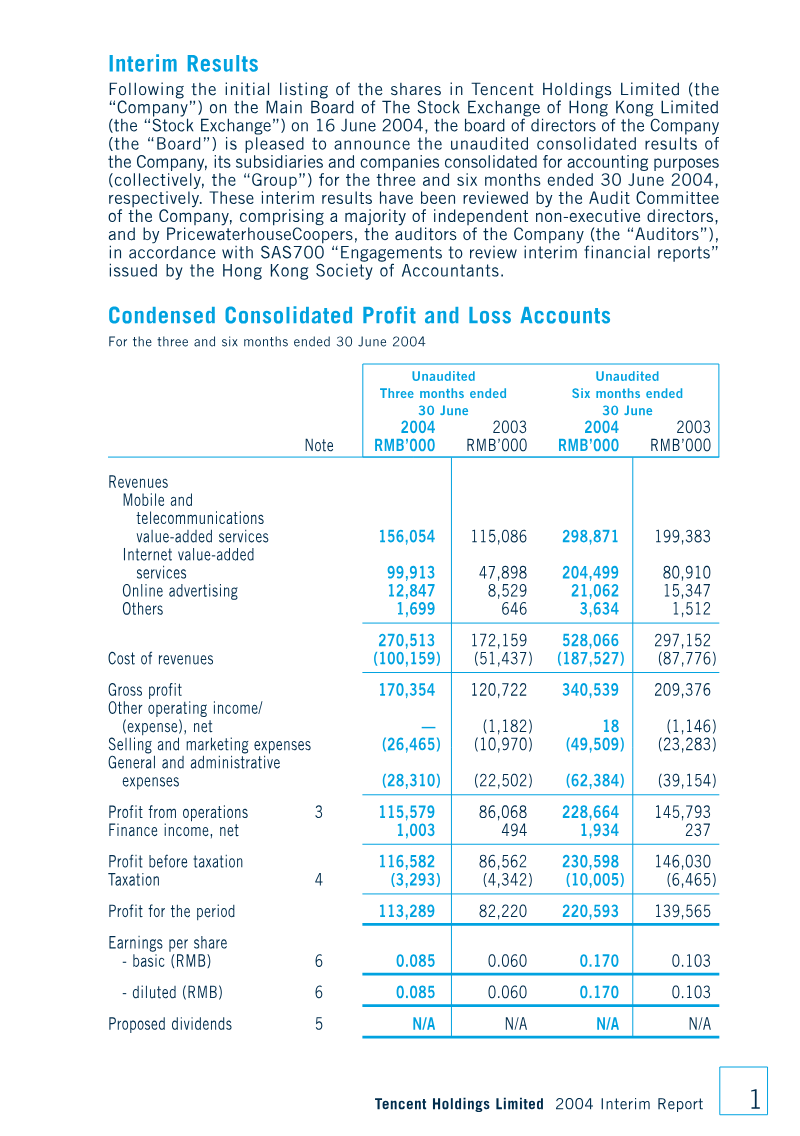
Tencent Holdings delivered a robust interim performance for the six months ended 30 June 2024, underscoring the resilience of its diversified internet‑services platform. Revenue rose 8 % year‑on‑year to RMB 161.1 billion, while profit attributable to equity holders surged 82 % to RMB 47.6 billion and non‑IFRS profit increased 53 % to RMB 57.3 billion. Gross profit expanded 21 % to RMB 85.9 billion, lifting the gross margin to 53 % from 47 % a year earlier, reflecting higher monetisation of gaming, digital content and cloud services across China and overseas markets. The balance sheet strengthened, with total assets climbing 4.9 % to RMB 1.655 trillion and equity reaching RMB 927.6 billion, driven by retained earnings of RMB 842 billion. Operating cash flow improved to RMB 126.5 billion, although financing activities generated a net outflow of RMB 99.8 billion, primarily due to share repurchases (RMB
Tencent Holdings reported a robust financial performance for 2023, with total revenue reaching RMB 609 billion—a 9.8% increase year‑on‑year—driven by value‑added services, online advertising and fintech & business services. Gross profit rose 23% to RMB 293 billion, lifting the gross margin to 48%, while operating profit surged 44% to RMB 160 billion, delivering a 26% operating margin and a 19% net margin. Net profit attributable to equity holders fell to RMB 115 billion, reflecting a 39% decline, yet non‑IFRS profit grew 36% to RMB 158 billion, and basic earnings per share were RMB 12.19. Operating cash flow improved to RMB 221.96 billion, offset by RMB 125 billion of investing outflows and a modest increase in total borrowings to RMB 197.4 billion. Strategically, the company set 2027 targets that include R&D investment of USD 78.5‑94.1 billion, overseas expansion of USD 31.4‑47.1 billion, and new product and service development of USD 15 billion. Cash is held almost entirely in RMB‑denominated accounts on the mainland, and the firm judges foreign‑exchange movements unlikely to materially affect results, monitoring leverage through a debt‑to‑adjusted‑EBITDA ratio. Governance remained a focal point, with the board adhering to the Model Code for securities transactions, an insider‑information framework, and comprehensive directors‑and‑officers liability insurance. Share‑option programmes granted roughly 58 million awards without performance conditions, while dividend policy stayed flexible, proposing a final dividend of HKD 3.40 per share. The board composition featured eight members, including one executive director, and operated five specialised committees that oversaw risk, audit, remuneration and governance. A three‑lines risk‑management model identified ten material risks, highlighting heightened concerns around market competition, innovation and business continuity. External auditors emphasized three key audit matters: revenue recognition for permanent virtual items, goodwill and investment impairment testing, and fair‑value measurement of Level 3 financial instruments. Overall, internal‑control, risk‑management and financial‑reporting systems were judged effective, supporting Tencent’s continued focus on user‑value creation, technological innovation and sustainable growth within the Chinese and global internet‑technology landscape.