Updated Apr 30, 2026 by Tencent
Financial
Published by Tencent
Tencent Holdings Limited experienced a period of rapid expansion during the first half of 2004, characterized by substantial revenue growth and a successful transition to a publicly traded entity. Total revenues for the six-month period ending June 30, 2004, reached RMB 528.1 million, representing a 77.7% increase over the previous year. This financial momentum was largely fueled by the robust performance of mobile, telecommunications, and internet value-added services, which remain the core pillars of the company’s business model. Profit for the period rose by 58.1% to RMB 220.6 million, reflecting a strong operational foundation despite rising costs associated with bandwidth, server capacity, and revenue-sharing agreements. The company’s strategic position was significantly bolstered by its initial public offering on June 16, 2004, which raised RMB 1,656.7 million and resulted in cash and cash equivalents totaling RMB 1.95 billion by the end of the half-year. While the second quarter saw a slight contraction in certain internet value-added services due to the proactive removal of inactive user accounts, the overall growth trajectory remained positive. The company also demonstrated significant organizational scaling, more than doubling its workforce to 804 employees to support its expanding operations. Looking ahead, management intends to leverage its strengthened capital position to drive further growth through the diversification of payment channels, the expansion of QQ-based value-added services, and the pursuit of strategic acquisitions. By maintaining a focus on corporate governance and operational efficiency, the company aims to sustain its market leadership within the Chinese internet and mobile services sectors. These results underscore a pivotal phase of institutional development, setting the stage for continued investment in infrastructure and service innovation.
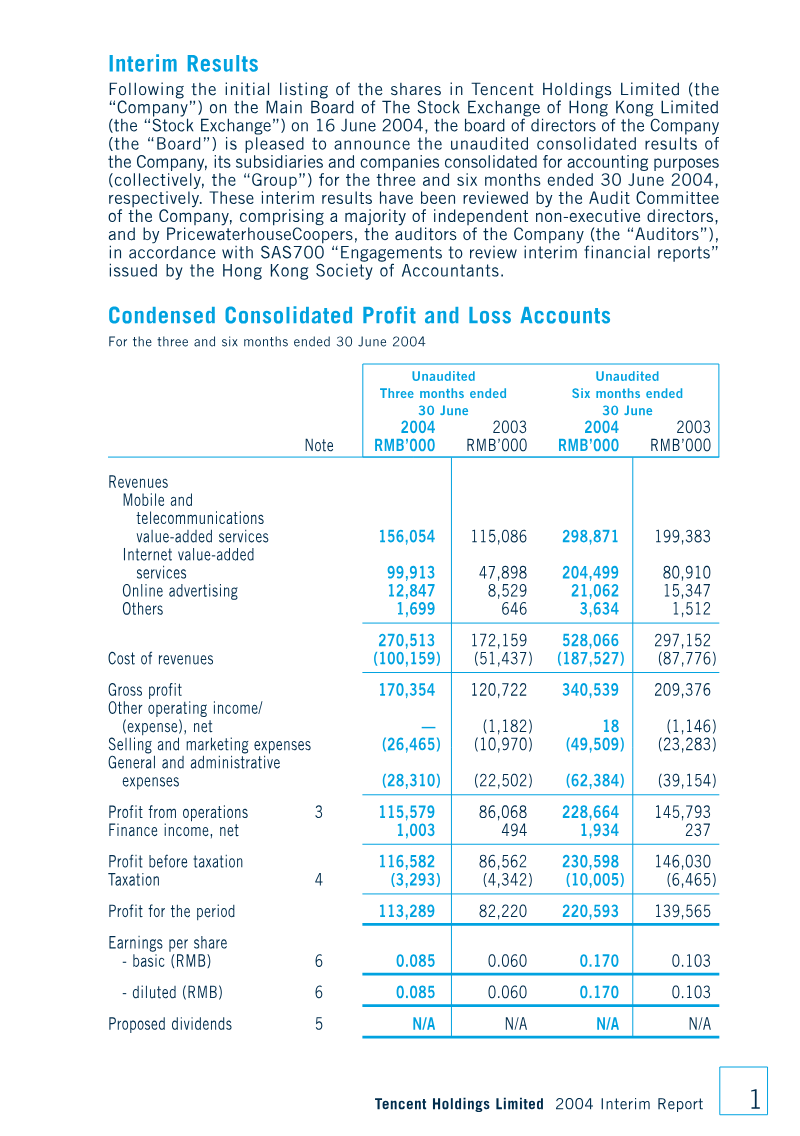
Interim Results Following the initial listing of the shares in Tencent Holdings Limited (the “Company”) on the Main Board of The Stock Exchange of Hong Kong Limited (the “Stock Exchange”) on 16 June 2004, the board of directors of the Company (the “Board”) is pleased to announce the unaudited consolidated results of the Company, its subsidiaries and companies consolidated for accounting purposes (collectively, the “Group”) for the three and six months ended 30 June 2004, respectively. These interim results have been reviewed by the Audit Committee of the Company, comprising a majority of independent non-executive directors, and by PricewaterhouseCoopers, the auditors of the Company (the “Auditors”), in accordance with SAS700 “Engagements to review interim financial reports” issued by the Hong Kong Society of Accountants. Condensed Consolidated Profit and Loss Accounts For the three and six months ended 30 June 2004 Unaudited Unaudited Three months ended Six months ended 30 June 30 June 2004 2003 2004 2003 Note RMB’000 RMB’000 RMB’000 RMB’000 Revenues Mobile and telecommunications value-added services 156,054 115,086 298,871 199,383 Internet value-added services 99,913 47,898 204,499 80,910 Online advertising 12,847 8,529 21,062 15,347 Others 1,699 646 3,634 1,512 270,513 172,159 528,066 297,152 Cost of revenues (100,159) (51,437) (187,527) (87,776) Gross profit 170,354 120,722 340,539 209,376 Other operating income/ (expense), net — (1,182) 18 (1,146) Selling and marketing expenses (26,465) (10,970) (49,509) (23,283) General and administrative expenses (28,310) (22,502) (62,384) (39,154)
ost of revenues (100,159) (51,437) (187,527) (87,776) Gross profit 170,354 120,722 340,539 209,376 Other operating income/ (expense), net — (1,182) 18 (1,146) Selling and marketing expenses (26,465) (10,970) (49,509) (23,283) General and administrative expenses (28,310) (22,502) (62,384) (39,154) Profit from operations 3 115,579 86,068 228,664 145,793 Finance income, net 1,003 494 1,934 237 Profit before taxation 116,582 86,562 230,598 146,030 Taxation 4 (3,293) (4,342) (10,005) (6,465) Profit for the period 113,289 82,220 220,593 139,565 Earnings per share - basic (RMB) 6 0.085 0.060 0.170 0.103 - diluted (RMB) 6 0.085 0.060 0.170 0.103 Proposed dividends 5 N/A N/A N/A N/A
Condensed Consolidated Balance Sheets As at 30 June 2004 and 31 December 2003 Unaudited Audited 30 June 31 December 2004 2003 Note RMB’000 RMB’000 Assets Non-current assets Fixed assets 7 113,298 80,139 Deposit in connection with the formation of an operating company, Shiji Kaixuan Technology 15 — 11,000 Current assets Accounts receivable 8 141,856 99,726 Amounts due from shareholders — 82 Prepayments, deposits and other receivables 9 42,572 35,872 Term deposits with initial term of over three months 62,971 23,311 Cash and cash equivalents 1,950,665 325,586 2,198,064 484,577 Total assets 2,311,362 575,716 Equity and liabilities Current liabilities Trade payables 10 3,864 — Other payables and accruals 11 86,129 59,301 Dividends payable 145 — Income taxes payable 4,644 7,115 Other taxes payable 23,656 32,679 Deferred revenue 12,839 3,676 131,277 102,771 Non-current liabilities Deferred tax liabilities 13 — 988 Total liabilities 131,277 103,759 Shareholders’ equity Share capital 12 183 138 Reserves 2,179,902 471,819 Total shareholders’ equity 2,180,085 471,957 Total liabilities and shareholders’ equity 2,311,362 575,716
Condensed Consolidated Statement of Changes in Equity For the six months ended 30 June 2004 Unaudited Share Share Capital Statutory Retained capital premium reserve reserves earnings Total RMB’000 RMB’000 RMB’000 RMB’000 RMB’000 RMB’000 Balance at 1 January 2004 13815,261 20,000 3,653 432,905 471,957 Dividends paid — — — — (28 ,935) (28 ,935) Profit for the period ———— 220,593 220,593 Issue of shares 45 1,656,687 — — — 1,656,732 Shares issue expenses — (140,262) — — — (140,262) Balance at 30 June 2004 183 1,531,686 20,000 3,653 624,563 2,180,085 Unaudited Share Share Capital Statutory Retained capital premium reserve reserves earnings Total RMB’000 RMB’000 RMB’000 RMB’000 RMB’000 RMB’000 Balance at 1 January 2003 149 53,105 1,000 — 143,696 197,950 Dividends paid — — — — (10,334) (10,334) Profit for the period ———— 139,565 139,565 Balance at 30 June 2003 149 53,105 1,000 — 272,927 327,181
Condensed Consolidated Cash Flow Statement For the six months ended 30 June 2004 Unaudited Six months ended 30 June 2004 2003 RMB’000 RMB’000 Net cash inflow from operating activities 177,860 126,526 Net cash used in investing activities (69,383) (17,495) Net cash inflow/ (used) in financing activities 1,516,602 (10,334) Increase in cash and cash equivalents 1,625,079 98,697 Cash and cash equivalents at 1 January 325,586 45,254 Cash and cash equivalents at 30 June 1,950,665 143,951 Analysis of balances of cash and cash equivalents: Bank balances and cash 1,950,665 143,951
Notes to the Condensed Accounts 1 Basis of preparation and presentation These unaudited consolidated condensed accounts of the Company, its subsidiaries and companies consolidated for accounting purposes (collectively, the “Group”) are prepared in accordance with International Accounting Standard (“IAS”) 34, “Interim financial reporting” issued by the International Accounting Standards Board. These condensed accounts should be read in conjunction with the Accountants’ Report and audited financial statements of the Group for the three years ended 31 December 2003 and the three months ended 31 March 2004 (collectively, the “IPO Financial Statements”) for inclusion in the prospectus of the Company dated 7 June 2004 in connection with the initial listing of the shares on the Main Board of the Stock Exchange. The accounting policies and methods of computation used in the preparation of these condensed accounts are consistent with those used in the IPO Financial Statements. In particular, we have consolidated Shenzhen Tencent Computer Systems Company Limited (“Tencent Computer”) and Shenzhen Shiji Kaixuan Technology Company Limited (“Shiji Kaixuan”) into the financial statements of the Group notwithstanding the lack of legal share ownership, because in substance certain contractual arrangements enacted with these companies give the Company control over the two companies by way of controlling more than one half of the voting rights of the two companies, governing their financial and operational policies and appointing or removing the majority of the members of their controlling authorities, and casting the majority of votes at meetings of such authorities.
Tencent demonstrated robust financial health and operational expansion during the first half of 2005, characterized by a strategic pivot toward Internet value-added services. Total revenues reached RMB 634.1 million, representing a 20.1% year-over-year increase, while net profit for the period climbed to RMB 283.9 million. This profitability was bolstered by a significant one-time deferred tax credit of RMB 88.6 million and a 92.8% quarter-over-quarter profit surge in the second quarter. These gains effectively offset a decline in mobile and telecommunications value-added services, which faced headwinds from regulatory shifts and billing adjustments. The company’s growth was underpinned by massive user engagement, with registered instant messaging accounts reaching 438.4 million and peak simultaneous online users hitting 16.2 million. To support this scale, the organization doubled its workforce to 1,648 employees, leading to a corresponding doubling of remuneration costs to RMB 134 million. Increased investments in research and development and new product launches remained central to the company’s strategy, even as operating expenses rose. The financial reporting for this period marked a transition to International Financial Reporting Standards, specifically adopting IFRS 2 to account for share-based compensation via the Black-Scholes model. Geographically focused on the Chinese market, the company navigated a changing macroeconomic landscape, including the decoupling of the RMB from the USD in July 2005, which introduced new foreign exchange risks. Corporate governance remained stable, with MIH QQ (BVI) Limited maintaining its position as the largest shareholder. Although the company deviated from standard governance practices by unifying the Chairman and CEO roles, the board maintained that this structure was essential for maintaining agility and operational stability within the rapidly evolving information technology sector.
IGG Inc. is a global developer and operator of online games, specializing in the free-to-play model where revenue is primarily generated through the sale of virtual items. Headquartered in Singapore with significant research and development operations in the People’s Republic of China, the company maintains a diverse portfolio of browser, client-based, and mobile titles. The primary purpose of the prospectus is to facilitate the company’s listing on the Growth Enterprise Market (GEM) of the Stock Exchange of Hong Kong, with an offering of 327,434,000 shares expected to raise between HK$588.4 million and HK$711.9 million. These proceeds are earmarked for marketing, strategic acquisitions, and the expansion of development teams to support the company’s transition toward mobile gaming. The company has demonstrated strong financial growth, with revenue increasing by 42.9% in the first five months of 2013 compared to the same period in 2012. While historical financial statements reflected net losses due to the fair value accounting of redeemable convertible preferred shares, these instruments were converted to equity by May 2013, resulting in a significantly improved balance sheet and a shift to a net current asset position. Despite this growth, the company faces substantial operational risks, including a high concentration of revenue within a small number of titles, reliance on third-party platforms like Facebook and mobile app stores, and the inherent volatility of the global gaming market. To navigate PRC foreign investment restrictions, the company employs a series of structured contracts to maintain control over its domestic operating subsidiary, Fuzhou Tianmeng. While legal counsel has confirmed the enforceability of these arrangements, they remain a point of regulatory uncertainty. Furthermore, the company must manage complex tax compliance issues across multiple jurisdictions, including potential changes to its preferential tax status in Singapore and China. Following the listing, controlling shareholders will retain over 30% of the issued share capital, and the company will continue to operate under a governance framework designed to mitigate conflicts of interest and ensure ongoing regulatory compliance.
Tencent Holdings Limited demonstrated robust financial expansion during the first half of 2008, characterized by an 84.8% year-over-year revenue increase to RMB 3.03 billion. This growth was underpinned by a significant rise in active user accounts, which reached 341.9 million by mid-year. Profit for the period climbed to RMB 1.19 billion, reflecting a strong 40.8% profit margin. The company’s performance was primarily driven by the scaling of internet value-added services, particularly online gaming and community platforms, alongside sustained growth in mobile telecommunications and online advertising. Operational scaling necessitated increased investment in human capital and infrastructure, leading to higher employee benefit costs and research and development expenditures. The workforce expanded to 5,168 employees, with total remuneration costs reaching RMB 593.6 million. Despite these rising operational expenses and the transition to a unified 25% PRC enterprise income tax rate, the company maintained a solid balance sheet with total assets of RMB 8.20 billion and a stable gearing ratio of 24%. Strategic initiatives during this period included the acquisition of mobile value-added service providers and equity interests in various international and domestic gaming entities, further diversifying the company's portfolio. The company navigated a complex macroeconomic environment, including the appreciation of the RMB against the USD and HKD, which resulted in exchange losses, and potential headwinds from a slowing Chinese economy. Governance remained stable, with MIH China (BVI) Limited serving as the largest shareholder at 35.08%. Through a combination of share repurchases and a share award scheme, the company continued to manage its capital structure and incentivize staff, ensuring alignment with long-term growth objectives while adhering to International Accounting Standard 34.
Tencent Holdings Limited delivered a robust fiscal year in 2010, reporting consolidated revenue of RMB 19.65 billion—an increase of nearly 58% over 2009—and net profit attributable to equity holders of RMB 8.05 billion, up 56% year‑on‑year. Growth was driven primarily by the online gaming segment, which generated RMB 15.48 billion in revenue (up 62%) and by a rapidly expanding user base, with instant‑messaging accounts reaching 647.6 million and Qzone users at 492 million. Mobile services, value‑added telecom offerings, and advertising also contributed to the revenue mix, while operating margins improved to 50% of earnings. Liquidity and capital structure remained strong. Total financial resources rose to RMB 22.1 billion, with cash and equivalents at RMB 10.4 billion and net financial resources of RMB 17.8 billion after short‑term borrowings. Capital expenditures doubled to RMB 2.01 billion, reflecting investment in infrastructure and new platforms. Share‑based compensation was significant; the company granted 4.85 million award shares in 2010, with no director awards, and maintained a share‑option pool of roughly 43 million shares. Governance structures were reinforced through independent remuneration, audit, and investment committees, and the board maintained a majority of non‑executive directors. Financial risk exposure was dominated by foreign‑exchange and interest‑rate sensitivities, with a 5 % currency swing estimated to affect profit by RMB 83 million. The gearing ratio increased from 30% to 39%, driven largely by bank borrowings, while fair‑value assets—primarily equity securities—remained level 2 instruments. Overall, Tencent’s 2010 performance underscored its ability to scale user engagement and diversify revenue streams while maintaining solid liquidity, disciplined capital allocation, and robust governance practices.