Updated Jun 1, 2026 by Stillfront Group
Financial · February 8, 2026
Published by Stillfront Group
Alexis Bonte Emily Villatte President & Group CEO Group CFO Margin expansion despite revenue decline ▪ Group Adj. EBITDAC margin 27% (25%) (organic growth, %) despite organic revenue decline of -9.4% 1,356 ▪ Europe delivers BIG franchise new game launch & divests Narrative portfolio SEKm, (-9.4%) ▪ North America continues efficiency focus S ▪ MENA & APAC lead growth (margin, %) Net revenue UAC Adj EBITDAC (organic growth, %) ...
Speakers Alexis Bonte Emily Villatte President & Group CEO Group CFO GroupCFO
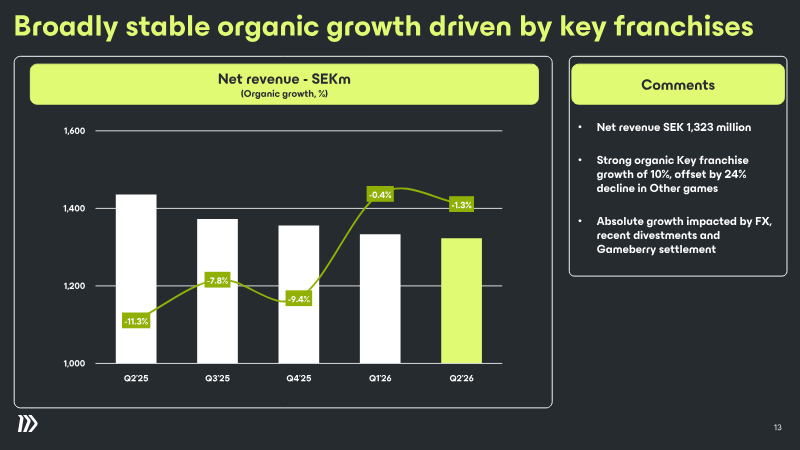
Margin expansion despite revenue decline Net revenue ▪ Group Adj. EBITDAC margin 27% (25%) (organic growth, %) despite organic revenue decline of -9.4% 1,356 ▪ Europe delivers BIG franchise new game launch & divests Narrative portfolio SEKm, (-9.4%) ▪ North America continues efficiency focus S EBITDAC Adj ▪ MENA & APAC lead growth (margin, %) SEKm (27%)
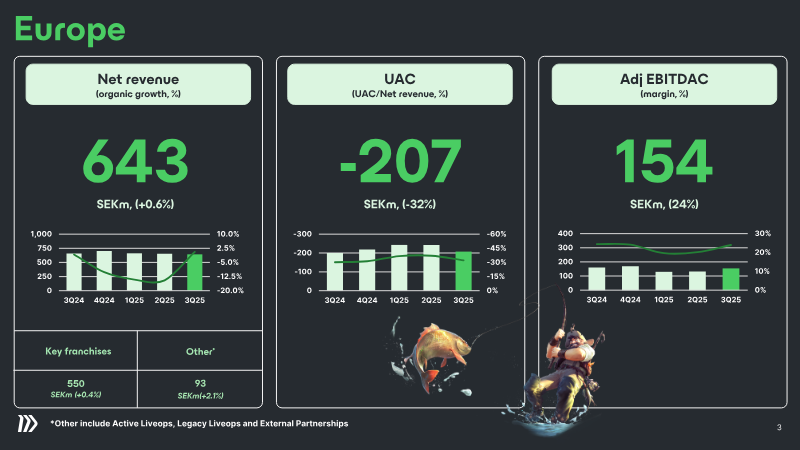
> **[Chart page]** This page contains visual data — view in PDF for the best experience. Net revenue UAC Adj EBITDAC (organic growth, %) (UAC/Net revenue, %) (margin, %) 622 - 227 94 SEKm, ( -5.7%) SEKm, ( -37%) SEKm, (15%) 1 000 7,5% -300 -60% 200 30% 750 1,5% -200 -45% 20% 500 -4,5% -30% 100 250 -10,5% -100 -15% 10% -16,5% 0 -22,5% 0 0% 0 0% 4Q24 1Q25 2Q25 3Q25 4Q25 4Q24 1Q25 2Q25 3Q25 4Q25 4Q24 1Q25 2Q25 3Q25 4Q25 Key franchises Other* 533 89 SEKm ( -3.5%) SEKm( -16.9%) *Other include Active Liveops, Legacy Liveops and External Partnerships 4
> **[Chart page]** This page contains visual data — view in PDF for the best experience. Net revenue UAC Adj EBITDAC (organic growth, %) (UAC/Net revenue, %) (margin, %) 197 - 88 23 SEKm, ( -31.3%) SEKm, ( -45%) SEKm, ( 12%) 600 0,0% -300 -80% 45 16% 450 -12,0% -225 -60% 30 12% 300 -150 -40% 8% 150 -24,0% -75 -20% 15 4% 0 -36,0% 0 0% 0 0% 4Q24 1Q25 2Q25 3Q25 4Q25 4Q24 1Q25 2Q25 3Q25 4Q25 4Q24 1Q25 2Q25 3Q25 4Q25 Key franchises Other* 151 46 SEKm ( -28.6%) SEKm( -38.8%) *Other include Active Liveops, Legacy Liveops and External Partnerships 5
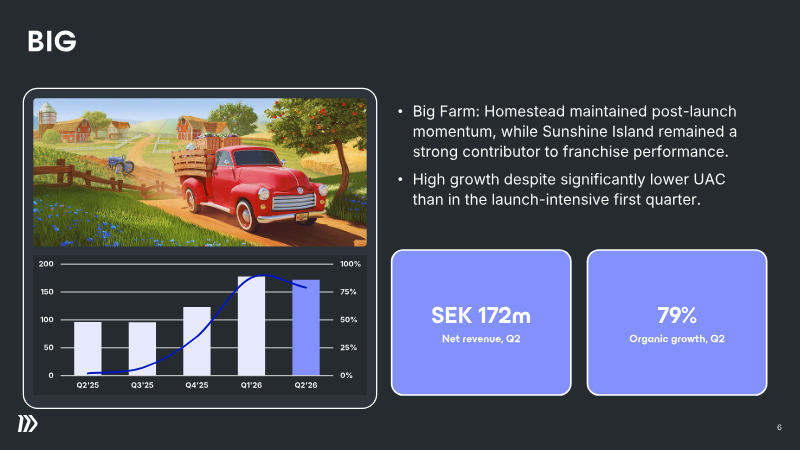
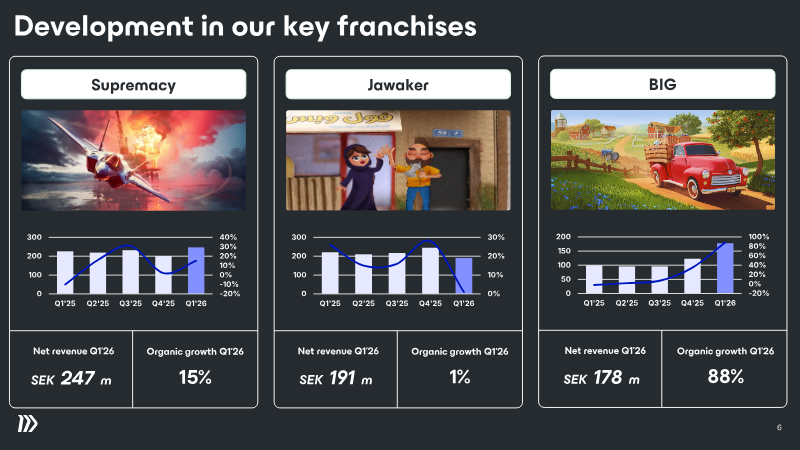
> **[Chart page]** This page contains visual data — view in PDF for the best experience. Net revenue UAC Adj EBITDAC (organic growth, %) (UAC/Net revenue, %) (margin, %) 537 - 40 288 SEKm , (+6.6%) SEKm, ( -8%) SEKm, (5 4 %) 600 10,0% -50 -8% 375 60% 450 8,0% -40 -6% 300 45% 300 6,0% -30 -4% 225 30% 4,0% -20 150 150 2,0% -10 -2% 75 15% 0 0,0% 0 0% 0 0% 4Q24 1Q25 2Q25 3Q25 4Q25 4Q24 1Q25 2Q25 3Q25 4Q25 4Q24 1Q25 2Q25 3Q25 4Q25 4Q24 1Q25 2Q25 3Q25 4Q25 Key franchises Other* 358 178 SEKm (+27.2%) SEKm( -20.2%) *Other include Active Liveops, Legacy Liveops and External Partnerships 6
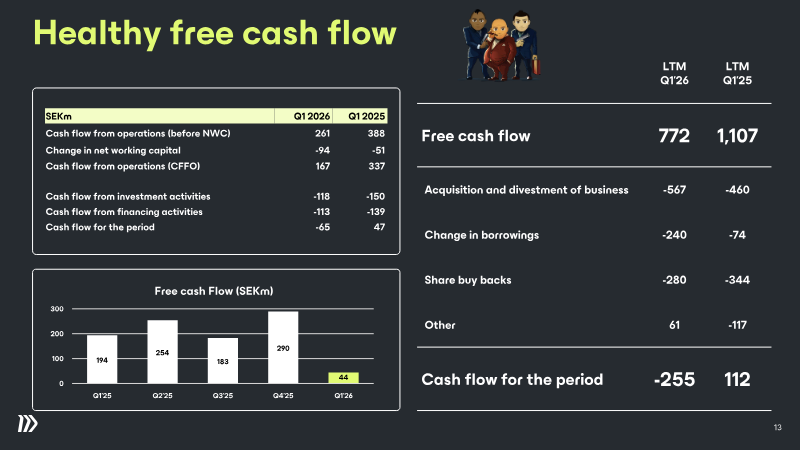
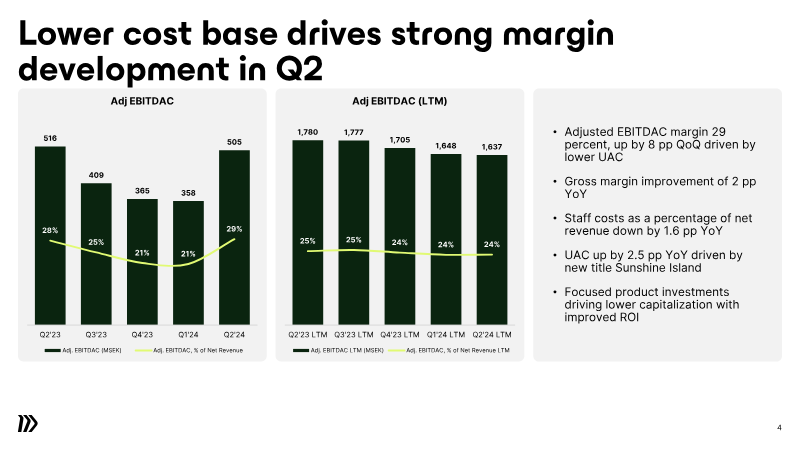
> **[Chart page]** This page contains visual data — view in PDF for the best experience. Net revenue UAC Adj EBITDAC Free cash flow (organic growth, %) (UAC/Net revenue, %) (margin, %) LTM 1,356 - 356 368 922 SEKm, ( -9.4%) SEKm, ( -26 %) SEKm, (27%) SEKm 1 800 0,0% -600 -40% 450 40% 1200 1 600 -4,0% -400 -30% 400 30% 900 1 400 -8,0% -20% 20% 600 1 200 -12,0% -200 -10% 350 10% 300 1 000 -16,0% 0 0% 300 0% 0 4Q24 1Q25 2Q25 3Q25 4Q25 4Q24 1Q25 2Q25 3Q25 Q425 4Q24 1Q25 2Q25 3Q25 Q425 4Q24 1Q25 2Q25 3Q25 Q425 Key franchises Other* 1,042 314 SEKm ( -3.9%) SEKm ( -23.6%) *Other include Active Liveops, Legacy Liveops and External Partnerships 7
The analysis demonstrates that the mobile‑gaming market expanded dramatically during the COVID‑19 pandemic, with global quarterly revenue reaching $33 billion in Q2 2020 and downloads climbing 39 % to 16 billion. The United States remains the dominant spend market, contributing 28 % of worldwide revenue in 2020 and generating $7 billion in Q1 2021, while emerging regions such as India (12 % of global installs) and Brazil drive download growth but lag in monetization. Hyper‑casual and shooter titles—PUBG Mobile, Garena Free Fire, Subway Surfers—consistently occupy top download positions worldwide. In 2020 and early 2021, revenue concentration persisted in mature markets (U.S., Japan, China), yet fast‑growing regions like Europe and Southeast Asia presented expanding opportunities. European revenue was led by Playrix ($700 M) and Supercell ($600 M), with Israeli publishers also in the top‑10, while installs remained near pandemic highs at roughly 4 billion in Q1 2021. In Asia, India’s explosive download growth (nearly 3 billion installs in Q3 2020) and Indonesia’s 26 % YoY rise positioned the region as the dominant market, with PUBG Mobile and Honor of Kings topping download charts. Despite a 44 % YoY decline in Chinese installs, mobile‑game spend there continued to rise, contributing to Asian revenue of $12 billion in Q1 2021. Genre‑level insights reveal hyper‑casual games as the fastest‑growing segment, expanding from 757 million installs in Q1 2018 to over 3.4 billion by Q1 2021 and accounting for more than 30 % of all mobile downloads that quarter. Freemium models dominate monetization, with 99 % of App Store revenue derived from free titles; subscription adoption remains a minority (≈29 %) among top U.S. games. Advertising revenue is heavily concentrated in puzzle and hyper‑casual titles, which captured over 30 % of ad spend across major networks in 2020. Playrix led overall ad spending, especially for its puzzle franchises, while Zynga’s acquisition of Rollic Games spurred a sharp increase in hyper‑casual ad spend on AdMob and Facebook. Overall, the data underscore a mobile‑gaming ecosystem where mature markets generate the bulk of revenue, emerging regions drive download growth, hyper‑casual and battle‑royale titles dominate user acquisition, and freemium monetization models—supported by advertising—remain the primary revenue engine.
The bulletin delivers a data‑driven assessment of the five most influential mobile game genres in Asia and MENA for 2022, combining a 9,000‑respondent survey from Niko Partners with AppMagic’s analytics of Apple and Google Play stores. The analysis covers China, India, Indonesia, Japan, Korea, Malaysia, Philippines, Saudi Arabia, Singapore, Thailand, UAE, Vietnam and Egypt, providing a comprehensive view of regional spending patterns, download volumes, and player demographics. RPGs dominate the market, generating 50 % more revenue than the other four genres combined and achieving the highest monetization score (7.7) thanks to strong spend in East Asia. Strategy games rank second in revenue and third in downloads, yet exhibit the lowest engagement score (5.2) due to shorter play sessions and lower player longevity. MOBAs deliver the second‑highest revenue per download (5.4) and lead in average weekly playtime, but their esports engagement is modest. Puzzle titles enjoy the largest download base (highest engagement score of 6.0) but suffer from low monetization and esports relevance. Battle Royale games, while generating the lowest total revenue, excel in esports metrics (score 9.5) and maintain high engagement levels. The methodology blends survey‑derived player profiles with AppMagic’s download, revenue, and esports viewership data across 21 metrics, weighted into four categories—monetization, engagement, esports appeal, and overall genre score. The resulting scores (1–10) rank RPG as the top genre overall, with Battle Royale leading in esports influence and Puzzle offering the broadest download reach. The bulletin concludes that developers targeting these markets should tailor monetization strategies to RPG’s high spend, leverage MOBAs’ loyal user base, and capitalize on Battle Royale’s esports traction.
The global mobile gaming market experienced an unprecedented surge during the 2020–2021 period, fueled by pandemic-related shifts in consumer behavior that accelerated both spending and engagement. By early 2021, quarterly consumer spending reached $22 billion, representing a 25% year-over-year increase. While the United States maintains its position as the primary revenue generator, Asia remains the dominant force in total download volume, led by high adoption rates in India and Indonesia. Europe has also demonstrated significant growth, particularly in Germany, where social and multiplayer titles have sustained long-term engagement even as initial pandemic-era download spikes began to normalize. Monetization remains heavily concentrated, with the top five global markets accounting for 77% of total spending. The freemium model continues to define the industry, generating 99% of App Store revenue, while premium titles face a continued decline. Although one-time in-app purchases remain the standard, subscription models are gaining momentum, currently utilized by 29% of top-grossing titles. Advertising remains a critical revenue stream, particularly within the hypercasual and puzzle genres, which lead the market in ad publishing volume and network spend. Major industry players like Zynga and Playrix continue to dominate the share of voice, though developers are increasingly cautious as they navigate the evolving landscape of user privacy and advertising attribution. Looking toward 2023, the industry is projected to reach $117 billion in consumer spending and 67.2 billion annual downloads. While role-playing games maintain their status as the highest-grossing genre, hypercasual titles continue to drive the majority of download volume. Future growth is expected to be particularly robust in emerging markets across Southeast Asia and Europe, which are anticipated to outpace global revenue growth rates. As the market matures, the strategic shift toward diversified monetization—balancing freemium, subscription, and ad-based models—will be essential for developers to sustain growth in a post-pandemic environment.
This financial presentation details GREE, Inc.’s performance for the third quarter of fiscal year 2018, ending March 31, 2018. The primary thesis centers on a strategic transition toward a three-pillar business model comprising mobile gaming, advertising and media, and a newly established live entertainment segment. Geographically, the report covers the Japanese domestic market and ongoing expansion efforts into North America, with future plans for Asia and Europe. Financial results for the quarter show net sales of ¥17.9 billion and operating income of ¥2.8 billion. While the company missed its revenue targets due to delays in title launches and business acquisitions, it exceeded profit expectations through aggressive cost reductions. Fixed costs were reduced by ¥500 million, and advertising spending was optimized, resulting in a 15% operating margin. For the fourth quarter, the company forecasts a slight revenue increase to ¥18.5 billion, supported by the global rollout of titles like DanMachi and the domestic performance of new releases such as In Love with News and Puchiguru Love Live!. A significant strategic shift highlighted is the entry into the live entertainment business, specifically focusing on the Virtual YouTuber (VTuber) market. GREE intends to leverage its existing 3D engineering capabilities from its gaming and VR divisions to manage production, distribution, and IP development for VTubers. Additionally, the company is diversifying its gaming portfolio by moving successful mobile IPs like Another Eden to consoles, including the Nintendo Switch. In the media segment, the travel application aumo is noted for its high category ranking, signaling steady growth in vertical media and client acquisition.