Updated Apr 30, 2026 by Tencent
Financial
Published by Tencent
Tencent demonstrated robust financial health and operational expansion during the first half of 2005, characterized by a strategic pivot toward Internet value-added services. Total revenues reached RMB 634.1 million, representing a 20.1% year-over-year increase, while net profit for the period climbed to RMB 283.9 million. This profitability was bolstered by a significant one-time deferred tax credit of RMB 88.6 million and a 92.8% quarter-over-quarter profit surge in the second quarter. These gains effectively offset a decline in mobile and telecommunications value-added services, which faced headwinds from regulatory shifts and billing adjustments. The company’s growth was underpinned by massive user engagement, with registered instant messaging accounts reaching 438.4 million and peak simultaneous online users hitting 16.2 million. To support this scale, the organization doubled its workforce to 1,648 employees, leading to a corresponding doubling of remuneration costs to RMB 134 million. Increased investments in research and development and new product launches remained central to the company’s strategy, even as operating expenses rose. The financial reporting for this period marked a transition to International Financial Reporting Standards, specifically adopting IFRS 2 to account for share-based compensation via the Black-Scholes model. Geographically focused on the Chinese market, the company navigated a changing macroeconomic landscape, including the decoupling of the RMB from the USD in July 2005, which introduced new foreign exchange risks. Corporate governance remained stable, with MIH QQ (BVI) Limited maintaining its position as the largest shareholder. Although the company deviated from standard governance practices by unifying the Chairman and CEO roles, the board maintained that this structure was essential for maintaining agility and operational stability within the rapidly evolving information technology sector.
Interim Results The board of directors (the “Board”) of Tencent Holdings Limited (the “Company”) Holdings is pleased to announce the unaudited consolidated results of the Company and its subsidiaries (collectively, the “Group”) for the three and six months ended 30 June 2005. These interim results have been reviewed by Limited PricewaterhouseCoopers, the auditors of the Company (the “Auditors”), in accordance with the International Standard on Review Engagements 2400 “Engagements to review financial statements” issued by the International Auditing and Assurance Standards Board, and by the Audit Committee of the Company, comprising a majority of the independent non-executive directors of the Company. Condensed Consolidated Balance Sheet As at 30 June 2005 and 31 December 2004 Audited (as restated) Unaudited (Note) 30 June 31 December 2005 2004 Note RMB’000 RMB’000 ASSETS Non-current assets Fixed assets 5 190,653 142,080 Intangible assets 6 18,055 — Held-to-maturity investments 167,358 167,374 Deferred tax assets 13 86,748 — 462,814 309,454 Current assets Accounts receivable 7 232,358 192,725 Prepayments, deposits and other receivables 32,910 50,347 Financial assets held for trading 8 675,200 666,900 Term deposits with initial term of over three months 547,459 784,054 Cash and cash equivalents 1,124,492 859,841 2,612,419 2,553,867 Total Assets 3,075,233 2,863,321 2005 Interim Report
Condensed Consolidated Balance Sheet (Continued) As at 30 June 2005 and 31 December 2004 Audited (as restated) Unaudited (Note) 30 June 31 December 2005 2004 Note RMB’000 RMB’000 EQUITY Shareholders’ equity Share capital 9 193 192 Share premium 9 1,781,904 1,777,721 Share-based compensation reserve 1, 10 15,426 5,583 Other reserves 66,609 52,442 Retained earnings 954,024 816,300 2,818,156 2,652,238 LIABILITIES Non-current liabilities Deferred tax liabilities 13 358 — Current liabilities Accounts payable 1,401 2,506 Other payables and accruals 11 110,006 79,912 Dividends payable — 145 Current income tax liabilities 18,119 5,648 Other tax liabilities 13,269 59,650 Deferred revenue 12 113,924 63,222 256,719 211,083 Total Liabilities 257,077 211,083 Total Equity and Liabilities 3,075,233 2,863,321 Note: The retained earnings and share-based compensation reserve as at 31 December 2004 have been restated as a result of the adoption of IFRS 2 (issued 2004), “Share-based Payment” (see Note 1.1).
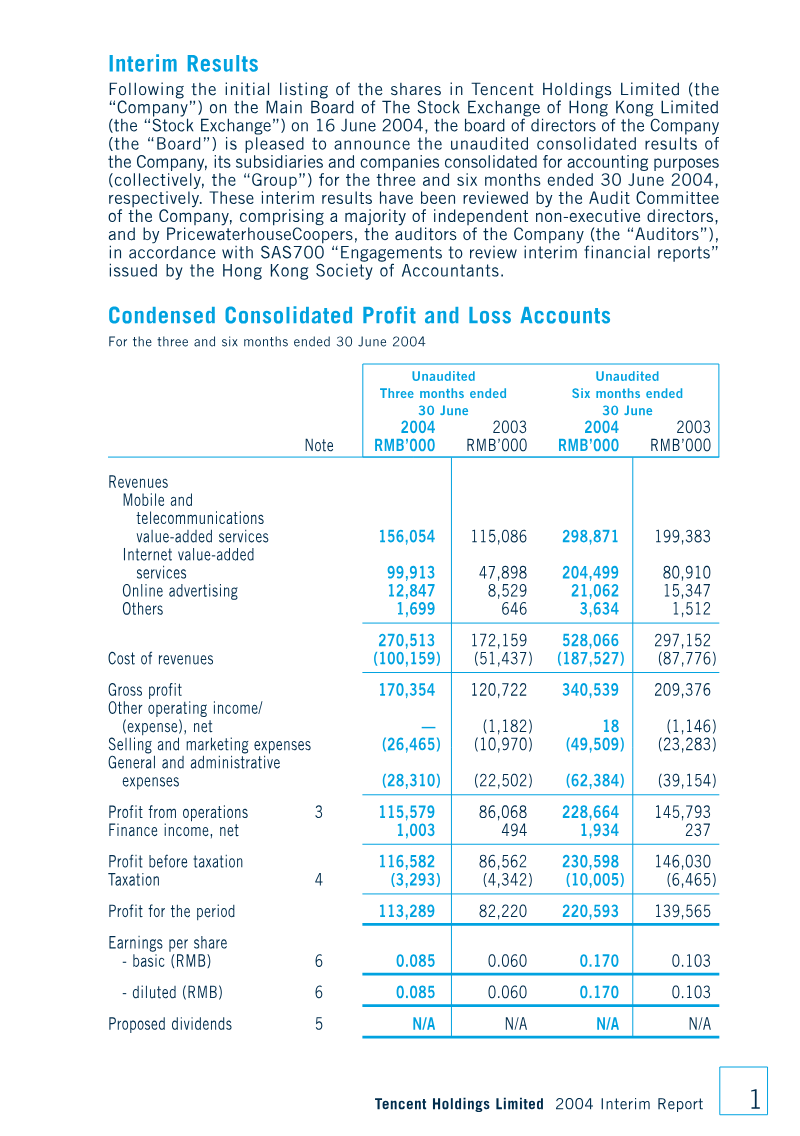
> **[Chart page]** This page contains visual data — view in PDF for the best experience. Condensed Consolidated Income Statements For the three and six months ended 30 June 2005Unaudited Unaudited Holdings Three months Six months Limited ended 30 June ended 30 June (as restated) (as restated) (Note) (Note) 2005 2004 2005 2004 Note RMB’000 RMB’000 RMB’000 RMB’000 Revenues Internet value-added services 169,883 99,913 318,947 204,499 Mobile and telecommunications value-added services 136,498 156,054 270,769 298,871 Online advertising 25,170 12,847 40,463 21,062 Others 2,114 1,699 3,957 3,634 333,665 270,513 634,136 528,066 Cost of revenues (108,963) (100,652) (210,891) (188,315) Gross profit 224,702 169,861 423,245 339,751 Other gains, net 14 15,148 1,061 27,053 1,928 Selling and marketing expenses (45,501) (26,773) (84,014) (50,005) General and administrative expenses (75,596) (28,957) (144,122) (63,436) Operating profit 118,753 115,192 222,162 228,238 Finance (costs)/income, net (51) (18) (166) 108 Profit before income tax 118,702 115,174 221,996 228,346 Income tax benefit/(expenses) 16 68,271 (3,293) 61,931 (10,005) Profit for the period 186,973 111,881 283,927 218,341 Earnings per share for profit attributable to the equity holders of the Company during the period (expressed in RMB per share) - basic 17 0.106 0.084 0.161 0.169 - diluted 17 0.103 0.083 0.156 0.168 Note: The cost of revenues, selling and marketing expenses and general and administrative expenses for the three and six months ended 30 June 2004 have been restated as a result of the adoption of IFRS 2 (issued 2004), “Share-based Payment” (see Note 1.1).
69 - diluted 17 0.103 0.083 0.156 0.168 Note: The cost of revenues, selling and marketing expenses and general and administrative expenses for the three and six months ended 30 June 2004 have been restated as a result of the adoption of IFRS 2 (issued 2004), “Share-based Payment” (see Note 1.1). 2005 Interim Report
Condensed Consolidated Statement of Changes in Shareholders’ Equity For the six months ended 30 June 2005 Unaudited Share-based Share Share compensation Capital Statutory Retained capital premium reserve reserve reserves earnings Total RMB’000 RMB’000 RMB’000 RMB’000 RMB’000 RMB’000 RMB’000 Balance at 1 January 2005, as previously reported 192 1,777,721 — 20,000 32,442 821,883 2,652,238 Effect of adoption of IFRS 2 (Note 1.1) — — 5,583 —— — (5,583 ) — Balance at 1 January 2005, as restated 192 1,777,721 5,583 20,000 32,442 816,300 2,652,238 Profit for the period ————— 283,927 283,927 Employees share option scheme: - value of employee services — — 9,843 ——— 9,843 - proceeds from shares issued 1 4,183 ———— 4,184 Profit appropriations to statutory reserves ———— 14,167 (14,167 ) — Dividend relating to 2004 (Note 18) ————— (132,036) (132,036) Balance at 30 June 2005 193 1,781,904 15,426 20,000 46,609 954,024 2,818,156 Unaudited (as restated) Share-based Share Share compensation Capital Statutory Retained capital premium reserve reserve reserves earnings Total RMB’000 RMB’000 RMB’000 RMB’000 RMB’000 RMB’000 RMB’000 Balance at 1 January 2004 138 15,261 — 20,000 3,653 432,905 471,957 Profit for the period, as restated ————— 218,341 218,341 Issue of shares in an initial public offering (“IPO”) 45 1,656,687 ———— 1,656,732 Shares issuance expenses — (140,262 ) ———— (140,262) Employees share option scheme: - value of employee services, as restated — — 2,252 ——— 2,252 Dividend relating to 2003 ————— (28,935 ) (28,935 )
—— 218,341 218,341 Issue of shares in an initial public offering (“IPO”) 45 1,656,687 ———— 1,656,732 Shares issuance expenses — (140,262 ) ———— (140,262) Employees share option scheme: - value of employee services, as restated — — 2,252 ——— 2,252 Dividend relating to 2003 ————— (28,935 ) (28,935 ) Balance at 30 June 2004 183 1,531,686 2,252 20,000 3,653 622,311 2,180,085
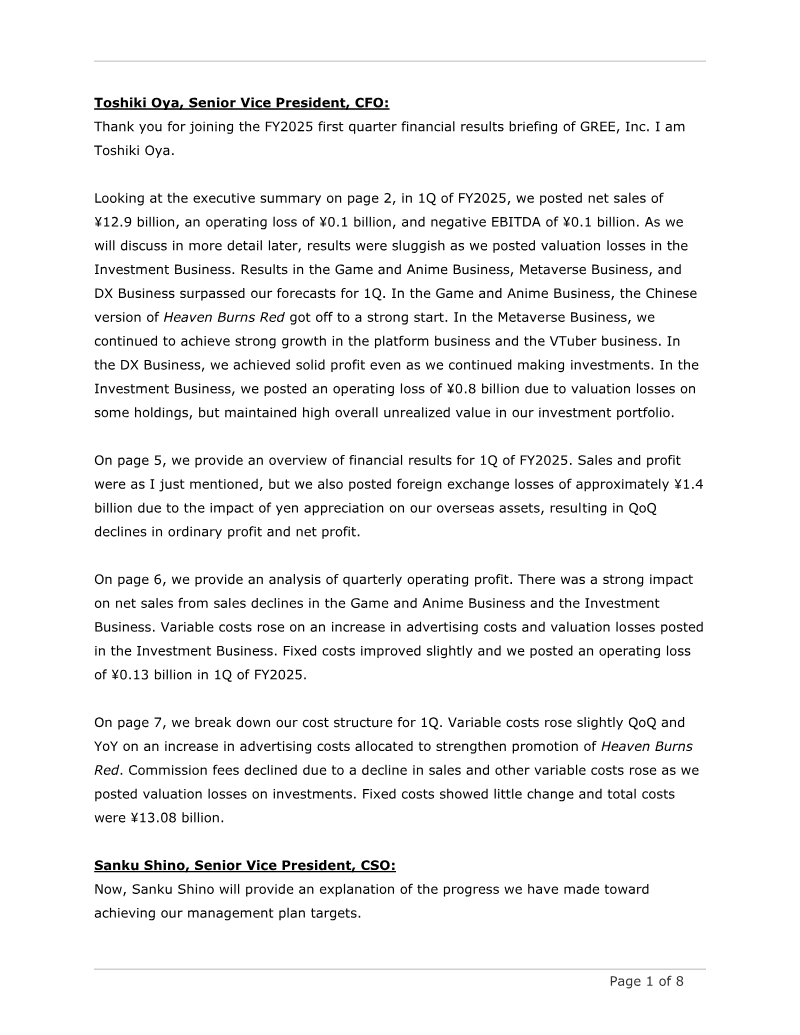
The briefing presents FY2025 first‑quarter results for GREE, Inc., highlighting a net sales figure of ¥12.9 billion and an operating loss of ¥0.1 billion, largely driven by valuation losses in the Investment Business and foreign‑exchange impacts from yen appreciation. While Game and Anime, Metaverse, and DX segments exceeded forecasts—thanks to strong performance of the Chinese version of *Heaven Burns Red*, continued growth in platform and VTuber services, and solid DX profitability—the Investment Business posted a ¥0.8 billion operating loss due to crypto‑asset valuation declines and write‑downs on maturing funds. Variable costs rose from advertising spend and investment losses, whereas fixed costs remained relatively stable. Geographically, the company operates globally with significant overseas assets; the report notes a ¥1.4 billion FX loss affecting ordinary and net profit. The management plan positions Metaverse and DX as continuous‑growth businesses targeting a 120–140 % CAGR in operating profit, while Game and Anime are treated as long‑term investment assets. Medium‑term targets emphasize aggressive investment in VTuber talent and DX product development, with expectations of profitability from the VTuber segment by FY2026 and accelerated growth in DX by FY2027. Methodologically, the briefing relies on quarterly financial statements, segment‑level performance data, and investment portfolio valuations. The Investment Business’s dual GP/LP structure is explained to contextualize volatility, with an emphasis on long‑term stability despite short‑term losses. Overall, the company projects FY2025 results in line with prior forecasts but anticipates slightly lower Game and Anime sales, offset by higher operating profit from continuous‑growth segments.
Tencent Holdings Limited demonstrated robust financial expansion during the first half of 2008, characterized by an 84.8% year-over-year revenue increase to RMB 3.03 billion. This growth was underpinned by a significant rise in active user accounts, which reached 341.9 million by mid-year. Profit for the period climbed to RMB 1.19 billion, reflecting a strong 40.8% profit margin. The company’s performance was primarily driven by the scaling of internet value-added services, particularly online gaming and community platforms, alongside sustained growth in mobile telecommunications and online advertising. Operational scaling necessitated increased investment in human capital and infrastructure, leading to higher employee benefit costs and research and development expenditures. The workforce expanded to 5,168 employees, with total remuneration costs reaching RMB 593.6 million. Despite these rising operational expenses and the transition to a unified 25% PRC enterprise income tax rate, the company maintained a solid balance sheet with total assets of RMB 8.20 billion and a stable gearing ratio of 24%. Strategic initiatives during this period included the acquisition of mobile value-added service providers and equity interests in various international and domestic gaming entities, further diversifying the company's portfolio. The company navigated a complex macroeconomic environment, including the appreciation of the RMB against the USD and HKD, which resulted in exchange losses, and potential headwinds from a slowing Chinese economy. Governance remained stable, with MIH China (BVI) Limited serving as the largest shareholder at 35.08%. Through a combination of share repurchases and a share award scheme, the company continued to manage its capital structure and incentivize staff, ensuring alignment with long-term growth objectives while adhering to International Accounting Standard 34.
Tencent Holdings Limited delivered a robust fiscal year in 2010, reporting consolidated revenue of RMB 19.65 billion—an increase of nearly 58% over 2009—and net profit attributable to equity holders of RMB 8.05 billion, up 56% year‑on‑year. Growth was driven primarily by the online gaming segment, which generated RMB 15.48 billion in revenue (up 62%) and by a rapidly expanding user base, with instant‑messaging accounts reaching 647.6 million and Qzone users at 492 million. Mobile services, value‑added telecom offerings, and advertising also contributed to the revenue mix, while operating margins improved to 50% of earnings. Liquidity and capital structure remained strong. Total financial resources rose to RMB 22.1 billion, with cash and equivalents at RMB 10.4 billion and net financial resources of RMB 17.8 billion after short‑term borrowings. Capital expenditures doubled to RMB 2.01 billion, reflecting investment in infrastructure and new platforms. Share‑based compensation was significant; the company granted 4.85 million award shares in 2010, with no director awards, and maintained a share‑option pool of roughly 43 million shares. Governance structures were reinforced through independent remuneration, audit, and investment committees, and the board maintained a majority of non‑executive directors. Financial risk exposure was dominated by foreign‑exchange and interest‑rate sensitivities, with a 5 % currency swing estimated to affect profit by RMB 83 million. The gearing ratio increased from 30% to 39%, driven largely by bank borrowings, while fair‑value assets—primarily equity securities—remained level 2 instruments. Overall, Tencent’s 2010 performance underscored its ability to scale user engagement and diversify revenue streams while maintaining solid liquidity, disciplined capital allocation, and robust governance practices.
Giant Network’s 2025 annual report demonstrates a robust year‑over‑year performance, with total revenue escalating 72.7 % to ¥5.05 billion and net profit attributable to shareholders rising 23.1 % to ¥1.76 billion. Operating cash flow surged by 188.6 %, underscoring strong liquidity generation. The company’s dual‑core strategy—leveraging the MMORPG IP “征途” and the casual title “超自然行动组”—drives growth, supported by AI‑enabled development and cross‑platform expansion. Despite these gains, recent non‑recurring losses have yet to turn positive, creating some uncertainty about long‑term profitability. Regulatory developments in China have accelerated a focus on original IP and digital‑culture products. Government policies encourage embedding traditional culture into game design, boosting AI and cloud R&D, and expanding overseas digital content. Giant Network aligns with these directives through a research‑and‑operations model, heavy IP investment, and compliance tightening under new child‑online‑protection rules. Financially, operating profit rose 54 % to ¥829 million, while net profit increased 93 % to ¥947 million, largely due to higher investment income and lower tax expense. R&D spending more than doubled, reflecting intensified product development. Other comprehensive income swung from a positive ¥219 million to a negative ¥220 million, driven by fair‑value changes and credit impairment losses. The group maintained a conservative asset‑liability ratio, rising from 12.76 % to 18.67 %, and retained over 80 % voting control through founder‑controlled entities. Key findings highlight that core gaming revenue remains strong, investment income is mixed, and non‑recurring items significantly impact overall profitability. The report covers China exclusively, focusing on the 2025 fiscal year and encompassing gaming operations, IP development, regulatory compliance, and financial risk management.