Updated Jun 10, 2026 by Tencent
Financial
Published by Tencent
Tencent Holdings Limited’s 2006 annual report demonstrates a dramatic expansion of its internet‑based business, with total revenues rising 96.3 % to RMB 2,800 million and net profit increasing 119 % to RMB 1.06 billion. Growth is driven primarily by a 132 % increase in Internet value‑added services and a 136 % jump in online advertising, while mobile/telecom services also contributed significantly. Operating profit surged to RMB 1.16 billion, and the net margin improved from 34 % to 38 %. Cash and investments totaled RMB 3.22 billion, largely in U.S. dollar‑denominated assets that expose the group to Renminbi appreciation risk. The company’s financial health is reinforced by a strong balance sheet: total assets rose to RMB 1.77 billion, and the group maintained no interest‑bearing borrowings as of year‑end. Shareholder value initiatives included a final dividend of HKD 0.12 per share, the repurchase and cancellation of 18.4 million shares during 2006, and a cumulative share buyback of over 32 million shares since its IPO. Governance structures feature a board with executive, non‑executive and independent directors, audit and remuneration committees, and compliance with Hong Kong listing rules. Key executives hold significant share positions through BVI entities, while Naspers‑controlled MIH QQ holds 35.6 % of issued shares. Geographically, operations are concentrated in mainland China (≈70 % of segment assets), with subsidiaries and customers spread across Asia, Africa, and the Mediterranean under Naspers’ umbrella. The report covers fiscal year 2006, detailing revenue streams from internet services, mobile telecoms, and online advertising, and outlines accounting policies such as IAS 39 adoption, fair‑value measurement for available‑for‑sale securities, and share‑based compensation recognition. Overall, Tencent’s 2006 performance reflects rapid scaling of core digital services, robust profitability, and a commitment to shareholder returns within a growing but still low‑penetration Chinese internet market.
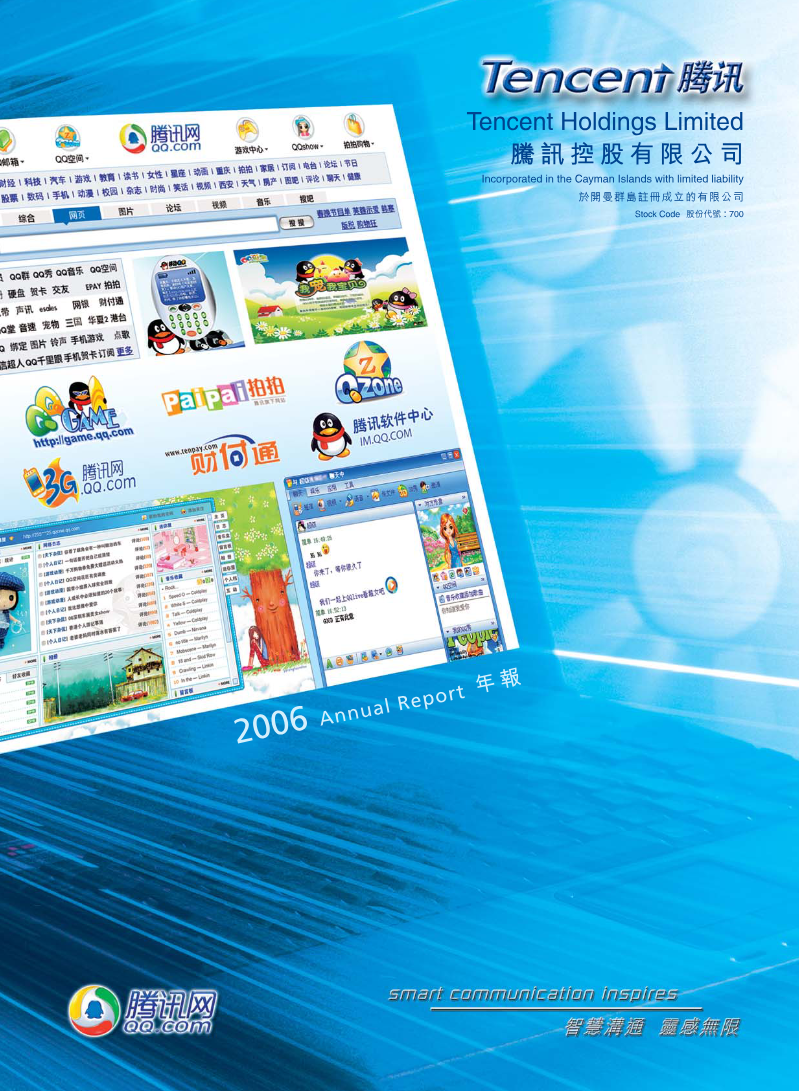
Tencent Hifl FLX QQshow- #818R9#- Tencent Holdings Limited $- QQ QQ.com #à TEBAA Incorporated in the Ca man Islands with limited liabilit 53 BH ie\ SU 5 tveWTEATE RA Stock Code 700 QQQ0 BaQQ * EPAY #89 esdes E M O *H8 O WE RK ME F A OTTE Palpal1018 zone CAME BERTA http/geq.com IM.Q.COM HIT ww.tenpay.com BEX .QQ.com 5 ER IR o IRTAR GE7R 15 18 16:9:25 BIXAR BR E WRW EiY BIAR mH B*7. HRAT BG8088 IARO R A.AB 10 R IM E&3 00 B ERR n-8E e aSERS ITABR RI M16:52: H B BITRL A BIA T AGUIEE-OS WXE 2006 Annual Report HTA smart communication inspires [email protected] HUHD E#R
Pu HL PAE0IN DA milEf- CONN- 0024- 86.76m 3#ò O0show HS5I R 0AIINIRIAIDAIMNLSIAHICIAINIIOIABIRIT8 BAIAAIROIRMTTLICD MOIOOIHEIEIL ms 7O (SOSOMH #8 TTE mut 124 INM CHsAARUm E3o JTioaHt*e LNmm B ooltn 4m an oot oo coms oopm HIHHTTETT CEHDLAE 2ILERAIM oovdo Mm mm wa M Rx oRo4tE EPAT MM MMI 5#5R# TEIE AMMA oo38 08 o * s m 98:ms ootH UHoo MTHA nATat AR E FEMIAMWSAOOFERPAMAIAPS CONTENTS Page Corporate Information 2 Financial Summary 3 Chairman’s Statement 4 Management Discussion and Analysis 8 Directors’ Report 20 Corporate Governance Report 34 Independent Auditor’s Report 43 Consolidated Balance Sheet 45 Balance Sheet 47 Consolidated Income Statement 49 Consolidated Statement of Changes in Shareholders’ Equity 50 Consolidated Cash Flow Statement 51 Notes to the Consolidated Financial Statements 52
CORPORATE INFORMATION DIRECTORS HEAD OFFICE AND PRINCIPAL PLACE OF BUSINESS Executive Directors 5th to 10th Floor FIYTA Hi-tech Building Ma Huateng Gaoxinnanyi Avenue Lau Chi Ping Martin (Appointed on 21 March 2007) Southern District of Hi-tech Park Zhang Zhidong Shenzhen, 518057 The PRC Non-Executive Directors Antonie Andries Roux PRINCIPAL PLACE OF BUSINESS IN HONG KONG Charles St Leger Searle Room 3002, 30th Floor Independent Non-Executive Directors Far East Finance Centre 16 Harcourt Road Li Dong Sheng Hong Kong Iain Ferguson Bruce Ian Charles Stone CAYMAN ISLANDS PRINCIPAL SHARE REGISTRAR AND TRANSFER OFFICE AUDIT COMMITTEE Butterfield Fund Services (Cayman) Limited Iain Ferguson Bruce (Chairman) Butterfield House Ian Charles Stone 68 Fort Street, P.O. Box 705, George Town Charles St Leger Searle Grand Cayman, Cayman Islands REMUNERATION COMMITTEE HONG KONG BRANCH SHARE REGISTRAR AND Antonie Andries Roux (Chairman) TRANSFER OFFICE Li Dong Sheng Computershare Hong Kong Investor Services Limited Ian Charles Stone Shops 1712-1716, 17th Floor, Hopewell Centre 183 Queen’s Road East AUDITORS Hong Kong PricewaterhouseCoopers WEBSITE Certified Public Accountants www.tencent.com PRINCIPAL BANKER The Hongkong and Shanghai Banking Corporation Limited STOCK CODE REGISTERED OFFICE Cricket Square, Hutchins Drive, P.O. Box 2681 Grand Cayman KY 1-1111, Cayman Islands 2 Tencent Holdings Limited Annual Report 2006
> **[Chart page]** This page contains visual data — view in PDF for the best experience. MANAGEMENT DISCUSSION FINANCIAL SUMMARY CONDENSED CONSOLIDATED INCOME STATEMENTS Year ended 31 December 2002 2003 2004 2005 2006 (Restated) RMB’000 RMB’000 RMB’000 RMB’000 RMB’000 Revenues 263,107 734,957 1,143,533 1,426,395 2,800,441 Gross profit 191,433 505,409 725,408 956,526 1,983,379 Profit before income tax 143,765 338,209 463,653 437,055 1,116,771 Profit for the year 140,707 322,196 441,119 485,362 1,063,800 CONDENSED CONSOLIDATED BALANCE SHEETS As at 31 December 2002 2003 2004 2005 2006 RMB’000 RMB’000 RMB’000 RMB’000 RMB’000 Assets Non-current assets 38,851 91,139 309,454 763,495 916,138 Current assets 174,815 484,577 2,553,867 2,663,627 3,734,434 Total assets 213,666 575,716 2,863,321 3,427,122 4,650,572 Equity and liabilities Shareholders’ equity 197,950 471,957 2,652,238 2,928,413 3,717,756 Non-current liabilities 3,058 988 – 810 64,969 Current liabilities 12,658 102,771 211,083 497,899 867,847 Total liabilities 15,716 103,759 211,083 498,709 932,816 Total equity and liabilities 213,666 575,716 2,863,321 3,427,122 4,650,572 Tencent Holdings Limited Annual Report 3 2006
CHAIRMAN’S STATEMENT HL qo.com Ma Huateng Chairman I am pleased to present our annual report for the year ended 31 December 2006 to the shareholders. OPERATING RESULTS Total revenues for the year ended 31 December 2006 increased by 96.3 % to RMB2,800.4 million, compared with the same period last year. Revenues from our Internet value-added services increased by 132.0% to RMB1,825.3 million, revenues from our mobile and telecommunications value-added services increased by 35.3% to RMB700.1 million and revenues from online advertising increased by 136.4% to RMB266.7 million. The Group’s audited profit for the year ended 31 December 2006 was RMB1,063.8 million, an increase of 119.2% compared with the results for the year ended 31 December 2005. Basic and diluted earnings per share for the year ended 31 December 2006 were RMB0.603 and RMB0.585 respectively. 4 Tencent Holdings Limited Annual Report 2006
CHAIRMAN’S STATEMENT BUSINESS REVIEW AND OUTLOOK During 2006, the China Internet market continued to grow at a rapid pace. According to China Internet Network Information Center (“CNNIC”), China’s Internet population grew by 23.4% in 2006 to reach 137 million. This growth rate was higher than the 18.1% registered in 2005. In particular, the number of broadband Internet users increased at a higher rate of 41.1% to reach 91 million, representing a broadband penetration of 66%. Broadband penetration is important as it allows the users to enjoy richer Internet services such as online games, video and other multimedia applications. Despite the strong growth, Internet penetration in China was only at 10.5%, a rate that is much lower than many other countries and that represents strong potential for future growth. We see both opportunities and challenges in this dynamic market. In 2006, we experienced a strong year of growth in our businesses, reaping the fruits of our investments in research and development as well as new products in 2005. On the other hand, we also faced intensifying competition as well as increase in “spam” messages and user account thefts in our IM service. In order to manage these challenges and to stay ahead in this market, we are committed to continue investing in research and development to enhance our existing products and launch new products. We are also determined to use every means to fight against spamming and user account theft. We believe our strategy of focusing on our users’ experience and building sustainable franchises will pay off for us over the long run.
Giant Network’s 2025 annual report demonstrates a robust year‑over‑year performance, with total revenue escalating 72.7 % to ¥5.05 billion and net profit attributable to shareholders rising 23.1 % to ¥1.76 billion. Operating cash flow surged by 188.6 %, underscoring strong liquidity generation. The company’s dual‑core strategy—leveraging the MMORPG IP “征途” and the casual title “超自然行动组”—drives growth, supported by AI‑enabled development and cross‑platform expansion. Despite these gains, recent non‑recurring losses have yet to turn positive, creating some uncertainty about long‑term profitability. Regulatory developments in China have accelerated a focus on original IP and digital‑culture products. Government policies encourage embedding traditional culture into game design, boosting AI and cloud R&D, and expanding overseas digital content. Giant Network aligns with these directives through a research‑and‑operations model, heavy IP investment, and compliance tightening under new child‑online‑protection rules. Financially, operating profit rose 54 % to ¥829 million, while net profit increased 93 % to ¥947 million, largely due to higher investment income and lower tax expense. R&D spending more than doubled, reflecting intensified product development. Other comprehensive income swung from a positive ¥219 million to a negative ¥220 million, driven by fair‑value changes and credit impairment losses. The group maintained a conservative asset‑liability ratio, rising from 12.76 % to 18.67 %, and retained over 80 % voting control through founder‑controlled entities. Key findings highlight that core gaming revenue remains strong, investment income is mixed, and non‑recurring items significantly impact overall profitability. The report covers China exclusively, focusing on the 2025 fiscal year and encompassing gaming operations, IP development, regulatory compliance, and financial risk management.
Tencent Holdings’ 2011 financial year was marked by a sharp expansion of its core internet platform, with consolidated revenues rising 45 % to RMB 28.5 billion and operating profit increasing 24.6 % to RMB 12.3 billion. The growth was driven primarily by internet value‑added services (IVAS) and mobile telecommunications services, which together accounted for 80 % of sales. Online gaming revenue surged 66 %, propelled by flagship titles such as *Cross Fire* and *League of Legends*, while social networking platforms—QQ.com, Qzone, Pengyou and Tencent Microblog—expanded user bases to 373 million registered users and 68 million daily active users. Total assets doubled from RMB 35.8 billion to RMB 56.8 billion, largely due to a jump in current assets and non‑current investments, including significant equity stakes in eLong, Kingsoft and other associates. Capital expenditures more than doubled to RMB 4.16 billion, reflecting investment in infrastructure and acquisitions such as Riot Games and Gamegoo, which generated goodwill of RMB 3.8 billion. Net profit attributable to equity holders rose 26.7 % to RMB 10.2 billion, with earnings per share reaching RMB 5.61 basic. Governance remained robust: the board met quarterly, retained a majority of non‑executive directors and three independent members, and maintained COSO‑based internal controls with no material deficiencies. Share‑based compensation expanded markedly—over 7 million options exercised and a share award pool of nearly 16 million shares outstanding—while dividend policy remained conservative with a final dividend of HKD 0.75 per share. Geographically, operations were concentrated in China through subsidiaries such as Tencent Computer and Tencent Technology, with the group’s legal domicile in the Cayman Islands and listing on Hong Kong. The period covered 2011, with a focus on internet services, mobile telecommunications, online gaming and advertising within the Chinese market.
Pearl Abyss achieved a record‑breaking first quarter of 2026, driven primarily by the launch of Crimson Desert. Operating revenue surged to KRW 328.5 billion, a 419.8 % year‑over‑year increase and 382.4 % quarter‑on‑quarter rise, while operating profit climbed to KRW 212.1 billion and net profit reached KRW 170.0 billion, supported by favorable foreign‑exchange gains and efficient marketing spend. Crimson Desert dominated sales, generating KRW 266.5 billion and accounting for 81 % of total revenue, with a balanced split between PC and console. The title achieved rapid early‑stage sales milestones—2 million copies on day one, 5 million within 26 days—and maintained strong momentum through continuous content updates. Black Desert contributed KRW 61.6 billion, maintaining stable quarterly performance through content optimization and seasonal events across PC, console, and mobile platforms. Operating expenses rose 72.7 % QoQ to KRW 116.4 billion, largely due to increased commissions (193.1 % QoQ) and advertising spend (151.6 % QoQ) linked to Crimson Desert’s launch, while labor costs increased 28.9 % QoQ because of temporary hires for the new IP. The company projects 2026 operating revenue between KRW 879.0–975.4 billion, with operating profit expected to reach KRW 487.6–572.6 billion and margin improving to 55.5–58.7 %. Planned releases include DokeV (pre‑production) and Plan 8 (conceptualization), aiming to sustain a new title every 2–3 years. A subsidiary sale of Fenris Creations to its management was completed in May 2026, with future collaboration opportunities retained.
Archosaur Games, a Hong Kong‑listed mobile‑game developer incorporated in the Cayman Islands and majority owned by Tencent and Perfect World, reported a 14.3 % revenue rise to RMB 1,304.4 million in FY 2025, driven by the launches of Dragon Raja: Cassell Gate and Immortal Skywalker in China. Gross profit climbed 11.8 % to RMB 923.7 million, but the margin slipped to 70.8 % because of higher IP‑holder commissions on licensed titles. Operating loss narrowed sharply to RMB 91.1 million from a ¥341.4 million loss in 2024, largely due to a 19 % cut in selling and marketing expenses; R&D spend remained flat. Net loss improved to RMB 36.7 million, an 87.2 % reduction versus the prior year, with an adjusted net loss of RMB 31.9 million after share‑based compensation add‑back. Cash flow and liquidity strengthened: operating cash usage fell 71.9 %, net current assets rose to RMB 1.48 bn and cash to RMB 1.09 bn, although gearing increased to 24.6 %. The group maintained a robust capital strategy with no external debt, Level‑3 fair‑value investments of RMB 2.24 bn, and a low credit‑risk profile for trade receivables. Governance structures met listing requirements; the board comprised two executives, two non‑executives and three independent directors, with audit, nomination, remuneration and risk committees each staffed by three members. Share‑based incentive plans remained within regulatory caps, granting 4.9 million RSUs and 4.1 million options in 2025. Geographically, Archosaur operates seven wholly‑owned overseas entities across Singapore, UAE, China, Japan, Korea and the U.S., while its Chinese subsidiaries are controlled through a complex contractual framework that navigates foreign‑investment restrictions. The company’s financial reporting follows IFRS and HKCO, with ongoing transition to IFRS 18 for revenue recognition. Overall, Archosaur Games achieved significant profitability improvement and strengthened liquidity while maintaining compliance with governance and regulatory standards across its global operations.